
Death of a Salesman
Arthur Miller
Death of a Salesman
Two years later, and the play in which Miller throws away every rule he keeps here.
Read our takeAll My Sons
Arthur Miller
A back yard, a broken apple tree, and a manufacturer who shipped cracked cylinder heads to the Air Force and let his partner go to prison for it.
All My Sons opened at the Coronet Theatre in New York on 29 January 1947, directed by Elia Kazan, with Ed Begley as Joe Keller and Arthur Kennedy as his son Chris. It ran 328 performances and closed on 8 November 1947.[1] The play took the New York Drama Critics' Circle Award for Best Play and two Tony Awards, for Author and for Direction; the Tony Awards had only begun that year and had no Best Play category yet.[1][2] Arthur Miller's first Broadway play had closed after four performances in 1944, so this was the one that made him.[3] Everything happens in one place: the back yard of the Keller house on the outskirts of an American town, at the end of summer 1946.[1]
During the war Joe Keller and his partner Steve Deever made aircraft parts. Cracked cylinder heads went out of the shop, twenty-one pilots died, and Steve Deever went to prison while Joe Keller was cleared and went back to business and grew rich.[4] Three years later the two families are entangled again: Joe's surviving son Chris wants to marry Ann Deever, Steve's daughter, and Ann's brother George is coming out from the city having just visited their father in jail.[4]
The other son is missing. Larry Keller did not come back from the war, and his mother Kate refuses to accept that he is dead. Her refusal is not sentiment but a position she needs to hold. If Larry is dead, the family has to face what killed him.[5][4] Chris and his father both know Larry is gone. Kate's refusal is the thing the whole household arranges itself around.
The play keeps to the classical unities and looks nothing like the play Miller wrote next. One set, one back yard, a single day from Sunday morning to the small hours of Monday, and three acts that move in order. Death of a Salesman two years later would abandon all of that; here Miller is writing inside the rules on purpose, with the past arriving as testimony rather than as staged memory.[4]
The text was first published in New York by Dramatists Play Service in 1947 and in London by Cresset in 1958, and Dramatists Play Service still licenses it, for a cast of four women and six men.[6][4] Penguin's edition is subtitled a drama in three acts and carries an introduction by Christopher Bigsby.[5]
A Sunday morning in the back yard of the Keller house, on the outskirts of an American town, at the end of summer 1946. A storm in the night has snapped the young apple tree planted for Larry Keller, the son who went missing in the war three years earlier. Joe Keller is reading the paper, the neighbours drift through, and Kate Keller has been out in the garden since four in the morning.[1]
Chris Keller, the surviving son, has invited Ann Deever to stay. Ann was Larry's girl, and Chris means to marry her. That plan runs straight into his mother, who insists Larry is alive and coming back, and who therefore cannot let Ann be anybody else's.[5]
Ann is also Steve Deever's daughter. During the war Joe Keller and Steve Deever made aircraft parts together, cracked cylinder heads went out to the Air Force, twenty-one pilots died, and Steve Deever went to prison while Joe Keller was cleared and grew rich.[4] Ann has not spoken to her father since. Chris has never doubted his own father's innocence.
Then Ann's brother George arrives from the city, having just seen their father in jail for the first time in three years, and he has been told something. Steve Deever's account is that Joe Keller telephoned the shop that morning, told him to cover the cracks and ship the parts, and then stayed at home so that no order could be traced to him. George has come to take his sister away.[4]
Joe Keller admits it. He shipped the parts because refusing would have destroyed the business, and the business was for his sons, and he had assumed the cracked heads would be caught before they flew. Chris, who has spent the war and the three years since believing in his father, cannot hold both things at once. Dramatists Play Service's own account puts it that Joe Keller's true culpability begins to surface and he suddenly faces the consequences of his actions.
Ann Deever then produces what she has been carrying all day: a letter Larry Keller wrote to her shortly before he went missing. Larry had read about the arrest in the newspapers, had understood what his father had done, and told Ann in the letter what he intended. Larry did not die in combat. He killed himself, and the letter is the proof Kate Keller has spent three years making sure nobody could look for.
Chris reads the letter aloud to his father. Joe Keller understands that the twenty-one dead pilots were all his sons, which is where the title comes from, goes into the house and shoots himself. Kate Keller, who knew all along what her husband had done, is left with the son who is still alive and with his sentence to her about the universe of people outside, to whom she is responsible.
The play opens on a back yard with a young apple tree broken off at the trunk. The tree was planted for Larry Keller, the son who did not come back, and a storm in the night has snapped it. Mordecai Gorelik designed the set and lit it for the 1947 production; the setting given on the playbill was the back yard of the Keller home on the outskirts of an American town, at the end of summer 1946.
Breaking the tree in the first stage direction does two jobs at once. It puts Larry Keller's absence in the middle of the yard where nobody can walk past it, and it gives Kate Keller a reason to have been awake and out in the garden at four in the morning. A reader watching for economy should notice that Miller gets the family's whole situation on stage before anybody has explained anything.
The yard also fences the play in. Everything happens in it, including two scenes that would conventionally happen elsewhere: the conversation with the lawyer next door, and George Deever's arrival straight from the prison visit. Neighbours walk through the hedge instead of being visited, so the family's private business is transacted in a space the whole street can see into.
Directors have kept coming back to the yard and building it differently. Simon McBurney's 2008 Broadway production, with John Lithgow and Dianne Wiest as the Kellers, had Tom Pye design both set and costumes. Jack O'Brien's 2019 revival at the American Airlines Theatre, with Tracy Letts as Joe Keller and Annette Bening as Kate, used a set by Douglas W. Schmidt and took three Tony nominations.
The crime is specific and the specificity is the play. Dramatists Play Service states it in its own summary. Joe Keller and Steve Deever made aircraft parts during the war. Deever went to prison for selling cracked cylinder heads to the Air Force, twenty-one pilots died, and Keller escaped punishment and grew wealthy. A cracked cylinder head is not sabotage. It is a part that will pass an inspection if somebody paints over the flaw.
Joe Keller's defence, when he finally makes it, is a defence of family. He did it for the business, and the business was for his sons, and a man has to look after his own. Penguin's own account of the play names the theme Miller would spend his career on: the relationship between fathers and sons, and the conflict between business ethics and personal ethics. Joe does not think of the twenty-one as anybody's sons.
The title is the counter-argument, and it is a line from the play rather than a label on it. Twenty-one dead pilots were somebody's children, and the play's argument is that a man who cannot see that has misunderstood what a family is. The National Endowment for the Humanities picks out Chris Keller's sentence to his mother as the play's core: that there is a universe of people outside, and she is responsible to it.
Once and for all you must know that there's a universe of people outside, and you're responsible to it.
Kate Keller insists that Larry is alive and will come home. Nobody else in the house believes it, and the play makes her insistence look at first like grief that has not moved on. Penguin's own description gets the mechanism right: a troubled father and son both know the second son will never return from the war, and the mother believes her missing boy will soon come home.
The refusal turns out to be structural rather than emotional. If Larry is alive, then Ann Deever is still Larry's girl and cannot marry Chris; the wedding Chris wants depends on the family agreeing that Larry is dead. And if Larry is dead, the question of what killed him is open, which is the question Kate Keller cannot afford anybody to ask.
Miller therefore gives the mother the play's best-defended position and the least honest one. Kate Keller knows more than her son does about her husband, and her hope for Larry is the one belief that keeps the rest of it unexamined. Beth Merrill created the part; Dianne Wiest played it in 2008 and Annette Bening was nominated for a Tony Award for it in 2019.
Everything then depends on a piece of paper. Ann Deever has brought something with her from the city and has been deciding all day whether to produce it, and Miller holds it back until the third act. Withholding a document is an old device, and what makes it work here is that the document destroys the very person who has been protected by the argument about whether Larry is alive.
All My Sons is the most conventionally made of Miller's major plays, and the convention is a decision. Three acts, one set, one day, cause following cause, every revelation delivered by somebody walking into the yard with news. Miller had watched his first Broadway play, The Man Who Had All the Luck, close after four performances in 1944, and he wrote the next one to a form that could not fail on structure.
Ibsen is the model, and the debt is easy to hear: a respectable household, a buried commercial crime, an outsider arriving with evidence, and a last act in which the head of the family has to answer for it. Miller made the connection explicit three years later by adapting Henrik Ibsen's An Enemy of the People, which premiered in 1950, and Viking published his version in 1951 with his own introduction.
Two years after this play he threw the form away. Death of a Salesman keeps one set but abandons chronology altogether, staging Willy Loman's memories in the same rooms as the present. Reading All My Sons first shows what Miller could already do, and makes the 1949 play look less like a young writer's experiment and more like a decision taken by somebody who had proved he could write the well-made version.
The play's own later life has been steady rather than spectacular. Arvin Brown's 1987 revival at the John Golden Theatre, with Richard Kiley as Joe Keller, won the Tony Award for Best Revival. Simon McBurney's 2008 production ran 101 performances with John Lithgow, Dianne Wiest, Patrick Wilson and Katie Holmes. Jack O'Brien's 2019 staging for the Roundabout Theatre Company took three Tony nominations. Miller also directed the play himself, at a summer theatre in Arden, Delaware, in 1953.
Once and for all you must know that there's a universe of people outside, and you're responsible to it.
A Drama in Three Acts
Not sabotage or profiteering in the abstract: cracked cylinder heads shipped to the Air Force because refusing the order would have shut the shop. Twenty-one pilots died. Dramatists Play Service states the facts in its own licensing summary, and the smallness of the decision is what makes it hard to dismiss.
Three acts, one back yard, a single day, and every revelation carried in by somebody walking through the hedge. Reading it beside Death of a Salesman shows that Miller abandoned chronology two years later by choice rather than by inability.
Miller's first Broadway play closed after four performances in 1944. This one ran 328, won the New York Drama Critics' Circle Award and took two of the first Tony Awards ever given, for Author and for Direction.
Kate Keller's insistence that her missing son is alive looks like grief and turns out to be the load-bearing wall of the whole house. Watching how Miller uses one character's hope to hold a plot together is a lesson in construction.
A self-made manufacturer in his sixties who made aircraft parts during the war, shipped cracked cylinder heads, and let his partner take the prison sentence. Twenty-one pilots died. Believes he did it for his family, which is the belief the play takes apart. Ed Begley created the part; Richard Kiley, John Lithgow and Tracy Letts have all played it on Broadway.
Joe's wife, who insists that their missing son Larry is alive and coming home. Her refusal is the one belief that keeps everything else in the house unexamined, and she knows more about her husband than her surviving son does. Beth Merrill created the part; Annette Bening was nominated for a Tony Award for it in 2019.
The surviving son, back from the war and working in his father's business. Has never doubted his father's innocence. Speaks the line the play's title argues for, about the universe of people outside. Arthur Kennedy created the part; Patrick Wilson and Benjamin Walker have played it since.
Steve Deever's daughter and Larry Keller's girl before the war, invited back by Chris, who wants to marry her. Has not spoken to her imprisoned father in three years, and has brought a letter with her that she spends the whole day deciding whether to produce. Lois Wheeler created the part; Katie Holmes played it in 2008.
Ann's brother, a lawyer, who arrives from the city having just visited their father in prison for the first time. Brings Steve Deever's version of the telephone call that sent the cracked parts out. Karl Malden created the part; Christian Camargo played it in 2008 and Hampton Fluker in 2019.
The missing son, absent from the cast list and present in every scene. Reported missing in the war three years before the play opens. His mother insists he is alive, a young apple tree in the yard was planted for him, and the letter he wrote to Ann Deever before he disappeared is what ends the play.
The doctor next door, who gave up the research he wanted to do in order to earn, and who sees the Keller household clearly because he has made a smaller version of Joe Keller's bargain. John McGovern created the part; Michael Hayden played it in 2019.
The doctor's wife, and the character who says out loud that the neighbourhood has always known Joe Keller was guilty. Wants Chris Keller out of her husband's life because Chris gives him ideas. Peggy Meredith created the part; Becky Ann Baker played it in 2008.
A neighbour who did not serve, and who is casting Larry Keller's horoscope to work out whether the day he went missing was a favourable one. Kate Keller has asked him to do it. Dudley Sadler created the part.
Frank's wife, who has three children and was George Deever's girl before the war. Her ordinary household is the life the war took from the people who went. Hope Cameron created the part; Danielle Ferland played it in 2008 and Jenni Barber in 2019.
1944
Miller's first Broadway play, The Man Who Had All the Luck, closes after four performances.
1947
All My Sons opens at the Coronet Theatre in New York on 29 January, directed by Elia Kazan, with Ed Begley as Joe Keller, Beth Merrill as Kate and Arthur Kennedy as Chris. It runs 328 performances.
1947
Takes the New York Drama Critics' Circle Award for Best Play, the Donaldson Award, and two of the first Tony Awards ever given: Author, for Miller, and Direction, for Elia Kazan. Dramatists Play Service publishes the text in New York.
1953
Miller directs the play himself at a summer theatre in Arden, Delaware.
1956
BBC Radio broadcasts the play on the Home Service.
1958
Cresset publishes the play in London, and ITV's Play of the Week broadcasts it in Britain.
1987
Arvin Brown's revival at the John Golden Theatre, with Richard Kiley as Joe Keller and Jamey Sheridan as Chris, wins the Tony Award for Best Revival.
1987
A television production of the play is broadcast on PBS in the United States.
2008
Simon McBurney's Broadway revival at the Gerald Schoenfeld Theatre runs 101 performances, with John Lithgow, Dianne Wiest, Patrick Wilson and Katie Holmes.
2019
Jack O'Brien directs Tracy Letts and Annette Bening for the Roundabout Theatre Company at the American Airlines Theatre, taking three Tony nominations including Best Revival of a Play.


Death of a Salesman
Arthur Miller
Two years later, and the play in which Miller throws away every rule he keeps here.
Read our takeThe Crucible
Arthur Miller
The play about a court, written by a man who had already written one about a family that acts like one.
Read our takeA View from the Bridge
Arthur Miller
Another household whose private arrangement turns out to have public victims, this time with a lawyer explaining it.
Read our takeTimebends
Arthur Miller
Miller's own account of the failure in 1944, the writing of this play, and what its success changed.
Read our takeJoe Keller made aircraft parts during the war with his partner Steve Deever. Cracked cylinder heads went out to the Air Force, twenty-one pilots died, Deever went to prison and Keller was cleared and grew rich. Three years later Keller's surviving son Chris wants to marry Deever's daughter, Deever's son arrives from a prison visit with his father's version of events, and the family has to face what Joe Keller actually did.
It is a line from the last act rather than a label. Joe Keller's defence has been that he did everything for his own sons, and the play's argument is that the twenty-one dead pilots were sons too. Chris Keller puts it to his mother as a fact about the world: there is a universe of people outside, and she is responsible to it.
Because both the plot and her own position depend on it. If Larry is dead, Ann Deever is free to marry Chris; and if Larry is dead, the question of how he died is open. Kate Keller knows what her husband did during the war, and her hope for Larry is the one belief that keeps nobody asking.
No, because there was no such category in 1947. The Tony Awards began that year, and the play won two of them: Author, for Arthur Miller, and Direction, for Elia Kazan. It also took the New York Drama Critics' Circle Award for Best Play and the Donaldson Award. The 1987 revival won the Tony Award for Best Revival.
Conventionally, and on purpose. Three acts in order, one set — the Keller back yard — and a single day from Sunday morning to the small hours. Every revelation is carried in by somebody arriving. Death of a Salesman, two years later, keeps the single set and abandons chronology altogether, staging Willy Loman's memories in the same rooms as the present.
On the kind of case that was reported during and after the war, when American manufacturers were prosecuted for shipping defective aircraft parts. Which particular prosecution Miller had in front of him is not established here. No character is a portrait of a real person; the Kellers and the Deevers are invented.
The Penguin Plays paperback issued for the Miller centenary is the standard text at 112 pages. Penguin also prints a 2000 edition with an introduction by Christopher Bigsby, and Dramatists Play Service publishes the acting edition, which is the text a company works from. The paired Penguin printing of A View from the Bridge and All My Sons carries both plays in one volume.
Explore authors with a similar voice, perspective, and influence.
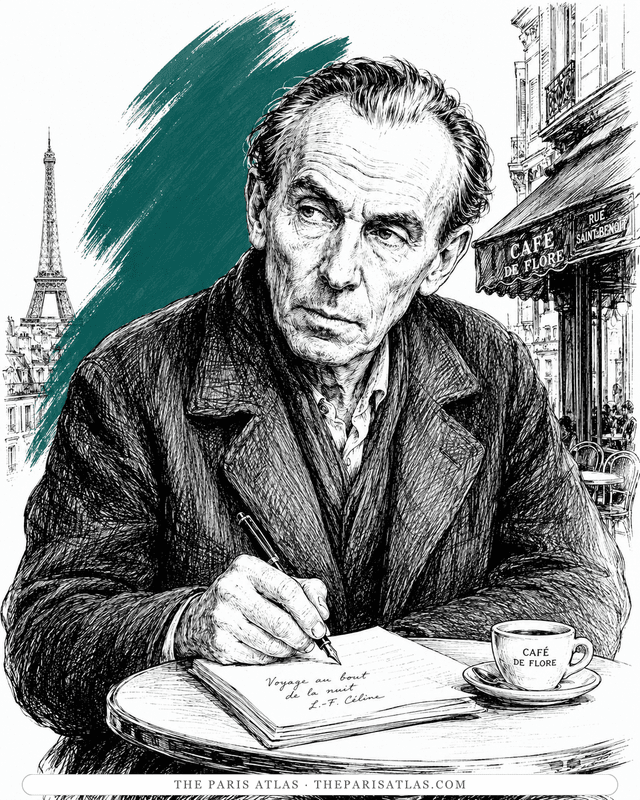
The doctor of the Paris slums who wrote the century's blackest, funniest novel — and changed the sound of French prose.
View author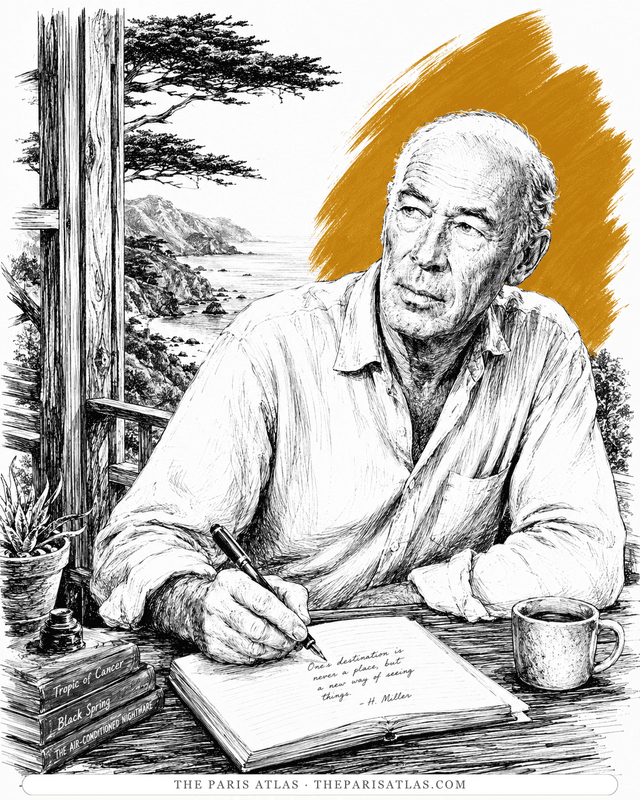
The Brooklyn dropout who arrived in Paris broke at thirty-eight and wrote the exuberant, banned books that ended American censorship.
View author
French writer and philosopher whose novels, memoirs, and social analysis examined freedom, gender, responsibility, aging, and the material conditions that shape a life.
View authorThe sources below include the primary text, editions, scholarship, archival materials, and other records that informed this page. They document All My Sons, its publication, and its place in literary history.


Penguin Random House's Penguin Plays catalogue record: the 1947 Drama Critics' Circle Award and Tony for Best Author, the themes of fathers and sons and of business against personal ethics, and the plot summary.
The scholarly society's chronology: the 1944 Broadway failure, the 1947 awards, the Ibsen adaptation of 1950 and Viking's 1951 edition, Miller's own Arden production of 1953, the 1956 BBC broadcast, and the 1958 and 1987 television productions.

Dramatists Play Service's licensing record: the character list, the cast of ten, the running time, the accolades, and the summary that states the cracked cylinder heads, the twenty-one dead pilots and Steve Deever's imprisonment.
Catalogue and edition records: the three-act subtitle, Christopher Bigsby's introduction, the publisher's description of Kate Keller's belief, the page counts, and the 1947 Dramatists Play Service and 1958 Cresset printings.
The scanned editions, all access-restricted to controlled lending, which is why quotation here is short and taken from catalogue records and institutional sources.
The National Endowment for the Humanities' biography, which quotes Chris Keller's line to his mother with its speaker and addressee, and records the 1947 Drama Critics' Circle Award.
Miller's own memoir, the standard first-hand account of the 1944 failure and of writing this play. Listed as the standard reference; no claim above rests on it alone.
The primary text represented by this page, used for descriptions of the work’s contents and for any quoted passages shown here.
The primary text is the baseline reference for every book page. Additional references document publication history, interpretation, and historical context where that evidence is available.
 Explore more resources