Death of a Salesman
Arthur Miller
Death of a Salesman
The play that does on one stage what this book does on the page: lets the past interrupt the present without warning.
Read our takeTimebends
Arthur Miller
Arthur Miller at seventy-two, writing his own life in the order memory hands it over rather than the order it happened.
Timebends: A Life was published by Grove Press in New York in 1987, when Arthur Miller was seventy-two, and ran to 614 pages.[1] It was taken up as a Book-of-the-Month Club selection, which for a playwright's autobiography is unusual.[2] The title states the method. Miller does not begin at the beginning and go forward; he lets one memory fetch another across fifty years, which is the same trick Death of a Salesman plays with a single stage.[3] Grove's own account tracks the shape of the life inside the book. Miller was born in 1915, raised in Harlem and then Brooklyn, a leftist during the Depression, a witness before a congressional committee in the 1950s, and president of PEN International near the end.[3] Marilyn Monroe, Elia Kazan, Clark Gable, Laurence Olivier, John F. Kennedy and Mikhail Gorbachev all pass through it.[3]
The book's first sentence is written from the floor of a room, at the height of a small child looking up at his mother's shoes while she talks into a wall telephone.[1] Starting at ankle height rather than with a date tells a reader immediately what kind of autobiography this is. Miller is not going to give a chronology; he is going to give what is still in the room with him.
The life it covers is long and public. Arthur Miller was born in New York City in 1915, the son of a clothing manufacturer whose business the Depression destroyed, and the family moved from Harlem to Brooklyn.[3][4] He wrote twenty-two plays. Death of a Salesman won the Pulitzer Prize in 1949 and All My Sons the New York Drama Critics' Circle Award in 1947. He also wrote the screenplay of The Misfits for Marilyn Monroe, which turned out to be her last film.[3]
The political spine of the book is the 1950s. Miller was refused a passport in March 1954. He testified before the House Un-American Activities Committee on 21 June 1956 and refused to name the people he had seen at meetings. He was convicted of contempt of Congress in 1957, and the United States Court of Appeals overturned the conviction in 1958.[5][6][4] Grove describes that stretch as a moral victory, which is the publisher's phrase rather than Miller's.[3]
The memoir is also where Miller settled some accounts. His verdict on Jean-Paul Sartre's screenplay for the 1957 French film of The Crucible appears here: that it tossed an arbitrary Marxist mesh over the story and produced a few absurdities.[7][8] The same year the book appeared, the University of East Anglia named its centre for American studies after him.[2]
The book runs from a child's-eye view of a Harlem apartment to an old man's Connecticut farmhouse, and it does not take that road in order. Arthur Miller was born in New York City on 17 October 1915, to a clothing manufacturer whose business the Depression destroyed, and the family moved out to Brooklyn.[3][4] He worked in an auto-parts warehouse, saved the wages, and went to the University of Michigan in 1934.[4]
The working life the book recounts begins with a Broadway failure and turns on two plays. The Man Who Had All the Luck closed in 1944 after four performances; All My Sons in 1947 took the New York Drama Critics' Circle Award; Death of a Salesman in 1949 took the Pulitzer Prize.[2][3] The Crucible followed in 1953, and three years later the committee that the play was about subpoenaed its author.[6]
The private life runs beside it: three marriages, to Mary Grace Slattery in 1940, to Marilyn Monroe in 1956, and to the photographer Inge Morath in 1962, who remained his wife for forty years.[4] The Misfits, written for Monroe, was released in 1961, the year she divorced him; she died in 1962.[3][2]
The last third is a public career of a different kind. Miller was International President of PEN from 1965 to 1969 and spent it arguing for censored and imprisoned writers in Yugoslavia, the Soviet Union and Czechoslovakia.[9] He took the Kennedy Center Honors in 1984, and in 1986 went to the Soviet Union among fifteen writers and scientists invited to talk policy with Mikhail Gorbachev.[4][2]
Timebends was published in 1987 and Miller lived another eighteen years, so the book is not a summing-up of the whole life. He went on writing plays, took the Jerusalem Prize in 2003, and died at his Roxbury farmhouse on 10 February 2005 at eighty-nine.
Grove Press has kept the book in print, most recently as a 640-page paperback issued on 9 July 2013. Bloomsbury publishes the British paperback at 688 pages.
Timebends is Miller's own word for how the book is arranged. Memory does not run in a line, so the narrative does not either: a face in 1975 calls up a face in 1932, and the paragraph goes there. Grove Atlantic's catalogue describes the book as revealing Miller's trajectory as a man and a writer, and the trajectory is not presented in order.
Readers who know the plays will recognise the method, because Miller had already built a stage out of it. Death of a Salesman puts Willy Loman's memories in the same rooms as his present and lets them interrupt, with no flashback convention and no change of set. Timebends does on the page what that play does on the stage, thirty-eight years later and about the author instead of a salesman.
The cost of the method is the cost any reader should be warned about. A life told by association has no index of events in it, so a reader looking for the date of a particular opening or the sequence of a particular quarrel will have to hunt. The Arthur Miller Society's year-by-year chronology is the thing to keep open beside it.
What the method buys is the quality other writers picked out. Harold Pinter called the book tough and very moving, and said Miller was that rare thing, a truly independent man. Anthony Burgess wrote that the personality the autobiography reveals is wholly admirable, and Louis Auchincloss called it as wise and witty and funny and brave as any of the plays.
The 1950s are the part of the book a reader is most likely to have come for, and the documented outline is worth having in mind before opening it. In March 1954 the State Department refused Miller a passport to attend the Brussels premiere of The Crucible, citing regulations denying passports to people believed to support the Communist movement. His reply to reporters at his Connecticut house was one sentence: that he was not supporting any communist movement.
On 21 June 1956 he appeared before the House Un-American Activities Committee. He admitted signing public appeals put out in the 1940s by Communist-front organisations, denied ever having been under Communist discipline, and refused to name the people he had seen at meetings. During a recess he told reporters he would marry the film star Marilyn Monroe before she left for England on 13 July.
He was convicted of contempt of Congress in 1957, and the United States Court of Appeals overturned the conviction in 1958. Grove Atlantic's catalogue copy calls the episode a moral victory against McCarthyism. The word belongs to the publisher; readers going to the book for Miller's own tone about it should be told that the phrase is not his.
Elia Kazan is the harder thread in the same stretch. Kazan had directed All My Sons in 1947 and Death of a Salesman in 1949, and the two of them worked together again in the 1960s. Grove lists Kazan among the people the memoir is about. What Miller says in the book about Kazan's own dealings with the committee is not summarised here, because the memoir could not be read: every scanned copy on the Internet Archive is restricted to controlled lending.
Marilyn Monroe was Miller's second wife, from 1956 to 1961, between Mary Grace Slattery and the photographer Inge Morath. He wrote the screenplay of The Misfits for her, and it became her last completed film. She divorced him in 1961 and died in 1962, and he married Inge Morath the same year.
Miller had already put a version of the marriage on a stage, and been attacked for it. After the Fall opened at the new Lincoln Center in 1964, with a self-destroying singer called Maggie whom audiences read straight as Monroe. Luchino Visconti staged the French version in Paris on 20 January 1965, with Annie Girardot as Maggie. Writing about Monroe again in 1987, at book length and under his own name, was doing the thing he had been criticised for, without the cover of fiction.
Grove Atlantic's catalogue puts Monroe first in the list of people the memoir is about, ahead of Elia Kazan, Clark Gable, Laurence Olivier, John F. Kennedy and Mikhail Gorbachev. Clark Gable acted in The Misfits with Monroe, and Laurence Olivier is there because Miller and Monroe met him in England in 1956, the year they married.
One thing has to be admitted outright. How Miller writes about Monroe, and how much of the marriage he gives, is the most argued-about part of the book. The memoir is in copyright and borrow-only, so nothing is quoted from those chapters here. Harold Pinter's verdict on the whole book — tough and very moving — is the nearest thing to a judgement available secondhand.
Twenty-two plays, several screenplays, short stories and essays is Grove Atlantic's count of the output the memoir looks back over. The National Endowment for the Humanities puts the honours alongside it. They run to the Pulitzer Prize, seven Tony Awards, two New York Drama Critics' Circle Awards, an Obie, an Olivier, the Kennedy Center Honors of 1984, and honorary doctorates from Oxford and Harvard.
The PEN years are the part of the life least covered elsewhere and the part Miller seems to have valued most. He was elected International President of PEN in 1965 and served until 1969, using the office for writers jailed for what they had written. The work took him to Yugoslavia, to Moscow in 1967 to recruit Soviet writers into the organisation, and to Czechoslovakia in 1969.
He kept at it after the book came out. In 1985 he went to Turkey with Harold Pinter for PEN. The same year he sat as a delegate at a meeting of Soviet and American writers in Vilnius, arguing that the Soviets should stop persecuting writers. In 1986 he was one of fifteen writers and scientists invited to the Soviet Union to discuss policy with Mikhail Gorbachev. Gorbachev is on Grove's list of the people the memoir is about.
The papers behind the book are now readable, even if the book is not. Miller's archive went in 2018 to the Harry Ransom Center at the University of Texas at Austin: more than fifty notebooks, drafts of every play, and his own files on the House Un-American Activities Committee. A reader who wants to check the memoir against what Miller wrote at the time has somewhere to go.
The view from the floor is of a pair of pointy black calf-height shoes, one of them twitching restlessly.
Tough, very moving. A book and a half. Arthur Miller is that very rare bird, a truly independent man.
seemed to me to toss an arbitrary Marxist mesh over the story that led to a few absurdities
Miller refuses chronology and lets one memory fetch another across fifty years, which is the same device Death of a Salesman uses on a single stage. Reading the memoir after the play shows that the trick was how he thought, not a stunt he invented for a hit.
The passport refusal of 1954, the hearing of 21 June 1956, the contempt conviction of 1957 and the reversal of 1958 are all documented elsewhere. This is where Miller sets them out himself, alongside his working relationship with Elia Kazan.
Miller's sentence about Jean-Paul Sartre tossing an arbitrary Marxist mesh over The Crucible, quoted in every account of the play's French reception, was written here at the age of seventy-two.
Harold Pinter called it tough and very moving and Miller a truly independent man; Anthony Burgess called the personality it reveals wholly admirable; Louis Auchincloss called it as wise and witty and funny and brave as any of the plays. It was a Book-of-the-Month Club selection, which a playwright's autobiography rarely is.
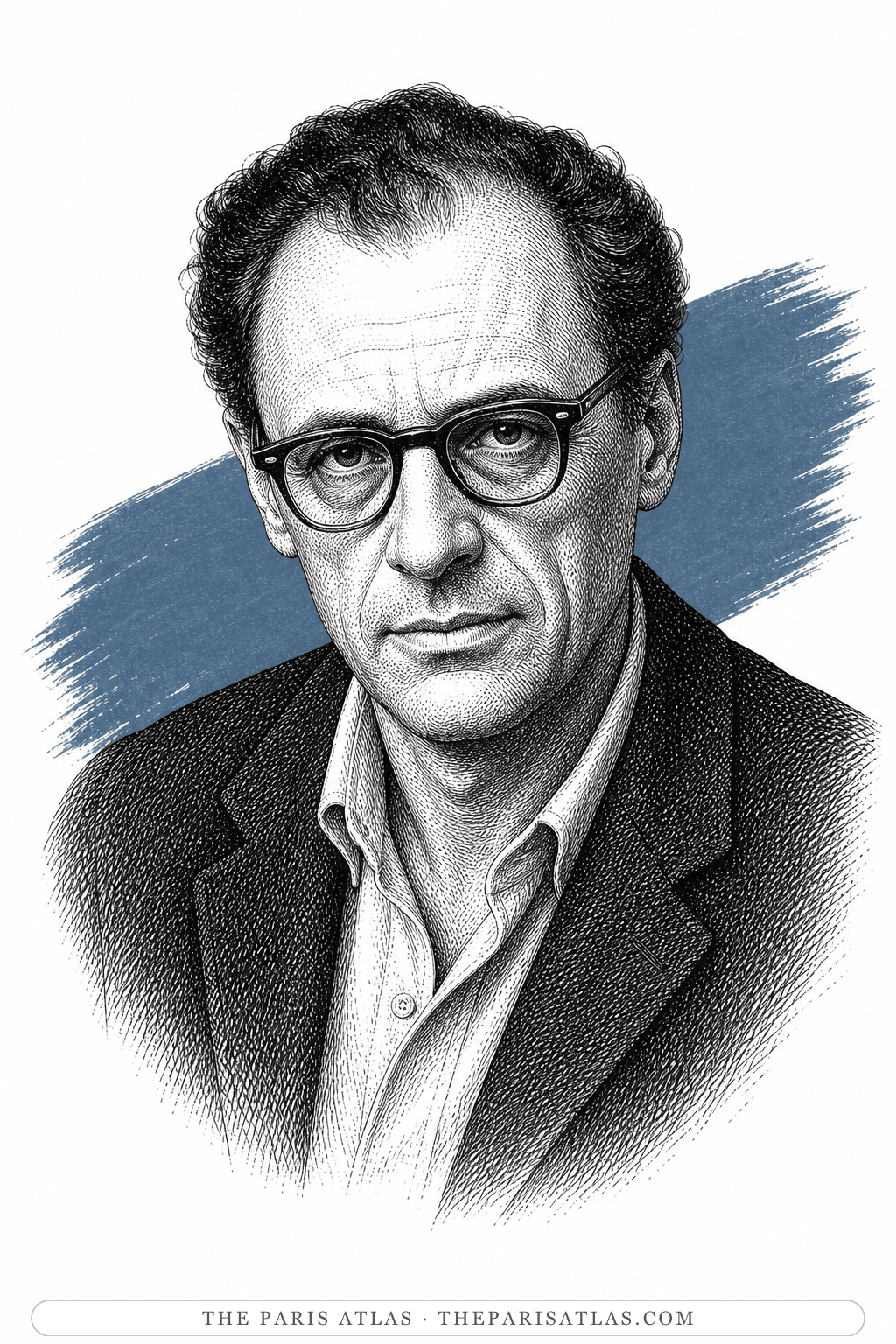
The author, writing at seventy-two about a life that ran from a Harlem apartment before the crash to a Connecticut farmhouse in the 1980s. Twenty-two plays, a Pulitzer Prize, seven Tony Awards, a contempt-of-Congress conviction and four years running PEN International.
Miller's second wife, from 1956 to 1961, and the person Grove Atlantic puts first in its list of who the memoir is about. He wrote the screenplay of The Misfits for her, and it became her last completed film. She divorced him in 1961 and died in 1962.
The director of All My Sons in 1947 and of Death of a Salesman in 1949, and the hardest relationship in the book. Won Tony Awards for directing both plays.
The photographer Miller married in 1962, the year Marilyn Monroe died, and who remained his wife for forty years. Their daughter Rebecca was born in 1962.
Miller's first wife, married in 1940 and divorced in 1956 after six weeks' residence in Nevada — the same stay that gave him the material for The Misfits. Mother of his son Robert, born in 1947.
Miller's father, a manufacturer of clothing whose business the Depression destroyed, forcing the family out of Harlem and into Brooklyn. He died in 1966.
Miller's mother, and the woman on the wall telephone in the book's first sentence, seen from the floor by a child too small to see her face. She died in 1961.
The English playwright, who went to Turkey with Miller for PEN in 1985 and whose verdict is printed on the book: tough, very moving, and Miller a truly independent man.
1915
Arthur Miller is born in New York City on 17 October, to a clothing manufacturer whose business the Depression will destroy. The family moves from Harlem to Brooklyn.
1934
Enters the University of Michigan on wages saved from an auto-parts warehouse, and leaves in 1938 intending to write plays.
1956
Divorces Mary Grace Slattery after six weeks in Nevada, which gives him the material for The Misfits, marries Marilyn Monroe, and is subpoenaed by the House Un-American Activities Committee.
1961
The Misfits is released, and Marilyn Monroe divorces him. She dies the following year, the year he marries Inge Morath.
1964
After the Fall opens at the new Lincoln Center, with a self-destroying singer audiences read as Monroe. Luchino Visconti stages the French version in Paris the following January.
1965
Elected International President of PEN, an office he holds until 1969.
1986
Goes to the Soviet Union as one of fifteen writers and scientists invited to discuss policy with Mikhail Gorbachev, the year before the memoir appears.
1987
Grove Press publishes Timebends: A Life in New York at 614 pages. It is taken as a Book-of-the-Month Club selection, and the University of East Anglia names its centre for American studies after Miller.
2005
Miller dies at his Roxbury, Connecticut farmhouse on 10 February, aged eighty-nine, eighteen years after the memoir.
2013
Grove Press reissues the book as a 640-page paperback on 9 July, the text that is in print now.
2018
Miller's archive goes to the Harry Ransom Center at the University of Texas at Austin: over fifty notebooks, drafts of every play, and his own files on the House Un-American Activities Committee.


Death of a Salesman
Arthur Miller
The play that does on one stage what this book does on the page: lets the past interrupt the present without warning.
Read our takeThe Crucible
Arthur Miller
The play the passport refusal and the committee hearing grew out of, and the one Miller passes his verdict on Sartre's film of here.
Read our takeAll My Sons
Arthur Miller
The 1947 success that ended the run of failure the memoir opens its working life with.
Read our takeA View from the Bridge
Arthur Miller
The Red Hook play, whose research and whose London rewrite for Peter Brook the memoir covers.
Read our takeArthur Miller's autobiography, published by Grove Press in 1987 when he was seventy-two, and running to 614 pages in its first edition. It covers his childhood in Harlem and Brooklyn, the Depression, the plays, the House Un-American Activities Committee, his marriage to Marilyn Monroe, and his presidency of PEN International. Marilyn Monroe, Elia Kazan, Clark Gable, Laurence Olivier, John F. Kennedy and Mikhail Gorbachev all appear in it.
Because the book is arranged the way memory works rather than the way a calendar does. Miller lets one recollection fetch another across decades instead of moving forward year by year. The method is the same one Death of a Salesman uses on stage, where Willy Loman's memories interrupt the present in the same rooms and with no flashback convention.
Yes, and Grove Atlantic's own catalogue puts her first in the list of people the book is about. She was Miller's second wife, from 1956 to 1961, he wrote the screenplay of The Misfits for her, and she divorced him in 1961 and died in 1962. He had already dramatised a version of the marriage in After the Fall in 1964 and been criticised for it.
The memoir is where Miller gives his own account of the episode. The documented outline runs as follows. The State Department refused him a passport in March 1954. He testified on 21 June 1956 and refused to name the people he had seen at meetings. He was convicted of contempt of Congress in 1957, and the United States Court of Appeals overturned the conviction in 1958. His publisher calls the episode a moral victory against McCarthyism, which is the publisher's phrase.
Yes. Miller's verdict on Jean-Paul Sartre's screenplay for the 1957 French film of The Crucible — that it tossed an arbitrary Marxist mesh over the story and led to a few absurdities — was written here, thirty years after the film. It is quoted in the scholarship on the play's French reception.
The Grove Press paperback of 2013 is the current American text at 640 pages. Bloomsbury publishes the British paperback at 688. The 1987 Grove first edition and an earlier Penguin paperback both run to 614 pages. All of them carry the same text in different settings.
No. Miller published it in 1987 and lived until 10 February 2005, so the last eighteen years are missing, including the Jerusalem Prize he took in 2003. For those years, and for a dated outline of the whole life, the Arthur Miller Society's chronology is the thing to use beside the book.
Explore authors with a similar voice, perspective, and influence.
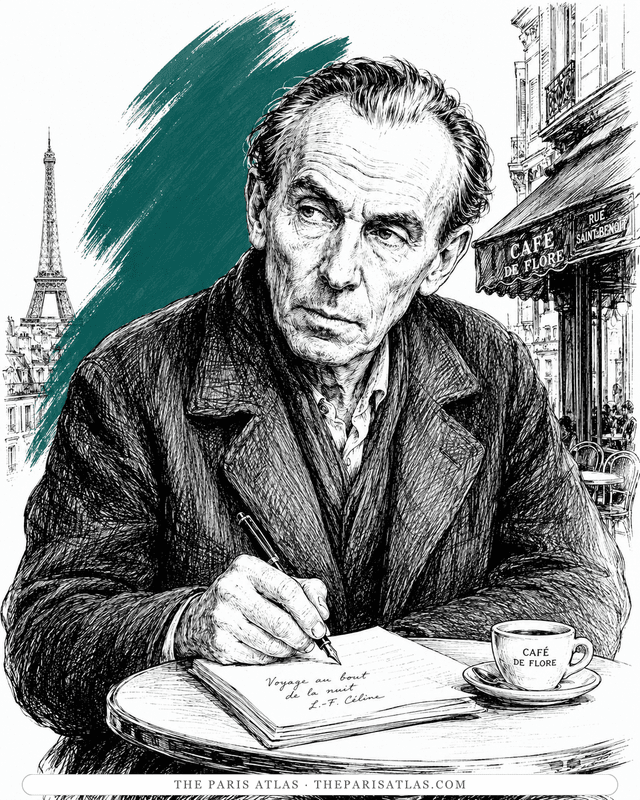
The doctor of the Paris slums who wrote the century's blackest, funniest novel — and changed the sound of French prose.
View author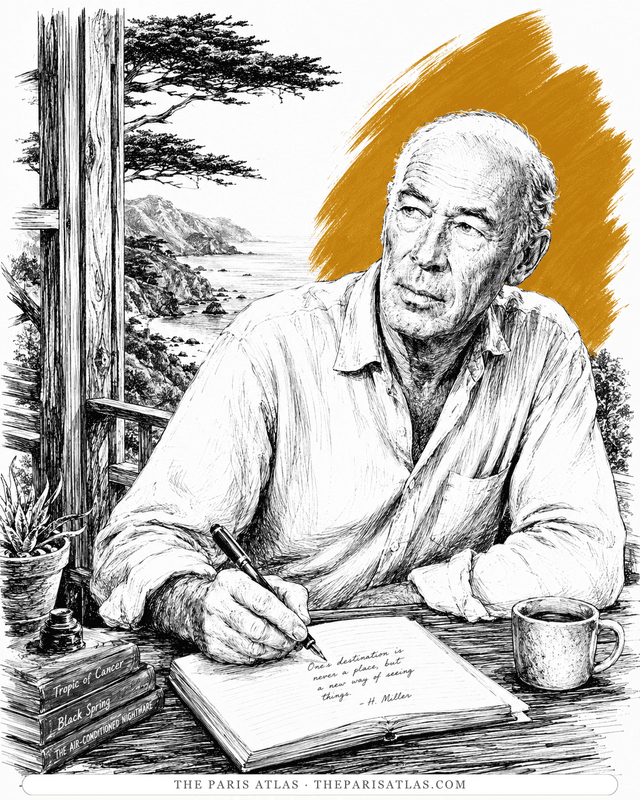
The Brooklyn dropout who arrived in Paris broke at thirty-eight and wrote the exuberant, banned books that ended American censorship.
View author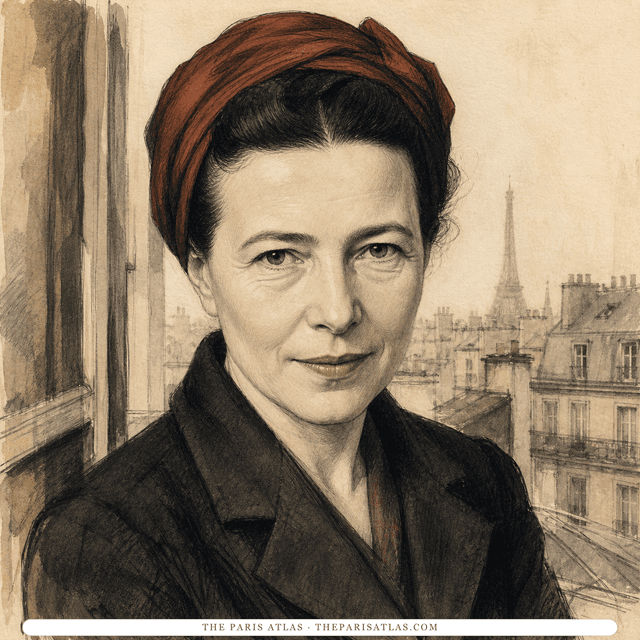
French writer and philosopher whose novels, memoirs, and social analysis examined freedom, gender, responsibility, aging, and the material conditions that shape a life.
View authorThe sources below include the primary text, editions, scholarship, archival materials, and other records that informed this page. They document Timebends, its publication, and its place in literary history.

The scholarly society's year-by-year chronology: the Nevada divorce and the marriage to Monroe in 1956, After the Fall in 1964, the 1985 Turkey trip with Harold Pinter and the Vilnius meeting, the 1986 Gorbachev invitation, the 1987 publication and Book-of-the-Month Club selection, the Arthur Miller Centre at the University of East Anglia, and Miller's death in 2005.
The publisher's own catalogue record: the description of the book and its shape, the count of twenty-two plays, the list of people it covers, the praise from Harold Pinter, Anthony Burgess and Louis Auchincloss, and the 640-page paperback of 9 July 2013.
The National Endowment for the Humanities' biography: the father's business and the move to Brooklyn, the three marriages with their dates, the 1957 conviction and 1958 reversal, and the list of honours.

The report of the State Department's passport refusal of March 1954, with the regulation cited and Miller's one-sentence reply.
The book itself, recorded here as the primary text. It could not be read directly: every scanned copy is restricted to controlled lending.
Julie Vatain-Corfdir's peer-reviewed article, which quotes Miller's sentence from Timebends about Sartre's screenplay.
PEN International's own history, for Miller's presidency from 1965 to 1969 and the Writers in Prison Committee of 1960.
The Harry Ransom Center's announcement of the 2018 acquisition of Miller's papers, including his own files on the House Un-American Activities Committee.
The production record for Après la chute at the Théâtre du Gymnase on 20 January 1965, directed by Luchino Visconti with Annie Girardot as Maggie.
The Broadway League's record of the 1949 production, cited here for Jo Mielziner's single set and the memory staging the memoir's method resembles.
The Broadway League's record of the 1947 production, cited here for Elia Kazan's direction and Tony Award.
The scanned copies, all access-restricted to controlled lending, which is why nothing is quoted here from the Monroe or Kazan chapters.
The primary text represented by this page, used for descriptions of the work’s contents and for any quoted passages shown here.
The primary text is the baseline reference for every book page. Additional references document publication history, interpretation, and historical context where that evidence is available.
 Explore more resources