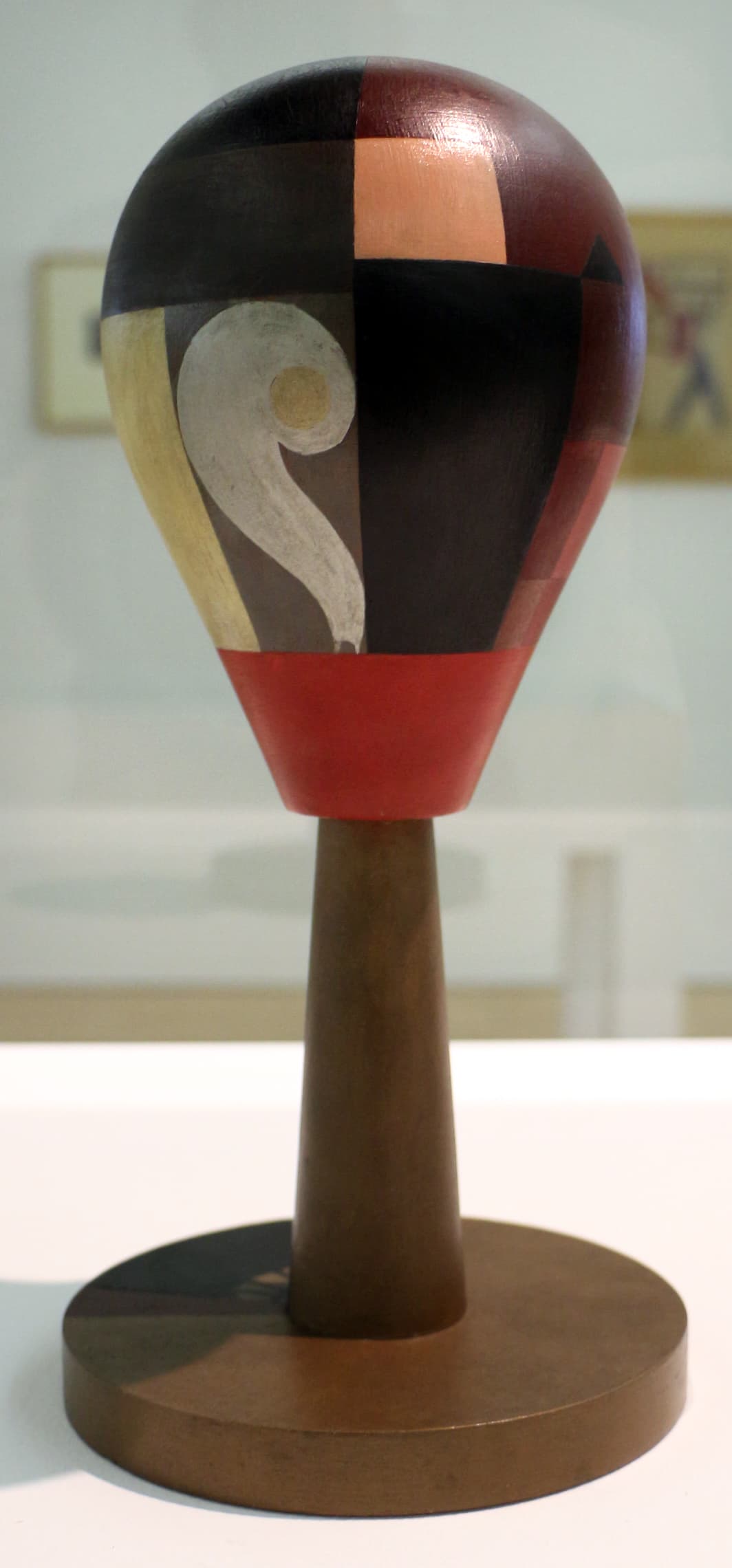
Dada Head
A turned wooden head painted with geometric shapes and bright colours, bringing sculpture and craft together.
- 1920
- Turned and painted wood
About Sophie Taeuber-Arp

A head built by turning and painting
The sculpture begins with a smoothly turned wooden form, a process associated with craft and applied art. Taeuber-Arp then made it a face through arcs, flat fields of color, an off-center eye, and painted lettering rather than through modeled anatomical features.
At 29.43 centimeters high and 14 centimeters in diameter, it remains close to the scale of a hat stand or display form. Jean Arp suggested it might function as a hat holder, a possibility that keeps utility and sculpture deliberately entangled.
Dada written across the face
The Centre Pompidou identifies this as the final work in Taeuber-Arp's series of Dada heads. Unlike the others, it displays its title, date, and the artist's initials: 1920 and DADA appear on the forehead, while “sht” is marked on the base.
Those markings turn documentation into part of the face. The museum describes the date and the word Dada as a manifesto—an explicit declaration of Taeuber-Arp's attachment to the movement.
No border between art and applied art
Taeuber-Arp taught at Zurich's School of Applied Arts while taking part in Dada through abstraction, textiles, design, and dance. The head brings those practices together instead of ranking sculpture above craft.
Its curved color fields relate to her geometric abstract compositions. At the same time, the form's possible use and her humorous photographs posing with it mock the conventions of portraiture.
Close reading
Reading the work, detail by detail
Taeuber-Arp converts the convention of a portrait bust into a painted geometric object that changes with every viewpoint. These details follow the face, bands, profile, stem, and base to show how identity is distributed across a constructed surface.
1.Date and movement cross the forehead
The words and date run laterally around the curved form like a label wrapped onto an object. Identity is supplied not by natural features but by typography, time, and affiliation.
2.The profile is assembled from flat geometry
A red wedge, cream arc, green curve, and dark sliver suggest a face without modelling one. The features remain readable while openly belonging to the object's decorative scheme.
3.The dark crown preserves the turning volume
Dark paint wraps across the upper oval in broad, uneven zones. Because the colours follow the curve rather than depicting hair, they insist on the head as a thing moving in space.
4.A red taper replaces the jaw
The face narrows into a saturated red cone with no mouth or anatomical jawline. This abrupt simplification joins portrait bust, turned wooden object, and abstract sign.
5.The pedestal becomes a second body
A slender black support descends from the head like an exaggerated neck or torso. Its severe taper gives the rounded upper form an unexpectedly poised, almost performative stance.
6.The base refuses to stay neutral
Red and black wedges extend the painted pattern onto the platform that should merely support the sculpture. No part remains outside the composition, so pedestal and artwork cannot be cleanly separated.
Where to see it

Centre Pompidou, Musée national d'art moderne, Paris
Place Georges-Pompidou, 75004 Paris, France
The Paris building is closed for renovation, with reopening planned for 2030. Check the museum’s off-site programme; this address is not currently a viewing location for the collection.
Plan your visitFrequently asked questions
Who made Dada Head?
Swiss artist Sophie Taeuber-Arp made it in 1920 as the last work in her series of turned-wood Dada heads.
What is Dada Head made from?
Turned and painted wood. It is 29.43 centimeters high and 14 centimeters in diameter.
What is written on Dada Head?
The forehead carries the date 1920 and the word DADA; the base bears Taeuber-Arp's initials, “sht,” for Sophie Henriette Taeuber.
Was Dada Head meant to hold a hat?
Possibly. The Centre Pompidou notes Jean Arp's suggestion that it could serve as a hat holder, but its painted face, inscriptions, and exhibition history also establish it as sculpture.
Where is Dada Head?
It belongs to the Centre Pompidou's Musée national d'art moderne collection as inventory AM 2003-332. Loans and display locations can change, so check the official record before visiting.
If you like Sophie Taeuber-Arp
Explore sculptors from the same movements and circles.
Jean Arp
Strasbourg-born sculptor and poet — Hans in German, Jean in French, both all his life — who co-founded Dada at the Cabaret Voltaire in 1916, composed collages by dropping torn paper 'according to the laws of chance', and settled at Meudon outside Paris in a house his wife Sophie Taeuber-Arp designed.
View artist
Marcel Duchamp
The century's quietest revolutionary — readymades, the abandonment of painting, chess on a Paris rooftop in Entr'acte, and one anemic film of spinning puns signed Rrose Sélavy.
View artist
Kurt Schwitters
Hanover artist who called his practice Merz and built collages, poems, typography, and environments from the discarded fragments of modern life.
View artist
References
The sources below include collection records, catalogues, scholarly research, and primary materials that informed this page. They document Dada Head, its making, and its place in cultural history.


1Sophie Taeuber-Arp, Tête dada (1920)
WebsiteCentre PompidouUsed forOfficial collection record for the date, materials, dimensions, inscriptions, provenance, Dada-head series, and relationship between sculpture and applied art.

2Sophie Taeuber-Arp
Official recordMuseum of Modern ArtUsed forOfficial record used to verify names, dates, institutional details, or other factual information on this page.
3Sophie Taeuber, Rythmes libres, 1919
WebsiteKunsthaus ZürichUsed forWeb source consulted for documented facts and historical context presented on the Dada Head page.
4Hans (Jean) Arp and Sophie Taeuber-Arp — Arp Museum Bahnhof Rolandseck
WebsiteArp Museum Bahnhof RolandseckUsed forWeb source consulted for documented facts and historical context presented on the Dada Head page.
These references provide the documented foundation for this work's history and interpretation. Claim-level citations remain attached to the specific claims they support.
 Explore more resources