Pies, Pies, Pies
by Wayne Thiebaud
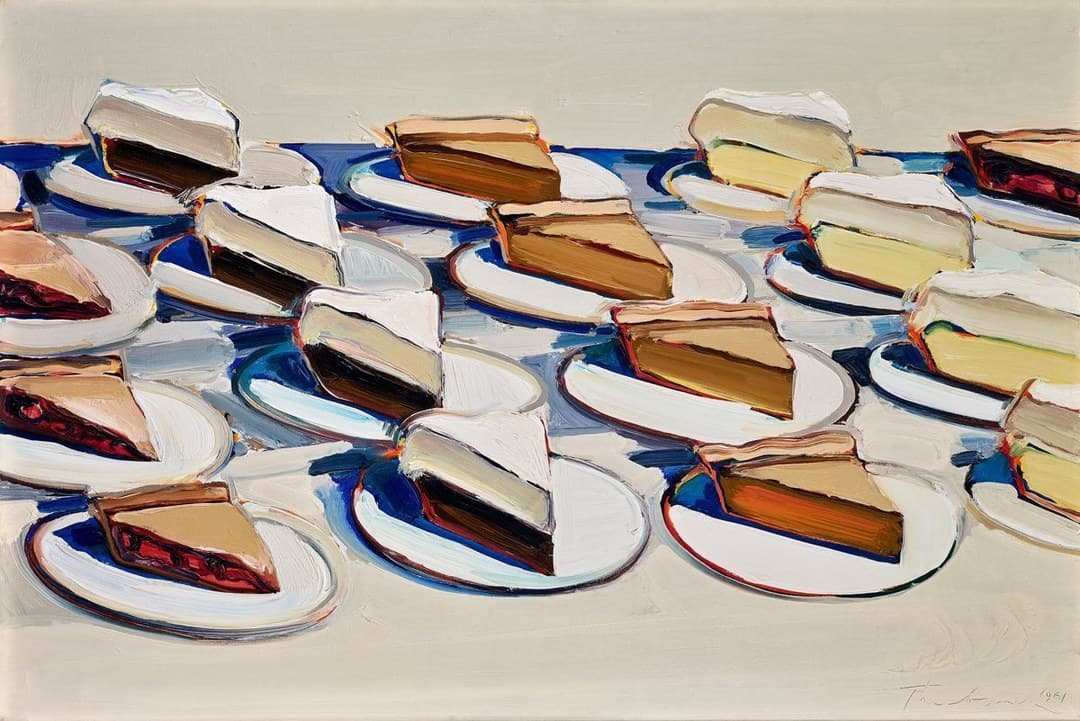
Wedges of pie stand on white plates in rows that climb the canvas, each one cut from a different pie. Wayne Thiebaud painted it in Sacramento in 1961, a year before the New York exhibition that made his reputation. The Crocker Art Museum holds it as 1974.12 and keeps it on view.
- 1961
- Oil on canvas
- Crocker Art MuseumSacramento, California, United States
What the painting shows
Wedges of pie sit on white plates in rows that step up the canvas from the bottom edge. The counter is a pale sand, measured off the reproduction at roughly #d9d1c0, and it meets a warm grey wall near the top, at about #c9c5b8. There is no back edge, no case and no wall fitting.
Four fillings recur. Cherry shows as a dark maroon near #472c36 under a band of tan custard. Pumpkin is a burnt orange. Lemon sits pale yellow under a white meringue. A fourth kind is almost black under a thick white cream.
Four rows step up the canvas. The front row holds three whole plates, with a further wedge cut through by the canvas at either edge. Every wedge sits with its tall crust end at the left and tapers to a point at the right. Every plate is an ellipse drawn in curved sweeps of white, its near rim run through with a dark red-brown line and its far side pooled in cobalt.
Wayne Thiebaud signed the canvas at the lower right in thin dark script and dated it 1961. Above the signature the counter carries loops scratched into wet paint.
Where the paint stands off the canvas
The meringue and cream tops are the thickest passages in the painting, and they are thick enough to read as relief in a flat photograph. Each one is a single loaded stroke, dragged and then lifted, so the ridge of paint along its upper edge throws a shadow of its own onto the paint below.
The Crocker Art Museum's stretcher measurement includes a depth of two and a half inches, which is the canvas, not the paint. The paint film itself is nowhere near that, but the plate rims in the front row stand clear enough of the ground that their edges catch light on the near side and go dark on the far one.
The San Francisco Museum of Modern Art describes the working method as painting with a knife, as if spreading frosting onto a cake, and notes that thick saturated hues outline the edges of his forms. Both are visible here without magnification.
The shadows are cobalt, not grey
Nothing in the painting casts a grey shadow. Behind each plate the counter turns cobalt, and where two plates overlap the blue deepens rather than darkening towards black. The blue runs up between the rows and ties them into a single mass, which is why the group reads as a bank of pies rather than as separate objects.
The near rims run the other way. Each plate carries a line of dark red-brown or orange along its front, and several carry a thin green or turquoise where the ellipse turns away. The Wayne Thiebaud Foundation describes the device as outlining forms in radiant colours to achieve a halo-like effect.
The critic Michael Kimmelman, in an audio commentary published by the San Francisco Museum of Modern Art, points to the blue halos and the lushness of the light as the qualities that separate the work from Pop painting.
Painted before the show that changed everything
The date matters. Pies, Pies, Pies was painted in 1961, and the Wayne Thiebaud Foundation records his breakthrough exhibition at the Allan Stone Gallery in New York in 1962. The painting belongs to the run of work that the New York show was drawn from, made when almost nobody outside California had seen any of it.
He had been exhibiting in Sacramento for a decade by then. The Crocker Art Museum gave him his first solo exhibition in 1951, and bought its first Thiebaud painting, Boston Cremes, in 1964.
Pies, Pies, Pies reached the museum later, as a gift from Philip L. Ehlert in memory of Dorothy Evelyn Ehlert, and was accessioned in 1974.
A counter, not a table
The arrangement comes from commercial display rather than from still-life tradition. Identical objects are ranged in rows, each isolated on its own white plate, all lit from the same direction, none overlapping another in a way that would hide it.
Wayne Thiebaud had drawn and lettered that kind of display for a living. The Wayne Thiebaud Foundation records that he began as a commercial artist in his teens, worked as a sign painter and apprenticed as an animator at The Walt Disney Studios. The Crocker Art Museum records that he served as a cartoonist for the United States Army Air Forces at Mather Field.
The San Francisco Museum of Modern Art sets the food paintings against the age of mass production, and describes the objects as commodities whose emphasis falls on appearance as much as taste.
Close reading
Reading the work, detail by detail
Four rows of plated wedges step up a pale sand counter towards a warm grey wall. The reproduction the Crocker Art Museum serves is square on and evenly lit, so the relief of the paint reads through it.
1.Three whole plates across the front
The front row holds three whole plates — a cherry wedge, a cream-topped dark wedge and a pumpkin wedge — with a fourth cut through by the edge of the canvas at the right. Every wedge is turned the same way, tall crust end at the left, tapering to a point at the right.
2.Cherry under a tan lid
The cherry filling measures around #472c36 and carries brighter red lumps through it, with a dark maroon crust line drawn across the top. Above that sits a thick tan lid near #c99d68. The plate beneath is white with a dark red-brown line along the near rim and a flat cobalt shadow behind.
3.The cream stands proud of the canvas
This is the thickest paint in the painting. The white cream is laid on and lifted in one movement, and the ridge left along its upper edge throws a small shadow onto the paint below it — visible in the reproduction without magnification. Underneath, the body of the wedge is a near-black brown.
4.Pumpkin, burnt orange under a brown band
The pumpkin wedge runs burnt orange through the body, under a paler tan-brown band and a dark crust line drawn along the top. The brush marks in the filling run with the taper of the wedge rather than across it, so the direction of the stroke follows the shape.
5.Cobalt between the rows
Between the rows the counter is not counter at all but cobalt, run in broad strokes that connect one plate to the next. Where two shadows meet the blue deepens rather than darkening towards black. It is the blue that stacks the rows into a single bank rather than leaving them as separate objects.
6.White laid in curved sweeps
Each plate is built from a few curving strokes of white rather than a filled shape, and the strokes stay legible as strokes. Round the near rim runs a single dark red-brown line; the far rim goes blue. The counter can be seen through the white in places where the brush ran dry.
7.The back row against the wall
The back row stands clear of the wall, which is a flat warm grey near #c9c5b8. There is no counter edge, no case and no fitting behind them — the wall simply starts. The wedges at this depth are painted with the same thickness as those at the front, so distance is carried by size alone.
8.Loops scratched into wet paint
The empty counter at the lower right is not blank. Faint loops have been scratched into the paint while it was still wet, catching the light against the horizontal drag of the brush. They sit just above the signature and describe nothing in particular.
9.Signed and dated 1961
Wayne Thiebaud signed at the lower right, on the bare counter, in thin dark script, and dated it 1961. That places the painting a year before the Allan Stone Gallery exhibition in New York, and thirteen years before the Crocker Art Museum accessioned it.
Timeline
1951
The Crocker Art Museum gives Wayne Thiebaud his first solo exhibition, in Sacramento.
1961
Pies, Pies, Pies painted in oil on canvas, 55.4 by 80.5 centimetres, and signed at the lower right.
1962
Wayne Thiebaud's breakthrough exhibition opens at the Allan Stone Gallery in New York, drawn from the run of work this painting belongs to.
1974
Given to the Crocker Art Museum by Philip L. Ehlert in memory of Dorothy Evelyn Ehlert, and accessioned as 1974.12.
Where to see it
Crocker Art Museum
Sacramento, California, United States
A public viewing address has not yet been confirmed for this holding.
The museum's object record lists the painting as on view in the American Art, 1945 to Today collection. Display status changes, so check the record before travelling.
Frequently asked questions
Where can you see Wayne Thiebaud's Pies, Pies, Pies?
The Crocker Art Museum in Sacramento, California, as accession 1974.12. The museum's object record lists it as on view, in the American Art, 1945 to Today collection. Check the record before travelling, since display status changes.
What kinds of pie are in Pies, Pies, Pies?
Four recur across the rows: cherry, shown as dark maroon under a band of tan custard; pumpkin, a burnt orange; lemon, pale yellow under white meringue; and a near-black filling under thick white cream. Every wedge is turned the same way, tall crust end at the left, tapering to a point at the right.
How big is Pies, Pies, Pies?
The Crocker Art Museum gives it as 21 13/16 by 31 11/16 inches, with a stretcher depth of 2 1/2 inches — about 55.4 by 80.5 centimetres. It is a wide painting rather than a large one.
When did Wayne Thiebaud paint Pies, Pies, Pies?
1961, in Sacramento, and he signed and dated it at the lower right. That places it a year before the 1962 Allan Stone Gallery exhibition in New York that the Wayne Thiebaud Foundation records as his breakthrough show.
How did the Crocker Art Museum get Pies, Pies, Pies?
As a gift from Philip L. Ehlert in memory of Dorothy Evelyn Ehlert, accessioned in 1974. The museum had already bought its first Thiebaud painting, Boston Cremes, ten years earlier, and had given him his first solo exhibition in 1951.
Why does the paint look so thick in Pies, Pies, Pies?
Because the cream and meringue tops are laid on as single loaded strokes and then lifted, leaving a ridge along the upper edge that casts its own shadow onto the paint below. The San Francisco Museum of Modern Art describes the method as painting with a knife, as if spreading frosting onto a cake.
More by Wayne Thiebaud
References
The sources below include collection records, catalogues, scholarly research, and primary materials that informed this page. They document Pies, Pies, Pies, its making, and its place in cultural history.

1Wayne Thiebaud, Pies, Pies, Pies 1961, accession 1974.12
Official recordCrocker Art Museum, SacramentoUsed forOfficial record used to verify names, dates, institutional details, or other factual information on this page.

2Wayne Thiebaud at the Crocker Art Museum
WebsiteCrocker Art Museum, SacramentoUsed forWeb source consulted for documented facts and historical context presented on the Pies, Pies, Pies page.
3Wayne Thiebaud: A Celebration (1920–2021)
WebsiteCrocker Art Museum, Sacramento, 2022Used forWeb source consulted for documented facts and historical context presented on the Pies, Pies, Pies page.
4Wayne Thiebaud — biography
WebsiteWayne Thiebaud FoundationUsed forWeb source consulted for documented facts and historical context presented on the Pies, Pies, Pies page.
5Wayne Thiebaud — biography and audio stories
WebsiteSan Francisco Museum of Modern ArtUsed forWeb source consulted for documented facts and historical context presented on the Pies, Pies, Pies page.
These references provide the documented foundation for this work's history and interpretation. Claim-level citations remain attached to the specific claims they support.
 Explore more resources