Pie Counter
by Wayne Thiebaud
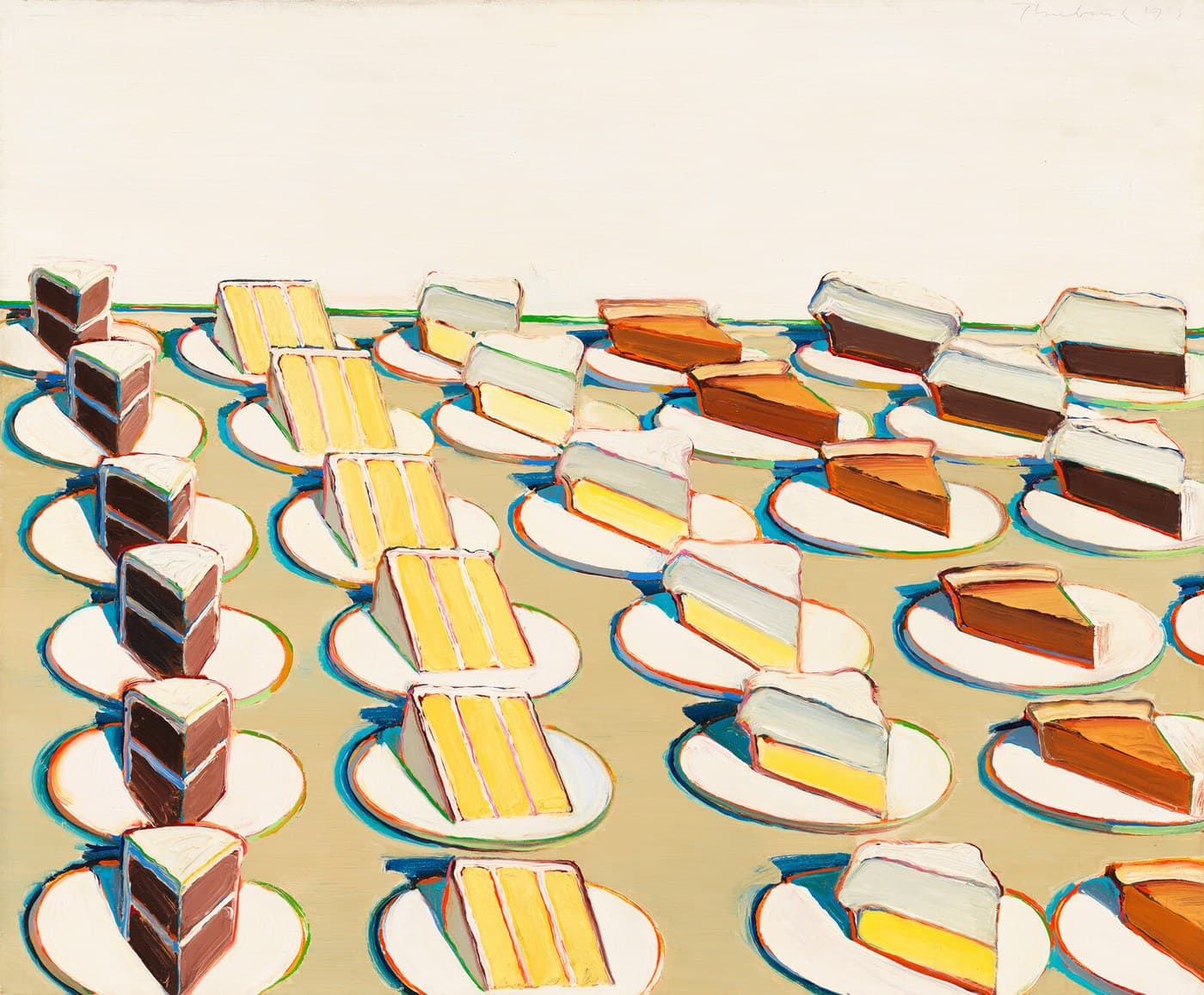
Plated slices of cake and pie stand in files that run back across a khaki counter, under a warm off-white wall. Wayne Thiebaud painted it in 1963, the year after the Allan Stone Gallery show in New York that made his name. The Whitney Museum of American Art bought it the following year and holds it as 64.11.
- 1963
- Oil on canvas
- Whitney Museum of American ArtNew York, United States
What the painting shows
Five files of plated slices run back and to the right across a counter. The counter is a flat khaki, measuring between #bab9a2 and #d0c199 across the reproduction, and it meets a warm off-white wall of about #f6efe5 along a thin green line roughly a third of the way up the canvas. Nothing else occupies the wall.
The left-hand file holds six slices of chocolate layer cake, each with a white frosting cap and a cut face so dark it reads almost black. The second file holds six slices of yellow layer cake, each cut face showing three tall yellow bands divided by thin pink and white seams. The third file holds pale slices with a thick grey-white meringue over a band of lemon yellow.
To the right of those, wedges of pumpkin pie lie flat on their plates, filling a bright orange near #f3942c under a pale crimped crust. The far right of the canvas carries more dark chocolate cream slices and more orange wedges, several cut off by the edge.
Every plate is white and elliptical, laid in with a loaded brush. Every slice and every plate carries a rim of separate colour — orange-red along the near edge, blue and green along the shadow side. Wayne Thiebaud signed the canvas in thin dark script at the upper right.
The paint behaves like the substance
The frosting is not painted to look like frosting. It is laid on in ridges thick enough that the marks left by the knife stay in the surface, which is the same thing a baker's spatula does to a cake. The Whitney Museum of American Art states the point directly in its own text for the painting.
“Unlike most of his Pop art contemporaries who were eliminating the nuances of touch in their work, he exploited the physical properties of paint to mimic the look and feel of the substance depicted.”
The San Francisco Museum of Modern Art describes the working method in the same terms, crediting the effect to the knife rather than the brush, and records that Wayne Thiebaud outlined his forms in thick saturated hues. The Wayne Thiebaud Foundation's own account calls the result a halo-like effect around each form.
The shadows are the other half of the method. Not one of them is grey. Each plate sits in a pool of blue and teal, with a darker navy wedge pushed in directly beneath the cake, and the counter shows through around it in unbroken khaki.
Why pie
Wayne Thiebaud chose counter food because of what surrounds it rather than because of how it looks. The Whitney Museum of American Art quotes him on the subject at length.
“Pie has a long history and it has other implications: the idea of 'Pie in the Sky,' the old American preoccupation with Mom and Apple Pie, pie throwing contests, pie throwing in Chaplin films. One makes a pie out of ordinary stuff, like raisins, squash or apples and gift wraps it, in a sense with a crust. It's very magical, very special.”
He had spent years drawing and lettering exactly this kind of display. The Wayne Thiebaud Foundation records that he began as a commercial artist in his teens, worked as a sign painter and apprenticed as an animator at The Walt Disney Studios. After the Second World War he designed movie posters, made cartoons and worked in advertising.
The Crocker Art Museum adds the war years: he was a cartoonist for the United States Army Air Forces while stationed at Mather Field. The arrangement in the painting — identical objects ranged in files, each isolated on its own white plate — is the logic of a display case, not of a still life on a table.
He refused the Pop label
Pie Counter was painted in the year the term Pop art settled on American painting, and it was hung under that heading for decades. The Whitney Museum of American Art showed it in 2004 in an exhibition titled Pop/Concept: Highlights from the Permanent Collection.
Wayne Thiebaud did not accept the description. The Wayne Thiebaud Foundation states that he never embraced the mantle of Pop, and that he preferred to describe himself as a traditional painter of illusionistic forms. The objection was practical rather than defensive: Pop painting of the period worked to strip touch out of the picture, and his whole method depends on touch being visible.
The critic Michael Kimmelman made the same separation in an audio commentary published by the San Francisco Museum of Modern Art. He pointed to the blue halos and the quality of light in the work as things that are not strictly Pop.
From Allan Stone's gallery to the Whitney
The Wayne Thiebaud Foundation records the 1962 exhibition at the Allan Stone Gallery in New York as his breakthrough show, and his first solo museum exhibition at the de Young Museum as its immediate sequel. He had been showing in Sacramento since 1951, when the Crocker Art Museum gave him his first solo exhibition.
Pie Counter followed in 1963. The Whitney Museum of American Art bought it with funds from the Larry Aldrich Foundation Fund and accessioned it in 1964, which is what the first two digits of 64.11 record.
The museum has since shown it in Wayne Thiebaud: A Paintings Retrospective in 2001, in Pop/Concept in 2004, and in America Is Hard to See, the exhibition that opened its Gansevoort Street building in 2015.
Fifty years of teaching
Wayne Thiebaud taught for most of his working life. The Wayne Thiebaud Foundation records eight years as an art professor at Sacramento Junior College, then the faculty of the University of California, Davis, retirement at seventy and a continuing appointment as professor emeritus.
The teaching shows up in how he talks about other people's paintings. Asked by the Metropolitan Museum of Art in 2015 to choose a work from its collection, he chose Rosa Bonheur's The Horse Fair and analysed it as a teacher would, convention by convention.
Close reading
Reading the work, detail by detail
The plates run in five files back across a khaki counter, with a thin green line marking where the counter meets the wall and the whole upper third of the canvas left empty. Each view below is a crop of the reproduction the Whitney Museum of American Art serves.
1.Six chocolate slices in the left-hand file
The left-hand file holds six slices of chocolate layer cake, counted from the front edge to the counter line. Each has a white frosting cap and a cut face of two dark bands divided by a paler mocha one. The side plane facing left is a lighter milk brown, so each slice reads as a solid wedge rather than a silhouette.
2.The cut face is almost black
At this range the frosting cap shows the ridges of the knife that laid it, and the cut face goes almost black. A blue line runs down the left edge of the slice where it turns away, and an orange-red line runs along the right edge and under the plate. Neither line is a shadow; they are separate colours laid along the boundary.
3.Three yellow bands and two pink seams
The second file is yellow layer cake, and every cut face carries the same structure: three tall yellow bands separated by two thin seams of pink and white. The frosting on top and the side plane are a pale grey-lavender. The repetition is exact from slice to slice, which is what makes the file read as stock rather than as portraits of separate cakes.
4.Grey-white meringue over lemon
The third file is a meringue-topped slice: a thick grey-white crown, laid on in a single heavy stroke, over a band of bright lemon. The two meet along an unblended edge, with no shading between them, and a thin pink line runs down the front corner where the crown overhangs.
5.Pumpkin wedges lie flat
The pie wedges do not stand up like the cake slices; they lie flat on the plate, tall crust end at the left, tapering to a point at the right. A pale crimped crust runs along the upper edge and turns down as a lip at the left. The filling measures around #f3942c, the most orange thing on the canvas, and a darker red-brown line runs underneath it.
6.The shadows are blue, not grey
Behind every plate the counter turns blue and teal, and directly under each cake a darker navy wedge is pushed in. Nowhere does the shadow go grey or brown. Where two plates sit close the blues run together, which ties the separate objects into a single mass across the canvas.
7.Each plate is one sweep of the brush
The plates are not drawn and filled. Each is a single curving sweep of loaded white, and the rim colours are laid round the outside of it afterwards — green at the far left, orange-red across the front, blue where the ellipse turns into shadow. The counter shows through between the strokes.
8.A green line for the back of the counter
The only thing marking the back of the counter is a thin green line, drawn straight across behind the last row of plates. Below it the khaki counter, above it the pale wall. There is no wall fitting, no case, no shelf and no second line.
9.The top third holds nothing
Above the counter line the canvas is an unbroken warm off-white, measuring about #f6efe5, taking up roughly the top third. Nothing is painted into it. The emptiness is what pushes the cakes down into the lower part of the picture and makes the counter read as long.
10.Signed at the upper right
Wayne Thiebaud signed in the empty wall at the upper right, in thin dark script, followed by a date. The line is scratched rather than brushed and sits above the level of every object in the painting. The Whitney Museum of American Art publishes no inscription field, so the reading here is of the mark only.
Timeline
1962
Wayne Thiebaud's breakthrough exhibition opens at the Allan Stone Gallery in New York, followed by his first solo museum show at the de Young Museum.
1963
Pie Counter painted in oil on canvas, 75.7 by 91.3 centimetres.
1964
Bought by the Whitney Museum of American Art with funds from the Larry Aldrich Foundation Fund and accessioned as 64.11.
2001
Shown in Wayne Thiebaud: A Paintings Retrospective at the Whitney Museum of American Art, 28 June to 23 September.
2004
Shown in Pop/Concept: Highlights from the Permanent Collection, 1 July to 24 October.
2015
Shown in America Is Hard to See, 1 May to 27 September, the opening exhibition of the museum's Gansevoort Street building.
Where to see it
Whitney Museum of American Art
New York, United States
A public viewing address has not yet been confirmed for this holding.
Frequently asked questions
Where is Wayne Thiebaud's Pie Counter?
The Whitney Museum of American Art in New York, as accession 64.11. The museum bought it in 1964 with funds from the Larry Aldrich Foundation Fund. It has been shown there in 2001, 2004 and 2015, and the museum's object record states its display status.
What is Pie Counter painted on and how big is it?
Oil on canvas, 75.7 by 91.3 centimetres, which the Whitney Museum of American Art gives as 29 13/16 by 35 15/16 inches. It is a small painting for its reputation, about the size of a laptop opened flat and then some.
Was Wayne Thiebaud a Pop artist?
He rejected the label. The Wayne Thiebaud Foundation states that he never embraced the mantle of Pop and preferred to describe himself as a traditional painter of illusionistic forms. Museums have nonetheless hung him under the heading, including the Whitney Museum of American Art in its 2004 exhibition Pop/Concept.
Why is the paint so thick in Pie Counter?
Because the paint is doing the work of the substance it shows. The Whitney Museum of American Art records that he exploited the physical properties of paint to mimic the look and feel of the substance depicted, where his Pop contemporaries were removing touch from their pictures. The frosting is laid on in ridges that hold the mark of the knife.
Why are the shadows in Pie Counter blue?
Wayne Thiebaud painted coloured shadows rather than grey ones throughout the food pictures. Each plate sits in a pool of blue and teal with a darker navy wedge directly under the cake. The San Francisco Museum of Modern Art describes thick saturated hues outlining the edges of his forms, and the critic Michael Kimmelman calls the effect blue halos.
How many slices are in Pie Counter?
The plates run in five files across the counter, and the left-hand file of chocolate layer cake holds six. Several plates at the right-hand edge are cut off by the canvas, so the arrangement reads as part of a longer counter rather than a closed group.
More by Wayne Thiebaud
References
The sources below include collection records, catalogues, scholarly research, and primary materials that informed this page. They document Pie Counter, its making, and its place in cultural history.

1Wayne Thiebaud, Pie Counter 1963, accession 64.11
Official recordWhitney Museum of American Art, New YorkUsed forOfficial record used to verify names, dates, institutional details, or other factual information on this page.
2Whitney Museum of American Art open-access collection dataset, artworks.csv
Official recordWhitney Museum of American Art, New YorkUsed forOfficial record used to verify names, dates, institutional details, or other factual information on this page.

3Wayne Thiebaud — biography
WebsiteWayne Thiebaud FoundationUsed forWeb source consulted for documented facts and historical context presented on the Pie Counter page.
4Wayne Thiebaud — biography and audio stories
WebsiteSan Francisco Museum of Modern ArtUsed forWeb source consulted for documented facts and historical context presented on the Pie Counter page.
5Wayne Thiebaud: A Celebration (1920–2021)
WebsiteCrocker Art Museum, Sacramento, 2022Used forWeb source consulted for documented facts and historical context presented on the Pie Counter page.
6Wayne Thiebaud on Rosa Bonheur’s The Horse Fair
WebsiteThe Metropolitan Museum of Art, 2015Used forWeb source consulted for documented facts and historical context presented on the Pie Counter page.
These references provide the documented foundation for this work's history and interpretation. Claim-level citations remain attached to the specific claims they support.
 Explore more resources