Valley Streets
by Wayne Thiebaud
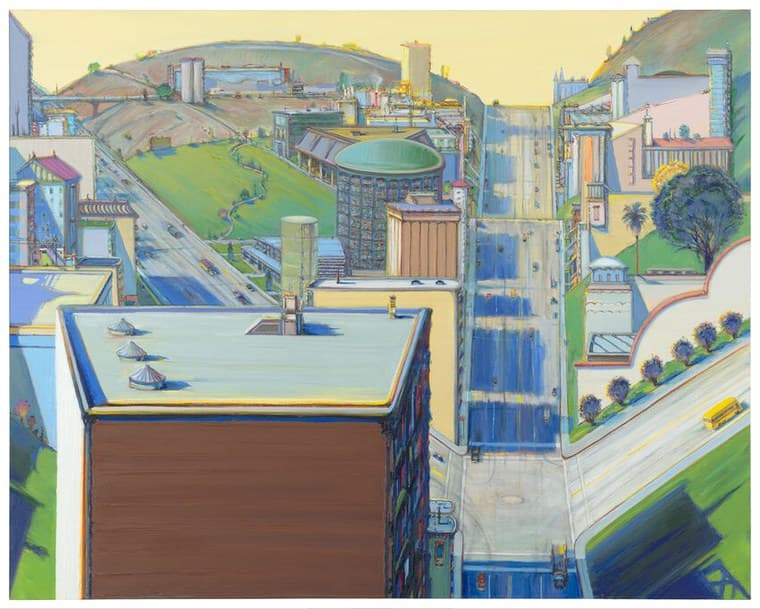
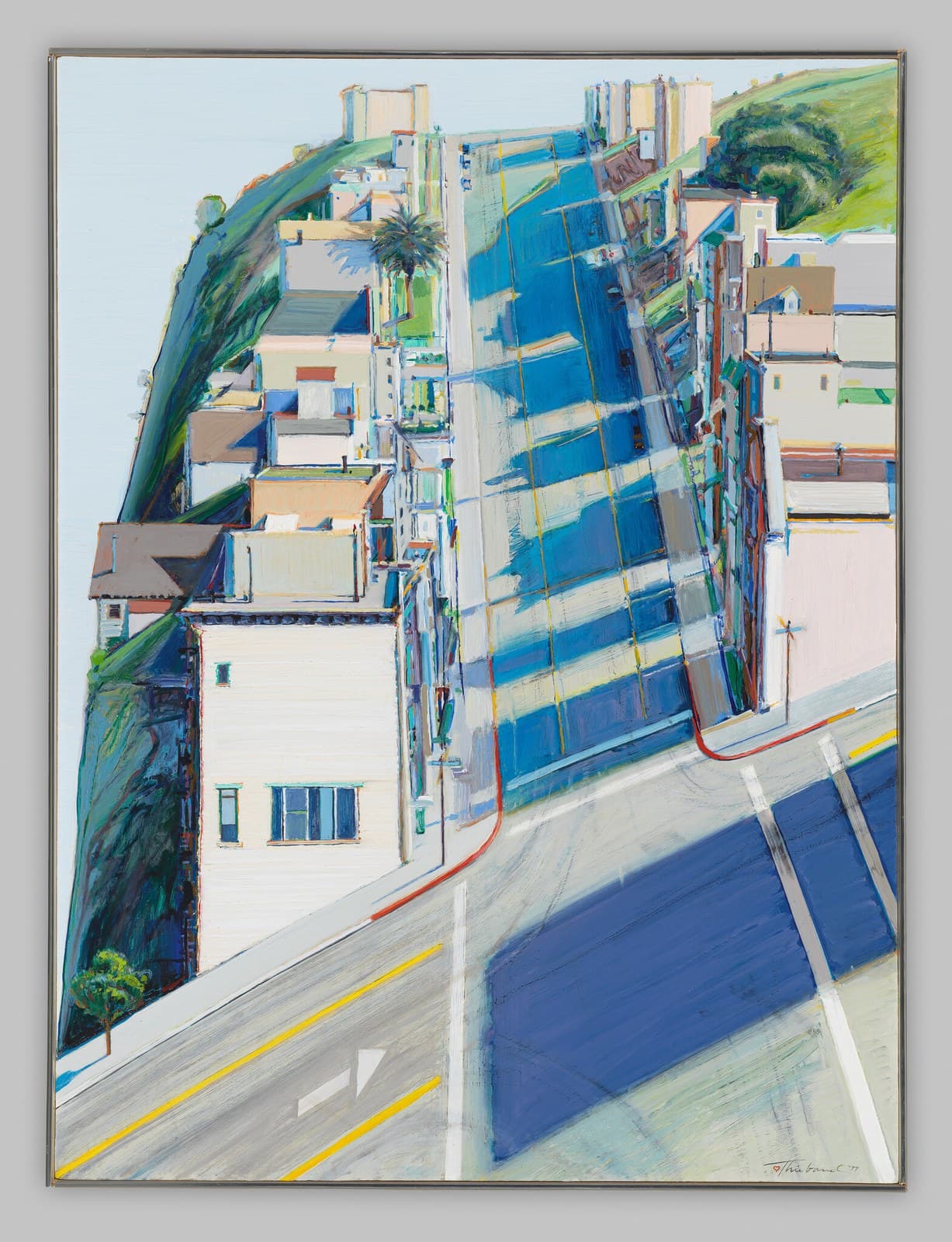
A city is laid out from above, with a flat-roofed block filling the lower left, a street plunging down the centre and bare hills closing the top under a pale yellow sky. Wayne Thiebaud painted it in 2003, past eighty and four decades on from the cake paintings. It belongs to the Doris and Donald Fisher Collection at the San Francisco Museum of Modern Art as FC.732.
- 2003
- Oil on canvas
- San Francisco Museum of Modern ArtSan Francisco, California, United States
What the painting shows
The sky is a flat pale straw, close to #f5eeca, and takes up only the top few centimetres of the canvas. Below it two bare hills meet at the centre, and everything else is city, seen from high enough to read roofs but not from directly overhead.
A flat-roofed block fills the lower left. Its roof is a pale blue-green near #b8ccca, carrying three conical vents in a diagonal file, a rectangular skylight opening and a tall chimney stack near the far edge. Each vent throws a hard blue shadow to its right. The parapet is edged with a yellow line over a deep blue band, and the facade below is a flat brown, about #745042, brushed in vertical strokes.
A street runs down the centre in cobalt, near #4770a0, widening as it comes forward, with small vehicles on it. On the left a multi-lane freeway curves through a green lawn and a bare earth hillside, with a pale cylindrical tank beside it and a green-domed round building rising above an open-sided structure of stacked bays.
On the right a white terrace curves away behind a parapet edged in orange-red. Six violet-blue trees stand on a green verge above a pale road, each with a yellow-green halo at its crown, and one yellow school bus runs along that road. Further up sit a small blue-and-white domed pavilion with arched windows, a single tall palm and a large dark tree on a green bank.
A city assembled rather than observed
No single viewpoint holds the picture together. The foreground roof is seen from above and slightly to the left. The brown facade under it is seen almost square on. The freeway at the left is read from higher still, and the hills at the top are seen level, as they would be from the ground.
The lighting does not agree with itself either. The three roof vents cast hard shadows to the right, and so does the chimney stack. The school bus on the right-hand road casts a pale shadow to its right. But the street down the centre is in full shadow along its length while the roofs either side of it are lit.
Wayne Thiebaud does not hide the joins. Where the foreground block ends, the freeway starts at a different scale with no transition; where the right-hand terrace curves away, its orange-red edge runs as a continuous line rather than fading with distance.
Space as a problem he kept naming
Twelve years after painting Valley Streets, Wayne Thiebaud was asked by the Metropolitan Museum of Art to choose a work from its collection for The Artist Project. He chose Rosa Bonheur's The Horse Fair, and what he talked about was how the space in it is built.
“You really can identify and walk up to those horses because the space is so valid.”
He said Rosa Bonheur had put three or four miles of space into the canvas, and that the lines in it are all inferred rather than drawn. On her light: she had used every kind of light, glowing, glinting, all the way to no light. He framed the whole analysis as a teacher's, saying it interested him in that role because she had used almost every painting convention.
He closed on what he took the example to demand.
“This is what you're going to have to do if you want to be a painter, to be able to employ all that heritage we have as painters.”
Nothing in the sources connects those remarks to Valley Streets, and none is asserted here. What they establish is that the construction of space was the thing he chose to talk about when given a free hand, at eighty-five, in front of somebody else's painting.
The second body of work
Wayne Thiebaud is best known for the food pictures of the late 1950s and 1960s, and the San Francisco Museum of Modern Art says so plainly in its own biography. The museum also records that his career spans seventy years and takes in figurative, landscape and city paintings.
Its own holdings bear that out. Alongside Valley Streets the museum lists Canyon Mountains of 2011 to 2012, a study for it of about 2011, and an untitled mountainside of about 1967, next to the cakes and the trays.
The Wayne Thiebaud Foundation records that he taught for eight years at Sacramento Junior College, then joined the faculty of the University of California, Davis, retired at seventy and stayed on as professor emeritus. Valley Streets was painted thirteen years after that retirement.
How it came to the museum
Valley Streets is catalogued as part of the Doris and Donald Fisher Collection at the San Francisco Museum of Modern Art, which is why its object number begins FC rather than with a year.
The museum's page carries a standing note that only part of its collection is online, that artwork locations change and that not all works are on view. It gives no display status for the painting.
The museum also prints the rights line differently from the other institutions holding Wayne Thiebaud's work, naming the Wayne Thiebaud Foundation where the Whitney Museum of American Art and the Crocker Art Museum name the artist.
Close reading
Reading the work, detail by detail
A city is laid out from above under a flat pale yellow sky, with a flat-roofed block in the lower left and a street plunging down the centre. The San Francisco Museum of Modern Art serves the painting small, so the smallest vehicles go soft at high zoom; the views below stay within what the file supports.
1.Three cone vents on the roof
Three conical vents stand on the roof in a diagonal file, counted from the file. Each throws a hard-edged blue shadow to its right, which fixes the light at the left. The roof plane measures about #bacecc, and its parapet is edged with a yellow line over a deep blue band.
2.A stack and an open skylight
Near the far edge of the same roof stand a tall pale stack and a rectangular skylight opening, the skylight painted as a dark hole rather than as glass. Both cast blue shadows to the right, agreeing with the vents. A small yellow-capped pipe stands beyond them on the next roof.
3.The facade is one flat brown
Below the parapet the whole face of the building is a single flat brown near #734f41, brushed in vertical strokes with no windows, doors or courses drawn into it. Above it run a thin yellow line and a deep blue band. The blankness is what makes the roof above read as the subject.
4.The street plunges in cobalt
The street down the centre is painted as stacked cobalt panels near #4770a0, widening as they come forward. It is in shadow along its whole length while the roofs on both sides are lit, which does not follow from any single light source in the picture.
5.Six trees on the verge
Six trees stand on the green verge above the pale road, counted from the file, ranged evenly up the slope. Each crown is a violet-blue mass near #697087 with a halo of yellow-green worked round its upper edge. A blue band runs continuously along the kerb below them.
6.One yellow school bus
One yellow school bus runs along the road below the trees, the only strongly yellow object below the sky. It casts a faint blue shadow to its right, agreeing with the roof vents. At this enlargement the reproduction goes soft, so the bus reads as a shape rather than as a drawn vehicle.
7.A freeway through green lawn
On the left a multi-lane freeway curves past a bright green lawn crossed by a thin winding path. Small vehicles sit on the carriageways, painted as single marks. A viaduct runs behind. The scale here does not match the foreground roof, which is read from much closer.
8.A green dome over stacked bays
A round building carries a pale green elliptical dome above a colonnade, and below that a drum of open stacked bays like a parking structure. It is the only domed roof of its size in the picture. The dome is drawn as a flat ellipse with a brushed gradient rather than modelled in light.
9.The sky is a flat band of straw
The sky measures about #f4eeca, a flat straw yellow with no gradient and no cloud, and it occupies only a narrow band at the top. Two bare hills meet beneath it at the centre. Their slopes are painted at eye level, while the city below is read from above.
10.An orange-red line round the terrace
The curving terrace at the right is edged with a continuous orange-red line that holds its width all the way round, rather than thinning with distance. Above it stand a small blue and white pavilion with arched windows, a single palm, and a large dark tree on a green bank.
Timeline
1990
Wayne Thiebaud retires from the University of California, Davis at seventy and continues as professor emeritus.
2003
Valley Streets painted in oil on canvas, 121.9 by 152.4 centimetres.
2015
Wayne Thiebaud chooses Rosa Bonheur's The Horse Fair for The Artist Project at the Metropolitan Museum of Art and talks about how its space is built.
2021
Wayne Thiebaud dies in Sacramento on 25 December, aged 101.
Where to see it
San Francisco Museum of Modern Art
San Francisco, California, United States
A public viewing address has not yet been confirmed for this holding.
The museum publishes no display status for the painting, and notes that only part of its collection is online, that locations change and that not all works are on view.
Frequently asked questions
Where is Wayne Thiebaud's Valley Streets?
The San Francisco Museum of Modern Art, as part of the Doris and Donald Fisher Collection, object number FC.732. The museum gives no display status for it and warns that artwork locations change and not all works are on view.
What is in Valley Streets?
A flat-roofed block with three conical vents fills the lower left, and a cobalt street plunges down the centre. A multi-lane freeway curves through green lawn and bare hillside at the left. At the right stand a curving white terrace, six violet-blue trees on a verge, a yellow school bus, a domed pavilion and a palm. Bare hills close the top under a flat pale yellow sky.
Is Valley Streets a real place?
The San Francisco Museum of Modern Art's record names no location. The picture holds several incompatible viewpoints at once: the foreground roof from above, the facade beneath it square on, the hills at eye level. The shadows do not all fall the same way either, so it cannot be read as a view from a single standpoint.
How big is Valley Streets?
121.9 by 152.4 centimetres, which the San Francisco Museum of Modern Art gives as 48 by 60 inches. It is a wide canvas, half as big again as Ripley Ridge of 1977.
Did Wayne Thiebaud only paint cakes and pies?
No. The San Francisco Museum of Modern Art records a career spanning seventy years that includes figurative, landscape and city paintings, and holds mountain and city pictures by him alongside the food paintings. Valley Streets was painted in 2003, four decades after Pie Counter.
How old was Wayne Thiebaud when he painted Valley Streets?
Eighty-two or eighty-three. The Wayne Thiebaud Foundation gives his birth year as 1920 and records that he retired from teaching at seventy and continued as professor emeritus. He died in December 2021 at 101.
More by Wayne Thiebaud
References
The sources below include collection records, catalogues, scholarly research, and primary materials that informed this page. They document Valley Streets, its making, and its place in cultural history.


1Wayne Thiebaud, Valley Streets 2003, accession FC.732
Official recordSan Francisco Museum of Modern ArtUsed forOfficial record used to verify names, dates, institutional details, or other factual information on this page.

2Wayne Thiebaud — biography and audio stories
WebsiteSan Francisco Museum of Modern ArtUsed forWeb source consulted for documented facts and historical context presented on the Valley Streets page.
3Wayne Thiebaud on Rosa Bonheur’s The Horse Fair
WebsiteThe Metropolitan Museum of Art, 2015Used forWeb source consulted for documented facts and historical context presented on the Valley Streets page.
4Wayne Thiebaud — biography
WebsiteWayne Thiebaud FoundationUsed forWeb source consulted for documented facts and historical context presented on the Valley Streets page.
These references provide the documented foundation for this work's history and interpretation. Claim-level citations remain attached to the specific claims they support.
 Explore more resources