Ripley Ridge
by Wayne Thiebaud
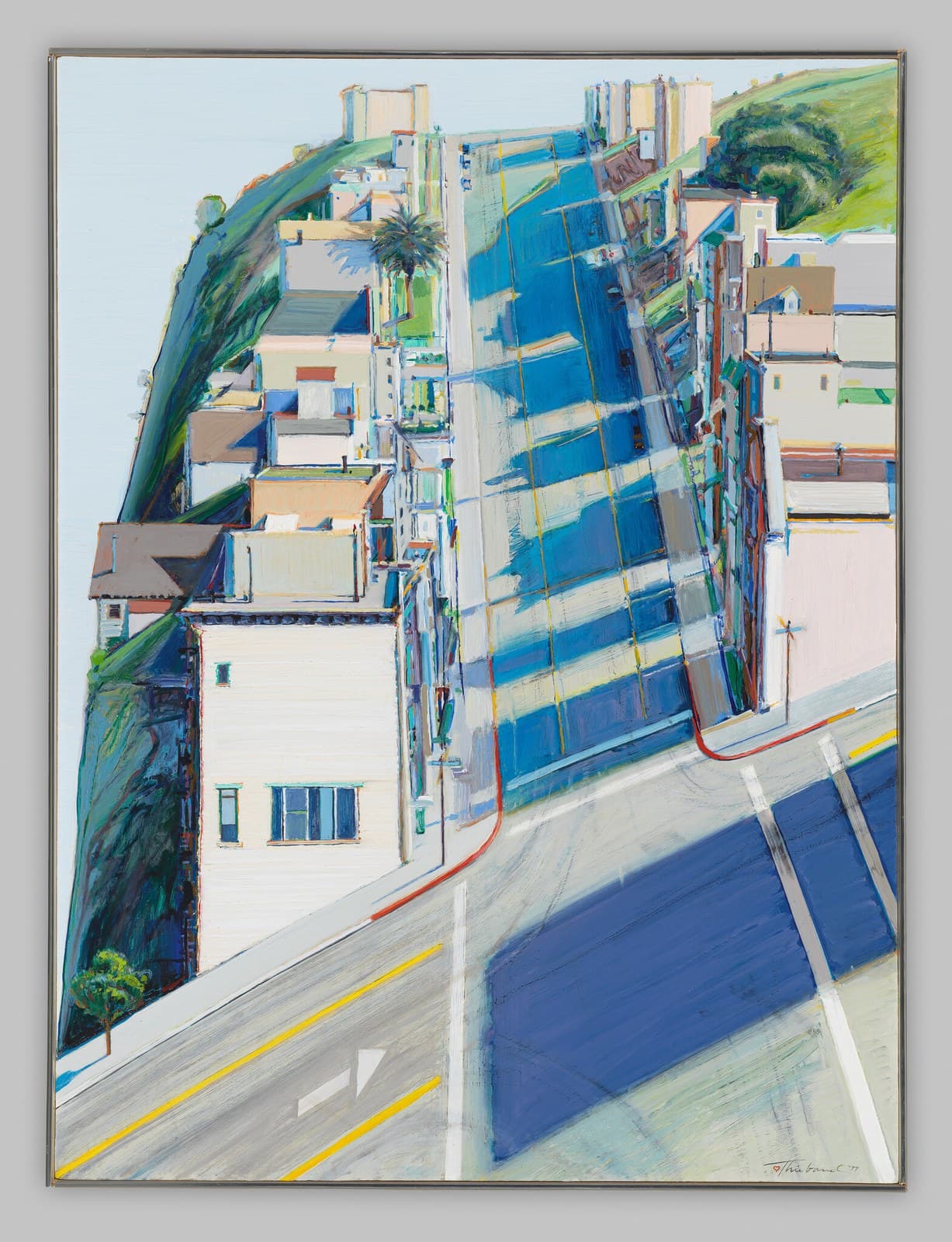
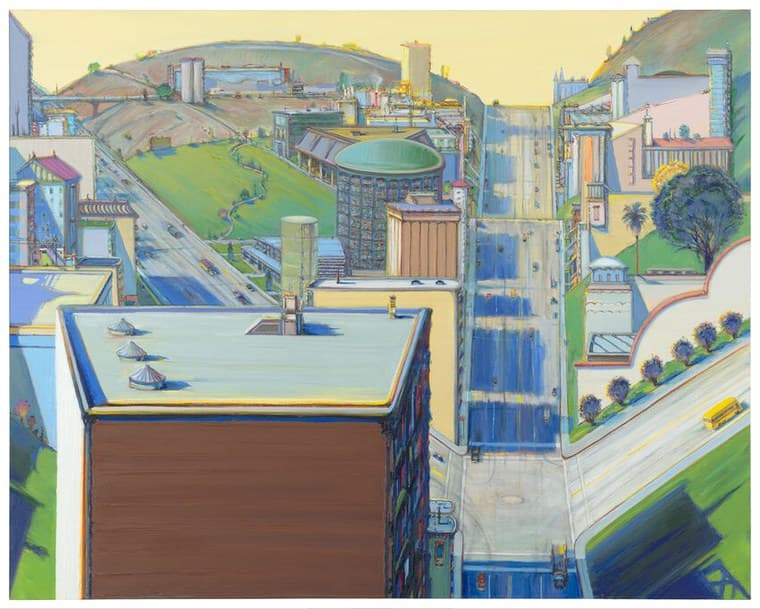
A street runs almost straight up the centre of the canvas between two banks of buildings, and a flat ultramarine shadow lies across the crossing in the foreground. Wayne Thiebaud painted it in 1977, in the body of steep city pictures he began in the 1970s. The Whitney Museum of American Art bought it in 2018 and holds it as 2018.98.
- 1977
- Oil on linen
- Whitney Museum of American ArtNew York, United States
What the painting shows
A street rises up the middle of a tall canvas until it nearly stands upright. Its surface is painted as a broad band of blue and grey-green with a thin yellow line up the centre, and the band is scored across by pale horizontals that read as cross streets. A red kerb line runs up the left side of it from the foreground to the crest.
The foreground is a wide crossing seen from above, in grey-green near #adabaa, with a yellow centre line, white lane markings and two pale crosswalk bars. A flat ultramarine rectangle, measured off the reproduction at about #3b5e98, lies diagonally across it — the shadow of a building outside the frame.
On the left a cream clapboard building stands closest to the viewer, with a dark bracketed cornice, one small high window and two larger windows below, all framed in green, the glass painted dark blue. Behind it roofs step upward against a hillside painted in teal, green and violet. A palm tree stands about halfway up. On the right the buildings are packed tighter and read mostly as short strokes of brown, ochre, teal and white.
At the crest, pale tower blocks stand against a pale blue sky, and a green hill carrying a dark tree mass closes the upper right. The reproduction the Whitney Museum of American Art serves shows the painting in its thin metal frame against a grey wall, so the frame appears along all four edges.
The street is tipped up, not seen from a height
The two halves of the picture do not agree about where the viewer is standing. The foreground crossing is seen from above, steeply enough to read the road as a flat plane. The buildings on the left are seen almost straight on, front doors and window frames square to the canvas.
The result is that the street does not recede so much as climb. Distance is carried by the objects getting smaller and by the stacking of roof above roof, not by a single vanishing point, and the roadway in the middle stays a broad flat band all the way to the top.
Wayne Thiebaud left the seams visible. The pale horizontals across the roadway are painted as bars rather than blended, and where the right-hand bank of buildings meets the road the two are separated by a hard edge rather than a shadow.
What he said he wanted from Rosa Bonheur
The construction of pictorial space is the thing Wayne Thiebaud talked about when the Metropolitan Museum of Art invited him to choose a work from its collection for The Artist Project in 2015. He chose Rosa Bonheur's The Horse Fair, painted between 1852 and 1855, and began with how he had first met it.
“I saw this painting when I was about seven years old in a photographic reproduction in black-and-white over my grandfather's desk. And I said, 'I love that photograph,' and he said, 'Wayne, that's not a photograph. It's a painting, much bigger than this: 8 feet by 16 feet long.'”
What he admired in it was the space, and he said so in a sentence the Metropolitan Museum of Art pulled out as the epigraph of the piece.
“You really can identify and walk up to those horses because the space is so valid.”
He worked through Rosa Bonheur's picture as a teacher, counting off what she had used — realism, romanticism, impressionist passages — and said she had employed almost every painting convention available. On her light: she used every kind of light, glowing, glinting, all the way to no light.
He did not connect that to Ripley Ridge, and no source does. What the record carries is his own account of what he valued in another painter's space, given nearly forty years after he painted this street, and still in the terms of a working problem rather than an admiration.
The shadows are ultramarine
The largest single passage of colour in the painting is a shadow. It falls across the foreground crossing as a flat ultramarine rectangle with sharp edges and no gradient, and it is a different blue from the roadway that runs up the centre.
The same habit runs through the food paintings of the previous decade, where the pools behind the plates are blue and teal rather than grey. The Wayne Thiebaud Foundation describes his forms as outlined in radiant colours to a halo-like effect, and the San Francisco Museum of Modern Art records thick saturated hues outlining the edges of his forms.
Here it is the thin red kerb line running up the left side of the street, and the red-orange edge along the pavement in the foreground, that do the outlining. The hillside on the left, closer to #658d7e than to any green, carries the same treatment in reverse: it is the shadow side of the whole picture and it is painted in colour rather than in darkness.
A heart before the signature
Wayne Thiebaud signed the canvas at the lower right, over the pale road surface, in thin dark script reading Thiebaud '77. Immediately before the name he painted a small red heart, filled solid and about the size of the capital letter beside it.
The Whitney Museum of American Art records no inscription field for the painting, so the mark is not described in its object record.
A late purchase
The Whitney Museum of American Art bought Ripley Ridge in 2018, forty-one years after it was painted, with funds from the Leonard A. Lauder Masterpiece Fund. The museum had held Pie Counter since 1964.
It holds ten works by Wayne Thiebaud in all. Among them is Study for 24th Street Intersection, a graphite drawing of 1978 accessioned as 86.3, which belongs to the same body of city pictures as Ripley Ridge.
The object record lists Ripley Ridge as not on view.
Close reading
Reading the work, detail by detail
The Whitney Museum of American Art photographs the painting in its thin metal frame against a grey wall, so the frame appears along all four edges of every view. The street runs up the centre of a tall canvas, with a wide crossing in the foreground seen from above.
1.Photographed in its frame
What the museum serves is a photograph of the framed object, not a flat plate. A thin metal moulding runs round all four sides and the grey wall shows beyond it. The frame is not the artist's statement about the picture, and nothing inside it should be read from the moulding.
2.A flat ultramarine rectangle on the crossing
The largest single area of colour in the painting is a shadow. It lies across the foreground crossing as a flat ultramarine rectangle near #3b5e98, with straight edges and no gradient, thrown by a building outside the frame. Two pale crosswalk bars run across it without changing colour where they cross.
3.A red heart before the signature
At the lower right, on the pale road surface, a small solid red heart is painted immediately before the name. It is about the height of the capital letter beside it and filled in rather than drawn. The Whitney Museum of American Art carries no inscription field for the painting, so the mark goes unrecorded there.
4.The cream building nearest the viewer
The nearest building is cream clapboard, the siding drawn as close horizontal lines, with a dark bracketed cornice along the top. Its left edge is a thin red-orange line laid straight against the dark hillside behind. The whole face is seen almost square on, while the road in front of it is seen from above.
5.Three windows, all framed in green
Three windows are visible in the near wall: one small high one, a narrow single beneath it at the left, and a wider three-pane window at the right. All three are framed in green and glazed in dark blue, and each carries a thin orange line under the sill. No curtain, fitting or interior is painted behind any of them.
6.A red kerb line up the left of the street
A red kerb line comes round the corner of the pavement in the foreground and runs straight up the left side of the rising street to the crest. It is the single most continuous line in the painting, and it does the work that perspective would otherwise do, pulling the eye up the canvas.
7.The roadway stays a flat band
The roadway does not narrow as it goes up. It stays a broad band of blue and grey-green panels with a thin yellow line up the middle, scored across by pale horizontal bars that read as cross streets. The panels are laid as separate rectangles with hard edges, so the surface reads as a plane tipped upright rather than as a road receding.
8.A palm halfway up
A single palm stands among the roofs partway up the left side, with a spiky shadow thrown across the pale wall behind it. It is the only tree of its kind in the picture and sits at the join between the square-on buildings below and the more loosely brushed roofs above.
9.Tower blocks at the crest
At the top of the rise, pale slab-sided towers stand against a sky of about #d0dfe6. They are painted flat, with no windows drawn and no modelling, so they read as the far end of the street rather than as buildings the viewer could approach. A green hill runs behind them.
10.The hillside is painted in colour, not darkness
The shadowed hillside down the left side is not painted dark; it is painted in colour, worked in strokes of teal, green and violet measuring around #658d7e overall. A brown gabled roof with a thin chimney sits at the top of it. The metal frame runs down the very edge of the view.
11.The right-hand side is built from short strokes
Where the left side gives whole walls and countable windows, the right side is built from short strokes of brown, ochre, teal and white that do not resolve into individual buildings. The two treatments meet along the edge of the roadway with no transition between them.
12.One small tree on the pavement
A small round-crowned tree stands on the pavement at the bottom left, the brightest green in the painting and the only living thing at street level. Its crown is stippled rather than brushed flat. Below it the pavement runs out of the picture and the frame closes the view.
Timeline
1977
Ripley Ridge painted in oil on linen, 121.9 by 91.4 centimetres, and signed at the lower right with a small red heart before the name.
1978
Study for 24th Street Intersection drawn in graphite, from the same body of city pictures; the Whitney Museum of American Art accessions it in 1986 as 86.3.
2015
Wayne Thiebaud chooses Rosa Bonheur's The Horse Fair for The Artist Project at the Metropolitan Museum of Art, and talks about the construction of its space.
2018
Bought by the Whitney Museum of American Art with funds from the Leonard A. Lauder Masterpiece Fund, and accessioned as 2018.98.
Where to see it
Whitney Museum of American Art
New York, United States
A public viewing address has not yet been confirmed for this holding.
The museum's object record lists the painting as not on view.
Frequently asked questions
Where is Wayne Thiebaud's Ripley Ridge?
The Whitney Museum of American Art in New York, as accession 2018.98. The museum bought it in 2018 with funds from the Leonard A. Lauder Masterpiece Fund, and its object record currently lists the painting as not on view.
What does Ripley Ridge show?
A street rising almost vertically up the centre of the canvas between two banks of buildings, with a wide crossing in the foreground seen from above and a flat ultramarine shadow lying diagonally across it. A cream clapboard building with green-framed windows stands at the left, and pale tower blocks and a green hill close the top.
Why does the street in Ripley Ridge look tipped up?
Because the picture does not hold to one viewpoint. The foreground crossing is seen from above, flat enough to read as a plane, while the buildings at the left are seen nearly square on. Depth is carried by stacking and by objects shrinking, not by a single vanishing point, so the roadway stays a broad band to the top of the canvas.
What is the red heart in Ripley Ridge?
A small solid red heart Wayne Thiebaud painted immediately before his signature at the lower right, ahead of the words Thiebaud '77. The Whitney Museum of American Art records no inscription field for the painting, so the mark goes undescribed in its object record.
How is Ripley Ridge connected to Rosa Bonheur?
Through what Wayne Thiebaud said rather than through the painting. In 2015 he chose Rosa Bonheur's The Horse Fair for The Artist Project at the Metropolitan Museum of Art. He said he had first seen it aged about seven, in a black-and-white reproduction over his grandfather's desk, and praised it because the space is so valid. He did not link it to his own street paintings, and neither does any source.
Is Ripley Ridge a painting of San Francisco?
It belongs to the body of steep city pictures Wayne Thiebaud began in the 1970s, and the Whitney Museum of American Art holds a related 1978 drawing titled Study for 24th Street Intersection. The museum's object record for Ripley Ridge names no street and no city, so no location is asserted here.
More by Wayne Thiebaud
References
The sources below include collection records, catalogues, scholarly research, and primary materials that informed this page. They document Ripley Ridge, its making, and its place in cultural history.


1Wayne Thiebaud, Ripley Ridge 1977, accession 2018.98
Official recordWhitney Museum of American Art, New YorkUsed forOfficial record used to verify names, dates, institutional details, or other factual information on this page.
2Whitney Museum of American Art open-access collection dataset, artworks.csv
Official recordWhitney Museum of American Art, New YorkUsed forOfficial record used to verify names, dates, institutional details, or other factual information on this page.

3Wayne Thiebaud on Rosa Bonheur’s The Horse Fair
WebsiteThe Metropolitan Museum of Art, 2015Used forWeb source consulted for documented facts and historical context presented on the Ripley Ridge page.
4Wayne Thiebaud — biography
WebsiteWayne Thiebaud FoundationUsed forWeb source consulted for documented facts and historical context presented on the Ripley Ridge page.
5Wayne Thiebaud — biography and audio stories
WebsiteSan Francisco Museum of Modern ArtUsed forWeb source consulted for documented facts and historical context presented on the Ripley Ridge page.
These references provide the documented foundation for this work's history and interpretation. Claim-level citations remain attached to the specific claims they support.
 Explore more resources