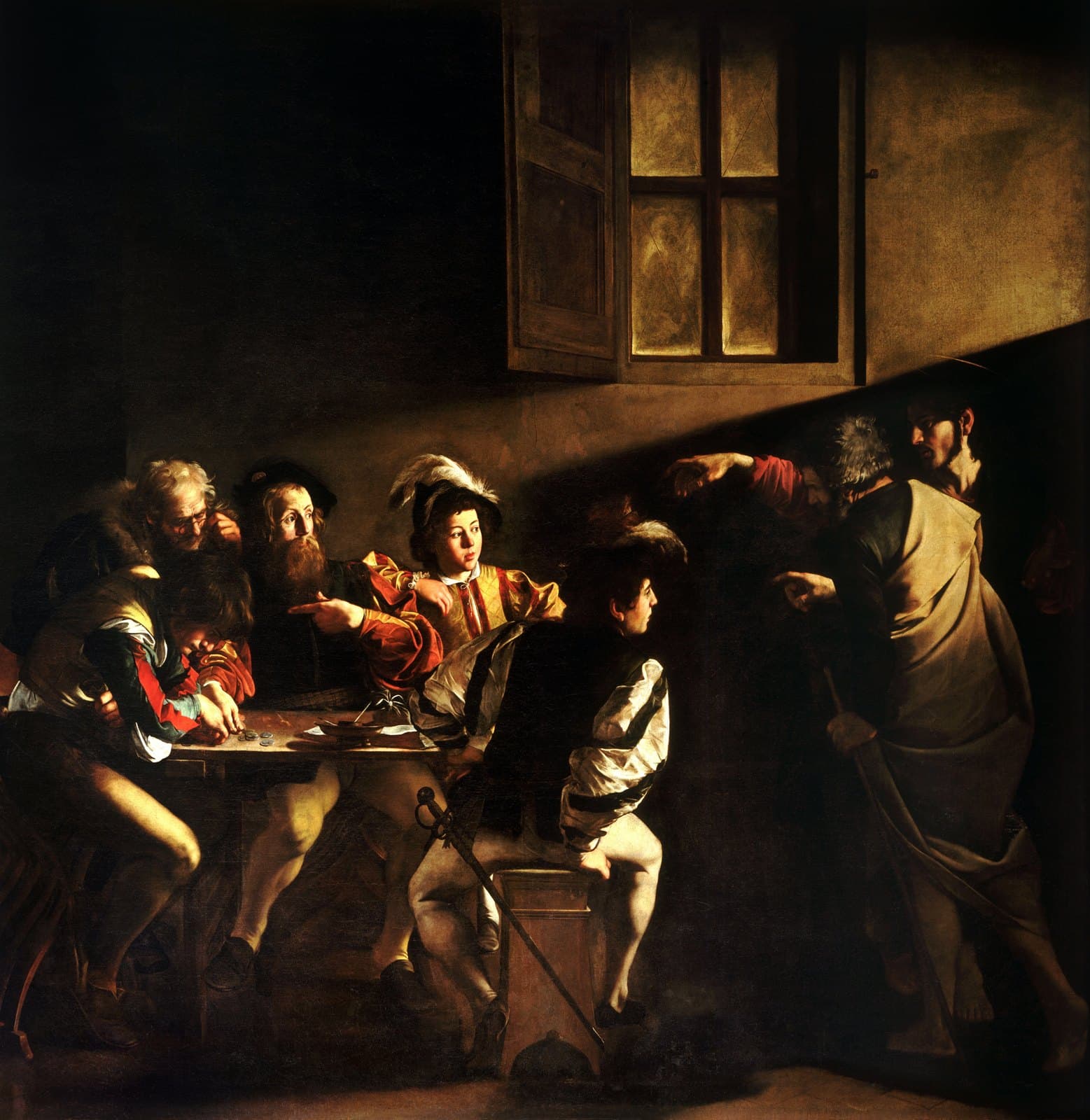
Caravaggio painted The Calling of Saint Matthew between 1599 and 1600 for the Contarelli Chapel in the church of San Luigi dei Francesi in Rome, where it still hangs. It shows the moment Christ picks out a tax collector from a table of men counting money.
The Calling of Saint Matthew is an oil painting created by Caravaggio in 1599–1600 for the Contarelli Chapel in the Church of San Luigi dei Francesi, Rome, where it remains. It depicts Christ calling a tax collector to become his disciple, presenting a biblical turning point through an encounter that resembles ordinary contemporary life. Together with its companion painting, The Martyrdom of Saint Matthew, it established Caravaggio's reputation as a major religious painter.
The Commission and Caravaggio's Breakthrough
The chapel was named after the French cardinal Matthieu Cointerel, known in Italy as Matteo Contarelli, who had provided money and instructions for its decoration before his death in 1585. Its imagery was to celebrate Saint Matthew, his namesake. Work progressed slowly, and the important wall paintings remained unfinished long after the patron's death. Caravaggio received the commission for the two lateral canvases in 1599, an extraordinary opportunity for an artist whose reputation had largely been established through smaller paintings for private collectors.
The intervention of Cardinal Francesco Maria del Monte, who had supported Caravaggio and welcomed him into his household, helped secure this first major ecclesiastical commission. When the paintings were unveiled in 1600, they placed his work before a much broader audience. His ability to give biblical figures the physical presence of people encountered in daily life became central to his success.
What the Painting Depicts
The subject comes from the Gospel account in which Jesus encounters Matthew at his tax-collecting station and calls him to follow. Caravaggio shows the moment before the decision is visibly completed. Five men gather around a table on the left, occupied with money or reacting to the visitors. Christ enters from the right with Saint Peter and extends his hand toward them. The setting is spare, the furnishings ordinary, and the men's clothing belongs largely to Caravaggio's own time.
This choice makes the episode more than an illustration of a distant event. The men do not respond uniformly: some look up, while others remain absorbed in the coins. Their differing reactions establish the painting's central contrast between attention to material affairs and awareness of a spiritual invitation.
Light, Gesture, and the Echo of Michelangelo
A strong diagonal beam crosses the room, directing attention toward the group at the table. Light acts as both illumination and an organizing force: it reveals faces and hands while leaving much of the setting indistinct. The painted lighting also responds to the chapel's actual illumination, helping connect the represented encounter with the spectator's physical surroundings.
Christ's extended hand recalls Adam's hand in Michelangelo's Creation of Adam on the Sistine Chapel ceiling. The comparison is sometimes described incorrectly as a quotation of God's hand. Caravaggio instead adapts the gesture of the human figure receiving life. In the church's interpretation, this connection presents Christ's call as a kind of renewed creation, transforming the tax collector's existence through grace.
Which Figure Is Matthew?
The traditional identification places Matthew in the bearded man who gestures toward his chest, apparently astonished that Christ has selected him. An alternative interpretation proposes that the man points beyond himself toward the younger figure bent over the money. Under that reading, Matthew has not yet noticed or acknowledged the call. The identity remains a subject of scholarly discussion rather than a question that every specialist considers definitively settled.
Either interpretation depends on the same carefully suspended moment. No one has yet stood up to follow Christ, and the painting leaves the response unfolding before the viewer. Its religious significance is carried through hesitation, attention, and the possibility of change rather than through an already completed miracle.
Continuing Religious and Artistic Significance
The painting's influence belongs to Caravaggio's wider transformation of European religious art, particularly his use of concentrated light and immediately recognizable human behavior. Its continued devotional importance is also documented. In a 2013 interview, Pope Francis recalled visiting the church and contemplating the painting, describing his identification with Matthew as someone unexpectedly singled out by Christ. This was a personal interpretation, but it demonstrates how the work continued to function as a religious encounter centuries after its creation.
Close reading
Reading the work, detail by detail
Caravaggio lights this room with one hard beam and leaves the rest in shadow. These six views follow the light from the wall it crosses to the hand that summons Matthew, then to the two men who might be him and the coins between them.
1.The beam across the wall
The light enters from somewhere outside the picture on the right and cuts the back wall in two. Nothing in the room explains where it comes from, and Caravaggio matched its direction to the real light of the chapel the painting hangs in.
2.Christ's outstretched hand
The hand is limp rather than commanding, and the pointing finger only marks a direction. Caravaggio took the pose from Adam's hand in Michelangelo's Creation of Adam, not from the hand of God the Father that reaches toward it.
3.The bearded man who points
Most writers have read this man as Matthew pointing at himself in disbelief. His eyes are on Christ, but his hand is the ambiguous part: the finger passes his own chest and carries on toward the left.
4.The young man over the money
He has not looked up, and the pointing finger at the right of this view runs toward him. Readers who identify this young man as Matthew take the picture to show the instant before he notices that he is being called.
5.The coins on the table
The takings are painted as plainly as the rest of the furniture: a few coins, a dish, a slip of paper. They are what the men at this end of the table are still attending to while Christ stands a few feet away.
6.The window that gives no light
The one window in the room is pushed open, but its panes are murky and no light comes through them. Its glazing bars make a cross, and the beam that lights the scene passes below it from another source entirely.
The French cardinal Matthieu Cointerel, known in Italy as Matteo Contarelli, dies. He has already left money and instructions for the decoration of his chapel in the Church of San Luigi dei Francesi, to be devoted to his namesake Saint Matthew.
1599
Caravaggio receives the commission for the two lateral canvases of the Contarelli Chapel: The Calling of Saint Matthew and The Martyrdom of Saint Matthew. It is his first major church commission.
1600
The two paintings are unveiled in the chapel. They put Caravaggio's work in front of a far larger audience than the private collectors who had bought his earlier pictures.
2013
Pope Francis, interviewed by the Jesuit editor Antonio Spadaro, says he often went to the Church of San Luigi dei Francesi to look at the painting, and that he identifies with Matthew.
Where to see it
Church of San Luigi dei Francesi, Contarelli Chapel
Rome, Italy
A public viewing address has not yet been confirmed for this holding.
The painting is in a working church, not a museum, and viewing depends on opening hours and on services. Check the church's own page before making a special trip.
Frequently asked questions
Where is The Calling of Saint Matthew?
It hangs in the Contarelli Chapel of the Church of San Luigi dei Francesi in Rome, the chapel it was painted for, and it has never left. Caravaggio made it in 1599–1600 as one of a pair with The Martyrdom of Saint Matthew, which hangs opposite it.
What is happening in The Calling of Saint Matthew?
Christ is calling a tax collector to become his disciple. Five men sit around a table on the left, occupied with money or reacting to the visitors; Christ enters from the right with Saint Peter and extends his hand toward them. Caravaggio shows the moment before the decision is visibly completed.
Which figure is Saint Matthew?
Traditionally he is the bearded man who gestures toward his chest, apparently astonished that Christ has selected him. An alternative reading proposes that the man points beyond himself toward the younger figure bent over the money, so that Matthew has not yet noticed the call. Scholars still discuss it.
Why does Christ's hand look like Michelangelo's Creation of Adam?
Because Caravaggio adapted the gesture from that fresco on the Sistine Chapel ceiling. The comparison is sometimes described incorrectly as a quotation of God's hand; the hand Caravaggio borrowed is Adam's, the human figure receiving life.
How big is The Calling of Saint Matthew?
It measures 322 by 340 centimeters, or roughly 10 feet 7 inches by 11 feet 2 inches, in oil on canvas. It is one of two large canvases Caravaggio painted for the side walls of the Contarelli Chapel.
Why did the commission matter to Caravaggio's career?
It was his first major church commission, and it put his work in front of a much wider audience. Until 1599 his reputation had largely been built on smaller paintings for private collectors, and Cardinal Francesco Maria del Monte, who had welcomed him into his household, helped him secure this one.
Why does Pope Francis talk about this painting?
In a 2013 interview he recalled visiting the church and contemplating the painting, and described identifying with Matthew as someone unexpectedly singled out by Christ. That is a personal reading rather than an art-historical one, but it shows the painting still working as a religious encounter four centuries after it was made.
In the atlas
What the graph records about this work — every claim carries its citation.
Caravaggio painted The Calling of Saint Matthew for the Contarelli Chapel between July 1599 and July 1600, and it is one of the paintings art historians point to when they describe what Baroque painting did differently. A single hard beam of light picks out the faces and hands and leaves the rest of the room dark, the men at the table wear the clothes of Caravaggio's own Rome rather than biblical dress, and the light inside the picture matches the real light of the chapel it hangs in.
— Jürgen Müller, Wer ist Matthäus? Eine neue Deutung von Caravaggios „Berufung des heiligen Matthäus“ aus der Contarelli-Kapelle (2021); Baroque Rome
Explore painters from the same movements and circles.
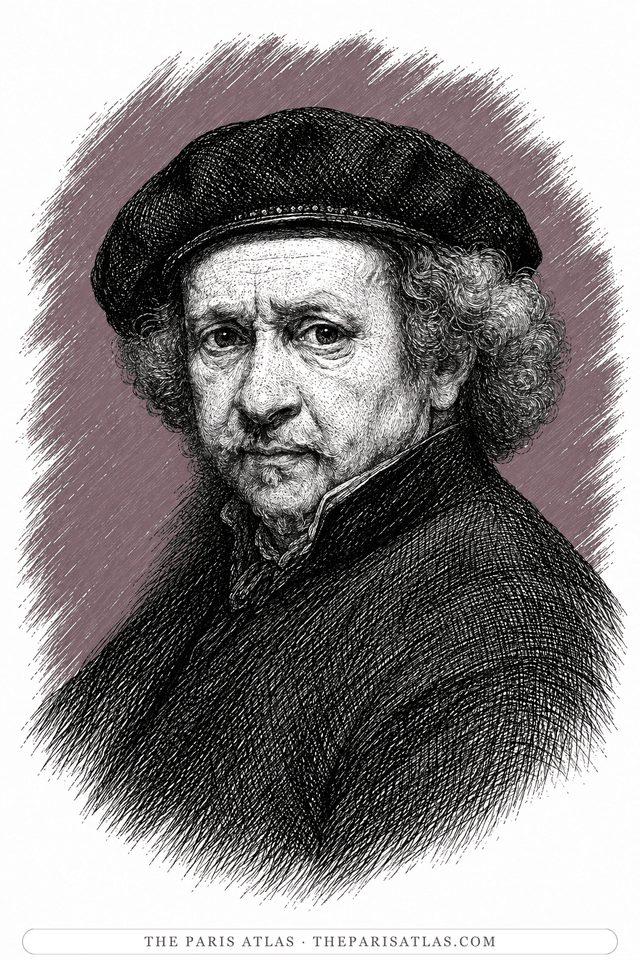
Rembrandt van Rijn
Dutch painter and etcher who worked in Leiden and Amsterdam and never traveled outside the Dutch Republic. He made about 300 etchings and roughly eighty self-portraits, trained some twenty-five painters, and was declared insolvent in 1656.
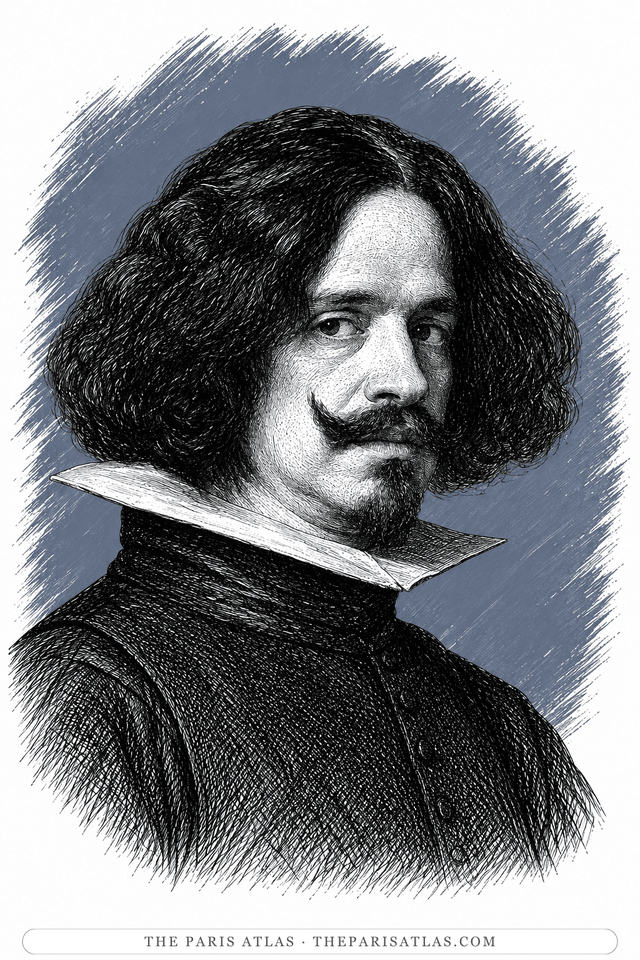
Spanish painter who spent thirty-seven years in the household of Philip IV, painting the king, his family and the dwarfs and jesters of the palace, and who ended his career as the official responsible for housing and moving the court.
Dutch painter who worked in Delft and left fewer than forty paintings, most of them small scenes of one or two people in a quiet room lit from a window. Girl with a Pearl Earring, The Milkmaid and View of Delft are the best known.
The sources below include collection records, catalogues, scholarly research, and primary materials that informed this page. They document The Calling of Saint Matthew, its making, and its place in cultural history.
1Wer ist Matthäus? Eine neue Deutung von Caravaggios „Berufung des heiligen Matthäus“ aus der Contarelli-Kapelle
Periodical
Kunstgeschichte: Open Peer Reviewed Journal, 2021
Used for
Peer-reviewed study of the painting: the 23 July 1599 commission, Del Monte's mediation, Cointerel's 1585 death, the 322 by 340 cm canvas, and the debate over which figure is Matthew that Andreas Prater opened in 1985.
The church's own reading of the painting: the borrowed gesture of Adam, the differing reactions around the table, and the fact that no one has yet risen to follow.
These references provide the documented foundation for this work's history and interpretation. Claim-level citations remain attached to the specific claims they support.



 View source