The Supper at Emmaus
by Caravaggio
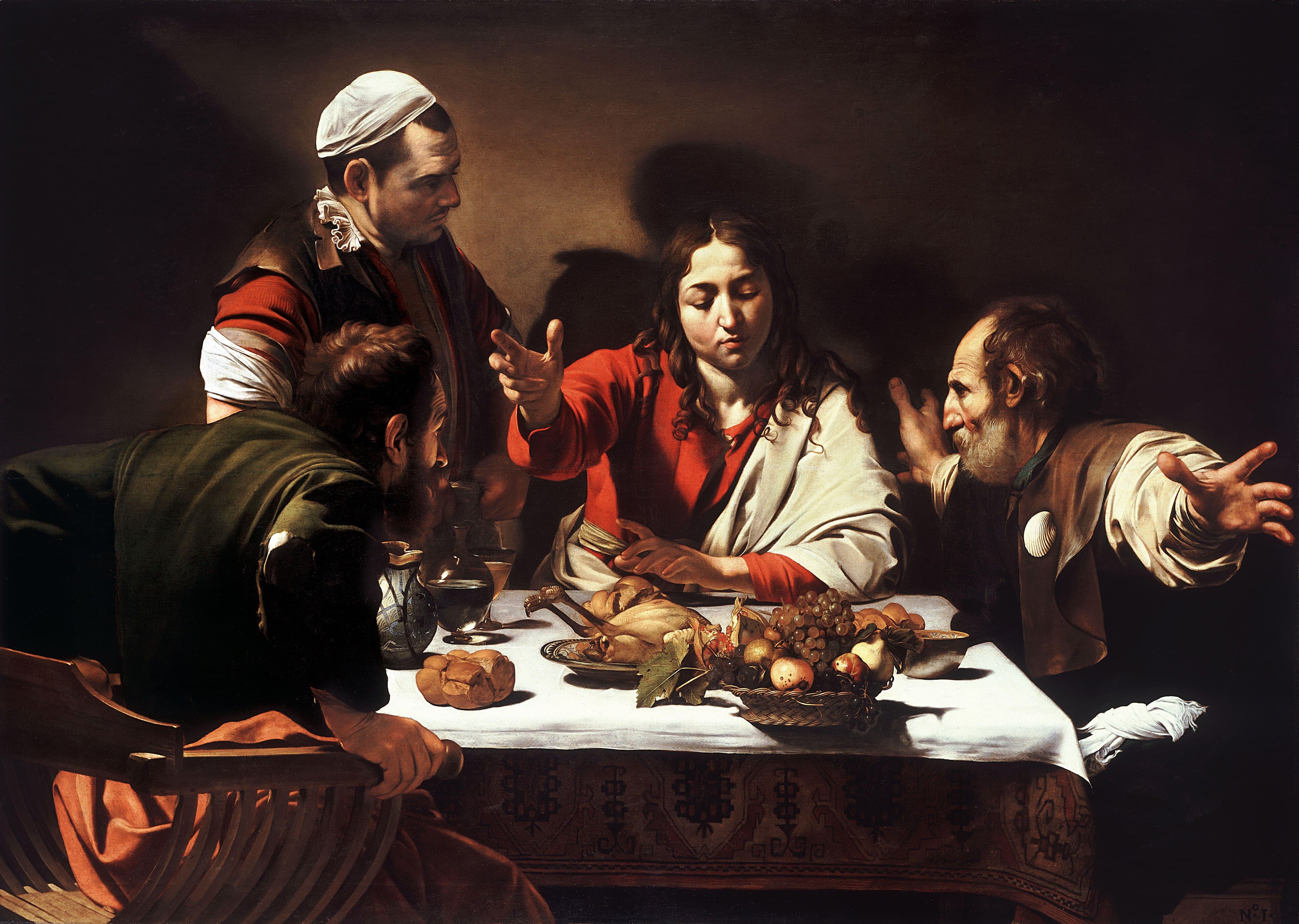
Two travellers recognise the risen Christ at an inn table, one gripping his chair to stand and the other throwing both arms wide, while a basket of fruit tips over the table edge. Michelangelo Merisi da Caravaggio painted it in 1601. The National Gallery in London holds it as NG172.
- 1601
- Oil on canvas
About Caravaggio
Overview
The Supper at Emmaus is an oil painting by Michelangelo Merisi da Caravaggio, dated by the National Gallery to 1601 and measuring 141 by 196.2 centimetres. It shows the moment from the Gospel of Luke when two disciples, walking to the village of Emmaus after the crucifixion, recognise the risen Christ as he breaks bread at their table.
Caravaggio painted the recognition itself rather than the meal around it. The figures are life-size, the table is close to the front of the canvas, and two of the four hands nearest the viewer are thrown forward out of the picture.
The Four Figures
Christ sits at the centre, and Caravaggio painted him without a beard. His hair is long, wavy and parted in the middle, his cheeks are full, and his eyes are lowered almost shut. He wears a red tunic under a cream mantle. His right hand is raised and strongly foreshortened above the table, the palm open, the fingers spread.
The disciple on the left is seen from behind in an olive-green jacket, gripping both arms of his wooden chair as though about to push himself up. There is a split in the cloth at his shoulder with pale lining showing through it. A salmon-coloured cushion is under him.
The disciple on the right is older, balding and grey-bearded, in a brown jerkin over white shirt sleeves. A white scallop shell, the badge of a pilgrim, is pinned to his chest. He has thrown both arms out sideways, and his right hand reaches so far toward the viewer that the fingers are foreshortened into blunt stubs.
Behind them stands the innkeeper in a white cap, a red sleeve showing under a dark jacket. He looks down at Christ without any reaction at all. He is the one person at the table who does not know who is sitting at it.
The Table
A white cloth is laid over a patterned carpet that hangs down the front of the table. On it are a roast fowl on a white dish with a knife beside it, and two bread rolls. Beyond them stand a glass of red wine, a jug decorated in white and blue, and a pale bowl at the right edge.
The wicker basket of fruit sits at the front, and its rim projects past the edge of the table into the viewer's space. It casts a hard shadow back across the cloth. Inside are pale green grapes, dark grapes, a split pomegranate with its red seeds showing, two pears, figs and an apple with a dark blemish in its skin.
The fruit is not idealised. One large vine leaf spread on the cloth is green, and another is brown and spotted. Caravaggio painted the basket as a thing that could fall.
Light and Shadow
The light enters from the upper left and falls across the table, the white cloth and Christ's face. The clearest proof of its direction is the innkeeper's shadow, thrown large and soft onto the bare wall to his right, directly behind Christ's head.
That shadow does the work a halo would do in an older painting. Caravaggio gave Christ no gold and no rays. The only thing marking him out is the dark shape a standing man casts on a plaster wall.
Acquisition and Provenance
The National Gallery records the painting at the Villa Borghese in Rome by 1650, probably in the ownership of Cardinal Scipione Borghese, and lists it in a Borghese inventory of 1693. It stayed in that collection until Prince Camillo Borghese sold it in 1801.
It had entered the collection of the Honourable George Vernon by 1831, and Vernon presented it to the National Gallery in 1839. It is NG172, and it hangs in Room 32.
A Second Supper
Caravaggio painted the subject again some years later, and the second version is in Milan. The London painting is the earlier and the more crowded of the two, with the fuller table and the wider gestures.
The comparison is often made to show how far his work changed after he left Rome in 1606. The later canvas is darker and quieter, with less on the table and smaller movements.
Close reading
Reading the work, detail by detail
Caravaggio pushed the table to the front of the canvas and then pushed things off it. A basket of fruit hangs over the edge, one disciple's hand comes out toward the viewer, and the figures are life-size. Close views show a meal painted as carefully as the miracle happening over it.
1.The basket hangs off the table
The basket sits at the front of the table and its rim projects past the edge into the viewer's space. It throws a hard shadow back across the white cloth. Inside are pale green grapes, dark grapes, a split pomegranate showing red seeds, two pears, figs, and an apple with a dark blemish in the skin.
2.A scallop shell pinned to his chest
A white scallop shell is pinned to the brown jerkin of the older disciple, its ribs picked out by the light. The shell is the badge of a pilgrim. It is painted brighter than his face and sits at the centre of his chest, directly below his open mouth.
3.A shadow where a halo would be
Christ is beardless, his hair long and parted in the middle, his eyes almost closed. His right hand is raised over the table, open and strongly foreshortened. Behind his head the bare wall carries a large soft shadow, cast by the innkeeper standing to the left. It occupies the place a halo would have taken.
4.His jacket is split at the shoulder
The disciple on the left is seen from behind in an olive-green jacket, and the cloth is split open at the upper arm with pale lining showing through the gap. The tear is lit directly. Caravaggio put his models in worn clothes and did not mend them for the picture.
5.The one man who does not know
The innkeeper stands behind the table in a white cap, a ruffled collar and a red sleeve under a dark jacket. He looks down at Christ with no reaction at all. He is the only person at the table who does not know who is sitting at it, and his shadow is the one marking Christ out.
6.A hand thrown out of the picture
The older disciple has thrown his right arm out sideways. The hand is turned toward the viewer and foreshortened so steeply that the fingers read as short blunt shapes. The white sleeve bunches at the wrist. The gesture carries the arm past the edge of the table and out of the painted space.
7.A roast bird and a knife
A roast fowl lies on a white dish with its legs drawn up. A knife handle projects past the rim of the dish toward the front of the table. A bread roll sits beside it. Christ's other hand, in a red sleeve, comes down over the food at the top of the group.
8.A decorated jug and a glass of wine
A jug decorated in blue and white stands on the cloth beside a clear glass holding dark red wine. Bread rolls lie in front of them. Caravaggio painted the reflections in the glass and the pattern on the jug at the same pitch of attention as the faces above them.
9.He is gripping the chair to stand
The chair is plain wood with a curved arm and a salmon-coloured cushion. The disciple's hand is closed round the end of the arm with the knuckles showing. He has not stood up yet. The grip is the only thing in the picture that says the movement is about to happen.
10.A patterned carpet under the linen
Below the white linen, a carpet hangs down the front of the table in a repeating geometric design of dark red, brown and cream. Only a band of it is lit. It is the one piece of decoration in a room that is otherwise a bare wall.
Timeline
1601
Caravaggio paints The Supper at Emmaus in Rome.
by 1650
The painting is recorded at the Villa Borghese in Rome, probably in the ownership of Cardinal Scipione Borghese.
1693
It is listed in a Borghese inventory.
1801
Prince Camillo Borghese sells it out of the family collection.
1831
It has entered the collection of the Honourable George Vernon.
1839
George Vernon presents the painting to the National Gallery in London, where it is NG172.
Where to see it
The National Gallery, London
Trafalgar Square, London WC2N 5DN, United Kingdom
Hung in Room 32.
Plan your visit on the museum’s official website (opens in a new tab)Frequently asked questions
Where is Caravaggio's The Supper at Emmaus?
The National Gallery in London, as NG172, in Room 32. The Honourable George Vernon presented it to the gallery in 1839. A second, later version of the subject by Caravaggio is in Milan.
What is happening in The Supper at Emmaus?
Two disciples are recognising the risen Christ as he breaks bread at an inn table, the moment told in the Gospel of Luke. One grips his chair to stand; the other throws both arms wide. The innkeeper stands behind them and shows no reaction, because he does not know who Christ is.
Why does Christ have no beard in The Supper at Emmaus?
Caravaggio painted him beardless, with long wavy hair parted in the middle and full cheeks, which departs from the usual way of showing Christ. It fits the story, in which the disciples walk with him for some time without knowing him. There is no halo either; a shadow on the wall marks his head instead.
How big is The Supper at Emmaus?
The National Gallery gives it as 141 by 196.2 centimetres in oil on canvas, so roughly 4 feet 8 inches high by 6 feet 5 inches wide. The figures are close to life size and the table sits near the front of the canvas.
What is in the basket of fruit?
Pale green grapes, dark grapes, a split pomegranate with its seeds showing, two pears, figs and an apple with a dark blemish in the skin. Two vine leaves lie on the cloth, one green and one brown and spotted. The basket's rim projects past the table edge and casts a shadow back onto the cloth.
What is the shell on the disciple's chest?
A scallop shell, the badge worn by pilgrims. Caravaggio pinned it to the brown jerkin of the older, grey-bearded disciple on the right, the one who throws both arms wide. It is painted white and catches the light directly.
More by Caravaggio
If you like Caravaggio
Explore painters from the same movements and circles.
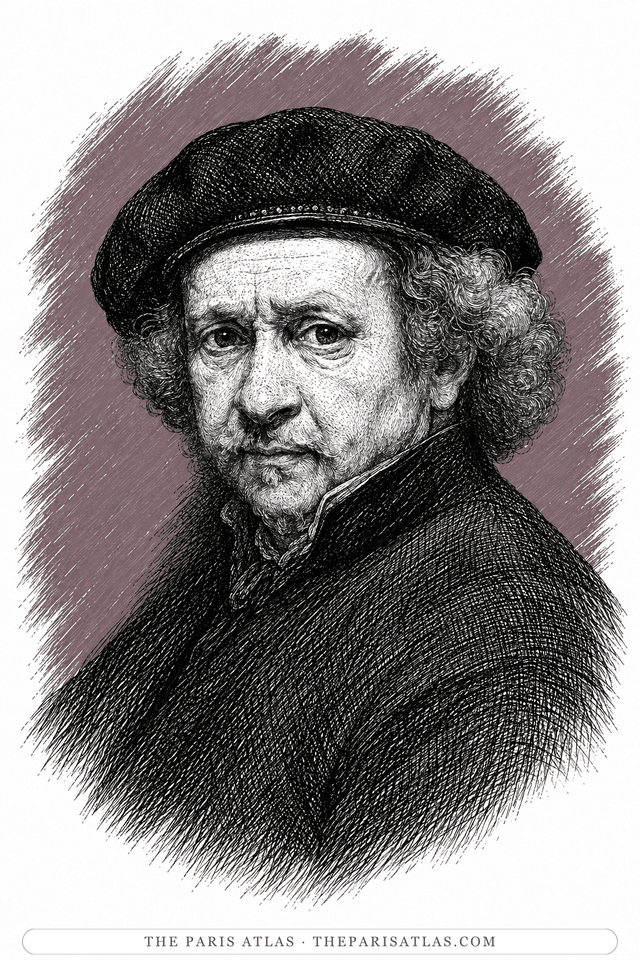
Rembrandt van Rijn
Dutch painter and etcher who worked in Leiden and Amsterdam and never traveled outside the Dutch Republic. He made about 300 etchings and roughly eighty self-portraits, trained some twenty-five painters, and was declared insolvent in 1656.
View artist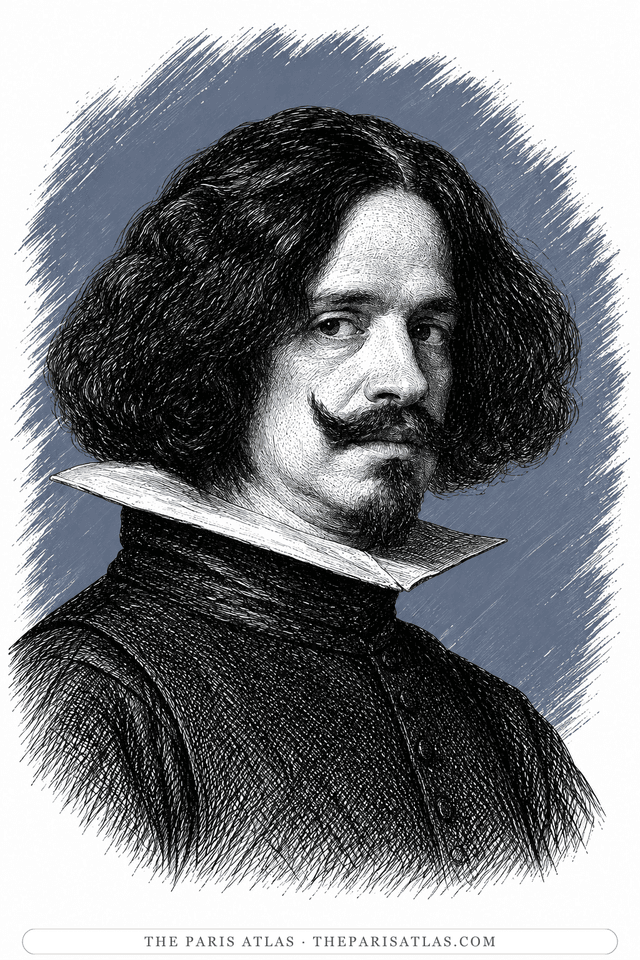
Diego Velázquez
Spanish painter who spent thirty-seven years in the household of Philip IV, painting the king, his family and the dwarfs and jesters of the palace, and who ended his career as the official responsible for housing and moving the court.
View artist
Johannes Vermeer
Dutch painter who worked in Delft and left fewer than forty paintings, most of them small scenes of one or two people in a quiet room lit from a window. Girl with a Pearl Earring, The Milkmaid and View of Delft are the best known.
View artist
References
The sources below include collection records, catalogues, scholarly research, and primary materials that informed this page. They document The Supper at Emmaus, its making, and its place in cultural history.

1Caravaggio (Michelangelo Merisi) (1571–1610) and His Followers
WebsiteThe Metropolitan Museum of ArtUsed forKeith Christiansen on Caravaggio's Roman years, his patrons, and the half-length figure pictures of the period around 1600.
2Baroque Rome
WebsiteThe Metropolitan Museum of ArtUsed forJean Sorabella on Baroque Rome and on Caravaggio's handling of light as the organising force of a picture.
3Caravaggio, The Supper at Emmaus (NG172) — collection record
WebsiteThe National Gallery, LondonUsed forThe National Gallery's record: the 1601 date, oil on canvas at 141 by 196.2 cm, Room 32, the presentation by the Hon. George Vernon in 1839, and the provenance from the Villa Borghese by 1650 through the 1693 Borghese inventory and Camillo Borghese's sale in 1801.
4Michelangelo Merisi da Caravaggio (1571–1610)
WebsiteThe National Gallery, LondonUsed forThe National Gallery on Caravaggio's Roman years, on Cardinal Francesco Maria del Monte taking him into his household in 1595, and on his making paintings that read as an extension of the viewer's own space.
These references provide the documented foundation for this work's history and interpretation. Claim-level citations remain attached to the specific claims they support.
 Explore more resources