The Paris AtlasCharting the artists, works, and places worth returning to.

In their own words

Albert Camus quotes

12 quotations, each verified against its source and credited to the work it comes from — the wording as Albert Camus wrote or said it, not as the internet passes it around.

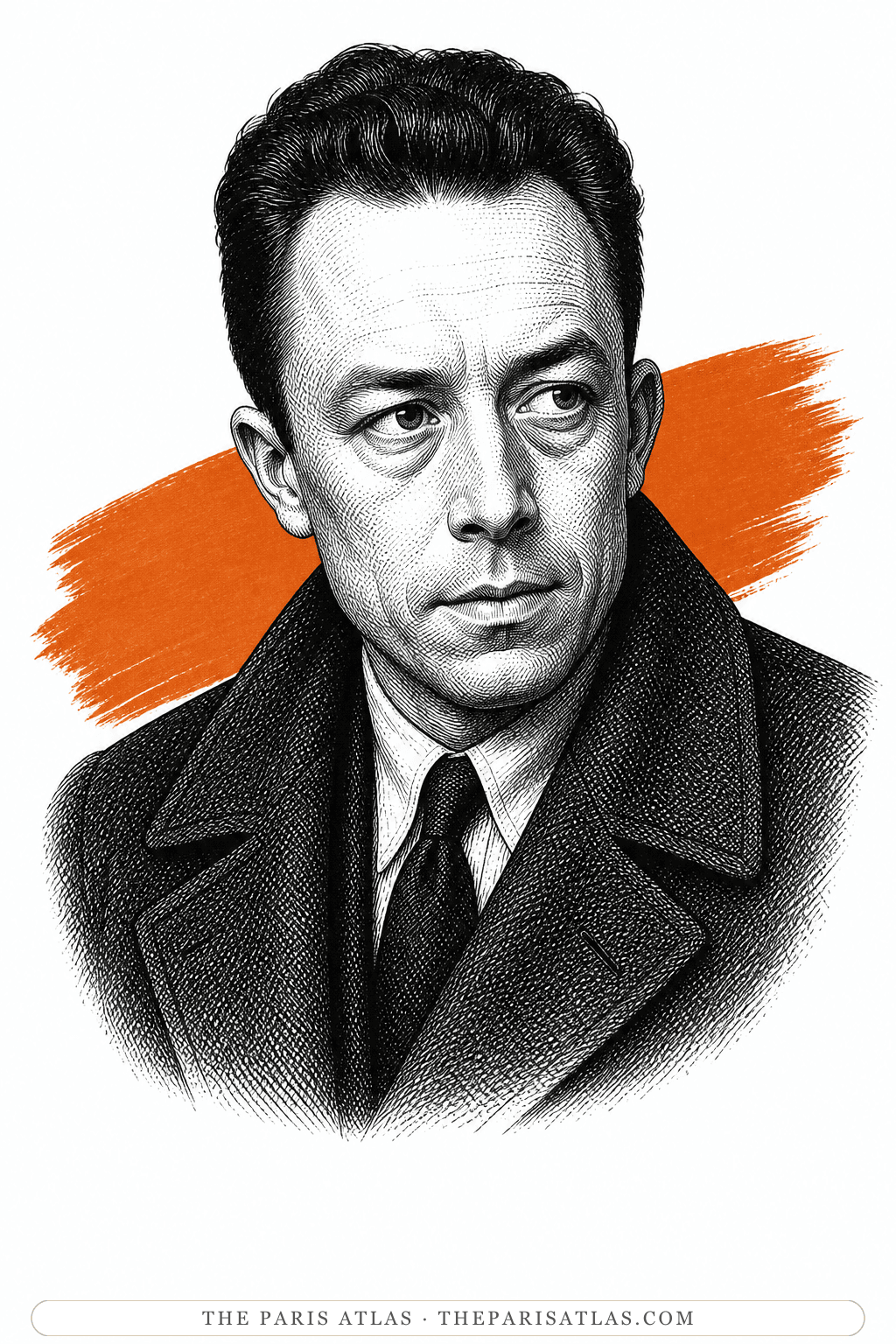
Illustrated portrait of Albert Camus

How these quotes were checked

How we decide whether a quote is genuine

Albert Camus is quoted constantly in English, which means he is quoted in translation — and much of what circulates under his name is either another translator's sentence or nobody's. A line enters this collection only when its wording has been checked against a printed translation, with the translator named, or against the Nobel Foundation's transcript of his 1957 banquet speech.

Two of the most shared “Camus” quotations appear nowhere in his published volumes, and his single most famous line — the invincible summer — circulates with openings his translators never wrote. All three cases are documented below.

Four famous Hemingway quotes, fact-checked

A sentence linked to Hemingway may be exact, shortened, remembered by someone else, or unsupported. Each label below explains what the available evidence actually proves.

Unproven

Don't walk behind me; I may not lead. Don't walk in front of me; I may not follow. Just walk beside me and be my friend.

A full-text search across Albert Camus's authored volumes — the novels, the essays, the notebooks, in English and French — finds no trace of this. It circulates on quote sites without a citation to any Camus text, and no scholarly source has produced one. It reads like the friendship-card verse it almost certainly is.

  • HathiTrust full-text search across Albert Camus's authored volumes (2026)

Unproven

The only way to deal with an unfree world is to become so absolutely free that your very existence is an act of rebellion.

Not found in any Camus volume in a full-text search of his authored works. The sentence compresses themes The Rebel actually argues — revolt, limits, freedom — into a slogan the book never states; The Rebel's own formulation is the one this collection carries: “What is a rebel? A man who says no.”

  • HathiTrust full-text search across Albert Camus's authored volumes (2026)
Verified

In the depths of winter, I finally learned that within me there lay an invincible summer.

The invincible summer is genuinely Camus, from “Return to Tipasa” (1954) — but the sentence circulates with openings that vary by translation and by meme: “In the depth of winter,” “In the depths of winter,” “In the midst of winter, I found there was, within me…”. In Ellen Conroy Kennedy's standard translation the verified wording is the close of the sentence: “…within me there lay an invincible summer.” Neither popular opening phrase appears in Camus's authored volumes in a full-text search.

  • Albert Camus, edited by Philip Thody, translated by Ellen Conroy Kennedy, Lyrical and Critical Essays (1968)
Each generation doubtless feels called upon to reform the world. Mine knows that it will not reform it, but its task is perhaps even greater. It consists in preventing the world from destroying itself.
Albert Camus, Nobel Banquet speech, Stockholm, 10 December 1957
By definition he cannot put himself today in the service of those who make history; he is at the service of those who suffer it.
Albert Camus, Nobel Banquet speech, Stockholm, 10 December 1957
Truth is mysterious, elusive, always to be conquered. Liberty is dangerous, as hard to live with as it is elating.
Albert Camus, Nobel Banquet speech, Stockholm, 10 December 1957
That is why true artists scorn nothing: they are obliged to understand rather than to judge.
Albert Camus, Nobel Banquet speech, Stockholm, 10 December 1957
Within me there lay an invincible summer.
Albert Camus, “Return to Tipasa” (1954), translated by Ellen Conroy Kennedy in Lyrical and Critical Essays (1968)
You know what charm is: a way of getting the answer yes without having asked any clear question.
Jean-Baptiste Clamence (dialogue) · Albert Camus, The Fall (1956), translated by Justin O'Brien (1957)
There is but one truly serious philosophical problem, and that is suicide.
Albert Camus, The Myth of Sisyphus (1942), translated by Justin O'Brien (1955)
The struggle itself toward the heights is enough to fill a man's heart. One must imagine Sisyphus happy.

Il faut imaginer Sisyphe heureux.

Albert Camus, The Myth of Sisyphus (1942), translated by Justin O'Brien (1955)
There is no fate that cannot be surmounted by scorn.
Albert Camus, The Myth of Sisyphus (1942), translated by Justin O'Brien (1955)
There are more things to admire in men than to despise.
Dr. Rieux (narration) · Albert Camus, The Plague (1947), translated by Stuart Gilbert (1948)
What is a rebel? A man who says no.
Albert Camus, The Rebel (1951), translated by Anthony Bower (1953)
Mother died today. Or, maybe, yesterday; I can't be sure.

Aujourd'hui, maman est morte. Ou peut-être hier, je ne sais pas.

Meursault (narration) · Albert Camus, The Stranger (1942), translated by Stuart Gilbert (1946), Part One

Questions about Albert Camus quotes

What is Albert Camus's most famous quote?

Probably the invincible summer, from his 1954 essay “Return to Tipasa”: “…within me there lay an invincible summer,” in Ellen Conroy Kennedy's translation. Its close rival is the last sentence of The Myth of Sisyphus: “One must imagine Sisyphus happy” — “Il faut imaginer Sisyphe heureux.”

Did Albert Camus say “walk beside me and be my friend”?

No. The sentence appears nowhere in his published volumes, in English or French, and no source has ever produced a citation for it. It is a quote-site attribution, not a Camus text.

Did Camus say “your very existence is an act of rebellion”?

There is no evidence he did — the sentence is absent from his published volumes. It paraphrases themes The Rebel argues, but the book's own words are different: “What is a rebel? A man who says no.”

What does “one must imagine Sisyphus happy” mean?

It is the final sentence of The Myth of Sisyphus (1942). Camus argues that Sisyphus, condemned to roll his rock forever, owns his fate in the moment he walks back down for it — “The struggle itself toward the heights is enough to fill a man's heart.”

What did Albert Camus say when he won the Nobel Prize?

At the Stockholm banquet on 10 December 1957 he said his generation's task “consists in preventing the world from destroying itself,” and defined the writer as being “at the service of those who suffer” history rather than those who make it.

What is the first line of The Stranger?

In French: “Aujourd'hui, maman est morte. Ou peut-être hier, je ne sais pas.” Stuart Gilbert's 1946 translation renders it “Mother died today. Or, maybe, yesterday; I can't be sure.”; Matthew Ward's 1988 American translation begins “Maman died today.”

References

References

The sources below are the editions, archives, and full-text searches used to verify the quotations on this page. Every line was checked against one or more of them before it appeared here.

  1. 1Albert Camus — Banquet Speech, Nobel Prize in Literature 1957

    Official record
    The Nobel Foundation, 1957
    Used for

    Official record used to verify names, dates, institutional details, or other factual information on this page.

    View source
  2. 2Lyrical and Critical Essays

    Essays
    Alfred A. Knopf, 1968
    Used for

    Published analysis and historical context used in preparing the Albert Camus page.

    View source
  3. 3HathiTrust full-text search across Albert Camus's authored volumes

    Website
    HathiTrust Digital Library, searched 29 August 2026, 2026
    Used for

    Web source consulted for documented facts and historical context presented on the Albert Camus page.

    View source
i
Why these sources are here

Verification is the point of this collection: a quotation is listed only when its wording has been checked against the sources above, and the attribution notes record what each check found about the famous lines that failed.

Explore more resources

The Friday Letter

One story from the atlas, every Friday.

No algorithms chasing attention. A work, a place, and the connection between them — with the history checked.

One email a week. No spam, no selling your address. Unsubscribe anytime.