The Paris AtlasCharting the artists, works, and places worth returning to.
  • Author
  • Journalist
· American · 1921–1992

Alex Haley

The journalist Malcolm X told his life to. Haley spent twenty years in the Coast Guard, launched Playboy's interview series in 1962, and drew The Autobiography of Malcolm X from more than fifty interviews between 1963 and 1965 — the book James Baldwin's screenplay One Day When I Was Lost adapts. Roots followed in 1976 and won a special Pulitzer Prize.

Details

Lived
1921–1992
Born
11 August 1921
Birthplace
Ithaca, New York
Died
10 February 1992 · aged 70
Place of death
Seattle, Washington
Nationality
American
Married
Nannie Branch · 1941–1964Juliette Collins · 1964–1972Myran Lewis · 1977–1992
Roles
AuthorJournalist
Also known as
Alexander Murray Palmer Haley

About Alex Haley

Alex Haley got the most guarded man in America to talk for two years. The result, The Autobiography of Malcolm X, was published in 1965 under the other man's name, which is roughly how Haley's whole career ran: the writer in the room the reader forgets is there. That book is the one James Baldwin was hired to turn into a film — the commission he abandoned and published as One Day When I Was Lost — and a decade later Haley wrote Roots and briefly became the most-read author in the country.

Twenty years at sea

Haley was born on 11 August 1921 in Ithaca, New York, and raised partly in Henning, a small town in western Tennessee, in his grandmother's house, where the family stories about an African ancestor called Kin-tay were told on the front porch. He enlisted in the Coast Guard in 1939, at seventeen, as a mess attendant — one of the few ratings open to Black sailors. The writing started on board, and it started commercially: shipmates paid him to compose their love letters.

He stayed twenty years. The service eventually created the rating of chief journalist expressly for him, the first in Coast Guard history, and when he retired in 1959 he did the arithmetic every staff writer recognizes: a pension, a typewriter, and no guarantee anyone would buy a word. The lean years that followed were real — he liked to say he had once been down to two cans of sardines and eighteen cents, and kept the cans framed in his study afterward as a reminder of the bottom.

The interviews

The freelance years paid off at Playboy. Haley's September 1962 conversation with Miles Davis launched the magazine's interview series, and the format — long, patient, verbatim — became his instrument. In May 1963 he interviewed Malcolm X. He sat with Martin Luther King Jr. for the longest interview King ever gave a publication, and with George Lincoln Rockwell, head of the American Nazi Party, who agreed to talk without knowing his interviewer was Black. Haley stayed at the table for that one too.

The Malcolm X assignment grew. Haley had first written about the Nation of Islam for Reader's Digest in 1960; the Playboy interview led to a book contract, and from 1963 to February 1965 Haley and Malcolm X met for more than fifty interview sessions. The early ones went nowhere — Malcolm X suspected him of working for the police — until Haley asked a question about his mother, and the life opened. The trust stayed partial and mutual — the epilogue records Malcolm X telling him, "I don't completely trust anyone... You I trust about twenty-five percent." He read and corrected chapters in his own hand and did not live to see the book in print. Haley's epilogue, written after the assassination, is the collaboration's own story, and one of the reasons the book endures.

Roots

Then Haley spent a decade chasing the porch stories. Working from his grandmother's account, ships' records, and a griot he heard in the Gambian village of Juffure, he traced the family line back to Kunta Kinte, an ancestor taken into slavery in the eighteenth century. By his own account he booked passage home on a freighter and spent nights lying in the dark of the hold, stripped to his underwear, trying to feel a fraction of what the crossing had been. Roots: The Saga of an American Family appeared in 1976; the ABC miniseries aired over eight consecutive nights in January 1977 and reached a record 130 million viewers; a special Pulitzer Prize followed the same year.

The record carries its qualifications, documented rather than whispered. Harold Courlander sued, showing that passages of Roots had been taken from his novel The African; Haley settled in 1978 for $650,000. Genealogists have since challenged the Gambian research, and the book is best read as what its subtitle says — a saga — rather than a verified family tree. None of that undoes what the phenomenon did: an American mass audience spent a week of prime time inside slavery, ancestor by ancestor, and tracing family history became a Black American pursuit on a scale it had never been.

Haley and James Baldwin

The connection runs through the book rather than a friendship. When Columbia Pictures decided to film The Autobiography of Malcolm X in 1968, it was Baldwin they hired to write it — a novelist adapting a journalist's book about a minister, each with his own claim on the story. Baldwin fought the studio, left Hollywood, and published his screenplay in 1972 as One Day When I Was Lost; the film that finally reached screens in 1992 was Spike Lee's, still credited to Haley's book. Haley died that February — a heart attack in Seattle, on 10 February 1992 — and was buried beside the Henning house where the stories started.

Life events

  1. 1921

    Born in Ithaca, New York, on 11 August; raised partly in Henning, Tennessee.

  2. 1939

    Enlists in the Coast Guard at seventeen as a mess attendant.

  3. 1959

    Retires after twenty years, the service's first chief journalist — a rating created for him — and starts freelancing.

  4. 1962

    His Miles Davis conversation launches the Playboy interview series in September.

  5. 1963

    Interviews Malcolm X for Playboy in May; the Autobiography collaboration begins the same year.

  6. 1965

    The Autobiography of Malcolm X is published by Grove Press in October, nine months after the assassination, with Haley's epilogue.

  7. 1976

    Roots: The Saga of an American Family is published after a decade of research.

  8. 1977

    The Roots miniseries reaches a record 130 million viewers over eight January nights; a special Pulitzer Prize follows.

  9. 1978

    Settles Harold Courlander's plagiarism suit over passages taken from The African for $650,000.

  10. 1992

    Dies of a heart attack in Seattle on 10 February; buried beside his boyhood home in Henning, Tennessee.

People they knew

Documented connections — every one carries its source.

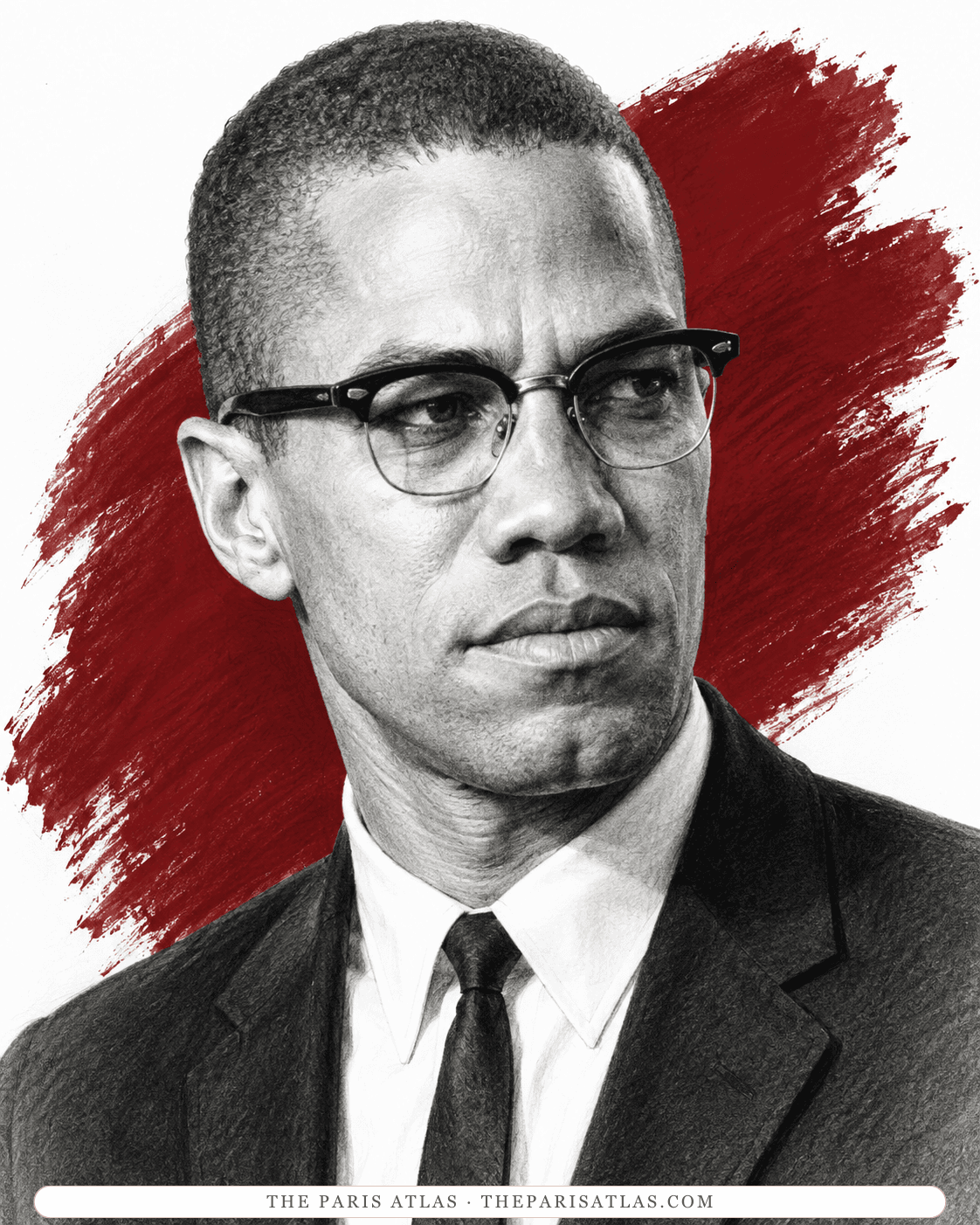
Illustrated portrait of Malcolm X

Malcolm X

  • Activist
  • Religious leader
  • Author

Collaborated with · 1963–1965

More than fifty interviews across two years produced The Autobiography of Malcolm X, published nine months after the assassination. Haley's epilogue records the collaboration itself — the guarded early sessions, the chapters corrected in Malcolm X's hand, and the February 1965 phone calls that were their last.


Malcolm X, as told to Alex Haley, The Autobiography of Malcolm X (1965), Epilogue

In works

Works in these pages connected to Alex through the claims of the graph.

Cover of The Autobiography of Malcolm X by Malcolm X

Depicted in · Book

The Autobiography of Malcolm X

Malcolm X · 1965

Haley enters his own book in the epilogue — his first-person account of the two-year collaboration, written after the assassination: how the interviews were won, how the chapters were corrected, and how the story ended at the Audubon Ballroom.

Malcolm X, as told to Alex Haley, The Autobiography of Malcolm X (1965), Epilogue

Questions about Alex Haley

Who was Alex Haley?

An American journalist and author, born in 1921. He spent twenty years in the Coast Guard, launched Playboy's interview series in 1962, produced The Autobiography of Malcolm X from two years of interviews, and wrote Roots (1976), which won a special Pulitzer Prize and became the most-watched American miniseries of its time.

Did Alex Haley write The Autobiography of Malcolm X?

He wrote it from more than fifty interviews conducted between 1963 and 1965; the title page credits it to Malcolm X, as told to Alex Haley. Malcolm X read and corrected chapters as they were drafted. Haley's epilogue, added after the assassination, tells the story of the collaboration itself.

What is his connection to James Baldwin?

The book, not a friendship. When Columbia Pictures set out to film The Autobiography of Malcolm X in 1968, it hired James Baldwin, the novelist and essayist, to write the screenplay. Baldwin left the project and published his script in 1972 as One Day When I Was Lost, which adapts Haley's book.

Was Roots true?

Partly. Haley called it a saga built on his family's oral history and a decade of research, and its cultural impact was real. But he settled a plagiarism suit with Harold Courlander in 1978 over passages taken from Courlander's novel The African, and genealogists have challenged the Gambian links, so the family tree is not treated as verified history.

How did Alex Haley die?

Of a heart attack in Seattle on 10 February 1992, at seventy. He is buried beside his boyhood home in Henning, Tennessee — the house where he first heard the family stories that became Roots.

Sourced claims

Every connection the graph holds for Alex, with the evidence behind it.

Collaborated with · 1963–1965

Malcolm X

More than fifty interviews across two years produced The Autobiography of Malcolm X, published nine months after the assassination. Haley's epilogue records the collaboration itself — the guarded early sessions, the chapters corrected in Malcolm X's hand, and the February 1965 phone calls that were their last.

Malcolm X, as told to Alex Haley, The Autobiography of Malcolm X (1965), Epilogue

Depicted in

The Autobiography of Malcolm X

Haley enters his own book in the epilogue — his first-person account of the two-year collaboration, written after the assassination: how the interviews were won, how the chapters were corrected, and how the story ended at the Audubon Ballroom.

Malcolm X, as told to Alex Haley, The Autobiography of Malcolm X (1965), Epilogue