The Paris AtlasCharting the artists, works, and places worth returning to.

In their own words

Ernest Hemingway quotes

165 quotations, each verified against its source and credited to the work it comes from — the wording as Ernest Hemingway wrote or said it, not as the internet passes it around. Page 1 of 7.

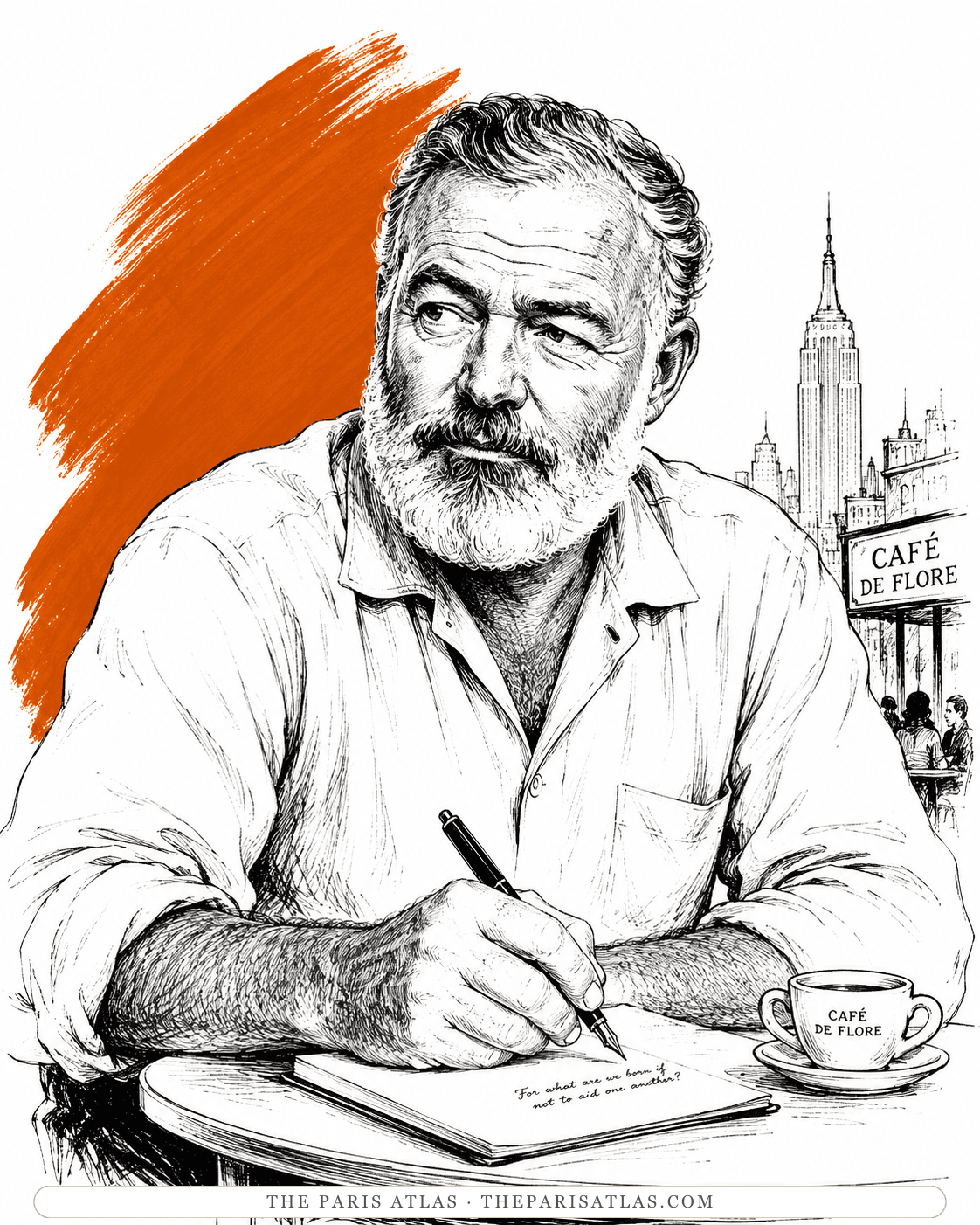
Illustrated portrait of Ernest Hemingway

How these quotes were checked

How we decide whether a quote is genuine

This collection separates Hemingway's own words from the sentences attached to his name later. A line enters the collection only when its wording can be checked against a book, a published interview, a speech transcript, or a dated letter discussed by the archive that holds the papers.

The distinction matters because fiction is not autobiography. Lines spoken by Jake Barnes, Catherine Barkley, Santiago, or another character remain credited to the book and speaker. Reported conversation is labeled as reported conversation. A popular paraphrase is not silently repaired and presented as a verbatim Hemingway sentence.

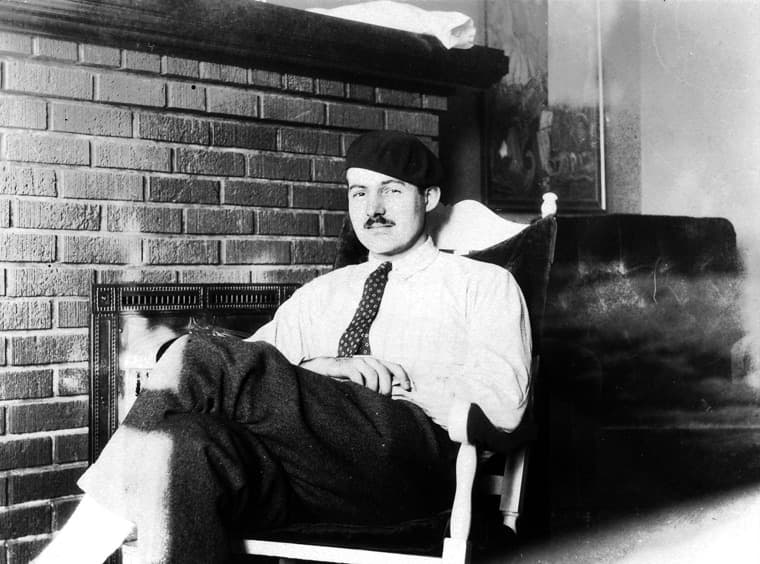
Portrait of Ernest Hemingway in Paris, 1924
Hemingway in Paris, 1924 — the year he quit journalism to write only fiction, over the sawmill at 113 rue Notre-Dame-des-Champs. Ernest Hemingway Photograph Collection, JFK Presidential Library. Public domain.

Four famous Hemingway quotes, fact-checked

A sentence linked to Hemingway may be exact, shortened, remembered by someone else, or unsupported. Each label below explains what the available evidence actually proves.

Misattributed

Write drunk, edit sober

No evidence places this sentence in Hemingway's work or letters. The closest documented precursor is in Peter De Vries's 1964 novel Reuben, Reuben, published three years after Hemingway died. Hemingway's 1958 Paris Review interview instead describes disciplined early-morning work and daily rewriting.

  • Jess Zafarris, Did Hemingway say 'write drunk, edit sober'? (2018)
  • George Plimpton, Ernest Hemingway, The Art of Fiction No. 21 (1958), working routine and revision questions

Unproven

For sale: baby shoes, never worn

There is no substantive evidence that Hemingway wrote the six-word story or won a lunch-table bet with it. Newspaper versions of the baby-shoes idea circulated while he was still a child, and the familiar Hemingway anecdote appeared decades after his death.

  • Garson O'Toole, For Sale, Baby Shoes, Never Worn (2013)
Common paraphrase

The world breaks everyone, and afterward many are strong at the broken places

This is based on a passage in A Farewell to Arms, but it is not the complete sentence as printed. The 1929 novel spells 'every one' as two words and continues by contrasting the people the world breaks with the people it kills. Our book quotation preserves that wording and identifies Book Four, Chapter 34.

  • Ernest Hemingway, A Farewell to Arms (1929), Book Four, Chapter 34
Reported speech

Courage is grace under pressure

Dorothy Parker's 1929 New Yorker profile reports that Hemingway defined 'guts' with the words 'grace under pressure.' The familiar sentence replaces 'guts' with 'courage' and removes the question-and-answer setting. It is therefore a shortened paraphrase of reported speech, not a line from one of his books.

  • Dorothy Parker, The Artist's Reward (1929), closing section

Nobel Banquet speech (1954)

Writing, at its best, is a lonely life.
Ernest Hemingway, Nobel Banquet speech (1954)
For a true writer each book should be a new beginning where he tries again for something that is beyond attainment.
Ernest Hemingway, Nobel Banquet speech (1954)
A writer should write what he has to say and not speak it.
Ernest Hemingway, Nobel Banquet speech (1954)

letter to Grace Hall Hemingway (1922)

Paris is so very beautiful that it satisfies something in you that's always hungry in America.
Ernest Hemingway, letter to Grace Hall Hemingway (1922)

letter to Sara Murphy (1935)

No one you love is ever dead.
Ernest Hemingway, letter to Sara Murphy (1935)

The Paris Review interview (1958)

I always rewrite each day up to the point where I stopped.
Ernest Hemingway, The Paris Review interview (1958)
When I am working on a book or a story I write every morning as soon after first light as possible.
Ernest Hemingway, The Paris Review interview (1958)

letter to Arnold Gingrich (1934)

The real secret in writing a novel is to keep inside of your action all the time, like a horse.
Ernest Hemingway, letter to Arnold Gingrich (1934)

The Sun Also Rises

“How did you go bankrupt?” Bill asked. “Two ways,” Mike said. “Gradually and then suddenly.”
Mike Campbell (dialogue) · Ernest Hemingway, The Sun Also Rises (1926), Book Two, Chapter 13
It is awfully easy to be hard-boiled about everything in the daytime, but at night it is another thing.
Jake (narration) · Ernest Hemingway, The Sun Also Rises (1926), Book One, Chapter 4
Listen, Robert, going to another country doesn’t make any difference. I’ve tried all that. You can’t get away from yourself by moving from one place to another. There’s nothing to that.
Jake Barnes (dialogue) · Ernest Hemingway, The Sun Also Rises (1926), Book One, Chapter 2
You’re an expatriate. You’ve lost touch with the soil. You get precious. Fake European standards have ruined you. You drink yourself to death. You become obsessed by sex. You spend all your time talking, not working. You are an expatriate, see? You hang around cafés.
Bill Gorton (dialogue) · Ernest Hemingway, The Sun Also Rises (1926), Book Two, Chapter 12
I did not care what it was all about. All I wanted to know was how to live in it. Maybe if you found out how to live in it you learned from that what it was all about.
Jake (narration) · Ernest Hemingway, The Sun Also Rises (1926), Book Two, Chapter 14
“Oh, Jake,” Brett said, “we could have had such a damned good time together.”
Brett Ashley (dialogue) · Ernest Hemingway, The Sun Also Rises (1926), Book Three, Chapter 19
“Yes,” I said. “Isn’t it pretty to think so?”
Jake Barnes (dialogue) · Ernest Hemingway, The Sun Also Rises (1926), Book Three, Chapter 19
I mistrust all frank and simple people, especially when their stories hold together.
Jake (narration) · Ernest Hemingway, The Sun Also Rises (1926), Book One, Chapter 1
“Everybody behaves badly,” I said. “Give them the proper chance.”
Jake Barnes (dialogue) · Ernest Hemingway, The Sun Also Rises (1926), Book Two, Chapter 16
It was pleasant to be drinking slowly and to be tasting the wine and to be drinking alone. A bottle of wine was good company.
Jake (narration) · Ernest Hemingway, The Sun Also Rises (1926), Book Three, Chapter 19
Don’t you ever get the feeling that all your life is going by and you’re not taking advantage of it? Do you realize you’ve lived nearly half the time you have to live already?
Robert Cohn (dialogue) · Ernest Hemingway, The Sun Also Rises (1926), Book One, Chapter 2
Nobody ever lives their life all the way up except bull-fighters.
Jake Barnes (dialogue) · Ernest Hemingway, The Sun Also Rises (1926), Book One, Chapter 2
Enjoying living was learning to get your money’s worth and knowing when you had it. You could get your money’s worth. The world was a good place to buy in.
Jake (narration) · Ernest Hemingway, The Sun Also Rises (1926), Book Two, Chapter 14
It was not brilliant bull-fighting. It was only perfect bull-fighting.
Jake (narration) · Ernest Hemingway, The Sun Also Rises (1926), Book Two, Chapter 18
I thought I had paid for everything. Not like the woman pays and pays and pays. No idea of retribution or punishment. Just exchange of values. You gave up something and got something else.
Jake (narration) · Ernest Hemingway, The Sun Also Rises (1926), Book Two, Chapter 14
At noon of Sunday, the 6th of July, the fiesta exploded. There is no other way to describe it.
Jake (narration) · Ernest Hemingway, The Sun Also Rises (1926), Book Two, Chapter 15
The things that happened could only have happened during a fiesta. Everything became quite unreal finally and it seemed as though nothing could have any consequences.
Jake (narration) · Ernest Hemingway, The Sun Also Rises (1926), Book Two, Chapter 15

From the books

Every book with a quote collection of its own, each line verified against the text.

Questions about Ernest Hemingway quotes

Did Ernest Hemingway say “write drunk, edit sober”?

No reliable source shows that he did. The closest documented wording appears in Peter De Vries's 1964 novel Reuben, Reuben, published after Hemingway's death. Hemingway told George Plimpton that he worked early in the morning and rewrote each day; that record points in the opposite direction.

Did Ernest Hemingway write “For sale: baby shoes, never worn”?

The attribution is unproven. Versions of the baby-shoes story circulated in newspapers while Hemingway was a child, and researchers have found no contemporary evidence for the later story about him winning a bet with six words. Read the full Atlas fact-check.

Where does “the world breaks everyone” come from?

It comes from A Farewell to Arms, Book Four, Chapter 34. The novel's exact wording begins, “The world breaks every one and afterward many are strong at the broken places.” The page keeps “every one” as the 1929 text prints it and credits the meditation to Frederic Henry's narration.

Did Hemingway say “courage is grace under pressure”?

He is reliably reported using the phrase, but not in that exact sentence. Dorothy Parker's 1929 New Yorker profile describes someone asking what Hemingway meant by “guts”; Parker reports his reply as “grace under pressure.” The common courage sentence is a later compression of that exchange.

What did Hemingway actually say about writing?

His documented advice emphasized routine, revision, and attempting something new. In The Paris Review he described writing after first light and rewriting each day. In his 1954 Nobel speech he said each book should be a new beginning and called writing, at its best, a lonely life.

Sources used to check these quotes

  • Ernest Hemingway, Ernest Hemingway: Nobel Banquet speech (1954)
  • George Plimpton, Ernest Hemingway, The Art of Fiction No. 21 (1958)
  • John F. Kennedy Presidential Library and Museum, Hemingway's Letters: transcript (2024)
  • Dorothy Parker, The Artist's Reward (1929)
  • Jess Zafarris, Did Hemingway say 'write drunk, edit sober'? (2018)
  • Garson O'Toole, For Sale, Baby Shoes, Never Worn (2013)
  • Ernest Hemingway, A Farewell to Arms (1929), Book Four, Chapter 34

The Friday Letter

One story from the atlas, every Friday.

No algorithms chasing attention. A work, a place, and the connection between them — with the history checked.

One email a week. No spam, no selling your address. Unsubscribe anytime.