The Paris AtlasCharting the artists, works, and places worth returning to.
  • Painter
· French · 1856–1910

Henri-Edmond Cross

French Neo-Impressionist who carried divided colour to the Mediterranean, enlarged the dot into a bright mosaic-like stroke, and influenced the young Henri Matisse.

Details

Lived
1856–1910
Born
20 May 1856
Birthplace
Douai, France
Birth name
Henri-Edmond-Joseph Delacroix
Died
16 May 1910 · aged 53
Place of death
Saint-Clair, France
Nationality
French
Profession
Painter, watercolourist, draughtsman and lithographer
Major works
The Evening Air, The Golden Isles, Afternoon at Pardigon and Mediterranean landscapes
Roles
Painter
Also known as
Henri Cross · Henri Edmond Cross

About Henri-Edmond Cross

Neo-Impressionist painter who transformed Pointillist dots into broad mosaics of Mediterranean colour

Henri-Edmond Cross was a French Neo-Impressionist painter who made the Mediterranean coast look less like a place observed than a world rebuilt in colour. Born Henri-Edmond-Joseph Delacroix in Douai in 1856, he changed his working name twice to avoid confusion with other artists. He helped establish the independent exhibiting society where Georges Seurat and Paul Signac gathered, but he did not adopt their divided-colour method immediately.

The decisive change came in 1891. Cross painted his first fully Neo-Impressionist canvas and moved south for his health, eventually settling at Saint-Clair near Le Lavandou. Signac established himself nearby at Saint-Tropez. Their friendship made this stretch of coast a second centre of Neo-Impressionism, linked to Paris by annual exhibitions at the Salon des Indépendants.

Cross gradually replaced the movement's tiny, regular dots with larger rectangular touches that behave like pieces in a mosaic. The broader marks let him intensify pinks, violets, oranges and blues without losing the principle of separated colour. Younger painters, including Henri Matisse, visited the region and found in Cross's freer colour a route from Neo-Impressionism toward Fauvism.

From Delacroix to Cross

Cross began his formal studies in 1878 at the Écoles Académiques de Dessin et d'Architecture in Lille, where he worked in Alphonse Colas's studio. He continued his training in Paris and exhibited at the Salon for the first time in 1881. His early portraits and still lifes were comparatively dark and conventional, very different from the radiant coast scenes for which he later became known.

His birth surname was Delacroix. In 1881 he shortened and Anglicised it to Henri Cross so that viewers would not confuse him with Eugène Delacroix; in 1886 he adopted Henri-Edmond Cross to distinguish himself from the artist Henri Cros. The name was practical rather than foreign: Cross remained a French painter whose career moved between northern training, Paris exhibitions and the Mediterranean.

An Independent before he was a Pointillist

In 1884 Cross helped found the Société des Artistes Indépendants, created to let artists exhibit without a jury or prizes. There he met Seurat, Signac, Charles Angrand and Albert Dubois-Pillet. Membership placed him at the centre of the emerging Neo-Impressionist network, although his own painting through most of the 1880s still drew on Naturalism, Impressionism and artists such as Bastien-Lepage and Manet.

He embraced divided colour only in 1891, the year Seurat died. His Portrait of Madame Cross is generally identified as his first Neo-Impressionist painting. That timing matters: Cross was not a follower who copied the movement's first experiments as they happened. He entered the method as a mature artist and soon altered it for his own purposes.

Saint-Clair and a larger kind of divided stroke

Rheumatism helped drive Cross south in 1891. He first settled at Cabasson and then at Saint-Clair, close to Le Lavandou, where he remained for the rest of his life apart from travel and regular trips to exhibit in Paris. Signac moved to Saint-Tropez soon afterwards. Cross also maintained close friendships with Maximilien Luce, Théo van Rysselberghe, Charles Angrand and the critic Félix Fénéon, so his coastal life was never an artistic retreat from the movement.

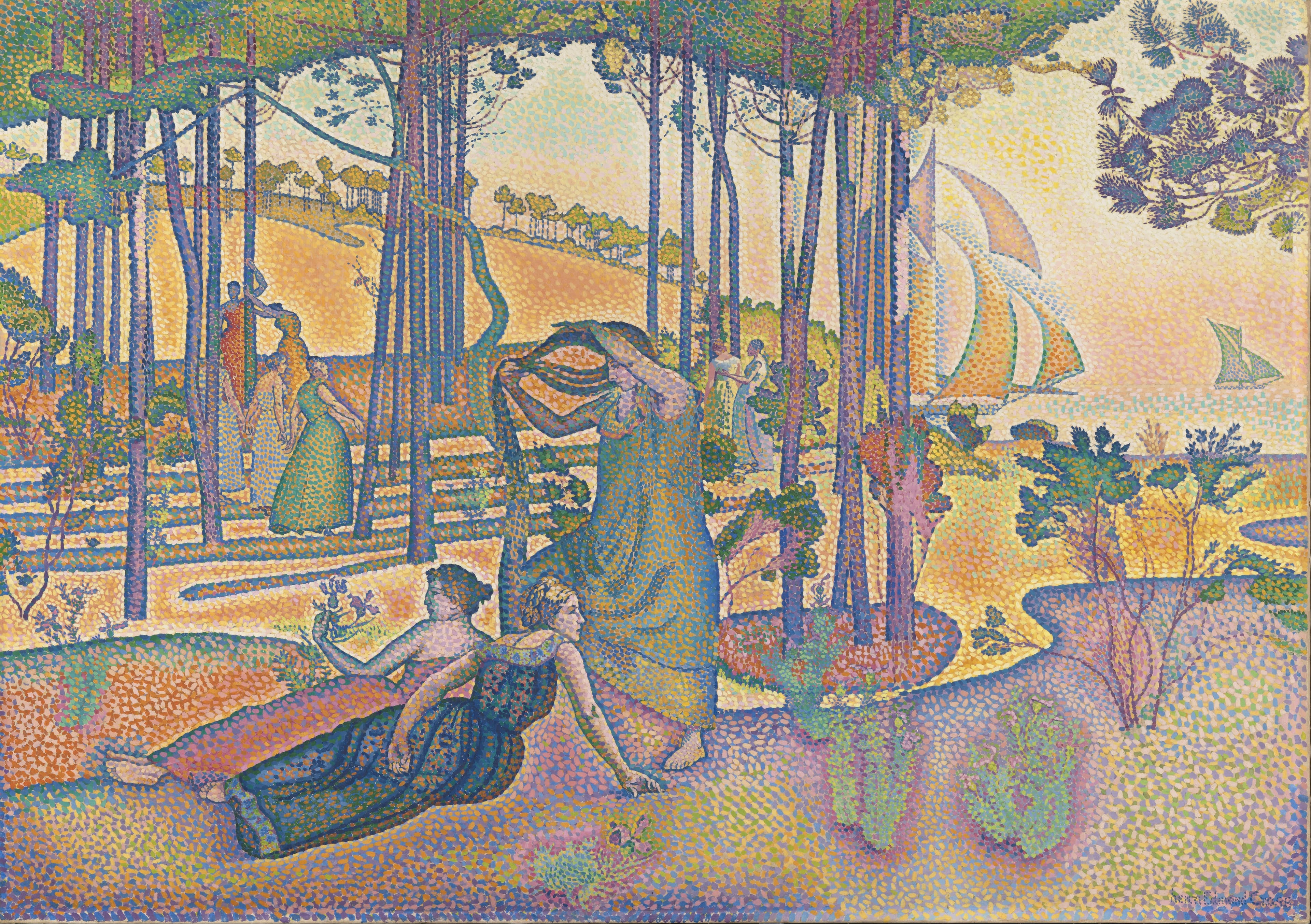
By the middle of the 1890s, Cross and Signac were moving away from minute, evenly distributed dots. Cross's larger rectangular marks keep colours separate but make each touch visible as a designed unit. In paintings such as The Evening Air, this mosaic-like handling supports an ideal landscape rather than a fleeting report of weather. The coast becomes calm, ordered and deliberately more harmonious than everyday life.

The route toward Fauvism

Cross met Henri Matisse at Saint-Tropez in 1904. Matisse and other younger painters encountered a version of divided colour that was no longer bound tightly to scientific rules or natural colour. Cross could turn the sea violet, the land pink and foliage blue-green if the total harmony required it. Museum accounts identify that freedom as a direct influence on the Fauves' use of intense, non-naturalistic colour.

Cross received his first solo exhibition at Galerie Druet in 1905, followed by a retrospective organised by Fénéon at Galerie Bernheim-Jeune in 1907. He continued to exhibit in Paris and abroad while living at Saint-Clair. He died there from cancer on 16 May 1910, four days before his fifty-fourth birthday.

Life events

  1. 1856

    Born Henri-Edmond-Joseph Delacroix in Douai on 20 May.

    Henri Edmond Cross

  2. 1878

    Begins formal study at the Écoles Académiques de Dessin et d'Architecture in Lille.

    Henri-Edmond Cross

  3. 1881

    Moves to Paris, exhibits at the Salon for the first time and adopts the working name Henri Cross.

    Henri-Edmond Cross

  4. 1884

    Helps found the Société des Artistes Indépendants and meets Seurat, Signac and other future Neo-Impressionists.

    Henri-Edmond Cross; Henri Edmond Cross

  5. 1891

    Adopts the Neo-Impressionist method and moves to the Mediterranean coast for his health.

    Henri-Edmond Cross; Henri-Edmond Cross

  6. c. 1893

    Paints The Evening Air as his decorative answer to Signac's proposal for a shared tribute to the southern landscape.

    L'Air du soir (Henri-Edmond Cross)

  7. 1904

    Meets Henri Matisse at Saint-Tropez; Cross's freer Mediterranean colour helps point the younger painter toward Fauvism.

    Henri Edmond Cross; Henri-Edmond Cross

  8. 1905–1907

    Receives a solo exhibition at Galerie Druet, followed by a retrospective organised by Félix Fénéon at Galerie Bernheim-Jeune.

    Henri-Edmond Cross

  9. 1910

    Dies from cancer at Saint-Clair on 16 May.

    Henri-Edmond Cross

Selected works

Cataloged from the holding institutions' records. Reproductions appear only where the rights are verified.

Paintings

Henri-Edmond Cross's Pointillist Mediterranean landscape with resting figures beneath tall trees, sailboats, and evening light

Artwork reproduction

Painting · Pointillism

The Evening Air

c. 1893 · Oil on canvas

Henri-Edmond Cross's large Mediterranean scene of people resting beneath trees at the end of the day, built from broad rectangular touches of divided color. Painted around 1893, it is held by the Musée d'Orsay but is not currently on display.

Musée d'Orsay, Paris

Henri-Edmond Cross, The Evening Air, c. 1893. Musée d'Orsay, Paris. Image: public domain.

Movements

The artistic and literary currents this life ran through.

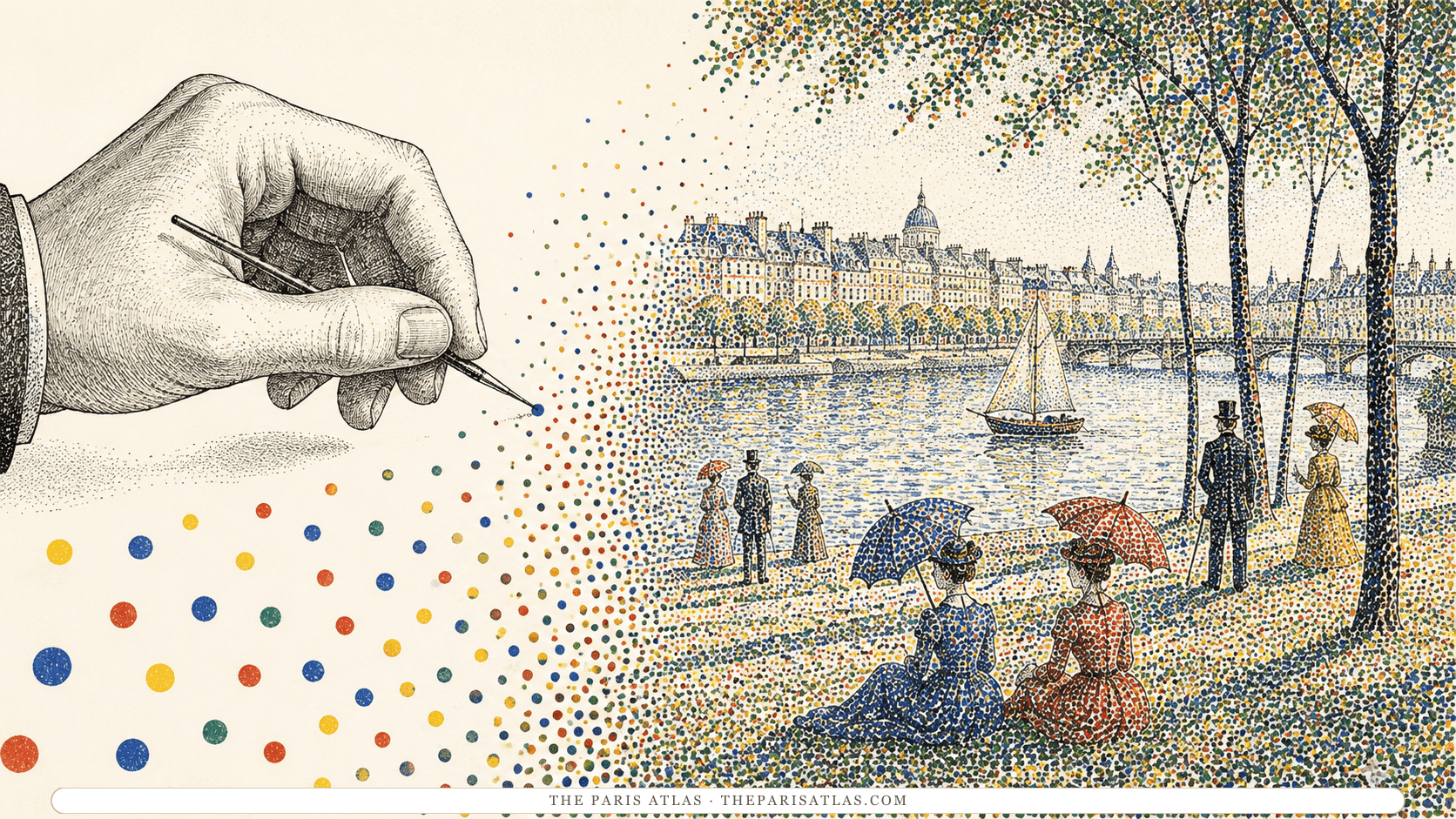
Engraved painter's hand placing a colored dot as separated blue, red, yellow, and green marks resolve into a Seine-side scene with trees, parasols, and a sailboat

Painting technique and movement · 1886–circa 1906

Pointillism

Cross joined the Neo-Impressionist circle through the Société des Artistes Indépendants and, from 1891, developed a broader mosaic-like form of divided colour on the Mediterranean coast.

Henri-Edmond Cross; Henri Edmond Cross

Questions about Henri-Edmond Cross

Who was Henri-Edmond Cross?

Henri-Edmond Cross (1856–1910) was a French Neo-Impressionist painter known for luminous Mediterranean landscapes made from separate touches of colour. He helped found the Société des Artistes Indépendants in 1884, adopted Divisionism in 1891 and later enlarged the tiny Pointillist dot into a broader, mosaic-like stroke.

Was Henri-Edmond Cross his real name?

No. He was born Henri-Edmond-Joseph Delacroix and changed his working name to avoid confusion first with Eugène Delacroix and then with Henri Cros. By 1886 he was exhibiting as Henri-Edmond Cross.

Was Cross one of the founders of Pointillism?

He belonged to the founding Neo-Impressionist circle, but he did not adopt its divided-colour method until 1891. Cross helped found the Indépendants and knew Seurat and Signac from 1884; his distinctive contribution came later, when he widened the dot into larger rectangular strokes and made colour freer.

Where did Henri-Edmond Cross live in southern France?

He settled first at Cabasson and then at Saint-Clair near Le Lavandou on the Mediterranean coast. He lived at Saint-Clair for most of the period from 1893 until his death in 1910, returning to Paris to exhibit and travelling to Italy twice.

How did Cross influence Henri Matisse?

Cross showed Matisse that separated colour could be intense, broad and independent of natural appearances. Matisse met him in the Saint-Tropez area in 1904, and museums identify Cross's Mediterranean paintings as an important step toward the brighter, freer colour of Fauvism.

What is Henri-Edmond Cross's most important painting?

The Evening Air, painted around 1893, is one of his defining works. The large Musée d'Orsay canvas combines divided colour, broad rectangular strokes and a classically ordered Mediterranean scene, and it later influenced Matisse's Luxury, Calm and Voluptuousness.

Where can you see paintings by Henri-Edmond Cross?

Major holdings include the Musée d'Orsay in Paris and the Museum Barberini in Potsdam. Check the institution's object page before travelling: the Musée d'Orsay currently identifies The Evening Air as part of its collection but not on display.

Sourced claims

Every connection the graph holds for Henri-Edmond, with the evidence behind it.

Associated with

Pointillism

Cross joined the Neo-Impressionist circle through the Société des Artistes Indépendants and, from 1891, developed a broader mosaic-like form of divided colour on the Mediterranean coast.

Henri-Edmond Cross; Henri Edmond Cross

References

References

The sources below include biographies, scholarly essays, interviews, and primary materials that informed this page. They reflect both the historical record and ongoing critical conversations about Henri-Edmond Cross and their work.

  1. 1Henri-Edmond Cross

    Website
    Museo Nacional Thyssen-Bornemisza
    Used for

    Web source consulted for documented facts and historical context presented on the Henri-Edmond Cross page.

    View source
  2. 2Henri Edmond Cross

    Website
    Städel Museum
    Used for

    Web source consulted for documented facts and historical context presented on the Henri-Edmond Cross page.

    View source
  3. 3Henri-Edmond Cross

    Website
    Museum Barberini
    Used for

    Web source consulted for documented facts and historical context presented on the Henri-Edmond Cross page.

    View source
  1. 4Henri-Edmond Cross (1856–1910)

    Website
    Musée d'Orsay
    Used for

    Web source consulted for documented facts and historical context presented on the Henri-Edmond Cross page.

    View source
  2. 5L'Air du soir (Henri-Edmond Cross)

    Website
    Musée d'Orsay
    Used for

    Web source consulted for documented facts and historical context presented on the Henri-Edmond Cross page.

    View source
  3. 6Henri Edmond Cross

    Website
    Bayerische Staatsgemäldesammlungen
    Used for

    Web source consulted for documented facts and historical context presented on the Henri-Edmond Cross page.

    View source
i
Why these sources are here

These references anchor the page in the documented record and in the scholarly conversations around Henri-Edmond Cross. Every claim on this page traces back to one or more of the works listed here.

Explore more resources