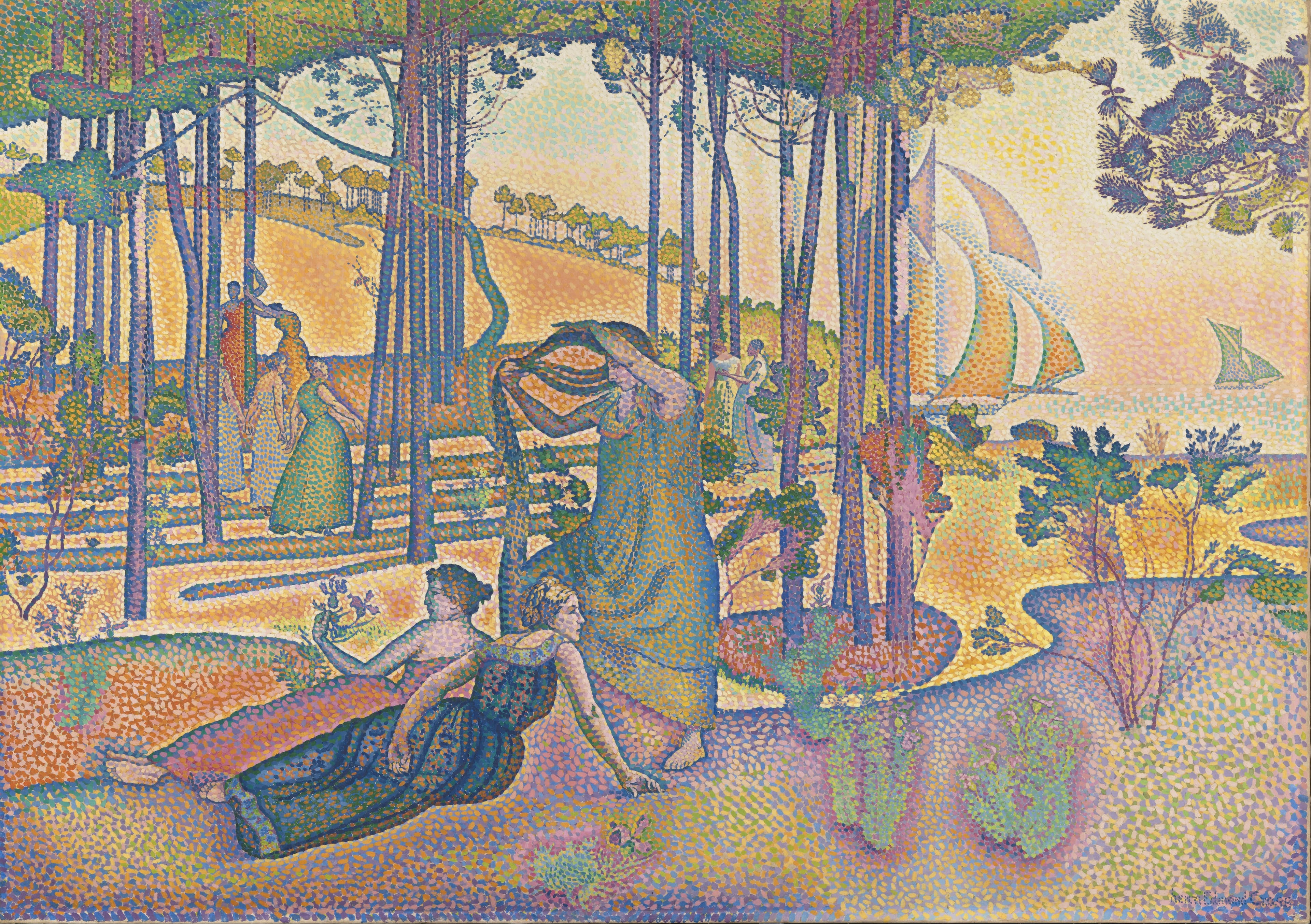
The Evening Air
Henri-Edmond Cross's large Mediterranean scene of people resting beneath trees at the end of the day, built from broad rectangular touches of divided color. Painted around 1893, it is held by the Musée d'Orsay but is not currently on display.
- c. 1893
- Oil on canvas
About Henri-Edmond Cross
What the painting shows
Tall, slender trees divide the canvas into vertical bands. Beneath them, women in long dresses pause, walk and recline on the ground. Beyond the grove, sailboats move across calm water under the soft light of late afternoon.
The figures do not form a single event or story. Their gestures are unhurried and their spacing is deliberate, so the scene feels suspended between activity and rest. Horizontal bands of land, sea and sky steady the tree trunks, while the repeated curves of bodies and branches keep the arrangement from becoming rigid.
Cross was not trying to record one ordinary afternoon exactly as it appeared. He reorganized the Mediterranean coast into an ideal scene of ease, balance and shared space.
A decorative monument to the southern coast
In April 1893 Paul Signac wrote to Cross proposing that the two friends create complementary decorative tributes to the sunny region they both knew. Signac's answer became In the Time of Harmony; Cross's became The Evening Air.
The word decorative is important here. At 166 centimeters wide, the picture asks to be read as a complete arrangement before it is inspected figure by figure. Cross chose the hour when heat and daylight begin to ease, then made that calm visible through balanced lines, softened color and poses that seem to stop time.
Why the surface looks like a mosaic
Cross remained faithful to the Neo-Impressionist principle of keeping colors in distinct touches, but the large format changed the mark he needed. Instead of covering the picture with only tiny, regular dots, he used wider rectangular strokes. Up close they sit beside one another like tesserae in a mosaic; from farther away they assemble light, foliage, clothing and water.
This is Divisionism without a strict dot. The colors remain separated so that neighboring tones can intensify one another, but the visible brushmark becomes part of the design. Cross's change helps explain why Pointillism, Divisionism and Neo-Impressionism are related terms rather than exact synonyms.
A classical model and a modern afterlife
The Musée d'Orsay connects Cross's classically ordered figures and ideal landscape to Puvis de Chavannes's Sweet Land. Cross could therefore use modern color theory while looking back to a much older ambition: the mural-like picture whose figures, landscape and scale form one stable whole.
The painting then became a model for a younger artist. Cross exhibited it in 1894 and later gave it to Signac. Henri Matisse encountered it in Signac's dining room at La Hune, and the museum identifies it as an inspiration for Matisse's Luxury, Calm and Voluptuousness. The broad separated strokes and imagined harmony helped open a route from Neo-Impressionism toward Fauvism.
Where the painting is now
The Evening Air entered the French national collection through a 1976 gift from Ginette Signac, Paul Signac's daughter, with a reserved right of use that ended in 1979. Its accession number is RF 1976 81, and its holding institution is the Musée d'Orsay in Paris.
A collection location is not the same as a gallery guarantee. The museum's current object page says that the painting is not presently exhibited, so anyone planning a visit should check that page before traveling specifically to see it.
Close reading
Reading the work, detail by detail
Cross designed this Mediterranean evening as a complete decorative harmony, but its calm depends on many separate decisions. Six close views show how the trees divide the space, how distinct groups of women create a slow rhythm, and how broad touches of color make the scene shimmer without dissolving its structure.
1.The tree trunks turn the landscape into a measured screen
The trunks rise as repeated vertical bands rather than naturalistic brown columns. Their spacing divides the long canvas into bays, letting Cross organize the figures almost like groups in a mural while the sea and sky remain visible through the gaps.
2.The standing women establish a slow human rhythm
The figures face different directions and pause at different moments, so they never become a formal parade. Cross repeats long dresses, pale hats, and upright bodies against the trunks, turning ordinary movement into a quiet sequence across the grove.
3.Reclining bodies anchor the foreground
Two women stretch across the ground in overlapping curves of blue, green, violet, and orange. Their broad horizontal shapes counter the trees' vertical pressure and make rest, rather than any single action, the painting's central condition.
4.Separate color builds the central figures
No dress is filled with one continuous local color. Blue sits beside yellow, green beside violet, and the rectangular touches remain legible as marks. Cross preserves the figures while making the same divided surface pass through bodies, grass, and trees.
5.A seated pair creates the scene's most intimate pause
The pair bends inward, one figure's pale arm crossing toward the other. Cross keeps their interaction understated, but the linked poses offer a small human center within a landscape otherwise organized through dispersed, self-contained groups.
6.A distant sail holds the fading light
The sail is only a thin blue-edged triangle, yet it makes the open water readable beyond the trees. Around it, pale yellow, pink, mint, and blue strokes share the sky and sea, turning late afternoon into a color harmony rather than a smooth atmospheric wash.
Timeline
1891
Cross adopts the Neo-Impressionist method and moves to southern France for his health.
April 1893
Signac proposes that he and Cross each create a decorative monument to the southern landscape they both love.
c. 1893
Cross paints The Evening Air, adapting divided color to a large canvas with broad rectangular touches.
1894
The painting appears at the third exhibition of the Neo-Impressionist group and at the Salon des Indépendants; Cross later gives it to Signac.
1976
Ginette Signac donates the painting to the French national museums with a reserved right of use; it receives accession number RF 1976 81.
1977–1979
The work is assigned to the Musée d'Orsay in 1977, and Ginette Signac gives up the reserved right of use in 1979.
Where to see it
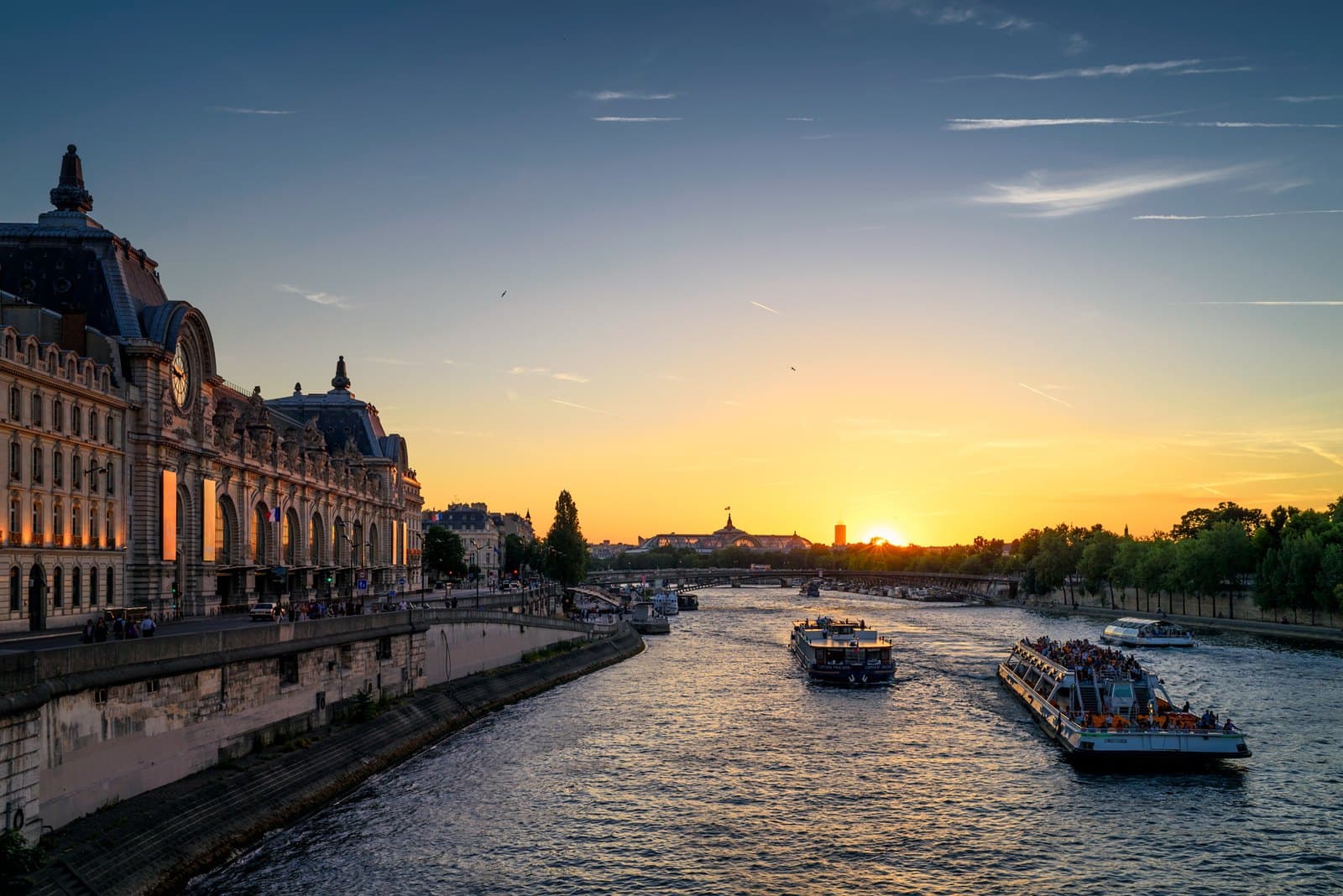
Musée d'Orsay, Paris
Esplanade Valéry Giscard d’Estaing, 75007 Paris, France
The museum currently lists this painting as not on display. Check the official object record before making a special visit.
Plan your visitFrequently asked questions
Who painted The Evening Air?
Henri-Edmond Cross painted The Evening Air around 1893. Cross was a French Neo-Impressionist who worked closely with Paul Signac and developed a broader, mosaic-like version of divided brushwork on the Mediterranean coast.
What does The Evening Air show?
It shows women resting and moving beneath tall trees beside calm Mediterranean water, with sailboats in the distance. Cross arranged the figures as part of an ideal, timeless landscape rather than as characters in a specific narrative.
Is The Evening Air a Pointillist painting?
Yes, broadly speaking, but its marks are not limited to tiny dots. Cross used the Neo-Impressionist principle of separate color while enlarging the touches into rectangular, mosaic-like strokes suited to the painting's scale.
Why did Cross paint The Evening Air?
He painted it as a decorative tribute to southern France after Signac proposed that each artist make a monument to the sunny region they knew. Signac's companion project became In the Time of Harmony.
How did The Evening Air influence Matisse?
Matisse saw the painting in Signac's dining room at La Hune and drew on it for Luxury, Calm and Voluptuousness. Its broad separated strokes, intense color and ideal coastal leisure helped show him how Neo-Impressionism could lead toward freer Fauvist color.
Where is The Evening Air?
It belongs to the Musée d'Orsay in Paris, accession number RF 1976 81. The museum's current object record says it is not presently on display, so check before making a special visit.
How large is The Evening Air?
The unframed canvas measures 116 by 166 centimeters. Its large size helped push Cross from minute dots toward the wider rectangular marks that create its mosaic-like surface.
If you like Henri-Edmond Cross
Explore painters from the same movements and circles.
Camille Pissarro
The eldest of the Impressionists and the only painter to show in all eight of the group's exhibitions, 1874 to 1886.
View artist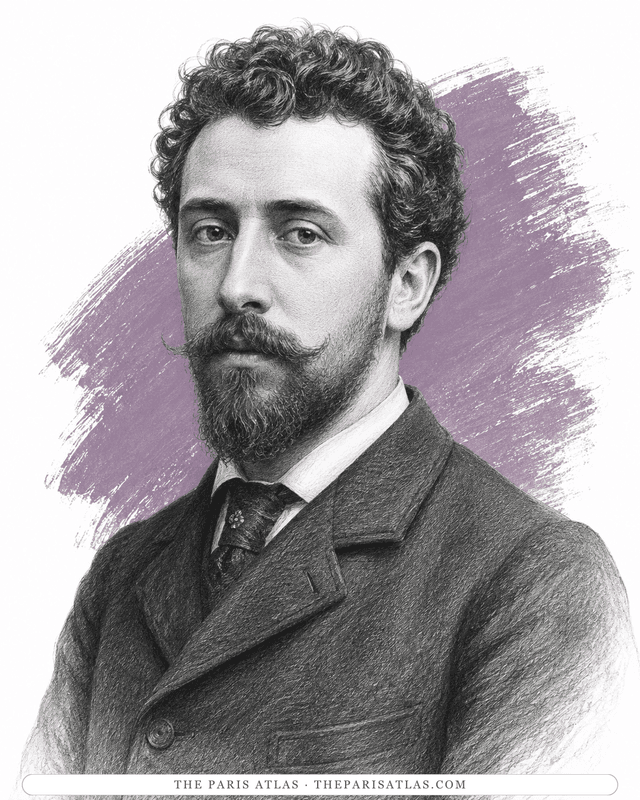
Georges Seurat
Parisian painter who built pictures from small dots of pure colour on optical principle, co-founded the Salon des Indépendants, and detonated the last Impressionist exhibition of 1886 with A Sunday on La Grande Jatte. He died at thirty-one.
View artist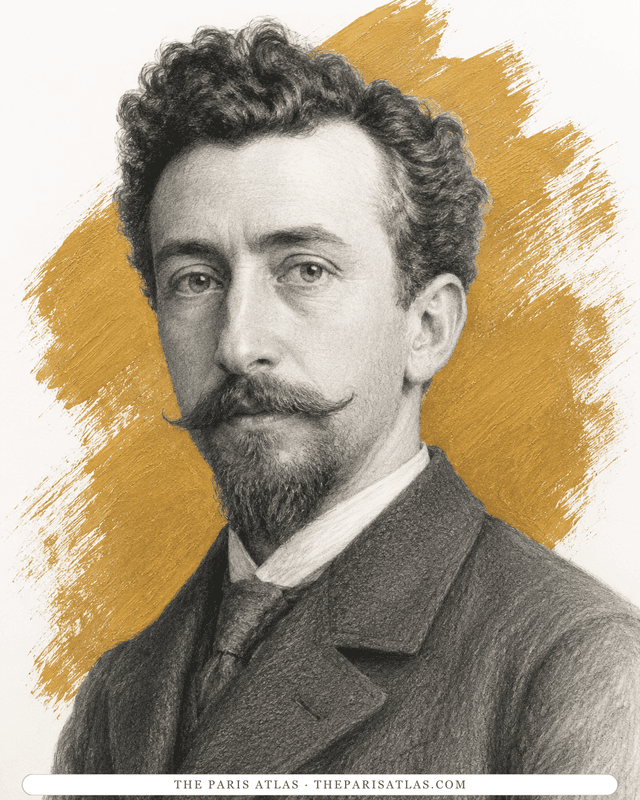
Paul Signac
Co-founder of Neo-Impressionism and, after Georges Seurat's death, the chief theorist and organiser of Pointillism.
View artist
References
The sources below include collection records, catalogues, scholarly research, and primary materials that informed this page. They document The Evening Air, its making, and its place in cultural history.


1L'Air du soir (Henri-Edmond Cross)
WebsiteMusée d'OrsayUsed forWeb source consulted for documented facts and historical context presented on the The Evening Air page.
2Etude pour 'L'air du Soir' (Henri-Edmond Cross)
WebsiteMusée d'OrsayUsed forWeb source consulted for documented facts and historical context presented on the The Evening Air page.
3Henri-Edmond Cross
WebsiteMuseo Nacional Thyssen-BornemiszaUsed forMuseum biography used for Cross's move south, Neo-Impressionist development and friendship with Signac.
4Henri-Edmond Cross
WebsiteMuseum BarberiniUsed forMuseum account used for Cross's increasingly free color and influence on Matisse.
5Georges Seurat (1859–1891) and Neo-Impressionism
WebsiteThe Metropolitan Museum of ArtUsed forWeb source consulted for documented facts and historical context presented on the The Evening Air page.
These references provide the documented foundation for this work's history and interpretation. Claim-level citations remain attached to the specific claims they support.
 Explore more resources