The Paris AtlasCharting the artists, works, and places worth returning to.
  • Filmmaker
· French · 1873–1925

Louis Feuillade

Gaumont's master of the serial — Fantômas and Les Vampires turned the real streets of wartime Paris into a landscape of crime, and the surrealists into filmgoers.

In images

Details

Lived
1873–1925
Born
19 February 1873
Birthplace
Lunel, Hérault
Died
26 February 1925 · aged 52
Place of death
Nice
Nationality
French
Roles
Filmmaker

About Louis Feuillade

Louis Feuillade came to cinema sideways — a wine merchant's son from the Midi, a cavalry volunteer, then a Paris journalist — and stayed to become the most productive director who ever lived. Hired at Gaumont as a scenarist in 1905, he was running the studio's entire artistic output within two years, and over two decades he directed on the order of seven hundred films of every kind the market asked for: comedies, melodramas, biblical epics, a celebrated series of child-star pictures.

What history kept is the crime serials. Fantômas (1913–14) put Marcel Allain and Pierre Souvestre's master criminal on screen and made the modern city itself look guilty; Les Vampires (1915–16) did it at seven hours' length with a gang, a journalist, and Musidora's Irma Vep; Judex (1916) answered the censors by inventing the caped avenger. Shot fast, on real streets, with a camera that simply watches, they achieved by economy what the avant-garde spent the next decade pursuing on purpose — the marvelous photographed as if it were ordinary. The surrealists noticed, and said so for the rest of their lives.

He never stopped working — he died at Nice in 1925, mid-career, at fifty-two — and never considered himself an artist. Posterity has overruled him on the second point.

Life events

  1. 1873

    Born at Lunel, in the wine country of the Hérault.

  2. 1905–07

    Joins Gaumont as a scenarist; within two years he is the studio's artistic director, in charge of its entire production.

    Louis Feuillade — Gaumont's artistic director and the maker of Fantômas and Les Vampires, photographer and date unrecorded. (Unknown photographer)

    Encyclopaedia Britannica — Louis Feuillade

  3. 1913–14

    The five-part Fantômas cycle — the master criminal loose in a documentary Paris, and the template for everything that follows.

    Encyclopaedia Britannica — Louis Feuillade

  4. 1915–16

    Les Vampires, ten episodes across eight months of wartime — Gaumont's answer to the American serials, and the making of Musidora's Irma Vep.

    Gaumont — 100 Years Since Les Vampires Was Released

  5. 1916

    Judex — the serial the censors could approve, with a caped avenger in place of the criminals they had banned.

    Encyclopaedia Britannica — Louis Feuillade

  6. 1925

    Dies at Nice at fifty-two, still directing — roughly seven hundred films after he began.

    Encyclopaedia Britannica — Louis Feuillade

Selected works

Cataloged from the holding institutions' records. Reproductions appear only where the rights are verified.

Cinema

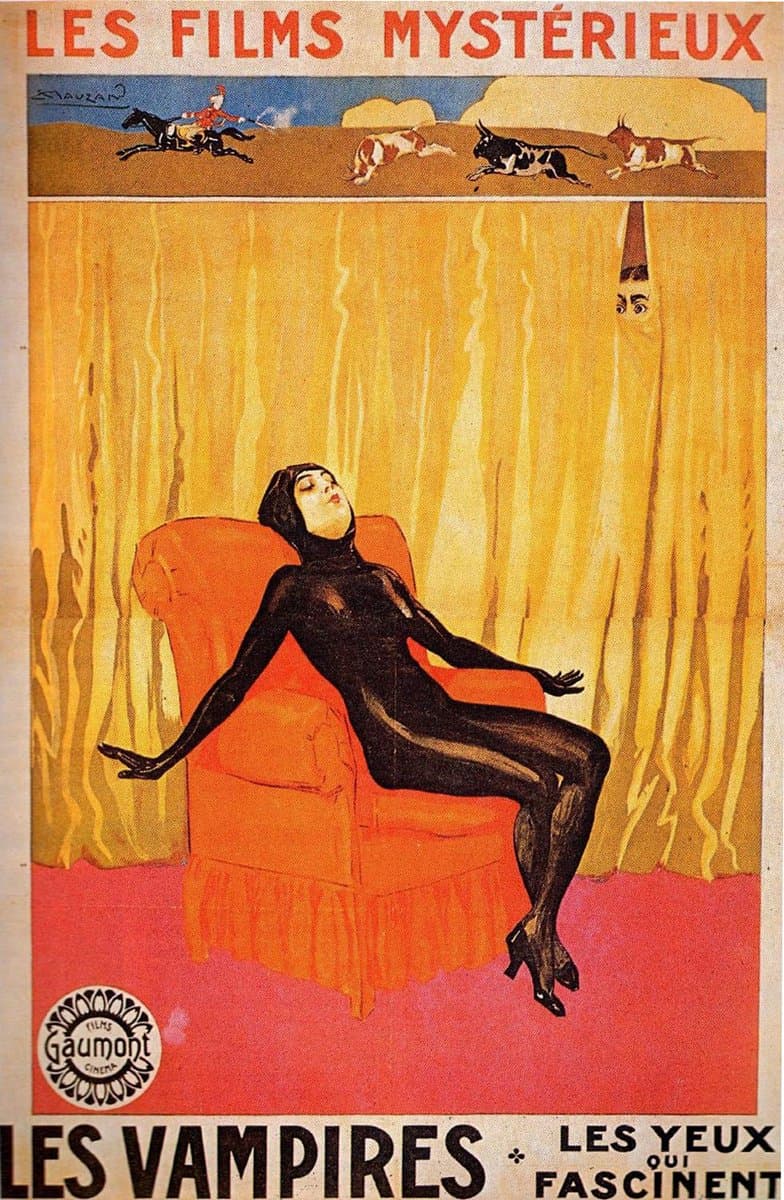
Achille Mauzan's 1916 poster for Les Yeux qui fascinent: Irma Vep in black looming over a hypnotized Philippe Guérande

Artwork reproduction

Film

Les Vampires

1915–16 · Silent serial in ten episodes

Feuillade's ten-episode serial about a criminal secret society loose in wartime Paris — and about Irma Vep, the gang's black-clad lieutenant, played by Musidora in a role the century never got over. Shot fast in real streets emptied by the war, it looks like documentary and moves like a dream, which is exactly why the surrealists claimed it as scripture.

Louis Feuillade, Les Vampires, 1915–16. Image: public domain.

People they knew

Documented connections — every one carries its source.

Illustrated portrait of Musidora

Musidora

  • Actor
  • Filmmaker
  • Author

Mentored · 1914–1918

Her formative screen years were spent under his direction at Gaumont — Les Vampires, then the title role in Judex — and she honored the Feuillade era for the rest of her life, down to her late work preserving its history at the Cinémathèque française.

Anthology Film Archives — Musidora retrospective notes; La Cinémathèque française (Henri) — Les Vampires, notes on the serial

Organizations

Worked for · 1905–1925

Gaumont

Gaumont's artistic director from 1907 — running the studio's production while directing at a pace of hundreds of films, Fantômas and Les Vampires among them, until his death in 1925.

Encyclopaedia Britannica — Louis Feuillade; La Cinémathèque française (Henri) — Les Vampires, notes on the serial

Questions about Louis Feuillade

Who was Louis Feuillade?

A French filmmaker (1873–1925), Gaumont's master of the serial, who directed hundreds of films — the crime serials Fantômas and Les Vampires among them — and turned the real streets of wartime Paris into a landscape of crime.

What is Louis Feuillade best known for?

His silent crime serials, above all Les Vampires (1915–16), whose dreamlike criminal underworld and black-clad villainess made it a landmark of early cinema.

Why did the Surrealists love his films?

Les Vampires played its crime as waking dream, and its cat-suited Irma Vep became an image the Surrealists canonized. Feuillade's serials turned them into filmgoers.

What was his role at Gaumont?

He was Gaumont's artistic director from 1907, running the studio's production while directing at a pace of hundreds of films, until his death in 1925.

How is Feuillade connected to Musidora?

He directed her as Irma Vep in Les Vampires and in the title role of Judex, and mentored her formative screen years at Gaumont. She honored the Feuillade era for the rest of her life.

Sourced claims

Every connection the graph holds for Louis, with the evidence behind it.

Worked for · 1905–1925

Gaumont

Gaumont's artistic director from 1907 — running the studio's production while directing at a pace of hundreds of films, Fantômas and Les Vampires among them, until his death in 1925.

Encyclopaedia Britannica — Louis Feuillade; La Cinémathèque française (Henri) — Les Vampires, notes on the serial

Mentored · 1914–1918

Musidora

Her formative screen years were spent under his direction at Gaumont — Les Vampires, then the title role in Judex — and she honored the Feuillade era for the rest of her life, down to her late work preserving its history at the Cinémathèque française.

Anthology Film Archives — Musidora retrospective notes; La Cinémathèque française (Henri) — Les Vampires, notes on the serial