
Unspoiled Monsters
The long first chapter and the narrator's own history: an orphanage in St Louis, massage and prostitution in New York, a book of stories, and the beginnings of a career spent among people with money. Esquire ran it in May 1976.
Answered Prayers
Truman Capote
Three chapters of the novel Capote never finished, and the magazine instalments that ended his friendships in 1975.
Truman Capote promised this novel for twenty years and never delivered it. Random House published what existed in 1987, three years after his death, as three chapters and a note explaining that the rest was missing.[1] The narrator is P. B. Jones, a young writer who has kept himself by sleeping with people who can help him, and the subject is the rich. Capote had let Esquire print portions of it from 1975, and one instalment retold the confidences of the wealthy women who had befriended him, with the names attached.[2] He lost nearly all of them, permanently, and never recovered the friendships or the book.
The three chapters printed in 1987 are "Unspoiled Monsters", "La Côte Basque" and "Kate McCloud".[1] "Unspoiled Monsters" is much the longest and carries the narrator's own history. P. B. Jones is an orphan who becomes a masseur and a hustler and then a writer, and the chapter follows him through New York and Europe collecting the people he will later sell.
"La Côte Basque" is the short one and the notorious one. Named after the fashionable Manhattan restaurant where rich women lunched, it consists almost entirely of one long lunch, at which a woman tells the narrator a series of true and mostly scandalous stories about people the reader can identify.[2] Esquire ran it in November 1975. That is the chapter that ended Capote's social life.
The Esquire instalments came out over eighteen months. "Mojave" appeared in June 1975, "La Côte Basque" in November 1975, "Unspoiled Monsters" in May 1976 and "Kate McCloud" in December 1976.[3] Capote afterwards withdrew "Mojave" from the novel altogether and printed it as a story in Music for Chameleons in 1980, which is why the 1987 book has three chapters and not four.[3]
Whether more of the novel was ever written is still open. Capote said at various points that he had completed a great deal of it and that the manuscript was in a safe-deposit box, and nothing has been produced. His papers are held at the New York Public Library and the Library of Congress, and no further chapters have come out of either.[4][5]
P. B. Jones, an orphan raised in a Catholic institution in St Louis, makes his way to New York and keeps himself by massage and prostitution while trying to become a writer. "Unspoiled Monsters", the long first chapter, follows him through that apprenticeship and on into Europe.
Jones publishes a book of stories, gets a reputation, and attaches himself to people with money. His path crosses a series of real figures, among them Colette, Jacqueline Kennedy and the Duchess of Windsor.[6]
"La Côte Basque" drops the chronology entirely and gives one lunch in a Manhattan restaurant, at which a rich woman tells Jones a run of scandalous stories about identifiable people.[2]
"Kate McCloud" introduces the woman the novel was apparently going to be built around, a beautiful and much-married figure whom Jones is drawn into serving. The chapter sets up a plot the book never carries out.
There is no ending, because Capote never wrote one. The 1987 volume stops after the third chapter. P. B. Jones is left unresolved, Kate McCloud's story is left unbegun, and the reader is given a note about the missing remainder rather than a conclusion.
Capote claimed at different times to have written much more and to have put it in a safe-deposit box. Nothing further has been found, in his papers at the New York Public Library and the Library of Congress or anywhere else.
"La Côte Basque" is built as a single meal. The narrator sits down with a rich woman in a restaurant on West Fifty-Fifth Street, and she talks. What she says is gossip about named and recognisable people, and it includes stories of infidelity, humiliation and one notably unpleasant episode involving a bedsheet. The structure is the oldest one there is: two people at a table, one of them talking.
The device let Capote publish what he had been told in confidence while appearing to be only the listener. P. B. Jones does not judge the speaker and barely interrupts her, so a reader receives the material directly, as Capote had received it. What the women who had confided in him recognised was not a novel about people like them. It was their own afternoons, in their own words, printed in a magazine with a circulation in the hundreds of thousands.
The consequences were immediate and total. William S. Paley, the head of the Columbia Broadcasting System, and his wife Babe Paley had been among Capote's closest friends, and they never spoke to him again. Others followed them out. Capote had spent fifteen years being the confidant of a small circle of very rich women, and the circle closed in a matter of weeks.
Nine years earlier he had given a masked ball at the Plaza Hotel for five hundred people he described as his very closest friends. The distance between that evening and the autumn of 1975 is the plot of the last third of his life. His drinking and drug use hardened into addiction, he was treated for both in the late 1970s, and the novel he had sacrificed the friendships for was never finished.
P. B. Jones is a writer who gets what he needs from people by going to bed with them, and Capote gave him that trade for a reason. A narrator who has always been paid for intimacy can move through the bedrooms of the rich without the book having to explain how he got there. It also lets Capote say something about himself without saying it directly.
Capote's own position had been much the same in kind if not in currency. He was kept in restaurants and country houses because he was entertaining, and the price of the seat was that he listened. P. B. Jones takes that arrangement and makes it literal. The publisher's own catalogue describes the narrator as moving between poverty and the company of Colette, Jacqueline Kennedy and the Duchess of Windsor. That is a fair summary of the book's method: a nobody at a table full of somebodies, writing it down.
Three chapters do not make a novel, and Random House did not pretend otherwise. The 1987 volume runs to about a hundred and eighty pages and carries the subtitle The Unfinished Novel, so a reader is told at the door that the thing is a fragment. There is no ending, no resolution for P. B. Jones, and no arrangement of the chapters that Capote himself approved.
That changes what the book is for. Read as fiction it is patchy, and "La Côte Basque" is much better than what surrounds it. Read as evidence it is unusually valuable, because it is the only place to see what Capote thought he was doing when he decided that the people who trusted him were material. His papers at the New York Public Library and the Library of Congress hold the working record, and no further chapters have emerged from either collection.
"La Côte Basque", named after the fashionable Manhattan restaurant where such women lunched, told true and mostly scandalous stories about the rich women who had befriended him, with the names attached.
"La Côte Basque" is about thirty pages of one lunch, and publishing it in Esquire in November 1975 ended nearly every friendship Capote had. Few short pieces of American fiction have had a more measurable effect on their author's life.
A narrator who has always been paid for intimacy, written by a man who was kept at other people's tables for being entertaining. The parallel is not hidden and it is not flattering.
Capote promised this novel from the early 1960s and produced three chapters. Reading them is the only way to see what he was actually attempting between In Cold Blood and his death.
A book that names names, was recognised by everybody it described, and produced an exodus that is documented in the obituaries and the oral biography. The gossip is the primary source.
The narrator: an orphan from a St Louis institution who became a masseur, a prostitute and then a writer. He gets his access to the rich by going to bed with people, and his trade is the novel's way of explaining how he is in the room.
The much-married beauty the third chapter introduces and the figure Capote apparently meant to build the novel around. Her story is set up and never told.
The woman who does the talking through the whole of "La Côte Basque". Capote's friends read her as an assembly of the women who had confided in him, which is part of why the chapter caused what it caused.
The long first chapter and the narrator's own history: an orphanage in St Louis, massage and prostitution in New York, a book of stories, and the beginnings of a career spent among people with money. Esquire ran it in May 1976.
One lunch in a Manhattan restaurant, and the chapter that ended Capote's friendships when Esquire published it in November 1975. A rich woman talks; the narrator listens; the people described are recognisable.
The chapter introducing the woman the novel was apparently to be built around. Esquire published it in December 1976, and the story it sets up was never written.
1966
Capote gives a masked ball at the Plaza Hotel in New York for five hundred of his very closest friends, at the height of the In Cold Blood success.
1975
Esquire publishes "Mojave" in June and "La Côte Basque" in November. The second instalment retells the confidences of the rich women who had befriended Capote, and they recognise themselves.
1976
Esquire publishes "Unspoiled Monsters" in May and "Kate McCloud" in December. William S. Paley, Babe Paley and much of Capote's circle have already cut him off.
1980
Capote removes "Mojave" from the novel and prints it as a story in Music for Chameleons.
1984
Capote dies in Los Angeles on 25 August, aged fifty-nine, with the novel unfinished and no further chapters found.
1986
Hamish Hamilton publishes the three surviving chapters in London, the first book edition.
1987
Random House publishes the American edition, at 180 pages, subtitled The Unfinished Novel.
2024
Modern Library reissues it as The Novel That Scandalized Capote's Women.


In Cold Blood
Truman Capote
The book whose success bought Capote the freedom to write this one, which he then could not finish.
Read our takeMusic for Chameleons
Truman Capote
Took "Mojave" out of this novel and printed it as a story, and contains the self-interview in which Capote accounts for the collapse.
Read our takeBreakfast at Tiffany's
Truman Capote
The earlier novel about living on other people's money, written with affection rather than revenge.
Read our takeOther Voices, Other Rooms
Truman Capote
The first novel, and the other book in which Capote wrote his own life with very little disguise.
Read our takeA writer called P. B. Jones, who has kept himself by prostitution, moving among very rich people and recording what they say. The three surviving chapters are "Unspoiled Monsters", "La Côte Basque" and "Kate McCloud". Capote never finished the novel, and Random House published what existed in 1987, three years after his death.
Because Esquire printed "La Côte Basque" in November 1975. The chapter retells, through an invented speaker at a lunch, true and mostly scandalous stories about the wealthy women who had confided in Capote, with the people identifiable. William S. Paley and Babe Paley never spoke to him again and much of his circle followed them.
No. Three chapters exist and there is no ending. The Vintage edition is subtitled The Unfinished Novel. Capote said at various times that he had written a great deal more, and that the manuscript was in a safe-deposit box. Nothing further has been found in his papers at the New York Public Library or the Library of Congress.
Four, between 1975 and 1976: "Mojave" in June 1975, "La Côte Basque" in November 1975, "Unspoiled Monsters" in May 1976 and "Kate McCloud" in December 1976. Capote later withdrew "Mojave" from the novel and printed it in Music for Chameleons, which is why the book has three chapters.
From a saying that more tears are shed over answered prayers than over unanswered ones, usually attributed to Teresa of Ávila. Capote applied it to people who had been given everything they wanted.
The invented woman who does the talking throughout "La Côte Basque". Capote's friends read her as a composite of the women who had confided in him over fifteen years, which is a large part of why the chapter caused what it did.
Read it after In Cold Blood and Breakfast at Tiffany's, and read it for the history rather than the story. As fiction it is uneven and incomplete. As the record of how a writer decided to spend his friends, it is the essential document of Capote's last decade.
Explore authors with a similar voice, perspective, and influence.
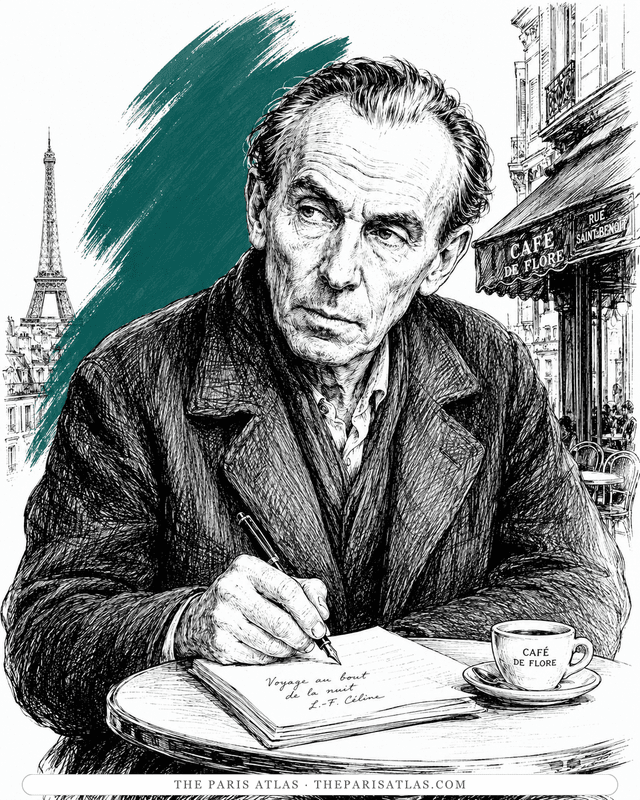
The doctor of the Paris slums who wrote the century's blackest, funniest novel — and changed the sound of French prose.
View author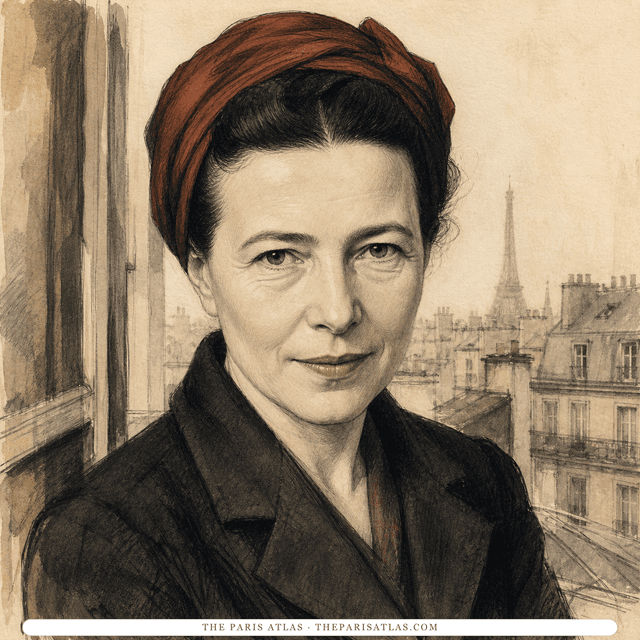
French writer and philosopher whose novels, memoirs, and social analysis examined freedom, gender, responsibility, aging, and the material conditions that shape a life.
View author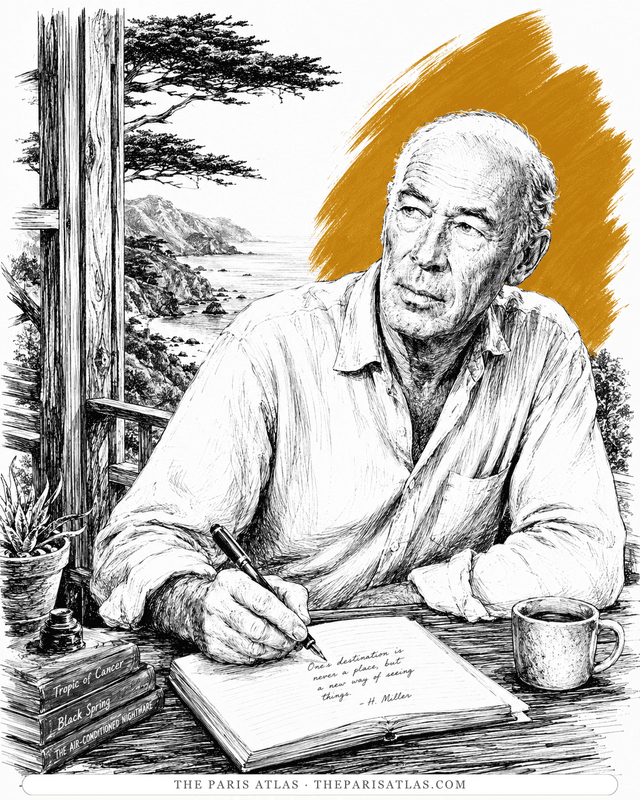
The Brooklyn dropout who arrived in Paris broke at thirty-eight and wrote the exuberant, banned books that ended American censorship.
View authorThe sources below include the primary text, editions, scholarship, archival materials, and other records that informed this page. They document Answered Prayers, its publication, and its place in literary history.

Catalogue and edition records: the Random House first edition of 1987 at LCCN 86010110, the Hamish Hamilton London edition of 1986, and the Vintage International edition subtitled The Unfinished Novel at LCCN 93043496.

Albin Krebs's obituary: the Esquire chapters, the restaurant the notorious chapter is named after, the lost friendships, the 1966 Plaza ball, and the addiction that followed.
The Truman Capote papers at the New York Public Library, one of the two collections holding the working record and containing no further chapters.
The Truman Capote papers at the Library of Congress, the other collection in which the missing remainder has never appeared.
Penguin Random House's catalogue record: P. B. Jones, the figures his path crosses, the magazine serial that betrayed Capote's confidantes, and the Modern Library ISBN and page count.
George Plimpton's oral biography, which collects the accounts of the people who withdrew from Capote after November 1975.
The primary text is the baseline reference for every book page. Additional references document publication history, interpretation, and historical context where that evidence is available.
 Explore more resources