

The Second Sex
Beauvoir's thousand-page 1949 argument that femininity is made and not born — the founding book of second-wave feminism and the century's most influential work of feminist philosophy.
Read our take
Beauvoir's late short novel about a Paris advertising executive and the polished consumer world that has trained her, her family, and her ten-year-old daughter to see other people's suffering as a stain to be removed from the picture.
Simone de Beauvoir's Les Belles Images (1966) is her sharpest short novel about postwar French consumer capitalism. Laurence, thirty-two, works in a Paris advertising agency; her husband Jean-Charles is an urban planner in a private practice; her father is a well-known writer; her mother is Dominique, a former Radio Luxembourg journalist newly discarded by her long-term lover; her ten-year-old daughter Catherine is starting to ask questions about poverty and suffering that the adults around her would prefer she stopped asking. The novel is short (about a hundred and eighty pages), set entirely in an affluent Paris and one summer holiday on Sardinia, and it is Beauvoir's most direct attack on the polished world of consumer surfaces the France of the mid-1960s had built for itself.
Beauvoir wrote Les Belles Images in 1964 and 1965, and Gallimard published it in Paris in October 1966. Patrick O'Brian's English translation appeared under the untranslated French title from Collins in London in 1968 and from G.P. Putnam's Sons in New York the same year. The book was Beauvoir's first novel in twelve years — since The Mandarins in 1954 — and it marked a change of direction: shorter, sharper, contemporary, and unmoored from the postwar-left milieu of her earlier fiction. The last three books she would publish in her lifetime (this one, The Woman Destroyed in 1967, and The Coming of Age in 1970) are the most compact and, in many ways, the most modern of her writing.
The book is Beauvoir's most sustained portrait of the French consumer capitalism of the mid-1960s — the world of the polished apartment, the second house, the discreetly kept lover, the Ministry of Culture salary and the advertising-agency salary and the technical consultancy salary that keep Laurence's circle above the waterline. Its title comes from the advertising slogan Laurence's agency has assigned itself and it invokes: 'belles images' — beautiful pictures — is what the agency produces and, by extension, what Laurence's family life is expected to look like. The novel is not against images. It is about what images are for.
It is also the piece of Beauvoir's fiction closest to what Marguerite Duras was writing on the same street at the same time. The prose is short-paragraphed, present-tense, close to Laurence's own consciousness, and organised by silence as much as by scene. Duras and Beauvoir did not much like each other's work; the closeness of Les Belles Images to Le Ravissement de Lol V. Stein (1964), which Duras had published two years earlier, is a coincidence of the moment rather than of an influence — but it is a real coincidence, and it puts Beauvoir's late fiction in the company it belongs in.
The novel opens on a spring evening in Paris. Laurence is on the balcony of her mother Dominique's flat — Dominique is fifty-eight, still handsome, still a name from her radio-journalism days, and freshly returned to Paris from a Sardinian holiday with her long-term lover Gilbert. Laurence's father is there, with his much younger companion Marthe; Laurence's husband Jean-Charles is there; the guests are talking about the new highways being cut through the outskirts of Paris and the summer house Dominique and Gilbert are thinking of buying in Corsica. The conversation is polished; the topics are polished; the wine and the platter of hors d'œuvres and the balcony view are polished. Laurence, thirty-two, an advertising creative in an agency that has just landed a new campaign, listens. She has been listening to this surface for years. She is beginning, in ways she cannot yet name, to be dissatisfied with it.
The middle section follows Laurence through the spring and summer. She has an affair with an older man named Lucien who is her physical opposite of Jean-Charles; the affair is a way of feeling something without particularly wanting more of it. Dominique, meanwhile, is discarded by Gilbert for a much younger woman named Patricia. Dominique's response is a slow-motion collapse: the discarded fifty-eight-year-old woman of Beauvoir's Second Sex analysis, made specific in one apartment in Paris. Laurence takes in her mother's situation with a mixture of horror, professional compassion, and a fear she cannot quite acknowledge — that she is looking at what she herself will be in twenty-six years unless she does something differently now. Meanwhile Catherine, at ten, comes home from school with more and more questions: about famine, about war in Vietnam, about the daughter of the concierge whose family is being evicted. Jean-Charles wants Catherine seen by a child psychiatrist; the questions are, he says, unhealthy.
The last third of the novel is the summer in Sardinia, the return to Paris, and Catherine's crisis. On the beach, Laurence tries to talk to Catherine about the things that have been troubling her; the conversation goes better than Laurence expected. Back in Paris, though, Jean-Charles has arranged an appointment with a well-known child psychiatrist. Laurence walks into her father's flat and asks him for advice. Her father — a man of the postwar left — tells her that she must let Catherine keep her questions; the disturbing thing about the world is that the world is disturbing, and there is no cure that is not a form of anaesthetic. Laurence walks home in the rain and cancels the appointment. The novel's last chapter is Laurence's decision: she will not send Catherine to be silenced.
The last twenty pages are Laurence's decision. Catherine has been given a course of tranquillisers by Jean-Charles's chosen doctor to help her sleep; she is stopping asking the questions. Laurence, sitting up alone one night, understands that she has come to the moment her mother's whole life had led her to — the moment where you either accept the polished picture or refuse it. She goes to her father's flat and asks him what to do. Her father tells her that Catherine's questions were the healthy thing, not the illness, and that the tranquillisers are what will make her ill. Laurence returns home, throws out the pills, and tells Jean-Charles that the psychiatric course is over. She will take Catherine out of the doctor's care. Whatever Catherine sees in the world, Laurence writes at the end, Catherine is entitled to see, and the adults around her are not entitled to make her stop seeing.
The last sentence closes on the image the whole novel has been circling: Laurence, standing at Catherine's bedroom door, watching her daughter sleeping, refusing the beautiful picture the world is offering her in exchange for her daughter's honest fear. It is a small ending compared with the Prix Goncourt sweep of The Mandarins twelve years earlier. But it is the sharpest of Beauvoir's endings and the one closest to what her fiction had, all along, been trying to say. Les Belles Images is a book about a woman refusing to sell her daughter a picture of the world.
The opening gathering already resembles a magazine spread, and Laurence imagines its compliments being repeated in another garden. What looks like distinctive taste becomes a reproducible social performance. Her job selling wood panelling belongs to this same traffic between possessions and desirable lives: the product promises a setting in which its buyer can appear successful. Beauvoir lets Laurence's private questions interrupt the smooth conversation, making the distance between a persuasive image and a satisfying experience audible before it becomes an explicit argument.
Catherine first appears reading by the fireplace, apparently the picture of a contented child. Yet Louise has heard her crying at night. Laurence runs through reasons to expect happiness: school, friendship, health and home. The list cannot explain the tears. This small interruption exposes the limits of judging an inner life by its reassuring surroundings. Read beside the bedtime illustration, it asks a different question from how to restore the family's good appearance: what has the mother not yet understood about her daughter?
It is Beauvoir's sharpest short novel about consumer culture, respectable family life, and the stories prosperity tells about itself.
Read it after The Second Sex to see social roles operating through ordinary work and family conversation rather than a general historical argument.
Beauvoir's late novel of Parisian consumer capitalism and its casualties — the closest her fiction ever came to a book by her friend Marguerite Duras, and the sharpest of her novels about the women it condemned to comfort.

The novel's centre. Thirty-two, an advertising creative in a Paris agency, married to Jean-Charles, mother of two daughters (Catherine, ten, and Louise, five). Grows dissatisfied with the polished surface of her Paris circle across the spring and summer of the novel; the book's crisis is her decision about Catherine.
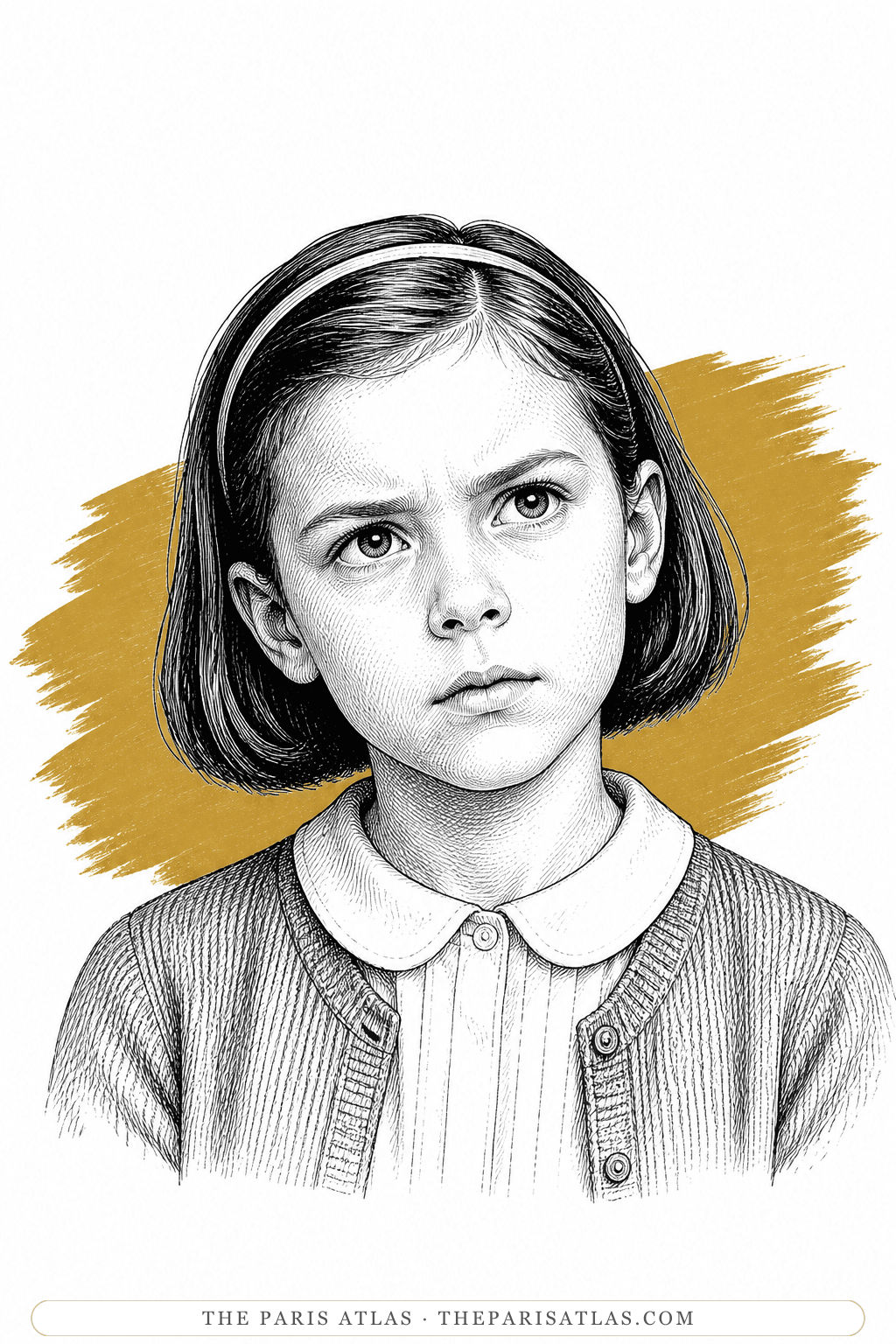
Laurence and Jean-Charles's ten-year-old daughter. At school she has heard about famine in North Africa, war in Vietnam, and a friend's family being evicted; the questions she has been asking about them are what the adults around her want stopped.

Laurence's mother. Fifty-eight, a former Radio Luxembourg journalist. Discarded by her long-term lover Gilbert for a younger woman named Patricia over the course of the novel. Her collapse is the specific case of the Second Sex analysis of the discarded middle-aged woman.

Laurence's husband. An urban planner in a private practice, working on the new roads and housing developments being built around the periphery of Paris. Wants Catherine's questions silenced by a child psychiatrist.

Unnamed. A well-known writer of the postwar Paris left. Divorced from Dominique for years, now with a younger woman named Marthe. Advises Laurence, in the novel's crisis scene, that Catherine's disturbing questions were the healthy thing rather than the illness.

Laurence's lover. Older than her, physically Jean-Charles's opposite. The affair does not survive the novel and is one of the polished pictures the novel is undoing.

Dominique's long-term lover. A wealthy older man who leaves her for the younger Patricia during the novel and is the visible cause of Dominique's collapse.
1964–1965
Beauvoir writes Les Belles Images at her studio on the rue Victor Schoelcher in Paris.
October 1966
Gallimard publishes Les Belles Images in Paris, Beauvoir's first novel in twelve years.
1967
Beauvoir publishes La Femme rompue (The Woman Destroyed), the story collection that continues the same analysis.
1968
Patrick O'Brian's English translation of Les Belles Images appears from Collins in London and from G.P. Putnam's Sons in New York.
1970
Beauvoir publishes The Coming of Age (La Vieillesse), the philosophical volume the late fiction had prepared the ground for.
Modern editions
Éditions Gallimard reprint Les Belles Images in the Folio paperback series; HarperPerennial keeps the O'Brian translation in print in the United States.

Beauvoir's thousand-page 1949 argument that femininity is made and not born — the founding book of second-wave feminism and the century's most influential work of feminist philosophy.
Read our take
Three long stories of middle-aged women whose lives are coming apart — Beauvoir at her most Chekhovian, in the fiction that best carries the analysis of women's mid-life she had made in The Second Sex twenty years before.
Read our takeA short 1966 novel about Laurence, a Paris advertising executive in her early thirties, and the polished consumer world that has trained her, her family, and her ten-year-old daughter to see other people's suffering as a stain to be removed from the picture. When her daughter Catherine's questions about famine and war become too troubling for the adults, Laurence has to decide whether to let her daughter keep asking.
Gallimard published Les Belles Images in Paris in October 1966. Patrick O'Brian's English translation appeared under the untranslated French title from Collins in London and from G.P. Putnam's Sons in New York in 1968. It was Beauvoir's first novel in twelve years, since The Mandarins in 1954.
'Belles images' means 'beautiful pictures' or 'pretty images.' It is the advertising slogan Laurence's agency has assigned itself in the novel and, by extension, the polished surface of the affluent Paris circle Laurence lives in — the second house on Sardinia, the discreetly kept lover, the well-arranged dinner conversation. The novel is about what such pictures are for.
Laurence, having watched her ten-year-old daughter Catherine become disturbed by the world's suffering and having watched her husband arrange a course of tranquillisers to make Catherine stop asking questions about it, decides to cancel the psychiatric appointment and take Catherine out of the doctor's care. The novel closes with Laurence at Catherine's bedroom door, watching her sleep, having refused the beautiful picture the world was offering in exchange for her daughter's honest fear.
The novel makes specific two of the arguments The Second Sex had made in 1949: the situation of the middle-aged woman discarded for a younger one (Dominique's plot) and the situation of the professional woman balancing work, marriage, and the small daily compromises that shape a life (Laurence's plot). It is Beauvoir's argument in fiction seventeen years after the philosophical case had been made.
It is the piece of Beauvoir's fiction closest to what Duras was writing on the same street at the same time. Duras had published Le Ravissement de Lol V. Stein in 1964; the two writers did not much like each other's work; the closeness of Les Belles Images to Duras's mid-1960s novels is a coincidence of the moment rather than of an influence — but it is a real coincidence, and it puts Beauvoir's late fiction in the company it belongs in.
Explore authors with a similar voice, perspective, and influence.

Both French writers used novels, essays, journalism, and public argument to ask how freedom and responsibility operate without a fixed moral system.
View author
The Brooklyn dropout who arrived in Paris broke at thirty-eight and wrote the exuberant, banned books that ended American censorship.
View author
The doctor of the Paris slums who wrote the century's blackest, funniest novel — and changed the sound of French prose.
View authorThe sources below include the primary text, editions, scholarship, archival materials, and other records that informed this page. They document Les Belles Images, its publication, and its place in literary history.


The opening of Les Belles Images in Lauren Elkin's 2025 translation, The Image of Her; used for passage-specific analysis, not for a new account of the ending or the complete advertising episode.

Library catalogue record used to verify the 1985 Flamingo Modern Classics edition, ISBN, format, pagination, and Patrick O'Brian association.
Used to place Les Belles Images within Simone de Beauvoir's published work and verify its bibliographic context.
Used for independent biographical, archival, or historical context surrounding Simone de Beauvoir's career and the period in which Les Belles Images appeared.
Used to cross-check authorship, chronology, and the work's place in Simone de Beauvoir's wider catalogue.
Used to verify Simone de Beauvoir's bibliography and place Les Belles Images within the broader chronology of Simone de Beauvoir's career.
The primary text is the baseline reference for every book page. Additional references document publication history, interpretation, and historical context where that evidence is available.
 Explore more resources