Three long stories of middle-aged women whose lives are coming apart — Beauvoir at her most Chekhovian, in the fiction that best carries the analysis of women's mid-life she had made in The Second Sex twenty years before.
Simone de Beauvoir's La Femme rompue (1967) collects three long stories about women whose established identities are collapsing. In 'The Age of Discretion,' a sixty-year-old writer and academic watches her lifelong intellectual partnership with her husband weaken as they disagree over their adult son's career. In 'The Monologue,' the divorced Murielle spends a New Year's Eve alone screaming into her tape recorder about the daughter, the ex-husband, and the son who have all left. In 'The Woman Destroyed,' Monique's diary of six months of 1963 records her attempt to understand her husband's affair with a younger woman, and the years in which she had made his life the measure of her own. Together they form Beauvoir's most Chekhovian fiction — the mid-life material she had analysed twenty years earlier in The Second Sex, this time carried through three specific voices.
The story, in more detail
Beauvoir wrote La Femme rompue between the spring of 1966 and the summer of 1967. Gallimard published it in Paris in October 1967, three years before The Coming of Age would apply the same analysis to a wider population. Patrick O'Brian's English translation, The Woman Destroyed, appeared from Collins in London in 1968 and from G.P. Putnam's Sons in New York in 1969. The book was heavily illustrated in some French editions with drawings by Beauvoir's sister Hélène de Beauvoir — one of the few times the two sisters worked together on a book.
Each of the three stories is written from inside a woman's own head, but Beauvoir varies the technique for each: 'The Age of Discretion' is a third-person interior narration close to the protagonist's consciousness; 'The Monologue' is exactly what its title says — Murielle speaking aloud to her tape recorder on New Year's Eve, no other voice present, sixty pages of her fury; 'The Woman Destroyed' is a diary. The variation is deliberate: Beauvoir is asking, three times in three forms, what a first-person narrator can and cannot see about her own life. Each of the three narrators is intelligent and each is limited, and the gap between what she says and what the reader can see is the argument.
Beauvoir told her memoir readers, in All Said and Done (1972), that the reception of the book had puzzled her. Many readers she respected wrote to say that the third story — the diary — had described their own life exactly, whether they were nearing sixty or nowhere near it. Others wrote that she had betrayed her feminism by writing about women who had made a man's life the measure of their own without stepping outside that measure to condemn it. The Woman Destroyed is a book that insists on staying inside a limited voice rather than lecturing the reader from above it — a decision The Second Sex had refused to make, and the piece of Beauvoir's fiction that carries the strongest counter-argument to her own analytical style.
The full plot
What happens, beginning to end — the ending included. Open when you're ready.
'The Age of Discretion' opens on a summer morning. The sixty-year-old narrator, whose name Beauvoir withholds, wakes up beside her husband André and thinks the same thought she has been thinking for weeks: they are both getting old. André, an atomic physicist whom the state has just forced into early retirement, spends longer over breakfast than he used to; their adult son Philippe has taken a job at the Ministry of Culture (an office the parents both consider a betrayal of everything Philippe once believed) and is drifting further from them. Over the summer the narrator finishes her new book and, when André reads it, he tells her honestly that it repeats her earlier work. The rest of the story is the summer holiday, the arguments with Philippe, the narrator's slow recognition that the intellectual partnership she and André had built now includes a form of disappointment on both sides, and her decision — the story's calm last paragraph — to keep working anyway.
'The Monologue' takes place across the New Year's Eve of an unspecified year. Murielle, divorced, forty-three, spends the whole night alone in her flat with a tape recorder. Her husband Tristan left her and remarried; their daughter Sylvie, whom Murielle blames Tristan for turning against her, killed herself; their son Francis has been living with Tristan and the second wife since the separation. Murielle's speech, into the recorder, is her account of what happened. The reader receives all of it in her voice — no third-person correction, no witness — and has to work out how much of what she says is true, how much of the isolation she describes is inflicted on her by others and how much is her own creation, and what she is trying to convince the recording of. The story ends at dawn, with Murielle drunk on champagne and demanding that Francis be sent back to her for the New Year.
'The Woman Destroyed' is the diary of Monique, forty-three, married for twenty-two years to Maurice, a successful Paris doctor. The diary begins on 13 September 1963. Monique has been on holiday alone in the Vercors mountains while Maurice worked in Paris; when she comes home, Maurice tells her he is in love with Noëllie Guérard, a lawyer in her early thirties. Monique's first response is that she can wait him out — Noëllie is a passing infatuation. Six months later the entries have moved from certainty to bewilderment to increasingly desperate self-examination: had she been paying attention? Had she made Maurice's career the shape of her whole adult life without knowing what she was doing? Had Noëllie been in the picture for years? The diary tracks Monique's decision to spend two weeks with her married daughter Colette in New York while Maurice and Noëllie decide what they are; the last entry is the plane journey home and Monique's arrival at an empty Paris apartment. She writes: 'I open the door. The apartment is empty. I am afraid.' The diary ends.
How it ends — spoilers aheadThe final movement, ending included. Open when you're ready.
Each of the three stories ends on a specific unresolved image. 'The Age of Discretion' closes with the narrator deciding to keep working — the summer's arguments have not resolved but they have not broken the couple either, and the narrator has accepted that some part of her intellectual life will now be conducted alongside a disappointment she did not have twenty years ago. 'The Monologue' closes with Murielle demanding, into her tape recorder, that Francis be sent back to her. Whether Francis comes is not the story's question. 'The Woman Destroyed' — the collection's title story — closes on Monique's line ('I open the door. The apartment is empty. I am afraid'). Whether Maurice comes back is not resolved.
The three stories together are Beauvoir's most sustained argument for what a first-person narrator can do that a third-person analytical voice cannot. The narrators of The Age of Discretion, The Monologue, and The Woman Destroyed cannot each see, from inside her own head, what the reader can see from outside it. The Second Sex had explained the whole structure. La Femme rompue lets three people who are inside the structure speak, one at a time, without narrative correction. Beauvoir told her memoir readers, in All Said and Done, that the reception of the book had puzzled her: many readers who wrote to her had read the third story and recognised their own lives; others had objected that a feminist should have written about women who saw the situation differently. She stood by the book. It is the piece of her fiction that carries the strongest counter-argument to her own analytical style.
Themes and analysis
These readings discuss events throughout the book, including its ending.
A changing Paris
From the balcony, the narrator can count new cranes but cannot recover a clear image of the city before them. Her wish for comparison photographs gives way almost immediately to the admission that she has already grown used to the changes. The same movement appears in her view of André: even photographs of his younger face seem to conform to the man she knows now. Paris is more than a backdrop to ageing here. The changing skyline exposes how familiarity can absorb alterations so thoroughly that continuity feels certain even when its evidence is unstable.
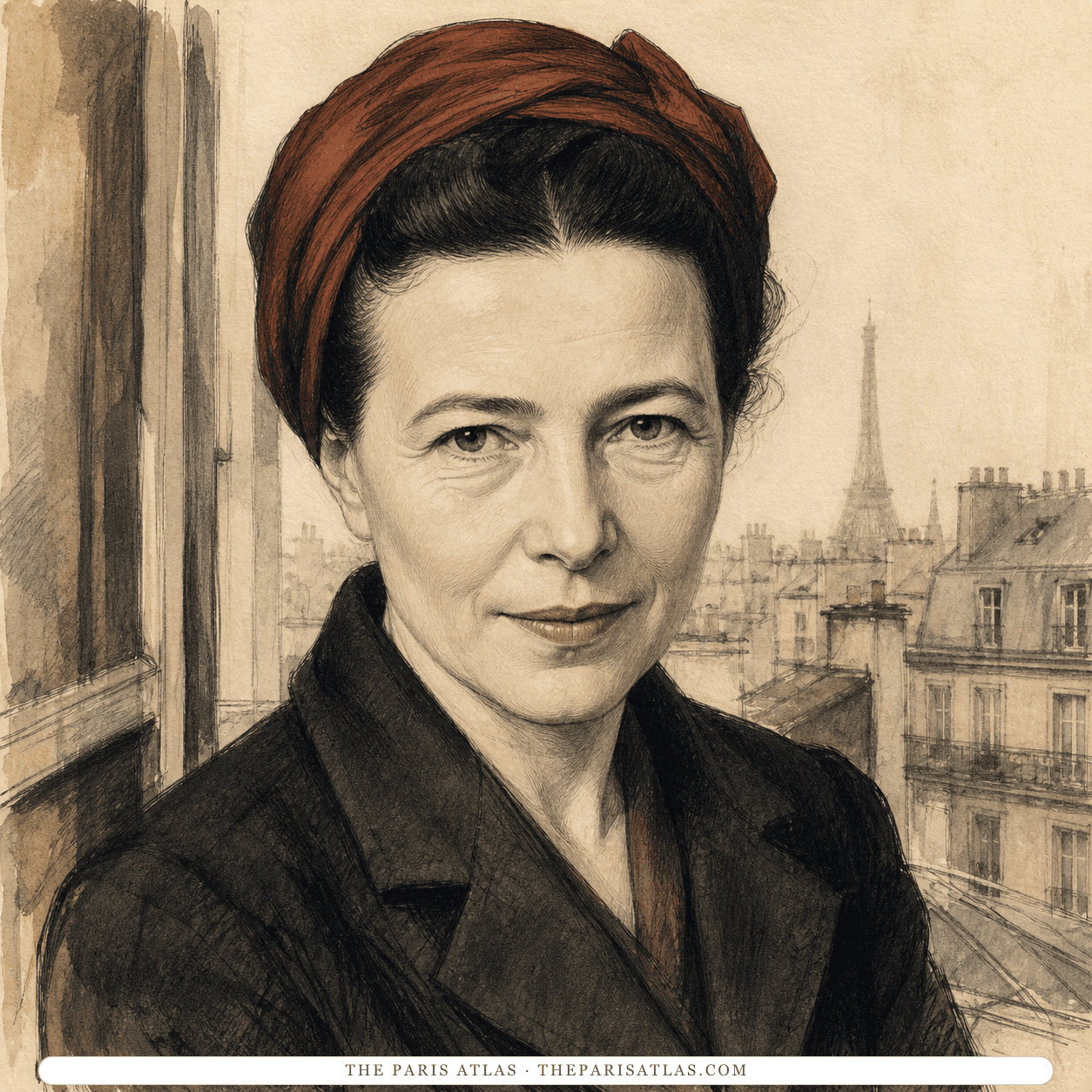
From her sixth-floor balcony, the narrator watches a Paris of old roofs and new construction. An imagined scene from “The Age of Discretion” in The Woman Destroyed. (Illustration — The Paris Atlas)
The clothes he leaves behind
The diary's sequence makes the wardrobe scene more than an isolated outburst. On 30 September, Monique thinks she might stop writing because she now understands her situation; by 2 October, the sight of Maurice's clothes brings a pain that her earlier reasoning had held away. Familiar garments prompt images of another woman's intimacy with him. No new confession is needed for the betrayal to become newly felt. The entries record a gap between explaining an affair to oneself and enduring what that explanation means in the ordinary textures of a shared life.
Monique opens Maurice’s wardrobe and begins to cry at the sight of his clothes. An imagined scene from the 2 October diary entry in The Woman Destroyed. (Illustration — The Paris Atlas)
Why we recommend it
1
Why it matters
Its three voices show how first-person honesty can coexist with self-deception.
2
Where it fits
It is a good shorter entry after Les Belles Images and before Beauvoir's nonfiction study of old age.
3
What lingers
Three long stories of middle-aged women whose lives are coming apart — Beauvoir at her most Chekhovian, and the fiction that best carries the analysis of women's mid-life she had made in The Second Sex twenty years before.
The three stories are Beauvoir's fiction, not roman à clef; none of the characters is drawn from a specific person in her life. Each story is inside one central voice, and each voice sees only what she can see. The names below are the principal figures in each of the three stories.
The narrator of 'The Age of Discretion'
Unnamed. Sixty. A retired writer and literature professor. Married thirty-five years to André, an atomic physicist. Mother of Philippe. Watches the intellectual partnership she and André had built weaken over a summer.
Murielle
The narrator of 'The Monologue.' Forty-three, divorced from Tristan (who has remarried), mother of Sylvie (who killed herself) and Francis (who now lives with his father). Speaks the whole story into a tape recorder on New Year's Eve alone in her flat.
Monique
The narrator of 'The Woman Destroyed.' Forty-three, married twenty-two years to Maurice, mother of two grown daughters. Keeps a six-month diary from September 1963 to March 1964 as she tries to understand her husband's affair with Noëllie Guérard.
Also in the book
André
The narrator's husband in 'The Age of Discretion.' Atomic physicist, recently forced into early retirement by the state. Reads the narrator's new book and tells her honestly that it repeats her earlier work.
Philippe
The narrator and André's adult son. Has just taken a job at the Ministry of Culture that both parents consider a sell-out. The catalyst for the summer's arguments.
Maurice
Monique's husband in 'The Woman Destroyed.' A successful Paris doctor. Announces at the start of the story that he is in love with the lawyer Noëllie Guérard and spends the six months of Monique's diary trying to decide what to do.
Noëllie Guérard
The younger woman Maurice is in love with in 'The Woman Destroyed.' A lawyer in her early thirties. She and Monique do not meet in the story; Monique's account of her is entirely reconstructed from what Maurice reports.
Bring it to book club
Each of the three stories is inside a single voice with no narrative correction. Read one of them and try to describe what the reader sees that the narrator does not. Where in the text does Beauvoir open that gap?
The title story is Monique's diary. Six months in, Monique writes that she is no longer sure whether the woman she saw when she looked in the mirror on the first page was the same woman she is now. Is she the same person? What is Beauvoir saying about who a diary belongs to?
Beauvoir told her memoir readers that many readers wrote saying 'The Woman Destroyed' described their own lives. Others objected that a feminist should have written about women who saw the situation differently. Was she right to stay inside Monique's voice?
Compare the ending of 'The Woman Destroyed' with the ending of She Came to Stay (1943) and the ending of The Mandarins (1954). Three women, three books, each alone at the end. What has changed for Beauvoir across twenty-four years?
A complete discussion guide is on our editorial calendar. Join the letter to hear when it ships.
Timeline
Spring 1966 – Summer 1967
Beauvoir writes La Femme rompue at her studio on the rue Victor Schoelcher in Paris.
October 1967
Gallimard publishes La Femme rompue in Paris, with illustrations by Hélène de Beauvoir.
1968
Patrick O'Brian's English translation, The Woman Destroyed, appears from Collins in London.
1969
The English translation appears from G.P. Putnam's Sons in New York.
1970
Beauvoir publishes The Coming of Age (La Vieillesse), the philosophical study of the mid-life and old-age situations The Woman Destroyed had staged in fiction.
1972
All Said and Done (Tout compte fait), the fourth and last memoir volume, discusses the reception of The Woman Destroyed at length.
Modern editions
Éditions Gallimard reprint La Femme rompue in the Folio paperback series; HarperPerennial keeps the English translation in print in the United States.
Book editions
Paperback
Paperback
French
Gallimard
·
1967
Original French publication as La Femme rompue. English editions use the translated title shown on this page.
Paperback
Harper Perennial
·
2006
ISBN-13
9780007204656
Translated by
Patrick O'Brian
Harper Perennial Modern Classics edition of the three-story collection; 220 pages.
Beauvoir's late short novel about a Paris advertising executive and the polished consumer world that has trained her, her family, and her ten-year-old daughter to see other people's suffering as a stain to be removed from the picture.
Beauvoir's six-hundred-page 1970 study of old age — the companion volume to The Second Sex, arguing that Western societies treat their elderly as a scandal to be hidden and that this is a decision, not a fact.
What is The Woman Destroyed by Simone de Beauvoir about?
A 1967 collection of three long stories about women whose established identities are collapsing. 'The Age of Discretion' follows a sixty-year-old writer whose intellectual partnership with her husband weakens over a summer. 'The Monologue' gives one woman's angry New Year's Eve tape recording to herself. 'The Woman Destroyed' is a six-month diary of a wife discovering her husband's affair.
When was The Woman Destroyed published?
Gallimard published La Femme rompue in Paris in October 1967. Patrick O'Brian's English translation, The Woman Destroyed, appeared from Collins in London in 1968 and from G.P. Putnam's Sons in New York in 1969. The first French edition was illustrated with drawings by Beauvoir's sister Hélène de Beauvoir.
How is The Woman Destroyed structured?
Three long stories of roughly seventy, sixty, and one-hundred-and-twenty pages each. Beauvoir varies the technique for each story: 'The Age of Discretion' is a third-person interior narration close to the protagonist's consciousness; 'The Monologue' is exactly what its title says — Murielle speaking aloud to her tape recorder on New Year's Eve; 'The Woman Destroyed' is Monique's diary.
How does The Woman Destroyed relate to The Second Sex?
The three stories carry into fiction the analysis of women's mid-life Beauvoir had made in the last section of The Second Sex twenty years earlier — women who had made a man's career or a household or a maternal role the shape of their whole adult life, and who no longer have that role to organise themselves around. The Second Sex explains the structure. The Woman Destroyed lets three women who are inside it speak, one at a time, without narrative correction.
How does The Woman Destroyed end?
Each of the three stories has its own ending. 'The Age of Discretion' closes with the narrator deciding to keep working. 'The Monologue' closes with Murielle demanding into her tape recorder that her son Francis be sent back to her. 'The Woman Destroyed' closes on Monique returning from a two-week trip to New York to her empty Paris apartment: 'I open the door. The apartment is empty. I am afraid.'
Was Monique's diary written by Beauvoir from experience?
No — the story is Beauvoir's fiction, not a roman à clef. Beauvoir told her memoir readers in All Said and Done (1972) that many readers had written to her saying the third story had described their own lives exactly. She had not written it from her own marriage; her partnership with Sartre never took the shape Monique's has. She was working from the shape of the situation, not from a specific case.
If you like Simone de Beauvoir
Explore authors with a similar voice, perspective, and influence.
Albert Camus
Both French writers used novels, essays, journalism, and public argument to ask how freedom and responsibility operate without a fixed moral system.
The sources below include the primary text, editions, scholarship, archival materials, and other records that informed this page. They document The Woman Destroyed, its publication, and its place in literary history.
The bookseller's bibliographic record verifies the Harper Perennial paperback edition, publication date, ISBN, English language, page count, and 1969 translation lineage.
Used for independent biographical, archival, or historical context surrounding Simone de Beauvoir's career and the period in which The Woman Destroyed appeared.
7The Woman Destroyed — The Age of Discretion, publisher's opening excerpt
Website
Pantheon / Penguin Random House; translated by Patrick O'Brian, 1987
Used for
Primary opening of The Age of Discretion in Patrick O'Brian's translation, used for the balcony, changing skyline and photograph comparison; not a full collection reading.
Lunwerg / Planeta; translated by Dolores Sierra and Neus Sánchez, 2020
Used for
Publisher's Spanish sample, diary entries 30 September–2 October, pp. 32–33, used for Monique's declared clarity and subsequent wardrobe distress. This passage was not collated against the French or English editions.
The primary text is the baseline reference for every book page. Additional references document publication history, interpretation, and historical context where that evidence is available.








 View source