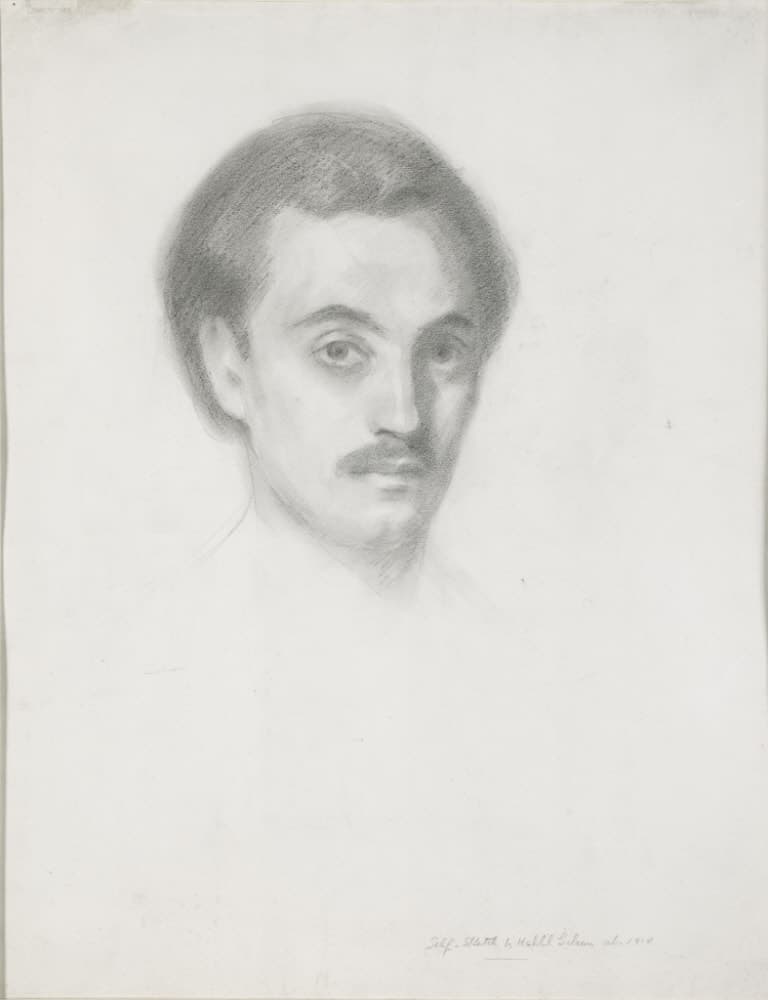
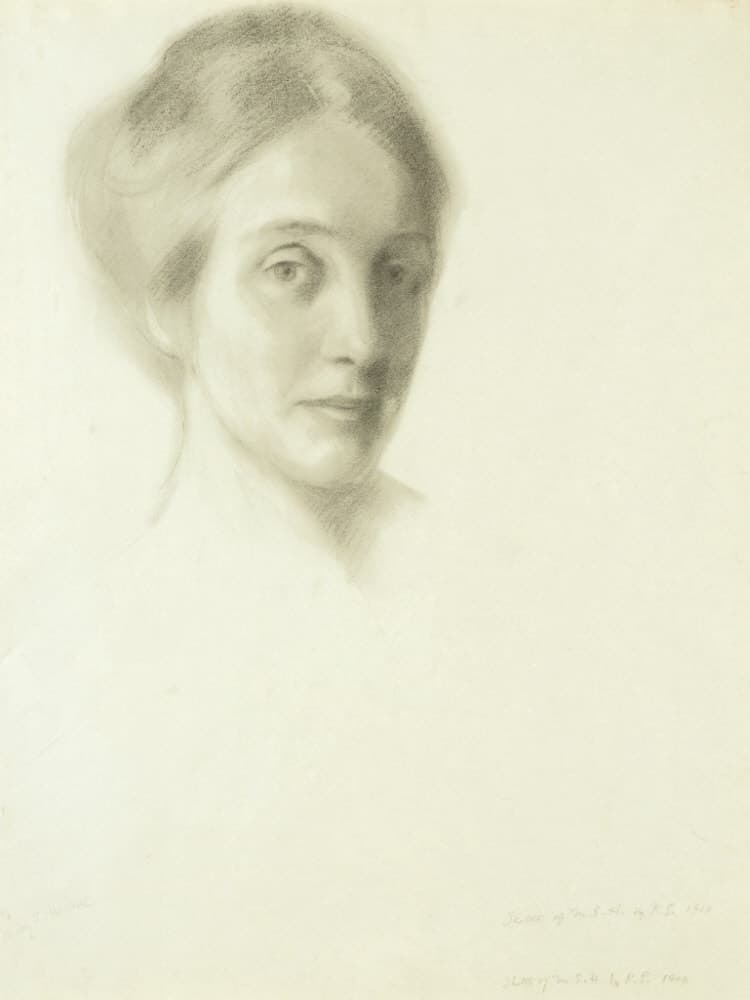
A pencil head of the artist at twenty-seven, looking out of the sheet, drawn in 1910 — the year Kahlil Gibran left Paris after two years of study paid for by Mary Haskell. The sheet is one half of a pair at Telfair Museums in Savannah: its companion, numbered 1950.8.94.b, is his portrait of Mary Haskell.
A young man's head and neck, turned very slightly, with the eyes looking straight out. The eye on the viewer's left is fully worked: iris, pupil, a highlight, the lids and a few lashes. The other eye sits in the shaded side of the face and its iris is only suggested, which tips the whole head towards the light without any background being drawn.
The brows are dark and heavy. The nose is modelled by leaving its left side white, and a soft moustache covers the upper lip, with a firm dark line between the closed lips beneath it.
The hair is the densest part of the drawing: a thick curving mass of parallel diagonal strokes, arcing down over the temple, with bare paper showing through at the crown.
Below the jaw the drawing thins to outline. Two contour lines carry the neck, a single faint line runs out to the left for a shoulder, and no collar or shirt is drawn at all. The lower half of the sheet is empty paper.
The writing on the sheet
A line of pencil writing runs across the lower right of the sheet, underlined: "Self-Sketch by Kahlil Gibran ab. 1910". It is written in the third person, so it is not a signature. The abbreviation "ab." stands for about, which makes the date on the sheet an estimate by whoever wrote it.
Telfair Museums catalogues the drawing as 1910 without qualification. The companion sheet carries the initials of Mary Haskell in the same manner, and her name is written faintly at its lower left, which points to her as the annotator of both.
1910, and what he was doing in it
Kahlil Gibran spent the year in Europe, chiefly in Paris. Mary Haskell had sent him there in July 1908, and he worked first at the Académie Julian, in the atelier of Jean-Paul Laurens, then from early 1909 in the studio of Pierre Marcel-Béronneau. He was back in the United States by 1911.
The drawing's date does not fix the city. Neither the sheet nor the museum record says where it was made, and 1910 is the year the Paris studies ended, so no place is claimed for it here.
What the year does fix is the moment: the end of the training. He had drawn from the model for two years, and had begun the series of pencil portraits of famous sitters that he called the Temple of Art in December 1909.
The sheet and its pair
Telfair Museums numbers the drawing 1950.8.94.a and its companion 1950.8.94.b, the two halves of one accession. Both are dated 1910 and both are pencil on wove paper. The second is the portrait of Mary Haskell.
Both came from her. Mary Haskell Minis gave Telfair Museums nearly a hundred works by Kahlil Gibran in 1950, and the museum's collection now counts five oils and ninety-two works on paper, the largest holding of his art in the United States.
Close reading
Reading the work, detail by detail
Kahlil Gibran drew himself at twenty-seven on a large sheet and used only the top half of it. The head is finished; the neck is outline; the shirt is not there at all. The close views take the lit side of the face, the hair, and the line of pencil writing that somebody else added at the foot of the sheet.
1.One eye is finished, the other is not
The eye on the viewer's left carries a full iris, a pupil, a highlight, both lids and a few lashes. The eye on the other side sits in the shaded half of the face and its iris is only suggested. Nothing in the background explains the light, so the difference between the two eyes supplies it.
2.The brows are the darkest marks on the face
Both brows are laid in as heavy dark bars, harder than anything else on the face. The forehead above them is left almost bare. They set the whole tone of the head, which is otherwise built from soft shading.
3.A soft moustache over a hard mouth line
The moustache is shaded softly, with a gap left at the middle of the upper lip. Under it, the line between the closed lips is firm and dark. Shadow gathers below the lower lip and under the chin.
4.The hair is built from parallel diagonals
The hair is the densest passage in the drawing. It is built from parallel diagonal strokes that follow the curve of the head and arc down over the temple. Near the crown the strokes thin out and the paper shows through.
5.The neck is outline and the shirt is missing
Two contour lines carry the neck, with shading under the jaw on one side. A single faint line runs out to the left where a shoulder would be. No collar, no shirt and no seam is drawn anywhere below.
6.The lower half of the sheet is bare
Below the shoulder line the sheet is empty. The drawing occupies the top half and is not centred on the paper. The only mark in the lower half is the line of pencil writing near the bottom edge.
7.Somebody labelled the sheet in pencil
The writing reads Self-Sketch by Kahlil Gibran ab. 1910, and it is underlined. Naming the artist in the third person makes it an owner's note rather than a signature. The abbreviation ab. stands for about, so even the date is given as an estimate.
Mary Haskell sees Kahlil Gibran's first exhibition at Fred Holland Day's Boston studio and becomes his patron.
1908
He reaches Paris in July on her money and joins the atelier of Jean-Paul Laurens at the Académie Julian.
1909
He moves to the studio of Pierre Marcel-Béronneau and, in December, begins the Temple of Art portraits.
1910
The drawing is made, in the last year of the Paris studies. He is back in the United States by 1911.
1950
Mary Haskell Minis gives her collection to Telfair Museums in Savannah; the sheet enters as 1950.8.94.a.
Where to see it
Telfair Museums
Savannah, Georgia, United States
A public viewing address has not yet been confirmed for this holding.
Frequently asked questions
Where is Kahlil Gibran's 1910 self-portrait?
Telfair Museums in Savannah, Georgia, object number 1950.8.94.a. It came in the 1950 gift from Mary Haskell Minis, his patron of twenty-seven years. The museum's online collection lists it as a drawing in pencil on wove paper.
What does the writing on the drawing say?
"Self-Sketch by Kahlil Gibran ab. 1910", in pencil at the lower right, underlined. The third-person wording makes it a note by an owner rather than a signature, and "ab." means about, so the date it records is an estimate.
Was the self-portrait drawn in Paris?
Not established. His Paris years ran from 1908 to 1910 and he was back in the United States by 1911, and neither the sheet nor the museum record names a place. The year is documented; the city is not.
How old was Kahlil Gibran in this drawing?
Twenty-seven. He was born in Bsharri, a village in the mountains of northern Lebanon, in 1883, and 1910 was the last year of the art training in Paris that Mary Haskell had funded since 1908.
Is there a companion drawing?
Yes. Telfair Museums holds his 1910 portrait of Mary Haskell as 1950.8.94.b, the second half of the same accession number. Both are pencil on wove paper and both are dated 1910.
Can the image be reproduced freely?
Yes. Kahlil Gibran died in April 1931, so the drawing is out of copyright in the European Union and in the United States, where an unpublished work by an author dead more than seventy years entered the public domain in 2002. Wikimedia Commons carries the reproduction as a faithful photograph of a two-dimensional public-domain work.
In the atlas
What the graph records about this work — every claim carries its citation.
Telfair Museums catalogues the sheet as Self-Portrait, dated 1910, and the sheet itself is annotated in pencil at the lower right: Self-Sketch by Kahlil Gibran ab. 1910. The note is in the third person, so it is an owner's label rather than a signature, and the abbreviation records the date as an estimate. The date is approximate for the same reason.
— Kahlil Gibran Collection — Telfair Museums online collection, 1950.8.94.a; The Art of Kahlil Gibran — Telfair Museums exhibition, 2010–11
Explore painters from the same movements and circles.
Jean Arp
Strasbourg-born sculptor and poet — Hans in German, Jean in French, both all his life — who co-founded Dada at the Cabaret Voltaire in 1916, composed collages by dropping torn paper 'according to the laws of chance', and settled at Meudon outside Paris in a house his wife Sophie Taeuber-Arp designed.
American Beat novelist, essayist, performer and visual artist who completed Naked Lunch at the Beat Hotel in Paris and made cut-up writing a defining avant-garde method.
English painter and writer who fled a debutante's future for Surrealist Paris at twenty, survived the war's wreckage of that life — internment for her lover Max Ernst, an asylum in Spain for her — and rebuilt herself in Mexico into one of the century's great painters of the uncanny.
The sources below include collection records, catalogues, scholarly research, and primary materials that informed this page. They document Self-Portrait, its making, and its place in cultural history.
Cited for the Paris chronology: the atelier of Jean-Paul Laurens at the Académie Julian, the move to Pierre Marcel-Béronneau's studio by February 1909, and the start of the Temple of Art portraits in December 1909.
4Minis Family Papers, 1739–1948 (collection 02725), Southern Historical Collection
Archive
Wilson Special Collections Library, University of North Carolina at Chapel Hill
Used for
Archival evidence used to document the historical record connected to Self-Portrait.
These references provide the documented foundation for this work's history and interpretation. Claim-level citations remain attached to the specific claims they support.

 View source