Towards the Infinite
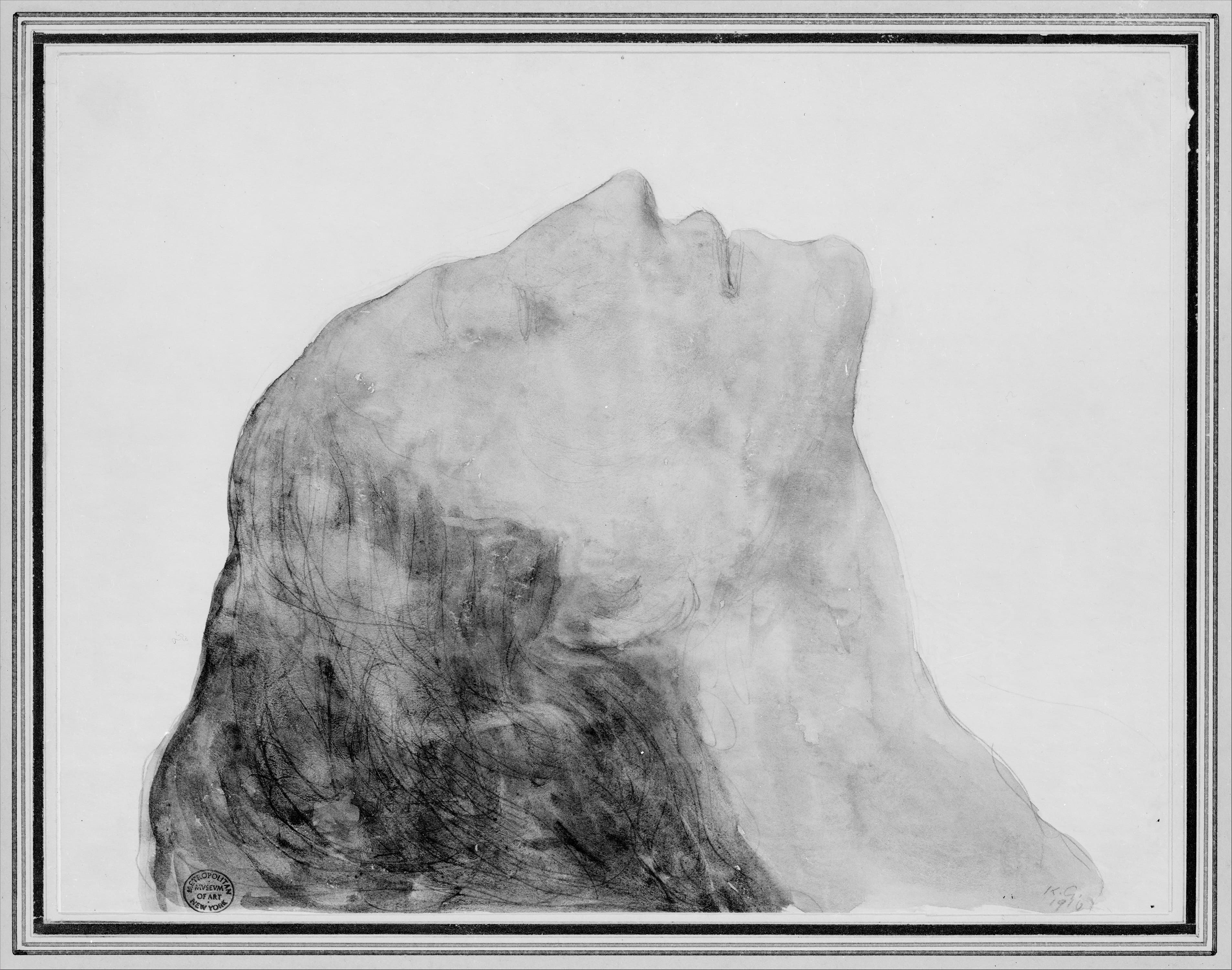
A head tipped back with the eyes closed, painted in thin watercolour over pencil, with a mass of dark hair worked in fine graphite strokes. Kahlil Gibran signed and dated it 1916 and made it the frontispiece of Twenty Drawings, the book of his own plates that Alfred A. Knopf published in 1919. The Metropolitan Museum of Art catalogues the sitter as his mother, Kamila Gibran.
- 1916
- Watercolor and graphite on paper
- The Metropolitan Museum of ArtNew York, United States
About Kahlil Gibran
What the drawing shows
A head is thrown back, chin lifted, eyes closed. A single contour carries the profile: it runs up over the brow, out along the nose and back under the lips to the chin. Inside that line the face is almost undrawn — a pale wash, a hooked line for the closed eye, a small shadow under the cheekbone.
The hair does the opposite. It is a heavy mass of fine curving graphite strokes laid over a darker wash, with paler channels twisting through it, and it fills the lower left of the sheet.
From the jaw a long wash runs down and out to the right, standing for the throat and the upper chest, and it fades before it reaches an edge. Nothing else is painted. The Metropolitan Museum of Art gives the sheet as 21.2 by 27.5 centimetres, roughly eight by eleven inches.
Plate one of Twenty Drawings
Alfred A. Knopf published Twenty Drawings in New York in 1919, with the copyright line "COPYRIGHT, 1919, BY ALFRED A. KNOPF, Inc." This drawing opens it. The list of plates names it first, as the frontispiece, and it is the only picture in the book a reader meets before the text.
The book carries an introductory essay by Alice Raphael, who wrote about Kahlil Gibran as a painter rather than a poet. Her essay is also an early printed account of what he had done in Paris.
“There he worked with Rodin and he exhibited at the Salon a series of portraits, which included Debussy, Rostand, Sarah Bernhardt, and Rodin himself…”
The same sentence runs on, and its second half attributes to Auguste Rodin the remark that Kahlil Gibran was a new William Blake. The remark has never been traced to anything Auguste Rodin wrote or is recorded as saying, and the museums that hold Kahlil Gibran's art do not repeat it. What her 1919 essay establishes is where the claim was printed, not that Auguste Rodin made it.
The sitter is his mother
The Metropolitan Museum of Art titles the drawing Towards the Infinite (Kamila Gibran, mother of the artist). Kamila Gibran carried her son out of Bsharri in 1895, when he was twelve, and raised the family in the immigrant tenements of Boston's South End.
The book gives no such identification. Twenty Drawings prints the title alone.
How it reached the Metropolitan Museum of Art
The museum's credit line reads "Gift of Mrs. Mary H. Minis, 1932". That is Mary Haskell, the Boston schoolmistress who had paid for Kahlil Gibran's training in Paris from 1908 and who married Jacob Florance Minis of Savannah in 1926.
She gave the museum five sheets in 1932, the year after Kahlil Gibran's death, numbered 32.45.1 to 32.45.5. The other four are portraits of Albert Pinkham Ryder and John Masefield, a drawing titled "I have come down the ages", and a sketch for Jesus the Son of Man. Eighteen years later she gave the bulk of her collection, nearly a hundred works, to Telfair Museums in Savannah.
What the reproduction shows, and how it differs from the book
The photograph published here is the museum's own, released into the public domain in the Metropolitan Museum of Art's 2014 image donation to Wikimedia Commons. It is black and white, and it shows the sheet in an old mount with a ruled black-and-white border, so the mat is part of the picture.
It also shows the sheet a quarter turn from the way the book printed it. In the photograph the face tips up to the right and the hair falls to the lower left. In Twenty Drawings the same drawing stands upright as a profile facing right, with the hair at the upper left, and it is printed in colour: green-black hair, a warm ochre face.
Two marks on the sheet are visible in the photograph. The signature "K.G." over "1916" sits in the pale area at the lower right, and the Metropolitan Museum of Art's circular collection stamp is pressed over the dark hair at the lower left.
Close reading
Reading the work, detail by detail
The Metropolitan Museum of Art photographed the sheet in an old mount and in black and white, and turned a quarter from the way Kahlil Gibran's own 1919 book printed it. In the photograph the face tips up to the right and the hair falls to the lower left. The close views follow that orientation, and two of them pick up marks on the sheet: his signature and the museum's stamp.
1.One line carries the whole profile
A single contour does the work of the face. It climbs the brow, turns out along the nose, comes back under the lips and finishes at the chin. Inside that line the face is a pale wash with almost no drawing in it.
2.The closed eye is a single hooked line
The eye is one short hooked line with a faint shadow under it. There are no lashes and no lid. It is the only mark inside the face apart from a small shadow under the cheekbone.
3.The hair takes all the drawing
Against the emptiness of the face, the hair is dense. Fine curving strokes are laid in run after run over a darker wash, and paler channels twist through the mass where the wash is left thin. It fills the lower left of the sheet.
4.The throat is a wash that fades out
From the jaw a long pale wash runs down and to the right for the throat and upper chest. A soft shadow follows one edge of it. The wash fades before it reaches any border, and no line closes the figure off.
5.Signed K.G. and dated 1916
In the pale area at the lower right, two short lines of pencil read K.G. over 1916. These are the artist's own initials and date, unlike the third-person notes on the Telfair sheets of 1910. The Metropolitan Museum of Art dates the drawing to that year.
6.The museum stamped the sheet
A circular stamp is pressed onto the sheet at the lower left, over the darkest part of the hair. The ring reads METROPOLITAN MVSEVM OF ART NEW YORK, with the older spelling that uses a V for the U. It marks the sheet as museum property rather than anything the artist added.
7.The mat is part of the photograph
The photograph includes the mount the sheet was kept in. A thick black band runs round the outside, with thin ruled lines inside it. Everything within that border is the drawing; the border itself is the mat.
Timeline
1895
Kamila Gibran brings her children from Bsharri to Boston, where the family settles in the immigrant tenements of the South End.
1908–1910
Kahlil Gibran trains in Paris on money sent by Mary Haskell, at the Académie Julian and then in the studio of Pierre Marcel-Béronneau.
1916
The drawing is made, signed K.G. and dated at the lower right.
1919
Printed as the frontispiece of Twenty Drawings, published by Alfred A. Knopf with an introductory essay by Alice Raphael.
1932
Given to the Metropolitan Museum of Art by Mary Haskell Minis, with four other sheets, as 32.45.1 to 32.45.5.
1950
Mary Haskell Minis gives nearly a hundred further works by Kahlil Gibran to Telfair Museums in Savannah.
Where to see it
The Metropolitan Museum of Art
1000 Fifth Avenue, New York, NY 10028, United States
Displays and loans can change. Check whether this work is on view before making a special trip.
Plan your visit on the museum’s official website (opens in a new tab)Frequently asked questions
Who is the woman in Towards the Infinite?
The Metropolitan Museum of Art identifies her as Kamila Gibran, the artist's mother, who brought the family from Bsharri to Boston in 1895. The 1919 book that first printed the drawing gives the title only, with no sitter named.
Where is Towards the Infinite?
The Metropolitan Museum of Art in New York, object number 32.45.4. It came as a gift from Mrs. Mary H. Minis in 1932 — Mary Haskell, the patron who had paid for Kahlil Gibran's art training in Paris. The museum's record shows no gallery, so check before travelling.
What is Twenty Drawings?
A book of twenty plates of Kahlil Gibran's own drawings, published in New York by Alfred A. Knopf in 1919 with an introductory essay by Alice Raphael. Towards the Infinite is its frontispiece and first plate.
How big is the drawing, and what is it made of?
21.2 by 27.5 centimetres, about eight by eleven inches, in watercolour and graphite on paper. Kahlil Gibran signed it in pencil at the lower right, "K.G.", and dated it 1916.
Why is the photograph black and white and turned on its side?
Because it is an old museum photograph of the sheet in its mount, released by the Metropolitan Museum of Art as public domain. The drawing is in colour, and the 1919 book printed it upright as a profile facing right, a quarter turn from the orientation in the museum's photograph.
Did Auguste Rodin call Kahlil Gibran a new William Blake?
There is no evidence that he did. Alice Raphael's essay in Twenty Drawings put the remark in print in 1919, attributed to Auguste Rodin, and it has been repeated ever since. No source for it in Auguste Rodin's own words has ever been produced, and the museums holding Kahlil Gibran's art do not use it.
Can the image be reproduced freely?
Yes. The drawing was published in the United States in 1919, which places it in the public domain there, and Kahlil Gibran's death in April 1931 ended the European Union term at the close of 2001. The photograph itself was released CC0 by the Metropolitan Museum of Art.
More by Kahlil Gibran
If you like Kahlil Gibran
Explore painters from the same movements and circles.
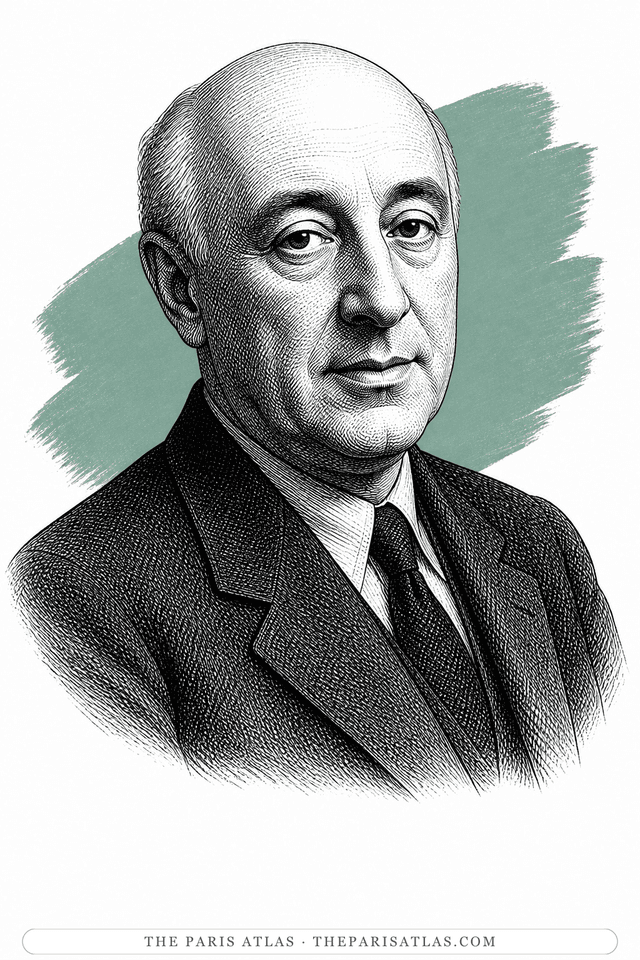
Jean Arp
Strasbourg-born sculptor and poet — Hans in German, Jean in French, both all his life — who co-founded Dada at the Cabaret Voltaire in 1916, composed collages by dropping torn paper 'according to the laws of chance', and settled at Meudon outside Paris in a house his wife Sophie Taeuber-Arp designed.
View artist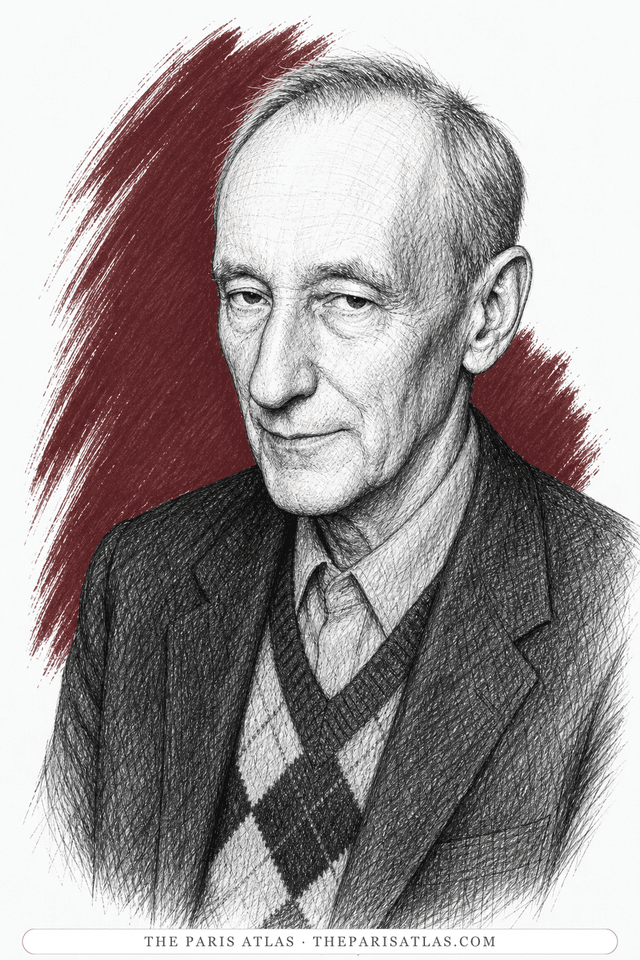
William S. Burroughs
American Beat novelist, essayist, performer and visual artist who completed Naked Lunch at the Beat Hotel in Paris and made cut-up writing a defining avant-garde method.
View artist
Leonora Carrington
English painter and writer who fled a debutante's future for Surrealist Paris at twenty, survived the war's wreckage of that life — internment for her lover Max Ernst, an asylum in Spain for her — and rebuilt herself in Mexico into one of the century's great painters of the uncanny.
View artist
References
The sources below include collection records, catalogues, scholarly research, and primary materials that informed this page. They document Towards the Infinite, its making, and its place in cultural history.

1Kahlil Gibran, Towards the Infinite (Kamila Gibran, mother of the artist), 32.45.4 — The Metropolitan Museum of Art collection record
WebsiteThe Metropolitan Museum of Art, New YorkUsed forWeb source consulted for documented facts and historical context presented on the Towards the Infinite page.

2Kahlil Gibran, Twenty Drawings, with an introductory essay by Alice Raphael (New York: Alfred A. Knopf, 1919) — Project Gutenberg transcription and plates
ArchiveAlfred A. Knopf, 1919Used forArchival evidence used to document the historical record connected to Towards the Infinite.
3The Art of Kahlil Gibran — Telfair Museums exhibition, 2010–11
WebsiteTelfair Museums, Savannah, GeorgiaUsed forFor the 1950 gift of nearly a hundred works to Telfair Museums.
4Minis Family Papers, 1739–1948 (collection 02725), Southern Historical Collection
ArchiveWilson Special Collections Library, University of North Carolina at Chapel HillUsed forFor Mary Haskell's support of the European travels of 1908 to 1911.
5Gibran: Man & Poet — the Kahlil Gibran Collective
WebsiteThe Kahlil Gibran CollectiveUsed forWeb source consulted for documented facts and historical context presented on the Towards the Infinite page.
These references provide the documented foundation for this work's history and interpretation. Claim-level citations remain attached to the specific claims they support.
 Explore more resources