The Head of Orpheus Floating Down the River Hebrus to the Sea
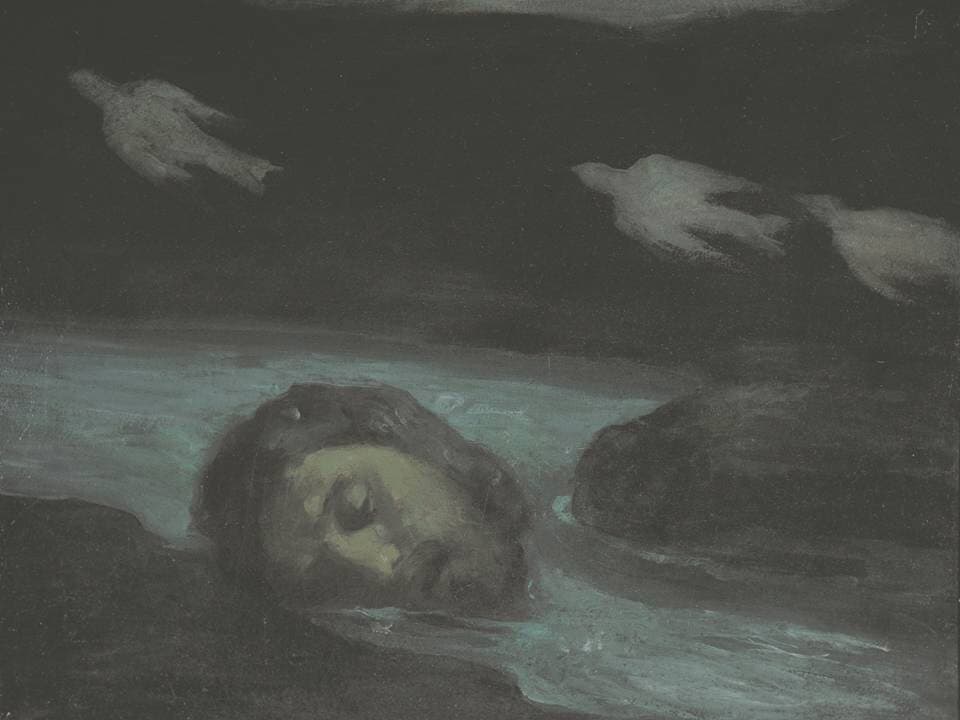
A severed head floats face-up in a pale green channel of water, under a black sky crossed by three pale hands. Telfair Museums dates the canvas to about 1908 to 1914, a bracket that opens with Kahlil Gibran's art training in Paris, and holds it as 1950.8.4 from the 1950 gift of Mary Haskell Minis. The subject is the end of the Orpheus myth: the singer's head thrown into the river Hebrus after he is torn apart.
- c. 1908–1914
- Oil on canvas
- Telfair MuseumsSavannah, Georgia, United States
About Kahlil Gibran
What the painting shows
A band of pale grey-green water runs across the middle of the canvas, streaked horizontally, and the head lies in it just left of centre. The face is turned up out of the water, painted in a pale olive-yellow, with the eyes closed as dark hollows and the nose and lips barely modelled.
Dark hair spreads around and above the face in heavy masses and merges with the water at the edges. Where the hair stops and the current begins cannot be told apart.
Above, the sky is close to black. Three pale forms float in it: one at the upper left with fingers held together and a thumb apart, and two at the upper right coming in from the edge, the nearer showing three or four separate fingers. They read as hands, and the second at the right edge is cut by the frame.
Dark masses close the scene in — a bank at the right where the green channel bends behind it, and a near-black foreground across the bottom left. No dimensions have been published by the museum.
The myth the title names
Orpheus was the singer of Greek myth whose music moved animals, trees and stones, and who failed to bring his wife Eurydice back from the underworld. In the version the title follows he is torn apart, and his head is thrown into the river Hebrus in Thrace, which carries it to the sea still singing.
The title is the museum's, and it names the moment rather than the story: the head, the river, the direction of travel. The figure on the canvas is the head alone, with no body and no attacker shown.
What the date bracket means
Telfair Museums gives the date as about 1908 to 1914. That is a seven-year bracket rather than a year, and it is how the museum catalogues several of the undated canvases in its Kahlil Gibran collection.
The bracket opens in the year Mary Haskell sent him to Paris. He reached the city in July 1908, joined the atelier of Jean-Paul Laurens at the Académie Julian, and by February 1909 was working in the studio of the painter Pierre Marcel-Béronneau. Telfair Museums names the French Symbolists among the influences on his art, along with the Italian Renaissance, the English Pre-Raphaelites and William Blake.
The bracket closes in the year his paintings were shown at the Montross Gallery in New York, from 14 to 30 December 1914. That catalogue lists twenty-five paintings and nineteen drawings, among them the Paris portraits of Auguste Rodin, Claude Debussy, Henri Rochefort and Edmond Rostand. It does not include this title, so the canvas cannot be dated by that exhibition.
How it reached Savannah
Mary Haskell Minis gave Telfair Museums nearly a hundred works by Kahlil Gibran in 1950. The museum's own account of the collection counts five oils and ninety-two works on paper, and calls it the largest collection of his visual art in the United States.
This is one of the five oils. The object number, 1950.8.4, carries the year of her gift.
Close reading
Reading the work, detail by detail
The canvas is dark, and it takes a moment to find what is in it. A pale channel of water runs across the middle with a severed head lying face-up in it, and three pale forms with fingers float in a near-black sky. The close views separate the head from the water and the forms from the dark.
1.The face is turned up out of the water
The face is turned up out of the water and painted in a pale olive-yellow, the lightest note on the canvas after the water itself. The eyes are closed and read as dark hollows. The nose and lips are barely modelled, and the mouth is not open.
2.The hair and the current run together
The hair spreads around and above the face in heavy dark masses. At the edges it merges into the water, and no line separates the two. Where the hair ends and the current begins cannot be told apart.
3.A pale hand at the upper left
In the black at the upper left, a pale form floats with its fingers held together and the thumb set apart. The surface is mottled with lighter flecks. Nothing supports it and nothing connects it to the rest of the picture.
4.Two more come in from the right
Two further forms come in from the upper right. The nearer shows three or four separate fingers and a pointed thumb. The second is cut off by the edge of the canvas, so only part of it is on the picture.
5.The river is a band of streaked grey-green
The river is a band of pale grey-green laid across the middle of the canvas. Horizontal brushmarks streak it, with small whitish flecks on the surface. It is much lighter than anything above or below it.
6.A dark bank turns the channel
On the right a large dark mass stands in front of the water, and the teal-green channel bends away behind it. The brushwork stays visible across the dark paint. The mass reads as a bank or a rock without being described in any detail.
7.The foreground is almost pure black
Across the bottom left the paint goes almost black, with no detail in it. It closes the scene off below the water. The only thing that breaks into it is the dark hair of the head at its right edge.
Timeline
1908
Kahlil Gibran reaches Paris in July on money sent by Mary Haskell and enters the atelier of Jean-Paul Laurens at the Académie Julian. The museum's date bracket for the canvas opens here.
1909
By February he is working in the studio of the painter Pierre Marcel-Béronneau.
1914
The Montross Gallery in New York exhibits his pictures from 14 to 30 December, twenty-five paintings and nineteen drawings. The museum's date bracket closes here; this canvas is not in the catalogue.
1950
Mary Haskell Minis gives her collection to Telfair Museums in Savannah, and the canvas enters as 1950.8.4.
Where to see it
Telfair Museums
Savannah, Georgia, United States
A public viewing address has not yet been confirmed for this holding.
Frequently asked questions
What is happening in the painting?
The severed head of Orpheus is floating face-up down a river. In the myth the singer is torn apart and his head is thrown into the river Hebrus, which carries it to the sea. Kahlil Gibran paints the head in a pale channel of water under a black sky with three pale hands in it.
Where is the painting?
Telfair Museums in Savannah, Georgia, object number 1950.8.4. It is one of five oils by Kahlil Gibran that Mary Haskell Minis gave the museum in 1950, alongside ninety-two works on paper.
When did Kahlil Gibran paint it?
Telfair Museums dates it to about 1908 to 1914 and does not narrow it further. The bracket opens with his arrival in Paris to study art in July 1908 and closes with his 1914 exhibition at the Montross Gallery in New York, whose catalogue does not list this title.
Are those hands in the sky?
They read as hands. Three pale elongated forms float in the near-black sky, one at the upper left and two entering from the upper right, and the fingers and thumb are visible on at least two of them. No published account of the canvas identifies them.
How does the painting connect to Paris?
Through its date and its manner. The museum's bracket begins in the year Mary Haskell sent Kahlil Gibran to Paris, where he worked at the Académie Julian and then in the studio of Pierre Marcel-Béronneau. Telfair Museums lists the French Symbolists among the influences on his work.
Can the image be reproduced freely?
Yes. Kahlil Gibran died in April 1931, so the European Union term expired at the end of 2001 and the painting entered the United States public domain by 2002 at the latest. Wikimedia Commons hosts the reproduction as a faithful photograph of a two-dimensional public-domain work.
More by Kahlil Gibran
If you like Kahlil Gibran
Explore painters from the same movements and circles.
Jean Arp
Strasbourg-born sculptor and poet — Hans in German, Jean in French, both all his life — who co-founded Dada at the Cabaret Voltaire in 1916, composed collages by dropping torn paper 'according to the laws of chance', and settled at Meudon outside Paris in a house his wife Sophie Taeuber-Arp designed.
View artist
William S. Burroughs
American Beat novelist, essayist, performer and visual artist who completed Naked Lunch at the Beat Hotel in Paris and made cut-up writing a defining avant-garde method.
View artist
Leonora Carrington
English painter and writer who fled a debutante's future for Surrealist Paris at twenty, survived the war's wreckage of that life — internment for her lover Max Ernst, an asylum in Spain for her — and rebuilt herself in Mexico into one of the century's great painters of the uncanny.
View artist
References
The sources below include collection records, catalogues, scholarly research, and primary materials that informed this page. They document The Head of Orpheus Floating Down the River Hebrus to the Sea, its making, and its place in cultural history.


1Kahlil Gibran Collection — Telfair Museums online collection
WebsiteTelfair Museums, Savannah, GeorgiaUsed forWeb source consulted for documented facts and historical context presented on the The Head of Orpheus Floating Down the River Hebrus to the Sea page.
2Visions of The Prophet: The Visual Art of Kahlil Gibran — Telfair Museums
WebsiteTelfair Museums, Savannah, GeorgiaUsed forFor the influences the museum names, and the source of the reproduction on Commons.

3Exhibition of Pictures by Kahlil Gibran, December 14–30, 1914
Exhibition catalogueMontross Gallery, New York, 1914Used forCatalogue scholarship used to verify attribution, provenance, chronology, and interpretive context for The Head of Orpheus Floating Down the River Hebrus to the Sea.
4Prophet: The Life and Times of Kahlil Gibran
BiographySt. Martin's Press, 1998Used forCited for the Paris chronology at the opening of the museum's date bracket.
5The Art of Kahlil Gibran — Telfair Museums exhibition, 2010–11
WebsiteTelfair Museums, Savannah, GeorgiaUsed forWeb source consulted for documented facts and historical context presented on the The Head of Orpheus Floating Down the River Hebrus to the Sea page.
These references provide the documented foundation for this work's history and interpretation. Claim-level citations remain attached to the specific claims they support.
 Explore more resources