Gian Lorenzo Bernini carved The Ecstasy of Saint Teresa between 1647 and 1652 for the Cornaro Chapel in the church of Santa Maria della Vittoria in Rome, where it stands above the altar. The marble group shows the Spanish mystic Teresa of Ávila at the moment an angel pierces her heart with a golden spear.
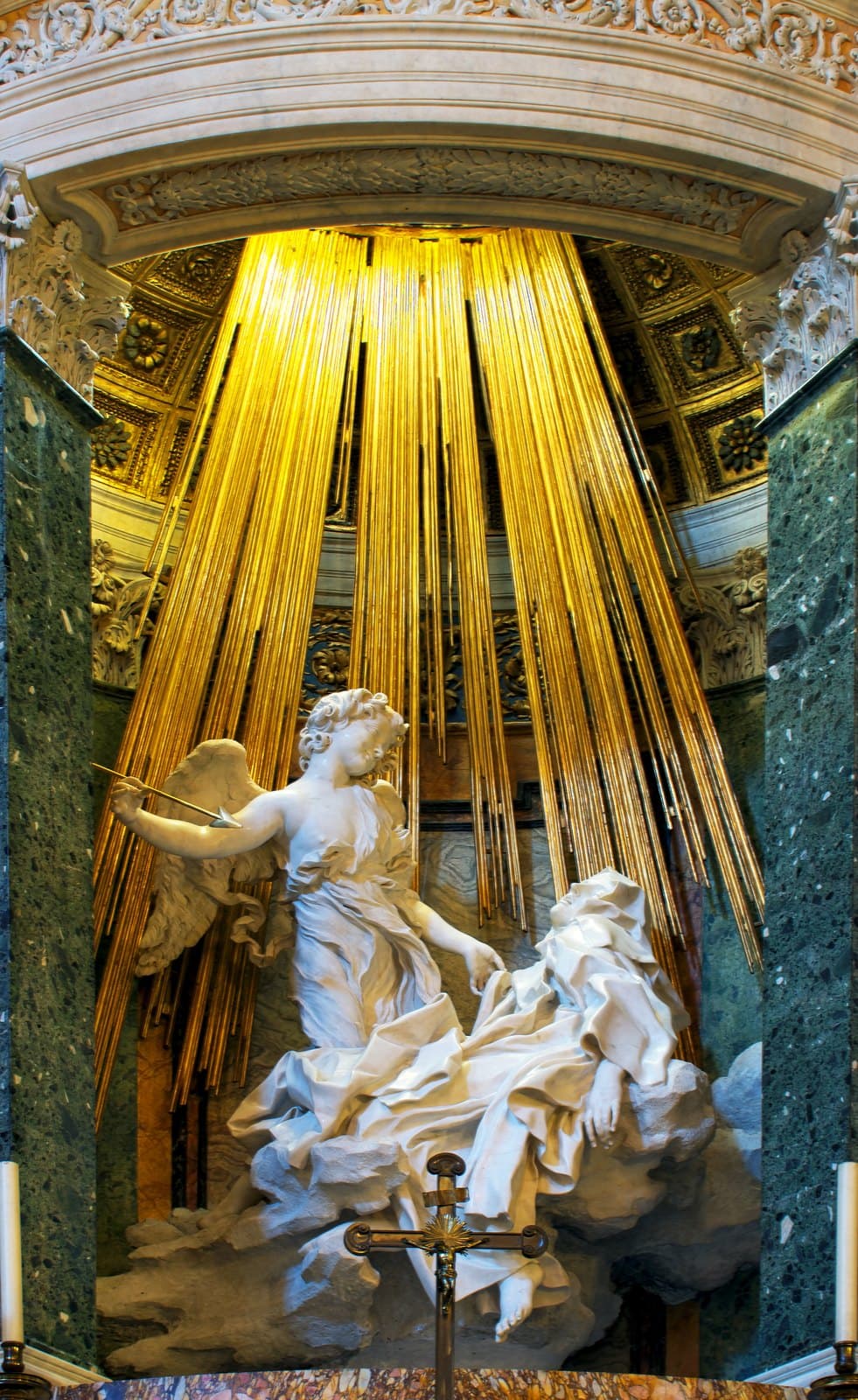
The Ecstasy of Saint Teresa is a marble sculptural group created by Gian Lorenzo Bernini between 1647 and 1652 for the Cornaro Chapel in the Church of Santa Maria della Vittoria, Rome, where it remains. It represents the Spanish mystic Teresa of Ávila overwhelmed by a vision of divine love. The central figures belong to a larger environment in which architecture, sculpture, color, and concealed illumination work together.
The work is one of the clearest examples of Bernini's ability to make stone appear responsive to movement and sensation. Its subject is spiritual, but its persuasive force depends on the visible language of the body.
The Commission and the Cornaro Chapel
The chapel was commissioned by Cardinal Federico Cornaro, whose family is commemorated within its decoration. Rather than supplying only a statue for an existing architectural frame, Bernini designed an ensemble in which the setting directs the encounter with the figures. White marble stands against richly colored surroundings, while the arrangement focuses attention above the altar.
The commission brought together private patronage and public devotion. It honored a saint, provided a religious setting associated with the Cornaro family, and displayed the family's prestige. These purposes coexist within the same space rather than being assigned to separate objects.
Teresa's Account of the Vision
Bernini's subject derives from Teresa's autobiography, particularly Chapter 29, in which she describes an angel holding a golden spear with fire at its point. She recounts the sensation of the angel piercing her heart and leaving her filled with intense love for God. The experience combines pain with an overwhelming sweetness that she does not wish to lose.
This episode is often called the transverberation, or piercing of the heart. It is a mystical experience as Teresa describes it, not an ordinary physical attack. Her own account distinguishes spiritual pain from bodily injury while acknowledging that the body participates in the experience. That distinction is important when interpreting Bernini's translation of the episode into sculpture.
The Figures and the Treatment of Marble
Teresa reclines on a cloudlike support, her head tilted backward and her mouth slightly open. The angel stands above her, holding the arrow and gently handling the edge of her garment. Their contrasting expressions and movements establish an encounter between Teresa's overwhelming experience and the angel's composed activity.
The folds of Teresa's habit are deeply cut and irregular, creating a restless surface that contrasts with the smoothness of exposed skin. Bernini distributes emotion across the entire figure rather than confining it to facial expression. Drapery, posture, and the relationship between the two bodies make a fixed material suggest an event still unfolding. This is the quality often described as his ability to create “living marble.”
Hidden Daylight and the Appearance of a Vision
The illumination is an essential part of the design. A concealed source of daylight above the figures lights the white marble, while gilded rays make the descent of light visible as a formal element. Because the source is not immediately apparent from the principal viewing position, the figures can seem illuminated by something beyond the ordinary conditions of the room.
This effect does not depend on sculpture alone. The surrounding architecture frames the encounter, the colored marbles distinguish different surfaces, and the lighting directs the spectator's attention. The chapel demonstrates how Baroque art could turn a physical interior into a coordinated experience rather than simply place an important object inside it.
The Cornaro Family as Witnesses
On the chapel's side walls, members of the Cornaro family appear in sculpted settings resembling theater boxes. They seem to converse, consult texts, or attend to the event before them. Their presence does not mean they historically witnessed Teresa's vision. Instead, the ensemble places commemoration and sacred experience within a shared imagined space.
These figures also give the actual spectator counterparts inside the work. The chapel contains people represented as looking, while visitors themselves look toward the central vision. Bernini's experience with theatrical design informed this coordination of action, framing, and audience, although the setting's purpose remained religious rather than merely entertaining.
Sensuality and Spiritual Meaning
The sculpture's bodily intensity has prompted repeated discussion of its sensual character. That response cannot simply be dismissed, but neither does it establish that Bernini substituted an ordinary erotic encounter for Teresa's religious account. Teresa herself used the language of piercing, sweetness, pain, and love to describe an experience she understood as communion with God.
Bernini gives that account a visible form without eliminating its difficult relationship between body and spirit. The work's importance lies partly in this tension: an inward, nonmaterial experience is communicated through the appearance of flesh, fabric, weight, and light. Seen within its original chapel rather than as an isolated photograph, the sculpture reveals the full scope of that ambition.
Close reading
Reading the work, detail by detail
Bernini's group is about three and a half metres high and stands above an altar, so most of it is well over a visitor's head. These eight views enlarge the parts that carry the scene: the two faces, the arrow, the hand at the habit, the folds, the bare foot, the gilded rays, and the green marble that frames them.
1.Teresa's head has fallen back
Her eyes are shut and her mouth is open, and the head hangs back far enough to expose the throat. The face is small within the group and does most of its work through that angle rather than through expression.
2.The angel looks down and smiles
The angel's head is turned down toward Teresa, the eyes half lowered and the mouth closed in a slight smile. Set beside her face, this calm is what makes the difference between the two figures visible.
3.The arrow, held away from her
The shaft is a thin gilded rod and the head is a separate piece of dark metal with barbs. Bernini shows the arrow drawn back rather than the wound itself, so the moment carved here comes just before the one Teresa described.
4.The angel's fingers take the edge of the habit
The free hand pinches one fold of cloth between finger and thumb and lifts it slightly. It is the only contact between the two figures, and it is carved small enough to be missed from the floor of the chapel.
5.The habit breaks into deep folds
The cloth is cut so deeply that whole folds stand clear of the block and throw shadows on the marble beneath. Nothing in the drapery follows the shape of the body underneath it.
6.One bare foot hangs off the cloud
The foot slips out from under the hem and hangs in the air with the toes curled, the plainest sign in the group that she is no longer holding herself up. The brass crucifix crossing this view stands on the altar in front of the sculpture and is not part of it.
7.The rays come out of an opening you cannot see
The rods are gilded and hang in front of the wall, packed most densely where they leave the top of the niche. The window that lights them sits behind the cornice, out of sight from where a visitor stands.
8.White marble against dark green
The piers on either side are dark green marble flecked with white, and the figures and capitals above them are white. The colored stone is what separates the vision from the chapel wall around it.
Teresa of Ávila is born at Ávila, in Old Castile, on 28 March.
1565
Teresa completes the autobiography known as her Life. Chapter 29 describes the angel holding a long golden spear with fire at its point, and the pain she says she could not wish to be rid of. This is the passage Bernini's group depicts.
1582
Teresa dies at Alba de Tormes on 4 October.
1622
Pope Gregory XV canonizes Teresa, forty years after her death; she had been beatified in 1614.
1647
Cardinal Federico Cornaro commissions the chapel in Santa Maria della Vittoria in Rome. Bernini designs the whole of it, from the architecture and the coloured marbles to the hidden window above the figures.
1652
The marble group is finished, about 350 centimetres high, standing above the chapel altar.
The Ecstasy of Saint Teresa, 1647–52, marble and gilded bronze, in the Cornaro Chapel of Santa Maria della Vittoria, Rome. A window hidden above the group lights it from the front. (Photograph by Alvesgaspar, via Wikimedia Commons)
Where to see it
Church of Santa Maria della Vittoria, Cornaro Chapel
Rome, Italy
A public viewing address has not yet been confirmed for this holding.
The group is on the altar of the Cornaro Chapel, on the left side of a working church that keeps its own opening hours. Check them before making a special trip.
Frequently asked questions
Where is The Ecstasy of Saint Teresa?
It is in the Cornaro Chapel of the Church of Santa Maria della Vittoria in Rome, the chapel it was made for, and it has never moved. The group stands above the chapel altar, so it is seen in a church rather than in a museum gallery.
When did Bernini make The Ecstasy of Saint Teresa?
Between 1647 and 1652. Cardinal Federico Cornaro commissioned the chapel, and Bernini designed the whole setting rather than supplying a statue for an architectural frame that already existed.
What is happening in the sculpture?
Teresa of Ávila is having the vision she described in Chapter 29 of her autobiography, in which an angel holds a golden spear with fire at its point, pierces her heart, and leaves her filled with intense love for God. In the marble, Teresa reclines on a cloudlike support with her head tilted backward and her mouth slightly open, and the angel stands above her holding the arrow and lifting the edge of her habit.
What is the transverberation?
It is the name often given to Teresa of Ávila's vision of the angel piercing her heart. Teresa described it as a mystical experience rather than an ordinary physical attack, and her own account separates spiritual pain from bodily injury while allowing that the body takes part in it.
Where does the light in the Cornaro Chapel come from?
A concealed source of daylight above the figures lights the white marble. Gilded rays make the descent of that light visible as a formal element, and because the source is not obvious from the main viewing position the figures can seem lit by something beyond the ordinary conditions of the room.
Who are the figures on the chapel's side walls?
They are members of the Cornaro family, carved in settings that resemble theater boxes. They seem to converse, consult texts, or attend to the event before them, but their presence does not mean they historically witnessed Teresa's vision.
How big is The Ecstasy of Saint Teresa?
The marble group is about 350 cm high, the figure given in the Web Gallery of Art's catalogue entry. That measurement is the height of the sculpture itself, not of the Cornaro Chapel, which is a whole ensemble of architecture, colored marbles, gilded rays, and further sculpted figures on the side walls.
Is The Ecstasy of Saint Teresa erotic?
The sculpture is often read that way, and the reading starts with the body Bernini carved: the head thrown back, the mouth open, one bare foot hanging off the cloud. That response cannot simply be dismissed. It also does not establish that Bernini replaced Teresa's religious account with an ordinary erotic encounter, because Teresa of Ávila described the vision in the language of piercing, sweetness, pain and love, and she meant communion with God.
In the atlas
What the graph records about this work — every claim carries its citation.
The Victoria and Albert Museum calls the group made for the Cornaro Chapel between 1647 and 1652 perhaps the quintessential image of Baroque religious art. It is the work most often used to show what Baroque art does when architecture, sculpture and light are designed together: a window hidden above the figures lights the white marble, gilded rays carry the light down, and members of the Cornaro family are carved on the side walls watching from what look like theater boxes.
— Bernini and the Baroque; Church of Santa Maria della Vittoria; Howard Hibbard, Bernini, Gian Lorenzo (1967)
If you like Gian Lorenzo Bernini
Explore sculptors from the same movements and circles.
Arman
French-American artist, lifelong friend of Yves Klein, and a founder of New Realism.
Strasbourg-born sculptor and poet — Hans in German, Jean in French, both all his life — who co-founded Dada at the Cabaret Voltaire in 1916, composed collages by dropping torn paper 'according to the laws of chance', and settled at Meudon outside Paris in a house his wife Sophie Taeuber-Arp designed.
Frédéric Auguste Bartholdi was a French sculptor best known for designing the Statue of Liberty, dedicated in New York Harbor in 1886. Born in Colmar and based in Paris, he created public monuments that gave visible form to ideas of freedom, resistance and national memory. His other major works include the Lion of Belfort and the fountain in Lyon's Place des Terreaux.
The Ecstasy of Saint Teresa, 1647–52, marble and gilded bronze, in the Cornaro Chapel of Santa Maria della Vittoria, Rome. A window hidden above the group lights it from the front.1647–1652 · Photograph by Alvesgaspar, via Wikimedia Commons · CC BY-SA 4.0
References
References
The sources below include collection records, catalogues, scholarly research, and primary materials that informed this page. They document The Ecstasy of Saint Teresa, its making, and its place in cultural history.
1Bernini and the Baroque
Website
Victoria and Albert Museum
Used for
The V&A's account of Bernini and of the Ecstasy of Saint Teresa as Baroque religious art, and of the pose, gesture and drapery behind his reputation for living marble.
The City of Rome's page for the church that holds the chapel: the 1647–1652 dates, the Cornaro commission, the materials, and the family seated in their sculpted boxes.
4The Life of St. Teresa of Jesus, translated by David Lewis, third edition (Project Gutenberg ebook 8120)
Memoir
Thomas Baker, London; Benziger Bros., New York, 1904
Used for
Teresa of Ávila's own words in David Lewis's translation: the angel with the long spear of gold, the fire at its point, and the pain she could not wish to be rid of.
5St. Teresa of Avila, The Catholic Encyclopedia, volume 14
Website
Robert Appleton Company, via New Advent, 1912
Used for
Names the episode: Benedict Zimmerman writes of “the piercing or transverberation of her heart” among the manifestations of these years. Also the dates in the timeline: born at Ávila 28 March 1515, the Life completed in 1565, died at Alba de Tormes 4 October 1582, beatified 1614 and canonized in 1622 by Gregory XV.
These references provide the documented foundation for this work's history and interpretation. Claim-level citations remain attached to the specific claims they support.



 View source