Lettres — Bibliothèque de la Pléiade (2009)
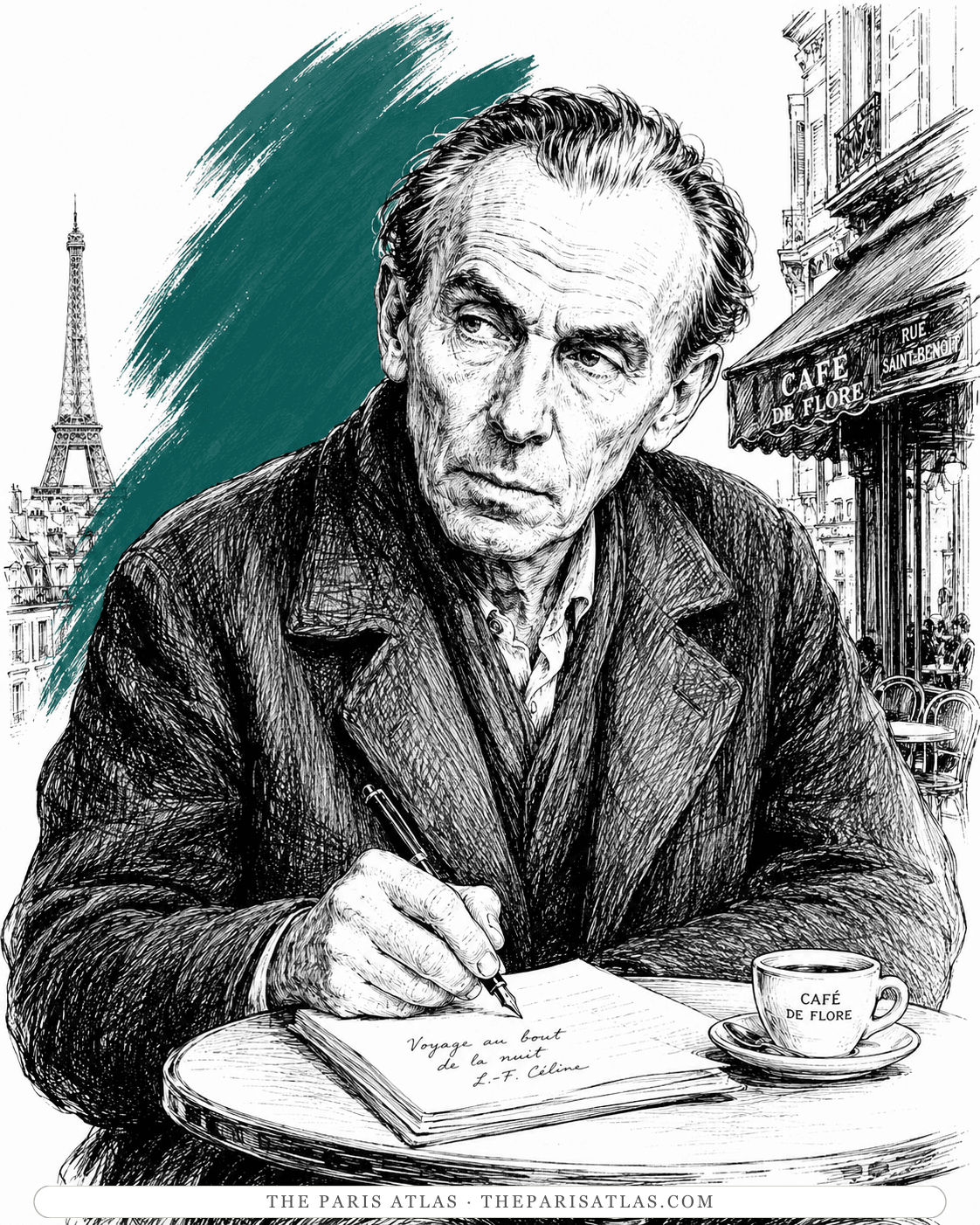
The single-volume Pléiade Lettres (2009), edited by Henri Godard and Jean-Paul Louis. Two thousand and eighty pages, five decades of correspondence, and the central hub for how Céline speaks in private.
The 2009 Pléiade Lettres is the central single-volume edition of Louis-Ferdinand Céline's correspondence. Edited by Henri Godard and Jean-Paul Louis, it runs to 2,080 pages and presents a chronological selection of letters by Céline and several of his correspondents covering 1907 to 1961. The letters themselves occupy pages 1–1583; almost 450 additional pages provide notes, indexes and a table of correspondents.
It is not a complete edition of every surviving Céline letter. It is a very large selection, incorporating previously published correspondence alongside many letters that had not previously appeared.
The arc, in five sweeps
The earliest correspondence precedes Céline entirely. We first encounter Louis Destouches as a young man sent abroad by his parents. Letters then follow him into the cuirassiers, the First World War, travel, Africa, medical work and the League of Nations. The emergence of the novelist can therefore be watched gradually rather than retrospectively.
After 1932, the letters document publishing, literary success, criticism, political writing and relationships with editors and friends. The wartime and Danish periods substantially change the texture of the correspondence. Exile and imprisonment make letters more necessary because the writer is physically separated from people with whom he would otherwise speak.
The final correspondence follows the return to France, the difficult reception of Féerie, Céline's relationship with Gallimard and the composition of his last novels.
The chronological advantage
One of the Pléiade's major advantages is chronological integration: letters previously published in separate books around one recipient can now be read beside letters written to entirely different people on the same dates. The result makes visible how dramatically Céline changes tone according to whom he is addressing.
The years, briefly
- 1907–1913 — adolescence, foreign stays and early independence
- 1913–1915 — cavalry service, war and the experience surrounding Céline's wounding
- 1916–1920s — Africa, travel, marriage, medicine and international public-health work
- 1932–1936 — the sudden emergence of Céline as a major novelist
- Late 1930s–1944 — publishing, polemical writing, correspondence with friends and literary figures, and wartime France
- 1944–1951 — Germany, Denmark, imprisonment, legal defence and exile
- 1951–1961 — return to France, Gallimard, Féerie, Entretiens avec le professeur Y, the German trilogy and Céline's final years
The principal correspondents
Among many others: Marie Canavaggia, Albert Paraz, Milton Hindus, Gaston Gallimard, Robert Denoël, Lucette Destouches, Joseph Garcin, Henri Mondor, Pierre Monnier, Antonio Zuloaga and the Danish lawyer Thorvald Mikkelsen. Individual correspondence editions — the Marie Canavaggia and Milton Hindus letters in Cahiers Céline vols. 9 and 11, the Paraz letters in vols. 6 and 10 — offer fuller sequences and additional context, but the Pléiade is the chronological hub.
Where it ends
The end has an unusual documentary force because it does not feel retrospectively composed. Céline is still writing, arguing about publication and thinking about the next book. The correspondence reaches the period in which he announces the manuscript of his final novel to Gaston Gallimard, shortly before his death on 1 July 1961.
What the letters do for a reader
The correspondence shows that there is no single "private Céline voice." He modifies himself according to recipient: intimate, comic, flattering, angry, tactical, professional, desperate, literary or practical. That variability is one of the primary reasons the chronological Pléiade is so useful.
The letters are also indispensable for textual history. They allow researchers to date works, watch titles change, track manuscripts, reconstruct relationships with publishers and see Céline explaining his stylistic intentions outside the formal setting of an interview.