Agatha Christie's first novel, written on a bet in a wartime dispensary, and the first appearance of Hercule Poirot.
The best-selling novelist in history — around a billion copies in English and a billion in translation — who invented two of the most famous detectives in fiction, the fastidious Belgian Hercule Poirot and the watchful village spinster Miss Marple, and wrote The Mousetrap, the longest-running play in the world. Her Paris connection is small and honest: at fifteen her widowed mother took her out of a school in Torquay, the Devon seaside town where she grew up, and put her through a run of Parisian boarding schools, where she was good enough at the piano to have gone professional and too frightened of audiences to try.
Agatha Christie is on this map for one year of her adolescence. In 1905 her mother, recently widowed and short of money, took her fifteen-year-old daughter out of an unsuitable school in Torquay and to Paris, where Agatha passed through a succession of boarding schools — the last of them a finishing school run by an Englishwoman, Miss Dryden, a finishing school being the sort of establishment that taught well-off girls French, music and manners before they were launched into society — taking piano and singing lessons and, in her own words, spending "two winters and one summer" that were "some of the happiest days I have ever known."[1]
The consequence was negative and decisive. She was, by the account of her own estate, good enough to have become a professional pianist, and could not perform: the shyness was crippling, and it closed the career she had been training for.[2] She went home to Devon, wrote short stories in bed with influenza because her mother suggested it, and in the First World War, dispensing medicines in a Torquay hospital, learned the poisons that would kill so many of her characters. Everything else follows from there — Hercule Poirot, the retired Belgian policeman with the moustache and the vanity; Miss Marple, the elderly village lady who misses nothing; sixty-six detective novels; the eleven days in 1926 when the whole country searched for her after she walked out of her house and vanished; twenty-five years of archaeological digs in Iraq and Syria with her second husband, the archaeologist Max Mallowan; and The Mousetrap, which opened in 1952 and has not closed since. Paris was a year of finishing school. It happens to be the year that redirected a performer into a writer.
Agatha Mary Clarissa Miller was born in Torquay, on the Devon coast, on 15 September 1890, and had almost no formal schooling: she taught herself to read at five against her mother's wishes and was educated at home.[3] Her father Frederick died suddenly shortly after her eleventh birthday, leaving the family short of money and Agatha as her mother Clara's closest companion. A girls' school in Torquay was tried and found unsuitable. Then Clara took her daughter to Paris.
This was the ordinary finishing-school circuit that middle-class English families used to complete a daughter's education, and Agatha did it thoroughly, moving through a succession of Paris boarding schools between 1905 and 1906 and finishing at the one she remembered most warmly in her autobiography, an English-run establishment kept by a Miss Dryden. She took piano and singing lessons and absorbed the city. The line she chose for it, quoted by her estate from her autobiography, is unequivocal: "The two winters and one summer that I spent in Paris were some of the happiest days I have ever known. All sorts of delightful things happened all the time."[1]
Paris was also where the music ended. She had trained seriously enough that, as her estate's official biography puts it, she "could even have been a professional pianist but for her excruciating shyness."[2] The talent was real and the nerve was not there; performing in front of people was impossible for her, and a girl who had been pointed at a concert career came home without one. It is worth being plain about the size of this: Paris was one year of finishing school in a life of eighty-five, and no part of her fiction is set there. What that year did was close a door. The writing began three years later, and it was work she could do alone in a room.
At eighteen, in bed with influenza and bored, she started writing short stories on her mother's suggestion. In 1914 she married Archibald Christie, an officer in the Royal Flying Corps — the British army's air arm, the forerunner of the RAF — on Christmas Eve; he returned to France two days later, and she spent the war working in a Torquay hospital dispensary — the room where medicines are made up and handed out — where she qualified as an apothecaries' assistant, a licensed dispenser of drugs, and learned a great deal about poisons. Her elder sister Madge bet her she could not write a good detective story. She took the bet.[2]
Thousands of Belgian refugees had fled the German invasion and settled in England, some of them in Torquay, and Christie decided her detective should be one of them: a retired Belgian police officer, fastidious, vain, and reliant on what he called the little grey cells of the mind. She named him Hercule Poirot. The murder was done with poison, described so accurately that when the book finally appeared it was reviewed in the Pharmaceutical Journal, the trade paper of British chemists — an unheard-of honour for a novel. She finished it on a fortnight's holiday at the Moorland Hotel on Dartmoor, the high open moor inland from Torquay, walking the moor and speaking the chapters aloud as her characters. Six publishers rejected it. The seventh, John Lane of the London house The Bodley Head, accepted it in 1919, asked her to replace the courtroom ending with a drawing-room denouement — the closing scene, since copied by everyone, in which the detective gathers the suspects in one room and explains the crime — and tied her to five more books. The Mysterious Affair at Styles was published in 1920.[4]
1926 was the year The Murder of Roger Ackroyd made her famous for a trick played on the reader — a solution that broke what critics had taken to be the rules of detective fiction, and that readers still argue about — and the year everything else came apart. Her mother died; her husband Archie told her he was in love with another woman and wanted a divorce. In early December, with her secretary and close friend Carlo away for the night, she left her daughter Rosalind with the maids, walked out of the house without saying where she was going, and vanished. Her car was found abandoned the next morning some miles away.[2]
The search that followed was the largest the country had seen for a missing person — thousands of police and volunteers, the newspapers running it daily for eleven days. She had in fact travelled to King's Cross station in London, taken a train to the spa town of Harrogate in Yorkshire, and checked into the Swan Hydropathic Hotel — a hotel built around water cures — under the name Theresa Neele, of South Africa. Staff in the hotel band recognised her and told the police. When Archie arrived to collect her she did not appear to know who he was; the contemporary account was that she was possibly concussed and suffering from amnesia. She never discussed the episode with her family or friends, or in her autobiography, for the remaining fifty years of her life.[2]
Divorced and travelling alone in 1930, she visited the great excavation at Ur in Iraq — the Sumerian city, one of the oldest in the world, that the archaeologist Leonard Woolley was digging out of the desert — and met a twenty-five-year-old archaeologist-in-training named Max Mallowan. They married on 11 September 1930 and stayed married until her death. She did not simply accompany him: on the digs she wrote in the mornings and worked in the afternoons, cleaning finds — famously with her own face cream — drawing them, and photographing them. The year acquired a shape it kept for decades: summers at Ashfield in Torquay with Rosalind, Christmases with family, late autumn and spring in Iraq and Syria, the rest in London and at Winterbrook, their house at Wallingford in Oxfordshire. From 1947 the winters were at Nimrud, the ruined Assyrian capital in northern Iraq that Mallowan was excavating, where she wrote novels in a tent. The Middle Eastern books — Murder in Mesopotamia, Death on the Nile, Appointment with Death — come straight out of that life. They left Iraq for good in 1960, after the revolution of 1958, which overthrew and killed the king, made the work impossible.[2]
In 1947 the BBC asked her for a radio play as a birthday present for Queen Mary — the widow of King George V and mother of the reigning George VI — who was turning eighty and had named Christie as the writer she wanted. The result, Three Blind Mice, grew into a stage play called The Mousetrap. It opened in Nottingham in October 1952, transferred to the Ambassadors Theatre in the West End, London's commercial theatre district, that November with the young actors Richard Attenborough and Sheila Sim in the leads, and by September 1956 was the longest-running play in British history. It moved next door to the St Martin's Theatre in 1974 and has run there ever since, apart from the pandemic closures — the longest-running play in the world.
She was made a Dame Commander of the Order of the British Empire in 1971 — the honour that made her, formally, Dame Agatha. Her last public appearance was in November 1974, at the premiere of the director Sidney Lumet's film of Murder on the Orient Express. She died on 12 January 1976 at Winterbrook, aged eighty-five, and is buried in the churchyard of St Mary's at Cholsey, near Wallingford; the West End dimmed its theatre lights for her. Her books have sold around a billion copies in English and another billion in translation, which makes her, by a distance, the best-selling novelist who has ever lived.[2]
Born Agatha Mary Clarissa Miller in Torquay, Devon, on 15 September; educated at home.
Her father Frederick dies shortly after her eleventh birthday, leaving the family with money worries.
Her mother takes her to Paris, where she passes through a succession of boarding schools — ending at Miss Dryden's — taking piano and singing lessons.
Marries Archibald Christie on Christmas Eve; works through the war in a Torquay hospital dispensary, learning poisons.
Takes her sister Madge's bet that she cannot write a good detective story, and invents Hercule Poirot as a Belgian refugee.
John Lane of The Bodley Head — the seventh publisher to see it — accepts The Mysterious Affair at Styles and contracts her for five more books. Rosalind is born on 5 August.
The Mysterious Affair at Styles is published, introducing Hercule Poirot.
The Murder of Roger Ackroyd makes her famous; her mother dies, her marriage collapses, and she disappears for eleven days, found at a Harrogate hotel registered as Theresa Neele.
Meets the archaeologist Max Mallowan at Leonard Woolley's excavation of the ancient city of Ur, in Iraq, and marries him on 11 September; she joins the dig teams as a working member.
Writes the radio play Three Blind Mice for Queen Mary's eightieth birthday at the BBC's request; the Mallowans begin wintering at Nimrud.
The Mousetrap, grown out of Three Blind Mice, opens in Nottingham in October and reaches the West End in November.
The Mousetrap becomes the longest-running play in British history.
Made a Dame Commander of the Order of the British Empire — from then on, formally, Dame Agatha.
Dies on 12 January at Winterbrook, Wallingford, aged eighty-five; buried at St Mary's, Cholsey, with the West End's lights dimmed for her.
Agatha Christie's first novel, written on a bet in a wartime dispensary, and the first appearance of Hercule Poirot.

A village doctor tells the story of his neighbour's murder, and tells it honestly. That is the trick.

A snowbound train, a dead American with twelve stab wounds, and a carriage full of strangers who all have an alibi.

An heiress, her new husband and the friend she took him from, on a Nile steamer with nowhere to go but the next temple.

Ten strangers on an island off Devon, a nursery rhyme on the wall, and no detective coming to save anyone.
One year of adolescence, and no more. In 1905 her widowed mother took her out of a Torquay school and to Paris, where she passed through a succession of boarding schools until 1906 — the last of them Miss Dryden's, an English-run finishing school — taking piano and singing lessons. She called those two winters and one summer some of the happiest days she had ever known. She set no novel in Paris and did not live there again; the year mattered because it ended her hopes of a musical career and left her with writing.
She trained for it in Paris and had the ability. Her estate's official biography states plainly that she "could even have been a professional pianist but for her excruciating shyness" — she could not bear to perform in front of an audience. The talent was not the problem. She began writing short stories at eighteen, at her mother's suggestion, while ill in bed.
In early December 1926, after her mother's death and her husband Archie's request for a divorce, she left her house at night without telling anyone where she was going. Her car was found abandoned the next morning, and a search involving thousands of police and volunteers ran for eleven days under daily newspaper coverage. She had gone by train from King's Cross to Harrogate and checked into the Swan Hydropathic Hotel as Theresa Neele of South Africa. Hotel musicians recognised her. When Archie came to collect her she seemed not to know him — possibly concussed and suffering from amnesia, according to the account of the time. She never spoke or wrote about it again.
Max Mallowan, an archaeologist. She met him in 1930 while visiting Leonard Woolley's excavation at Ur in Iraq, when he was twenty-five and still training; they married on 11 September 1930 and were together until she died in 1976. She worked on his digs for decades — writing in the mornings, then cleaning, drawing and photographing finds in the afternoons — and wintered at Nimrud, the Assyrian site in northern Iraq, from 1947 until the couple left the country in 1960.
Since 1952. It began as Three Blind Mice, a radio play the BBC commissioned in 1947 for Queen Mary's eightieth birthday at the Queen's own request, and opened on stage in Nottingham in October 1952 before transferring to the Ambassadors Theatre in London that November with Richard Attenborough and Sheila Sim. By September 1956 it was the longest-running play in British history. It moved to the St Martin's Theatre next door in 1974 and has played there ever since, pandemic closures aside.
Around a billion copies in English and another billion in translation, according to her estate — a total no other novelist approaches. She wrote sixty-six detective novels, more than a hundred short stories, and a run of plays, plus six novels under the name Mary Westmacott.
In the churchyard of St Mary's at Cholsey, near Wallingford in Oxfordshire, close to Winterbrook, the house where she died on 12 January 1976 at eighty-five. West End theatres dimmed their lights the night her death was announced.
Visited · 1905–1906
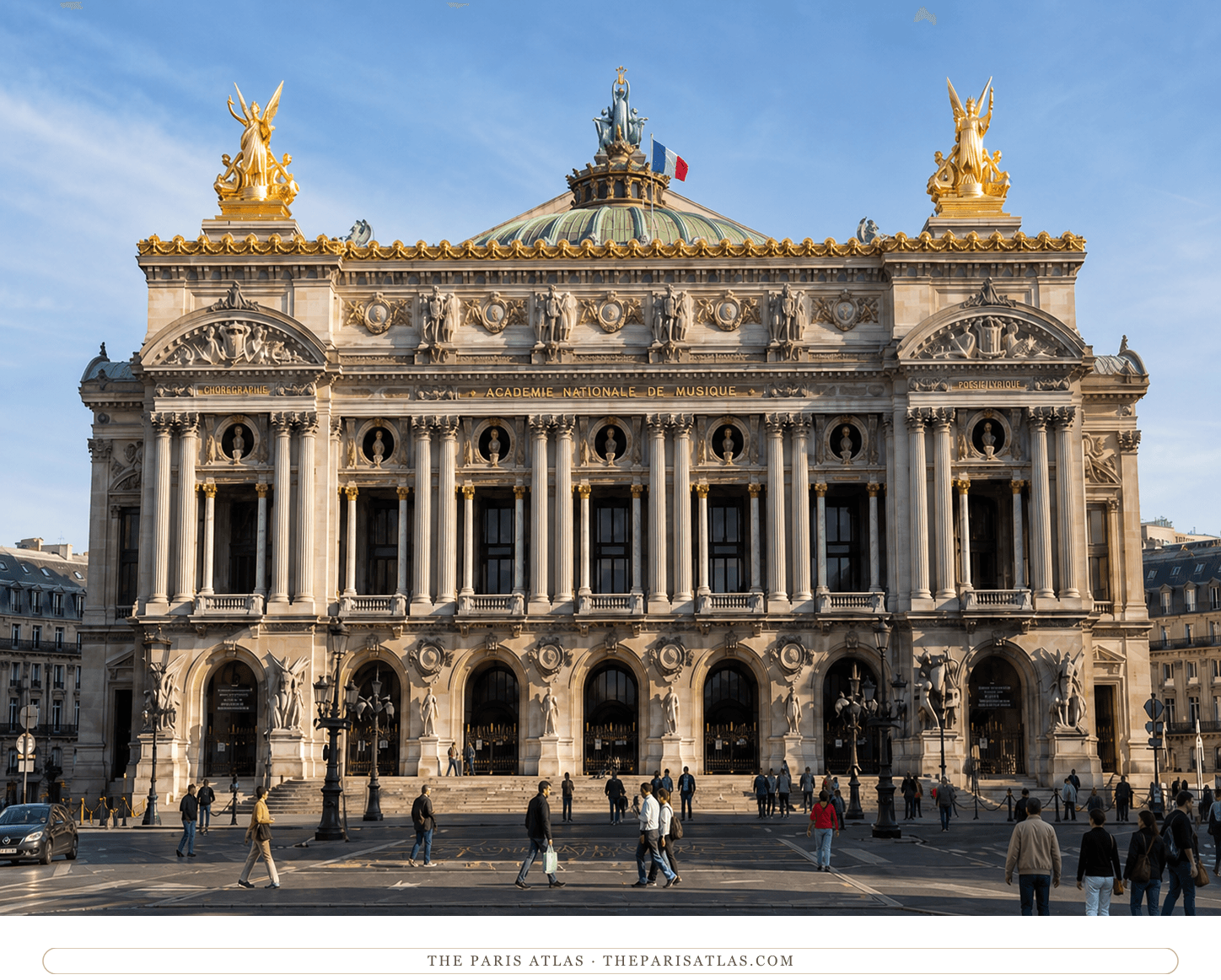
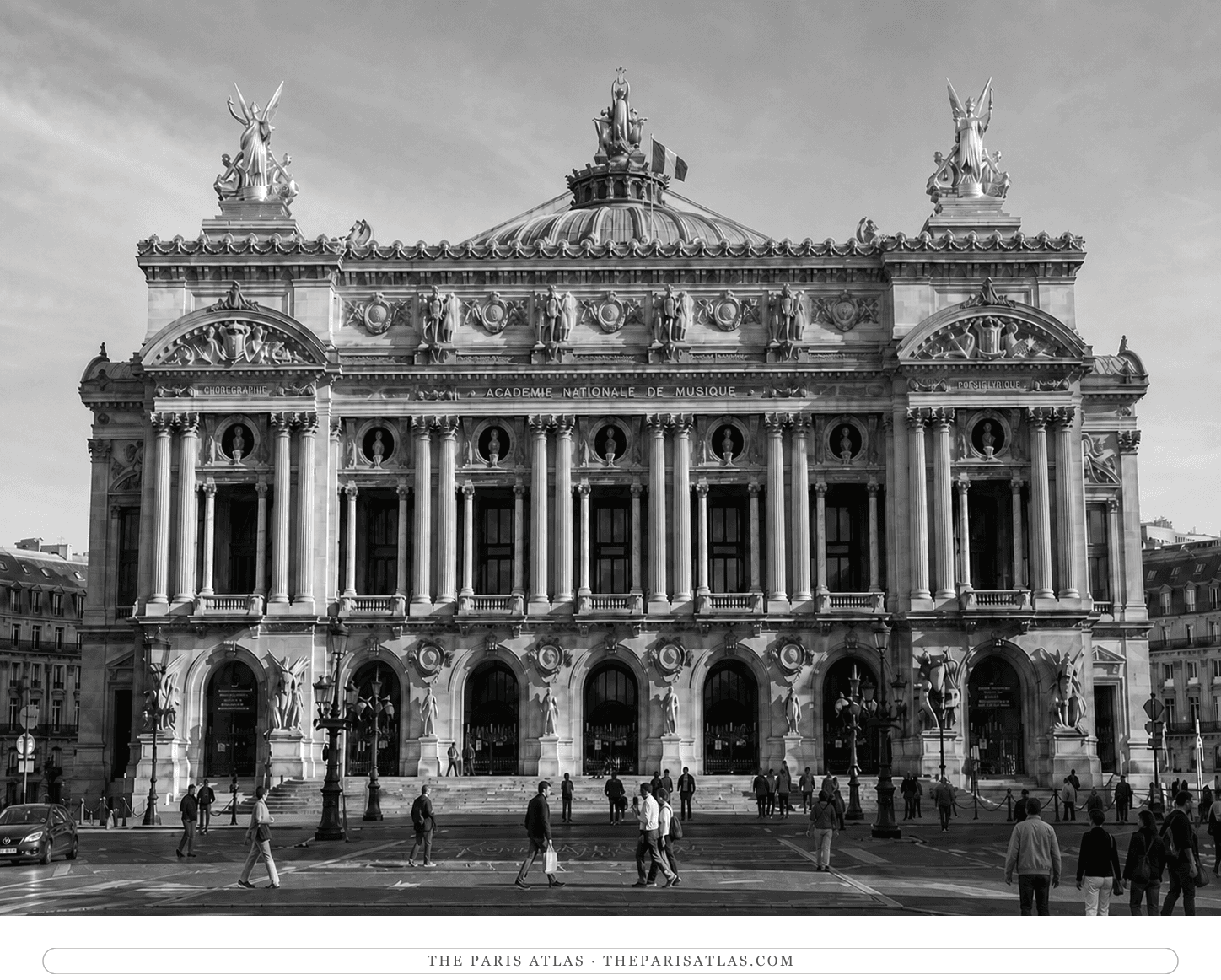
Christie's estate documents the outings but not the address. Its official biography, on the year she spent at Paris pensions from the age of fifteen, says that "much more to her tastes were the visits with her mother to the Grand Opera and excursions to Versailles, Fontainebleau and other historic places" — so that she went to the opera in Paris with Clara Miller in 1905–06 is stated directly. Which building is not. The identification rests on two things: "the Grand Opera" was the ordinary English name for the Paris Opera, as distinct from the Opéra-Comique, the city's other opera house; and the Paris Opera's house throughout those years was the Palais Garnier, which the company had occupied since 1875 and would occupy alone until the Opéra Bastille opened in 1989. The Opera's own history of the period describes the Palais Garnier as one of the major meeting and entertaining places of Paris in the Belle Époque, which is exactly the sort of evening the estate is describing. Recorded as probable rather than documented because no source in hand puts Christie inside this building by name.
The sources below include biographies, scholarly essays, interviews, and primary materials that informed this page. They reflect both the historical record and ongoing critical conversations about Agatha Christie and their work.

These references anchor the page in the documented record and in the scholarly conversations around Agatha Christie. Every claim on this page traces back to one or more of the works listed here.
 Explore more resources