
Murder on the Orient Express
Agatha Christie
Murder on the Orient Express
The other great Poirot journey, three years earlier, with the same closed circle of travellers and a detective who decides what justice is.
Read our takeDeath on the Nile
Agatha Christie
An heiress, her new husband and the friend she took him from, on a Nile steamer with nowhere to go but the next temple.
Linnet Ridgeway is twenty, beautiful and one of the richest women in England. Her friend Jacqueline de Bellefort asks her to give a job to the man she is going to marry, Simon Doyle. Linnet marries him instead. On their honeymoon in Egypt, Jacqueline follows them from hotel to hotel, and when the Doyles board the steamer Karnak for a week on the Nile she is on board too. So is Hercule Poirot, on holiday. Agatha Christie published the novel in 1937, after her own Nile journey, and it is the Poirot book with the largest cast and the most careful floor plan.
Agatha Christie went up the Nile in 1933 with her husband, the archaeologist Max Mallowan, on the steamer Sudan, stopping at the Cataract Hotel at Aswan and going on to Abu Simbel. The boat in the novel is called the Karnak, and her grandson Mathew Prichard has said that its layout was observed as carefully as the railway carriage in Murder on the Orient Express. The first movement of the book, in Part One, takes place on the terrace of the Cataract Hotel.[1][2]
Her notebooks show a different book. The early notes, in what John Curran numbers Notebook 30, are little more than a cast list, and the detective in them was Jane Marple. The novelist Salome Otterbourne began life under the name Mrs Pooper. By the time Christie wrote, Poirot had the case and the cast had grown to the two dozen names the book carries.[3]
The Saturday Evening Post ran the novel in eight parts from May to July 1937. The Collins Crime Club published it in London on 1 November 1937, with a jacket by Robin Macartney showing the Karnak before the temple at Abu Simbel, and Dodd, Mead published it in New York in February 1938. Christie later turned it into a play, first called Hidden Horizon and staged in London in 1946 as Murder on the Nile, with Poirot removed.[4][5]
Part One gathers the passengers. In England Linnet Ridgeway has just come into Wode Hall and her fortune. Her friend Jacqueline de Bellefort, poor and in love, asks her to employ Simon Doyle as land agent so that they can marry. Three months later Linnet has married Simon herself. Elsewhere a mother and son called Allerton plan a trip, an American trustee called Andrew Pennington hears of the marriage and books a passage, and a romantic novelist called Salome Otterbourne drags her daughter Rosalie to Egypt.
At the Cataract Hotel in Aswan the Doyles find Jacqueline waiting on the terrace. She has followed them through Italy and Egypt, and she means to go on. Linnet asks Hercule Poirot, who is on holiday, to make her stop. Poirot speaks to Jacqueline instead. She shows him a small pistol with a pearl handle and tells him she has thought of putting it against Simon's head. He tells her to turn back before it is too late. She says it is already too late.
The Doyles change their plans secretly and board the steamer Karnak for the trip south to the Second Cataract. Jacqueline is on board. So are Poirot and Colonel Race, who is hunting a political agitator travelling under a false name. So are Pennington, the Allertons and the Otterbournes. The rich and light-fingered Miss Van Schuyler is aboard with her cousin Cornelia and her nurse Miss Bowers. So are a German doctor called Bessner, a young lawyer called Fanthorp, a loud young socialist called Ferguson, and Linnet's French maid Louise Bourget. At Abu Simbel a boulder falls from the cliff and misses Linnet by feet.
On the night after Wadi Halfa, Jacqueline drinks too much in the saloon and quarrels with Simon in front of Cornelia and Fanthorp. She draws the pistol and fires. Simon falls with blood on his trouser leg. Jacqueline collapses in hysterics. Fanthorp and Cornelia get her to her cabin, where Miss Bowers sits up with her, and fetch Dr Bessner for Simon, who has a bullet in the bone above the knee. Someone kicks the pistol under a settee. When they look for it, it is gone.
In the morning Linnet is found in her cabin shot through the head as she slept, a letter J drawn on the wall beside her in her own blood. Her pearls are missing. Jacqueline was never alone that night and Simon could not stand. Poirot and Race question the boat. Louise Bourget says that if she had gone out on deck she might have seen the murderer, and looks at someone as she says it. The pistol is dredged from the river wrapped in Miss Van Schuyler's velvet stole, with two shots fired. In Linnet's cabin is a bottle of nail polish labelled Rose that holds red ink.
Louise Bourget is found dead in her cabin, stabbed with one of Dr Bessner's scalpels, a torn corner of a thousand-franc note in her fingers. Salome Otterbourne comes to the cabin where Simon lies and announces that she saw who went into Louise's cabin. A shot from the doorway kills her before she can say the name. Pennington is found to have been stealing from Linnet's estate and trying to get her signature on papers. The pearls turn out to have been swapped for fakes by Tim Allerton, and the fakes taken by Miss Van Schuyler. Poirot says that the facts that will not fit are always the ones that matter, and asks Race to hear how it was done.
Simon Doyle and Jacqueline de Bellefort planned it together, for Linnet's money. In the saloon Jacqueline fired and missed on purpose. Simon faked his wound with red ink from the nail polish bottle. When Fanthorp and Cornelia had taken Jacqueline away and gone for the doctor, Simon ran to Linnet's cabin and shot her. He drew the J to point at Jacqueline, ran back, and shot himself in the leg through the velvet stole to muffle the sound. He threw the pistol out of the window. Then he lay where he had fallen until the doctor came.
Louise Bourget had seen him and tried to sell her silence. Jacqueline, carrying a message from Simon, killed her with the scalpel. Salome Otterbourne had seen Jacqueline go in, and Jacqueline shot her with a pistol taken from Pennington's cabin. Poirot tells all this to the two of them. As the Karnak reaches Shellal, Jacqueline goes to Simon on the deck, shoots him, and shoots herself with a second pistol she had kept. Race asks Poirot whether he knew she had it. Poirot says that he did.
The first chapter is a series of short scenes in England, America and the Cataract Hotel, each introducing a passenger and a motive. A trustee hears about a wedding and books a ticket. A lawyer is sent out by his firm. A woman steals a string of beads. None of it looks like plot. Agatha Christie is loading the boat, one passenger at a time, and every scene contains a fact that Poirot will use.
The scene on the Cataract terrace between Poirot and Jacqueline is the moral centre of the book and comes before any crime. She shows him the pistol and tells him what she has imagined doing with it. He tells her to turn back. The whole novel is the consequence of her refusal, and Christie makes sure the reader has heard the warning before the boat sails.
The shooting in the saloon is witnessed by two reliable people, and that is the trick. Cornelia and Fanthorp see the pistol fired, see Simon fall, see blood on his leg, and their first duty is to the hysterical woman with the gun. They take her away. They go for the doctor. For a few minutes the wounded man is alone, and nobody thinks that a man with a bullet in his leg can move. He had no bullet in his leg yet.
Christie leaves the evidence on the floor. A bottle of nail polish labelled Rose contains red ink, which Poirot notices because the colour does not match the name. A velvet stole comes out of the river wrapped round the pistol, scorched where a shot went through it. The pistol has fired twice when the saloon saw one shot and the cabin needed one more. Poirot's line to Race, that the facts which will not fit are the significant ones, is the method stated plainly. Every fact that would not fit was a fact about Simon.
Jacqueline's alibi is a nurse who never left her side. Simon's is a doctor and a bullet. Both are true. The book's design is that the two people with the strongest motive have the two strongest alibis, and that each alibi was built by the other. Christie had used a version of the idea before, but never with the reader watching the alibi being made.
The boat is full of people with smaller secrets, and each one is a false trail that is also true. Pennington really was robbing Linnet. Tim Allerton really did steal the pearls. Miss Van Schuyler really is a thief and Ferguson really is a lord. Race really is hunting an agitator, and finds him. The book solves every one of these before the main solution, so that by the last chapters the only people left unexplained are the two the reader stopped suspecting first.
Poirot has known since the second murder, he tells Race, and he waits. He lays it all out to Simon and Jacqueline in the doctor's cabin, and then he does not have Jacqueline searched. She has a second pistol. On the landing stage she uses it, first on Simon and then on herself, and Race asks the question the reader is asking. Poirot's answer is yes.
The ending is the book's judgment on the terrace scene. Jacqueline chose, and Poirot let her finish choosing. When Christie turned the novel into a play in 1944 she removed Poirot entirely, which changed the ending's meaning: a story about a detective's mercy became a story about a woman's. The 1978 film with Peter Ustinov, the 2004 ITV version with David Suchet, Emily Blunt and James Fox, and Kenneth Branagh's 2022 film all kept the shots on the landing stage.
It is always the facts that will not fit in that are significant.
The two people with the strongest motive have the two strongest alibis, and the reader watches both being made without seeing it. On a second reading the whole mechanism is in view.
She went up the Nile on the steamer Sudan in 1933 and stayed at the Cataract Hotel at Aswan. The Karnak is the Sudan with the name changed, and the terrace at Aswan is where the book turns.
Poirot knows about the second pistol and does nothing. What he allows on the landing stage at Shellal is the most argued-over thing he ever did, after the Orient Express.
The retired Belgian detective on holiday, who warns a young woman on a hotel terrace and then has to watch what she does with the warning.
The heiress who took her best friend's fiancé and cannot understand why her honeymoon is being followed.
The good-looking young man with no money, engaged to Jacqueline and married to Linnet within three months.
The friend Linnet betrayed, who follows the honeymoon across Egypt with a pearl-handled pistol in her bag.
Poirot's old friend, on the Karnak to catch a political agitator travelling under another name, who ends up questioning a boatload of suspects instead.
The novelist of sexual passion, in a turban, whose books no longer sell and whose daughter carries a secret about her.
The novelist's sullen daughter, seen throwing something into the Nile in the night.
Linnet's American trustee, who happens to be in Cairo with a briefcase full of papers for her to sign.
The charming young man travelling with his mother, who knows the girl in London who copies famous pearls.
Linnet's French maid, who might have seen the murderer if she had gone out on deck, and says so to the wrong person.
1933
Christie and Max Mallowan travel up the Nile on the steamer Sudan and stay at the Cataract Hotel at Aswan.
1937
The Saturday Evening Post serialises the novel in eight parts from May to July; the Collins Crime Club publishes it in London on 1 November.
1938
Dodd, Mead publishes the American edition in February.
1946
Christie's stage version, written without Poirot, opens in London as Murder on the Nile and on Broadway the same year.
1978
John Guillermin's film is released with Peter Ustinov as Poirot.
2004
ITV broadcasts the David Suchet adaptation, with Emily Blunt and James Fox.
2022
Kenneth Branagh's film is released in February.


Murder on the Orient Express
Agatha Christie
The other great Poirot journey, three years earlier, with the same closed circle of travellers and a detective who decides what justice is.
Read our takeThe Murder of Roger Ackroyd
Agatha Christie
Poirot's most famous case, for readers who want the detective's boldest trick after his best-built one.
Read our takeAnd Then There Were None
Agatha Christie
Written two years later: the same idea of a company of the guilty, cut off, with no detective this time.
Read our takeThe Mysterious Affair at Styles
Agatha Christie
Poirot's first case, where the method of the fact that will not fit was first used.
Read our takeYes. Agatha Christie went up the Nile in 1933 with her husband Max Mallowan on the steamer Sudan and stayed at the Cataract Hotel at Aswan. The Karnak in the novel is the Sudan under another name, and the hotel terrace is where the book's first movement is set.
No. When Christie adapted the novel for the stage in 1944 she removed him. The play was first called Hidden Horizon, was staged in London in 1946 as Murder on the Nile, and reached Broadway the same year.
An old friend of Poirot's in British government service, on the Karnak to catch a political agitator travelling under a false name. He had appeared in earlier Christie novels and takes charge of the inquiry when Linnet is killed.
According to John Curran's study of Christie's notebooks, the earliest notes for the book had Jane Marple as the detective. By the time Christie wrote it, Poirot had the case.
There are three. John Guillermin's 1978 film has Peter Ustinov as Poirot and a large star cast. ITV's 2004 version has David Suchet, with Emily Blunt and James Fox. Kenneth Branagh's film was released in February 2022.
The plot section below tells it in full, with the murderers named and the last scene at Shellal described. Nothing above the plot section gives it away.
Explore authors with a similar voice, perspective, and influence.
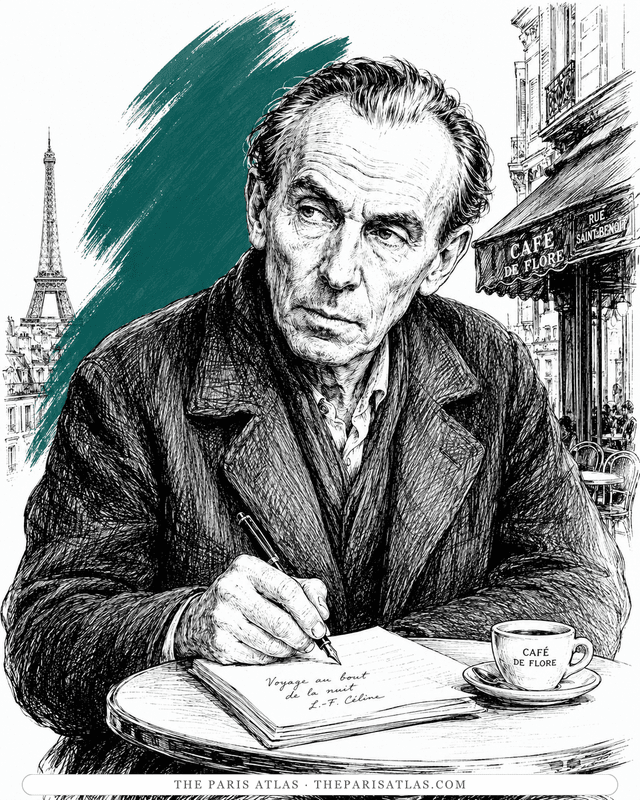
The doctor of the Paris slums who wrote the century's blackest, funniest novel — and changed the sound of French prose.
View author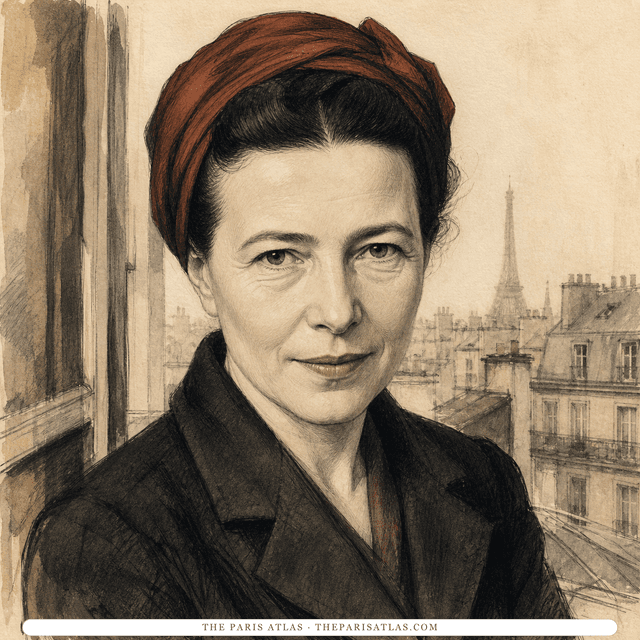
French writer and philosopher whose novels, memoirs, and social analysis examined freedom, gender, responsibility, aging, and the material conditions that shape a life.
View author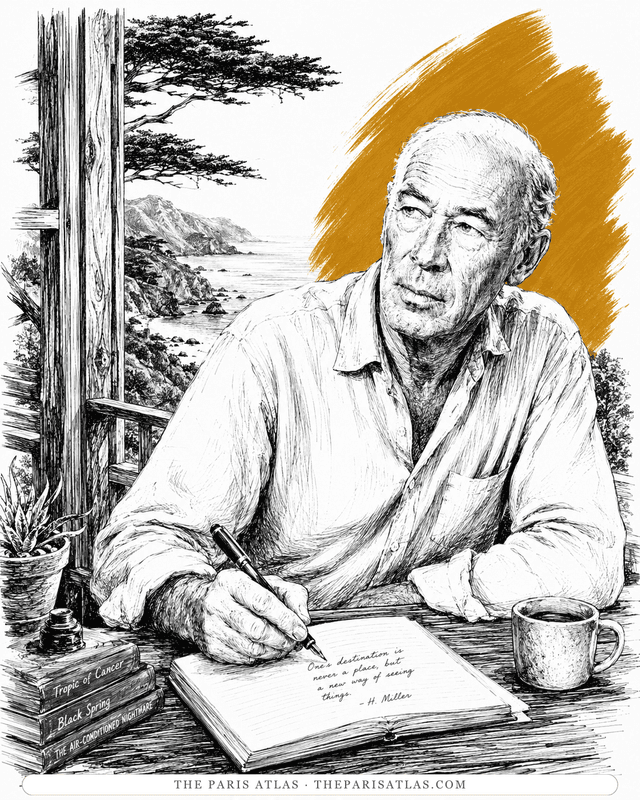
The Brooklyn dropout who arrived in Paris broke at thirty-eight and wrote the exuberant, banned books that ended American censorship.
View authorThe sources below include the primary text, editions, scholarship, archival materials, and other records that informed this page. They document Death on the Nile, its publication, and its place in literary history.


The 1933 journey on the Sudan, the Cataract Hotel and Abu Simbel.
Mathew Prichard on how closely the boat's layout was observed.

The notebooks: Miss Marple as the first detective, Mrs Pooper, and the sketchy state of Notebook 30.
A collectors' bibliography, the source for the 1937 serial, the Collins and Dodd, Mead dates and the Macartney jacket.
The estate's own page for the novel: the Egypt travels, the play's titles and dates, the films and the Poirot line quoted above.
A first-edition guide, used to check the page counts and prices.
HarperCollins UK's product page, the source for the current paperback and ebook ISBNs.
Open Library edition records, used to check the William Morrow and HarperCollins ISBNs.
The primary text represented by this page, used for descriptions of the work’s contents and for any quoted passages shown here.
The primary text is the baseline reference for every book page. Additional references document publication history, interpretation, and historical context where that evidence is available.
 Explore more resources