
Death on the Nile
Agatha Christie
Death on the Nile
The other great Poirot travel book, three years later: a Nile steamer instead of a train, and the same closed circle of passengers.
Read our takeMurder on the Orient Express
Agatha Christie
A snowbound train, a dead American with twelve stab wounds, and a carriage full of strangers who all have an alibi.
Hercule Poirot, the retired Belgian police officer, boards the Simplon Orient Express at Istanbul in the dead of winter. The Calais coach is unexpectedly full. On the second night a snowdrift stops the train in Yugoslavia, and in the morning an American passenger called Samuel Ratchett is found stabbed in his locked compartment. Nobody can have left the train. Poirot has the passengers, their luggage and one long day of snow. Agatha Christie published the book in 1934, and it is her most famous single puzzle.
Agatha Christie knew the train. She first rode the Simplon Orient Express in 1928, on her first journey alone after her divorce, on her way to Baghdad and the excavation at Ur where she met Max Mallowan. In 1931 she rode it back from Istanbul through a thunderstorm and a flood. The train stopped in the middle of the night, and she wrote to Max Mallowan describing the passengers around her. The estate says some of them, including the woman who became Mrs Hubbard, went into the book.[1]
Two newspaper stories fed the plot. In 1929 the real Orient Express was marooned in a Turkish blizzard for six days. In 1932 the twenty-month-old son of the aviator Charles Lindbergh was kidnapped for ransom and killed. The kidnapping in the novel, of a small girl called Daisy Armstrong, follows the Lindbergh case closely and was written while that case was still open.[2]
The novel ran first in the American Saturday Evening Post in the autumn of 1933 under the title Murder in the Calais Coach. The Collins Crime Club published it in London on 1 January 1934, and Dodd, Mead published it in New York the following month, keeping the American serial title so that readers would not confuse it with Graham Greene's Stamboul Train. Christie dedicated it to Max Mallowan, dating the dedication from the dig at Arpachiyah in Iraq in 1933.[3]
The coach is the through carriage from Istanbul to Calais. Its route would have run through Milan, Lausanne and Paris before the Channel. The snow stops it between Vinkovci and Brod, in what was then Yugoslavia, and the book never leaves that spot. Paris is where everybody is going and stays off the page.[4]
Hercule Poirot has finished a case in Syria and is travelling home. On the Taurus Express to Istanbul he notices two English passengers, Mary Debenham and Colonel Arbuthnot, who behave like strangers and are not. At the Tokatlian Hotel in Istanbul a telegram calls him back to London at once. His friend Monsieur Bouc, a director of the sleeping-car company, finds him a berth in the Istanbul to Calais coach, which is oddly full for December.
An American called Samuel Ratchett, travelling with a secretary, Hector MacQueen, and a valet, Edward Masterman, offers Poirot a large fee to protect him. He has received threatening letters. Poirot refuses. He tells Ratchett he does not like his face.
The train leaves Belgrade and runs into snow in the night. In the morning it is stuck fast between Vinkovci and Brod. Ratchett is dead in his compartment, stabbed twelve times. The door was locked and chained from inside, and the window is open onto snow that shows no footprints. His watch has stopped at a quarter past one.
Bouc asks Poirot to find the killer before the Yugoslav police arrive. Dr Constantine, a Greek doctor on the train, reports that the wounds make no sense. Some are deep and some are shallow. Some were struck by a right hand and some by a left. In the compartment Poirot finds a pipe cleaner, a woman's handkerchief embroidered with the letter H, and a scrap of burned paper. Heat brings up the words that were burned away: the name Daisy Armstrong.
Poirot knows the name. Daisy Armstrong was a small American girl kidnapped and murdered some years before. Her mother died in childbirth from the shock, her father shot himself, and a nursemaid wrongly suspected of helping the kidnapper threw herself from a window. The kidnapper, a gangster called Cassetti, bought his way out of a conviction and vanished. Ratchett was Cassetti.
Poirot questions every passenger in turn. He starts with the conductor Pierre Michel, the secretary MacQueen and the valet Masterman. Then come the loud American widow Mrs Hubbard, the Swedish missionary Greta Ohlsson, and the Russian Princess Dragomiroff with her German maid Hildegarde Schmidt. After them the Hungarian Count and Countess Andrenyi, Colonel Arbuthnot, the American salesman Cyrus Hardman, the Italian Antonio Foscarelli, and Mary Debenham. Each has an alibi supplied by another passenger. Several saw a small dark man in a conductor's uniform who does not exist. Mrs Hubbard says a man was in her compartment in the night, and later finds a bloody knife in her sponge bag.
The luggage search turns up a conductor's uniform in Hildegarde Schmidt's case and a scarlet kimono in Poirot's own. Poirot sits back, thinks, and asks the passengers to gather in the dining car.
Poirot offers two solutions. In the first, a stranger boarded the train at Vinkovci dressed as a conductor, killed Ratchett, and slipped away before the snow closed in. In the second, every passenger in the coach was connected to the Armstrong household. Mrs Hubbard is the actress Linda Arden, Daisy's grandmother. The Countess is Daisy's aunt. Colonel Arbuthnot was her father's friend, and MacQueen the son of the prosecutor. Masterman was the family's old batman, Hildegarde Schmidt the cook, Greta Ohlsson the nurse and Foscarelli the chauffeur. Mary Debenham was the governess. Hardman was a policeman in love with the dead nursemaid, and Pierre Michel was her father. Princess Dragomiroff was Daisy's mother's godmother.
Twelve of them stabbed Ratchett in turn, one blow each, like a jury of twelve delivering a sentence. The Count struck for his wife so that she would not have to. The false clues, the stopped watch, the phantom conductor and the contradictory wounds were all arranged to point away from the coach. Bouc and Dr Constantine choose the first solution to give to the police, and Poirot says he has the honour to retire from the case.
The first thing Poirot is shown is a room that seems to prove its own story. Ratchett's door was locked and chained from inside. The communicating door to Mrs Hubbard's compartment was bolted on her side. The window stood open, and the snow below it was smooth. The watch in his pyjama pocket had stopped at a quarter past one. Every one of those facts is presented before Poirot has spoken to a single passenger, so the reader takes them as the ground the case stands on.
Agatha Christie's method is to let the evidence be too helpful. A stopped watch is the oldest trick in the genre, and Poirot says so. An open window in a snowstorm is not an escape route but a suggestion of one. The burned scrap of paper that gives up the name Armstrong is the one clue that was not meant to survive, and it is the only one that leads anywhere. The reader is invited to sort the planted facts from the accidental one, and the book is fair because it shows Poirot doing exactly that.
Dr Constantine's report is the book's central clue, and it is handed over in the plainest words. Some wounds are deep enough to kill and some barely broke the skin. Some were struck by a right-handed person and some by a left-handed one. Two were made after death. The doctor's conclusion is that there must have been two murderers, and he cannot make even that work. Poirot's response is to treat the contradiction as information rather than noise.
The same is true of the objects. The pipe cleaner points at Colonel Arbuthnot, the only pipe smoker. The handkerchief with an H points at three women. The kimono points at a woman nobody can name, and the uniform button at a conductor nobody can find. Poirot says in Part Two that the impossible cannot have happened, so the impossible must be possible in spite of appearances. The line is the book's rule of play. Too many clues pointing in too many directions is itself a clue, and it points at everybody.
Part Two gives each passenger a chapter of their own, and the structure is doing the hiding. Read one at a time, every account is reasonable. The valet vouches for the secretary, the secretary for the Colonel, the Swedish nurse for Mrs Hubbard. Only when the chapters are set side by side, as Poirot does in the summary chapter, does the pattern show. Every alibi in the coach is supplied by another suspect, and no two people admit to knowing each other.
Two small clues carry the weight of the solution. The Countess Andrenyi's passport has a grease spot over the first letter of her name, and Poirot works out that Elena was once Helena, a name with the initial on the handkerchief. The handkerchief itself belongs to Princess Natalia Dragomiroff, because in the Russian alphabet the letter for N is written like a Latin H. Both clues are the sort a reader can solve at home, and Christie places them in full view before Poirot explains them.
Most detective novels end with one answer. Christie ends this one with two, and she has Poirot present the false one first and in full. The stranger who boarded at Vinkovci is a complete story, with a uniform, a pass-key and an escape into the snow. Then Poirot tells the true one, name by name, until the whole coach is accounted for. The choice between them is given to Bouc and Dr Constantine, who represent the railway and the law, and they choose the lie.
The ending has been argued over since 1934 because Poirot, who elsewhere refuses to let murderers go, walks away from twelve of them. The book's answer is the Armstrong story itself, told in Part One and repeated in the confession: a child killed, a mother and an unborn baby dead, a father's suicide, a nursemaid's suicide, and a killer who bought a jury. Sidney Lumet's 1974 film, with Albert Finney as Poirot, kept the double ending, and Christie attended its London premiere at eighty-four. It was her last public appearance.
The impossible could not have happened, therefore the impossible must be possible in spite of appearances.
Everybody thinks they know it. Reading the book shows how carefully the twelve wounds, the stopped watch and the false conductor were set up so that the solution is fair.
She rode the Simplon Orient Express in 1928 and again in 1931, when it stopped in the night in a flood. Her letter home about the other passengers is where Mrs Hubbard comes from.
Once the Armstrong story is told, the question stops being who did it and becomes what Poirot will do about it. The book gives its detective a choice and lets the reader judge it.
The retired Belgian police officer with the egg-shaped head and the enormous moustache, going home to London and finding a corpse in the next coach.
The rich American with the soft voice and the evil face, travelling with a secretary and a valet and a stack of threatening letters.
The talkative American widow next door to the dead man, who found a stranger in her compartment in the night and a knife in her sponge bag in the morning.
The cool English governess Poirot first notices on the Taurus Express, saying something to Colonel Arbuthnot that a stranger would not say.
The British officer back from India, the only pipe smoker on the train, who sat up late with the secretary and would rather not discuss Mary Debenham.
Ratchett's young American secretary, who translated for a man who spoke no French and read the threatening letters before his employer did.
Poirot's old friend, a director of the sleeping-car company, who finds him a berth and then hands him the case.
The ugly, ancient Russian aristocrat with the German maid and the will to match her name.
The Greek doctor from the Athens coach who examines the body and cannot make the wounds agree.
The French conductor of the Calais coach, who answered every bell that night and swears nobody passed him.
1928
Agatha Christie rides the Simplon Orient Express for the first time, alone, on her way to Baghdad and the excavation at Ur.
1929
The real Orient Express is stranded in a Turkish blizzard for six days.
1931
Returning from Istanbul, Christie's train is stopped in the night by a flood after a thunderstorm; her letter to Max Mallowan describes the passengers.
1932
The Lindbergh baby is kidnapped and killed in New Jersey, the case behind the novel's Armstrong kidnapping.
1933
The Saturday Evening Post serialises the novel in six parts as Murder in the Calais Coach.
1934
The Collins Crime Club publishes it in London on 1 January; Dodd, Mead publishes it in New York in February under the serial title.
1974
Sidney Lumet's film opens with Albert Finney as Poirot; Christie attends the London premiere, her last public appearance.
2010
David Suchet plays Poirot in the ITV adaptation, broadcast on Christmas Day.
2017
Kenneth Branagh directs and stars in a new film.


Death on the Nile
Agatha Christie
The other great Poirot travel book, three years later: a Nile steamer instead of a train, and the same closed circle of passengers.
Read our takeThe Murder of Roger Ackroyd
Agatha Christie
The book that made Christie's name for a trick, eight years earlier; the two are usually named together as her boldest solutions.
Read our takeAnd Then There Were None
Agatha Christie
Ten strangers cut off from the world instead of thirteen — the same shape of puzzle without a detective in it.
Read our takeThe Mysterious Affair at Styles
Agatha Christie
Poirot's first case, where the Belgian refugee with the moustache is introduced.
Read our takeNo. He is Belgian, a retired officer of the Brussels police, and he corrects people who call him French throughout the book. Agatha Christie made him Belgian in 1916 because Belgian refugees from the German invasion were living near her home in Torquay.
In a snowdrift between Vinkovci and Brod, in what was then Yugoslavia, on the second night out of Istanbul. The coach is the through carriage to Calais, which would have gone on through Milan, Lausanne and Paris. The book never leaves the snowdrift.
Two of them. The Armstrong kidnapping in the book follows the 1932 kidnapping and murder of Charles Lindbergh's baby son, which was still unsolved when Christie wrote. The snowbound train follows a real incident of 1929, when the Orient Express was stuck in a Turkish blizzard for six days. Christie had also ridden the train herself, in 1928 and 1931.
Yes. That was the title of the American magazine serial in 1933 and of the first American edition from Dodd, Mead in 1934. American editions have used the British title for decades.
The plot section answers that in full, with the ending told. The short spoiler-free version is that Dr Constantine counts twelve wounds and cannot make them agree.
Sidney Lumet's 1974 film with Albert Finney as Poirot is the one Christie saw; she attended its London premiere at eighty-four, her last public appearance, and Ingrid Bergman won an Academy Award for it. David Suchet's television version came in 2010 and Kenneth Branagh's film in 2017.
No. Paris is on the coach's route and in the passengers' plans, and that is all. Christie's own Paris was a year of finishing school in 1905 and 1906, and she set no novel there.
Explore authors with a similar voice, perspective, and influence.
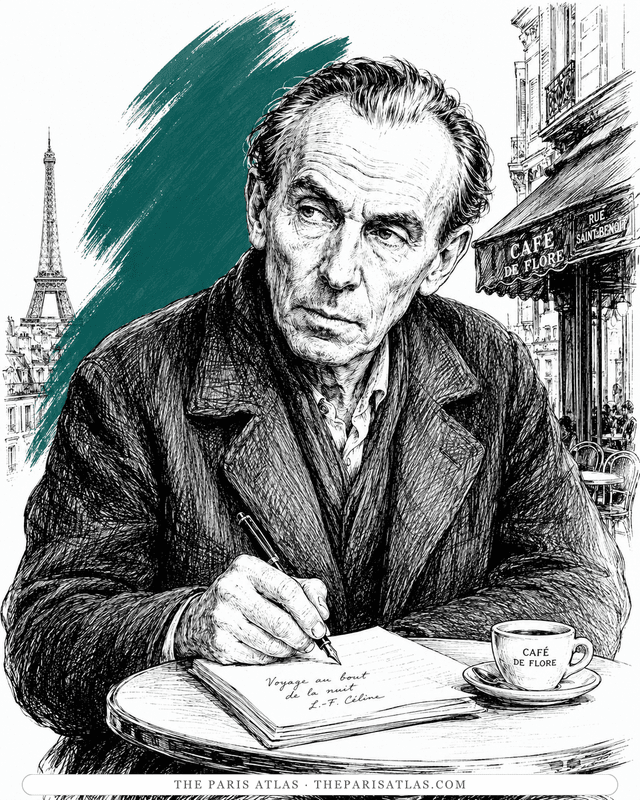
The doctor of the Paris slums who wrote the century's blackest, funniest novel — and changed the sound of French prose.
View author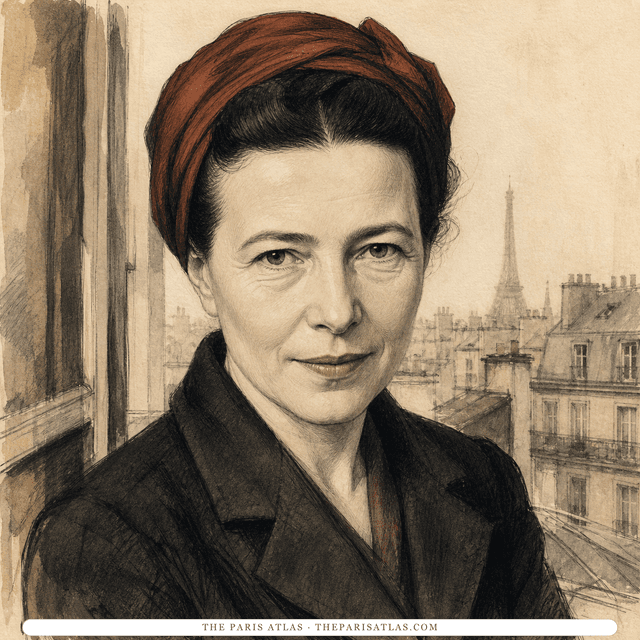
French writer and philosopher whose novels, memoirs, and social analysis examined freedom, gender, responsibility, aging, and the material conditions that shape a life.
View author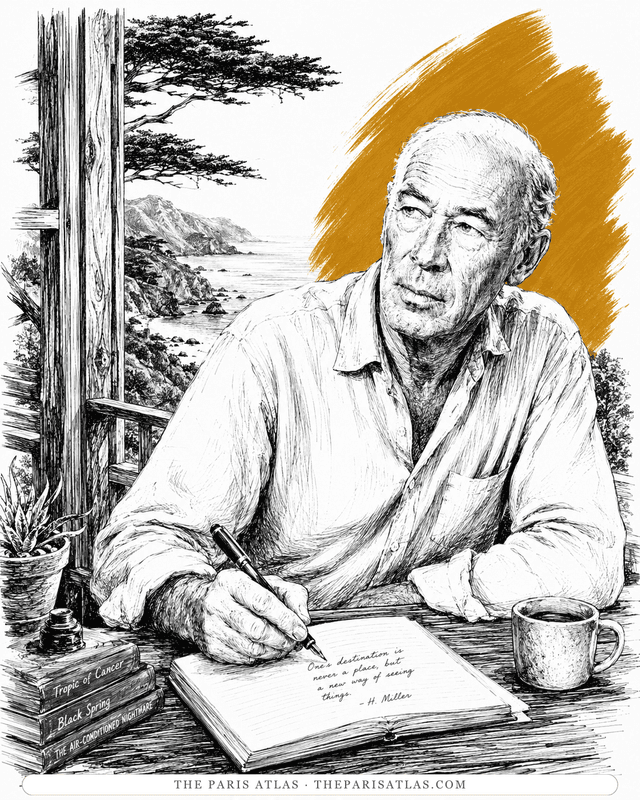
The Brooklyn dropout who arrived in Paris broke at thirty-eight and wrote the exuberant, banned books that ended American censorship.
View authorThe sources below include the primary text, editions, scholarship, archival materials, and other records that informed this page. They document Murder on the Orient Express, its publication, and its place in literary history.

The estate on Christie's 1928 and 1931 journeys and her letter home about the passengers.
The estate on the Lindbergh case, the 1929 blizzard, the dedication to Max Mallowan and the 1974 premiere.
A collectors' bibliography for the 1934 Collins and Dodd, Mead first editions.
The estate's own page for the novel: publication, the serial title, adaptations and the Poirot line quoted above.
Mathew Prichard on the 1931 journey and on how closely the train's layout was checked.
HarperCollins UK's product page, the source for the current paperback and hardback ISBNs.
Open Library edition records, used to check the William Morrow and HarperCollins ISBNs.
The estate's life of Christie, for Poirot's origin among the Belgian refugees in Torquay.
Christie's own account of inventing a Belgian detective.
The primary text represented by this page, used for descriptions of the work’s contents and for any quoted passages shown here.
The primary text is the baseline reference for every book page. Additional references document publication history, interpretation, and historical context where that evidence is available.
 Explore more resources