
The Paris AtlasCharting the artists, works, and places worth returning to.

In their own words

F. Scott Fitzgerald quotes

141 quotations, each verified against its source and credited to the work it comes from — the wording as F. Scott Fitzgerald wrote or said it, not as the internet passes it around. Page 1 of 6.

Illustrated portrait of F. Scott Fitzgerald

How these quotes were checked

How we decide whether a quote is genuine

F. Scott Fitzgerald is quoted everywhere and verified almost nowhere. A line enters this collection only when its wording has been read against a printed edition — the Crack-Up essays and notebooks in the New Directions text, and his letters in Andrew Turnbull's edition of the letters to his daughter — with the page recorded for each.

Two of the most shared “Fitzgerald” quotations are not his, and one of his most famous lines is usually quoted as only half a sentence. Where a familiar wording fails the check, it is listed below with what the evidence shows, rather than left off quietly.

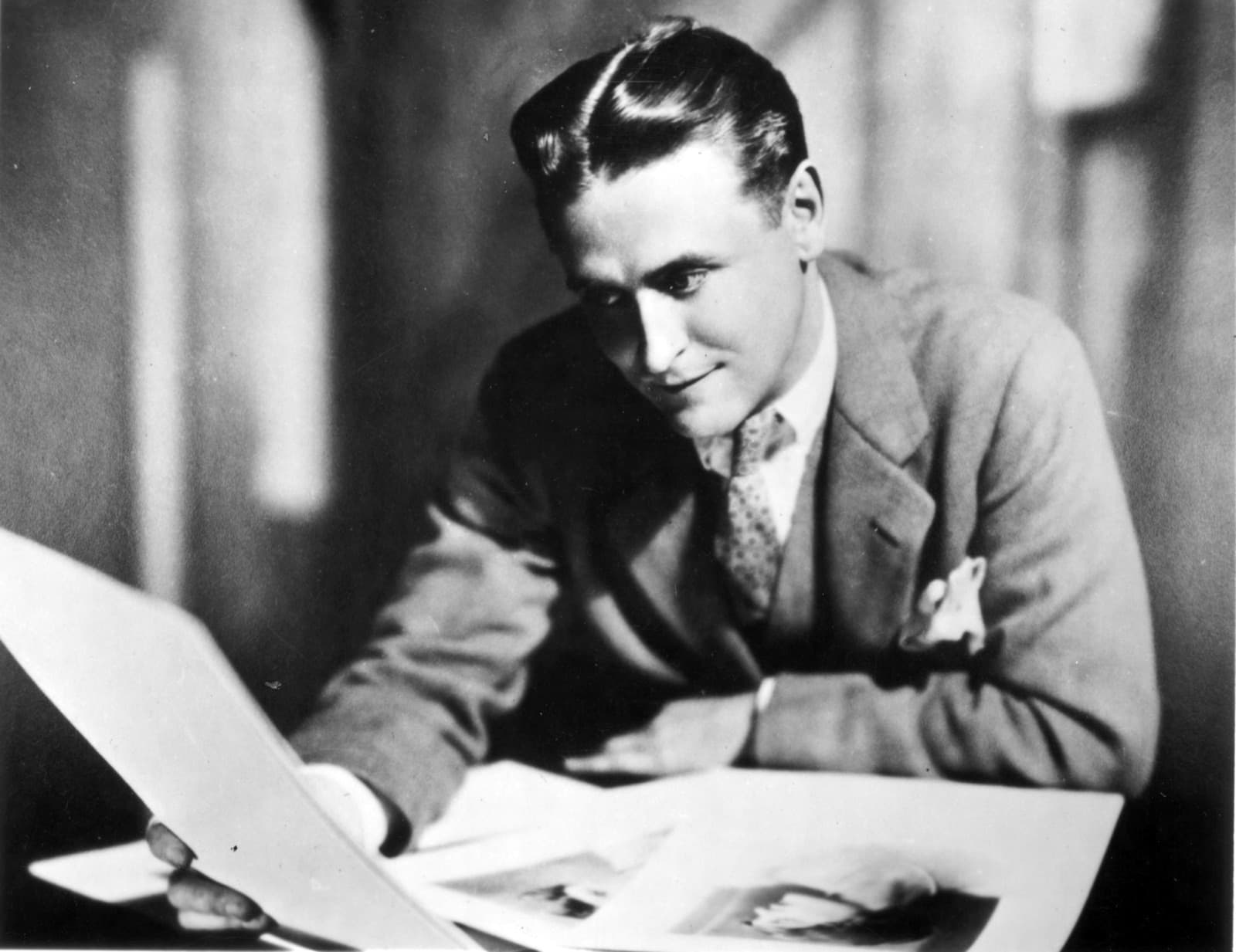
Portrait of F. Scott Fitzgerald by Nickolas Muray, 1929
Fitzgerald photographed by Nickolas Muray, 1929 — the mature portrait, made in the long middle of the Tender Is the Night years. Nickolas Muray. Public domain.

Four famous Hemingway quotes, fact-checked

A sentence linked to Hemingway may be exact, shortened, remembered by someone else, or unsupported. Each label below explains what the available evidence actually proves.

Misattributed

For what it's worth: it's never too late or, in my case, too early to be whoever you want to be.

This speech comes from the 2008 film The Curious Case of Benjamin Button, written by the screenwriter Eric Roth. Fitzgerald's 1922 short story of the same name, published in Tales of the Jazz Age, contains no version of it — the full Project Gutenberg text has no “never too late” passage at all. The film credit migrated to Fitzgerald because the story supplied the film's title and premise.

  • F. Scott Fitzgerald, Tales of the Jazz Age (1922)
Unproven

First you take a drink, then the drink takes a drink, then the drink takes you.

No Fitzgerald text, letter, or interview containing this sentence has been produced. The saying was already in print as a temperance maxim before his career began — the Anti-Saloon League Song Book carried it in 1919, the year before his first novel — and proverb collections file it as a Japanese proverb. Because Fitzgerald's drinking is famous, quote sites attach it to him without a citation.

  • E. O. Excell, The Anti-Saloon League Song Book (1919)
Verified

In a real dark night of the soul it is always three o'clock in the morning.

Genuine, but usually quoted as half of its sentence and without its ending. In “Pasting It Together,” the second Crack-Up essay, the full sentence begins “But at three o'clock in the morning, a forgotten package has the same tragic importance as a death sentence,” and closes “day after day.” The notebooks carry a compressed variant of the line as well.

  • F. Scott Fitzgerald, edited by Edmund Wilson, The Crack-Up (1945)

notebook entry, published in The Crack-Up (1945) quotes

Show me a hero and I will write you a tragedy.
F. Scott Fitzgerald, notebook entry, published in The Crack-Up (1945)
You don't write because you want to say something; you write because you've got something to say.
F. Scott Fitzgerald, notebook entry, published in The Crack-Up (1945)
Genius is the ability to put into effect what is in your mind. There's no other definition of it.
F. Scott Fitzgerald, notebook entry, published in The Crack-Up (1945)
Vitality shows in not only the ability to persist but the ability to start over.
F. Scott Fitzgerald, notebook entry, published in The Crack-Up (1945)
Listen, little Elia: draw your chair up close to the edge of the precipice and I'll tell you a story.
F. Scott Fitzgerald, notebook entry, published in The Crack-Up (1945)
No grand idea was ever born in a conference, but a lot of foolish ideas have died there.
F. Scott Fitzgerald, notebook entry, published in The Crack-Up (1945)
Switzerland is a country where very few things begin, but many things end.
F. Scott Fitzgerald, notebook entry, published in The Crack-Up (1945)
After all, the portrait of an old shoe by Van Gogh hangs in the Louvre, but where is there a portrait of Van Gogh by an old shoe?
F. Scott Fitzgerald, notebook entry, published in The Crack-Up (1945)
Optimism is the content of small men in high places.
F. Scott Fitzgerald, notebook entry, published in The Crack-Up (1945)
Then I was drunk for many years, and then I died.
F. Scott Fitzgerald, notebook entry, published in The Crack-Up (1945)

“The Crack-Up,” Esquire, February 1936 quotes

The test of a first-rate intelligence is the ability to hold two opposed ideas in the mind at the same time, and still retain the ability to function.
F. Scott Fitzgerald, “The Crack-Up,” Esquire, February 1936
Of course all life is a process of breaking down, but the blows that do the dramatic side of the work—the big sudden blows that come, or seem to come, from outside—the ones you remember and blame things on and, in moments of weakness, tell your friends about, don't show their effect all at once.
F. Scott Fitzgerald, “The Crack-Up,” Esquire, February 1936

“Pasting It Together,” Esquire, March 1936 quotes

But at three o'clock in the morning, a forgotten package has the same tragic importance as a death sentence, and the cure doesn't work—and in a real dark night of the soul it is always three o'clock in the morning, day after day.
F. Scott Fitzgerald, “Pasting It Together,” Esquire, March 1936

undated letter to his daughter Frances Scott Fitzgerald quotes

All good writing is swimming under water and holding your breath.
F. Scott Fitzgerald, undated letter to his daughter Frances Scott Fitzgerald

letter to his daughter Frances Scott Fitzgerald, Grove Park Inn, Asheville, 20 October 1936 quotes

Nothing any good isn't hard, and you know you have never been brought up soft, or are you quitting on me suddenly?
F. Scott Fitzgerald, letter to his daughter Frances Scott Fitzgerald, Grove Park Inn, Asheville, 20 October 1936
Nobody ever became a writer just by wanting to be one. If you have anything to say, anything you feel nobody has ever said before, you have got to feel it so desperately that you will find some way to say it that nobody has ever found before, so that the thing you have to say and the way of saying it blend as one matter—as indissolubly as if they were conceived together.
F. Scott Fitzgerald, letter to his daughter Frances Scott Fitzgerald, Grove Park Inn, Asheville, 20 October 1936

The Great Gatsby quotes

So we beat on, boats against the current, borne back ceaselessly into the past.
Nick (narration) · F. Scott Fitzgerald, The Great Gatsby (1925), Chapter 9
Whenever you feel like criticizing anyone, he told me, just remember that all the people in this world haven’t had the advantages that you’ve had.
Nick's father (quoted by Nick) · F. Scott Fitzgerald, The Great Gatsby (1925), Chapter 1
“I wouldn’t ask too much of her,” I ventured. “You can’t repeat the past.” “Can’t repeat the past?” he cried incredulously. “Why of course you can!”
Nick and Gatsby (exchange) · F. Scott Fitzgerald, The Great Gatsby (1925), Chapter 6
They were careless people, Tom and Daisy—they smashed up things and creatures and then retreated back into their money or their vast carelessness, or whatever it was that kept them together, and let other people clean up the mess they had made …
Nick (narration) · F. Scott Fitzgerald, The Great Gatsby (1925), Chapter 9
I’m glad it’s a girl. And I hope she’ll be a fool—that’s the best thing a girl can be in this world, a beautiful little fool.
Daisy Buchanan (dialogue) · F. Scott Fitzgerald, The Great Gatsby (1925), Chapter 1
Her voice is full of money.
Jay Gatsby (dialogue) · F. Scott Fitzgerald, The Great Gatsby (1925), Chapter 7
They’re a rotten crowd. You’re worth the whole damn bunch put together.
Nick Carraway (dialogue) · F. Scott Fitzgerald, The Great Gatsby (1925), Chapter 8
Gatsby believed in the green light, the orgiastic future that year by year recedes before us. It eluded us then, but that’s no matter—tomorrow we will run faster, stretch out our arms further … And one fine morning—
Nick (narration) · F. Scott Fitzgerald, The Great Gatsby (1925), Chapter 9
Reserving judgements is a matter of infinite hope.
Nick (narration) · F. Scott Fitzgerald, The Great Gatsby (1925), Chapter 1

From the books

Every book with a quote collection of its own, each line verified against the text.

Questions about F. Scott Fitzgerald quotes

Did F. Scott Fitzgerald say “it's never too late to be whoever you want to be”?

No. That speech was written by Eric Roth for the 2008 film The Curious Case of Benjamin Button. Fitzgerald's 1922 short story, which gave the film its title and premise, contains no version of the line — the complete story text has no “never too late” passage at all.

Did Fitzgerald say “first you take a drink, then the drink takes a drink”?

There is no evidence he did. The saying appears in American temperance literature by 1919 — before Fitzgerald had published a novel — and proverb collections record it as a Japanese proverb. It attached itself to Fitzgerald later because his drinking is famous.

What is F. Scott Fitzgerald's “two opposed ideas” quote?

“The test of a first-rate intelligence is the ability to hold two opposed ideas in the mind at the same time, and still retain the ability to function.” It comes from “The Crack-Up,” the first of his three 1936 Esquire essays, where the next sentence gives his example: seeing that things are hopeless and being determined to make them otherwise.

Where does “Show me a hero and I will write you a tragedy” come from?

From Fitzgerald's notebooks — the Epigrams, Wisecracks and Jokes section — published by Edmund Wilson in The Crack-Up in 1945, five years after Fitzgerald's death. It is a standalone entry, not a line from one of the novels.

What did Fitzgerald actually say about writing?

His documented advice is concrete. To his daughter he wrote that “all good writing is swimming under water and holding your breath,” and that nobody ever became a writer just by wanting to be one. His notebooks add: “You don't write because you want to say something; you write because you've got something to say.”

Is “in a real dark night of the soul it is always three o'clock in the morning” really Fitzgerald?

Yes — from “Pasting It Together,” the second Crack-Up essay, March 1936. The familiar version is half of a longer sentence that begins with a forgotten package taking on the importance of a death sentence, and it ends “day after day.”

Sources used to check these quotes

  • F. Scott Fitzgerald, edited by Edmund Wilson, The Crack-Up (1945)
  • F. Scott Fitzgerald, edited by Andrew Turnbull, Scott Fitzgerald: Letters to His Daughter (1965)
  • F. Scott Fitzgerald, Tales of the Jazz Age (1922)

  • E. O. Excell, The Anti-Saloon League Song Book (1919)

The Friday Letter

One story from the atlas, every Friday.

No algorithms chasing attention. A work, a place, and the connection between them — with the history checked.

One email a week. No spam, no selling your address. Unsubscribe anytime.