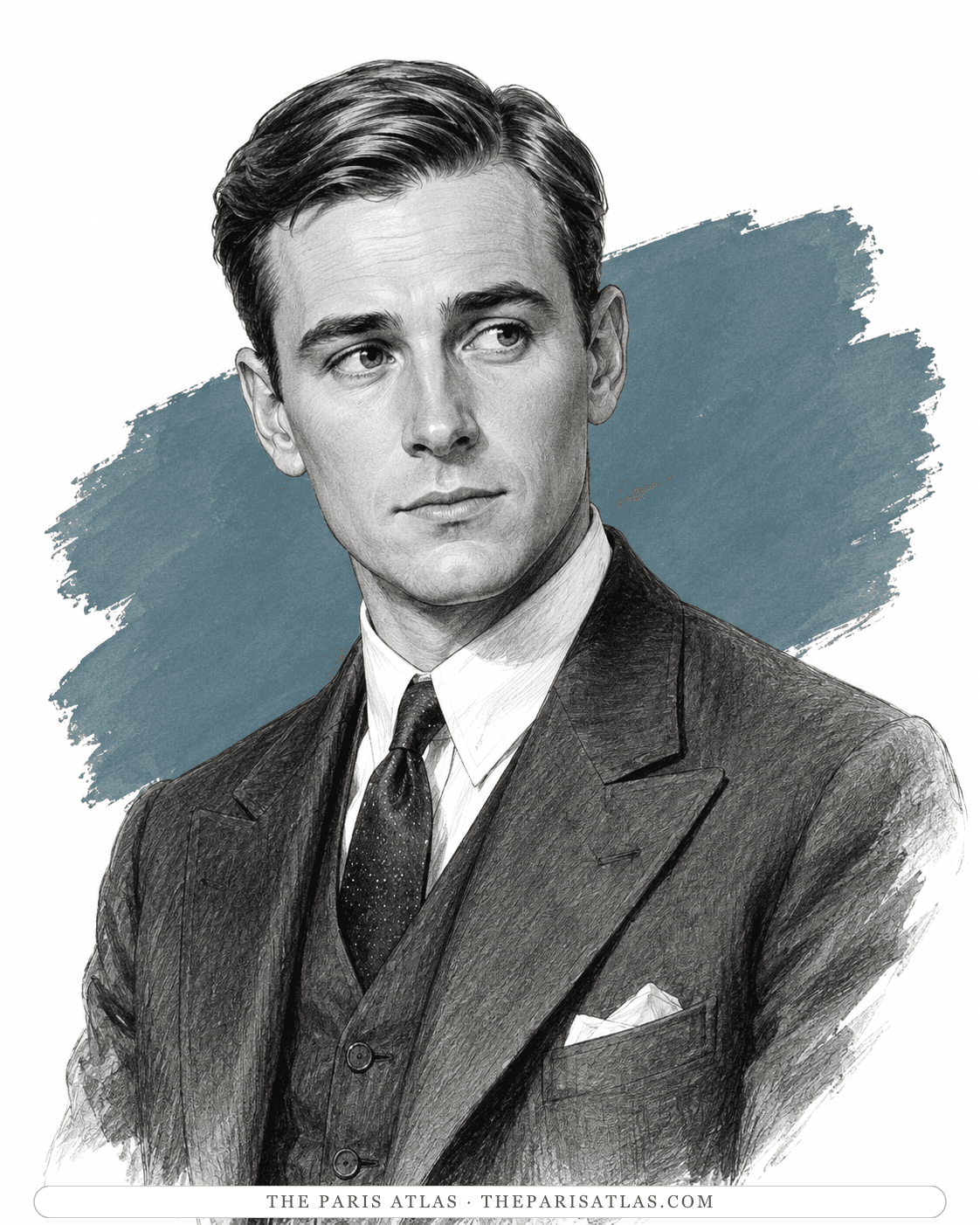
Nick Carraway
The narrator. A young Midwesterner selling bonds in New York, Daisy's cousin, and Gatsby's next-door neighbour.
Somewhere to be that is not home. The Middle West had come to feel like the ragged edge of the universe, so he came East to learn the bond business, determined to reserve all judgements.
The book

At a glance
- Narrator — bond salesman, Yale 1915, veteran, twenty-nine turning thirty
- A weather-beaten cardboard bungalow on West Egg, squeezed between two mansions, at eighty dollars a month
- Daisy Buchanan — his second cousin once removed
- Wholesale hardware in a Middle Western city, three generations
- A girl back home he has been writing to once a week and means to break with
- F. Scott Fitzgerald — the author, split in two · 1896–1940 · St. Paul, Minnesota
Who they are in the book
Spoiler-freeNick Carraway comes from a well-to-do family in a Middle Western city, three generations into the wholesale hardware business. He graduated from New Haven in 1915, went to the war, came back restless, and moved East in the spring of 1922 to learn the bond business because everyone he knew was in it. He rents a small house on West Egg for eighty dollars a month, with Gatsby's mansion next door.
He is Daisy Buchanan's second cousin once removed and knew Tom slightly at Yale, which puts him on both sides of the bay and makes him useful to everyone. He arranges the tea at which Gatsby and Daisy meet again, spends the summer with Jordan Baker, and tells the story afterwards from a distance he never specifies. He opens the book quoting his father on reserving judgements and calls himself one of the few honest people he has ever known. Both claims are worth watching.
How Nick Carraway Is Portrayed
- The father's adviceThe first page: whenever you feel like criticizing anyone, remember that all the people in the world haven't had your advantages. Nick reports that reserving judgements is a matter of infinite hope, and then reserves rather fewer than he claims.
- The one virtue he claims“Everyone suspects himself of at least one of the cardinal virtues, and this is mine: I am one of the few honest people that I have ever known.” He says it two paragraphs after admitting he has been signing weekly letters “Love, Nick” to a girl back home he intends to break with.
- The warHe calls it that delayed Teutonic migration known as the Great War, and says he enjoyed the counter-raid so thoroughly that he came back restless. That is the whole account.
- The job nobody describesHe is in bonds. The novel almost never shows him working: he reads a dozen volumes on banking and credit in his first weeks, then spends the summer on other people's lawns.
- ThirtyIn the middle of the Plaza confrontation he interrupts himself: “I just remembered that today's my birthday.” Driving home he thinks about thirty as the promise of a decade of loneliness, a thinning list of single men to know, thinning hair.
- The witnessBy the end he is doing the things nobody else will: telephoning for people who will not come, keeping reporters out, standing in the rain at the funeral, and telling Tom Buchanan he will not shake his hand.
Nick Carraway quotes
So we beat on, boats against the current, borne back ceaselessly into the past.
Whenever you feel like criticizing anyone, he told me, just remember that all the people in this world haven’t had the advantages that you’ve had.
“I wouldn’t ask too much of her,” I ventured. “You can’t repeat the past.” “Can’t repeat the past?” he cried incredulously. “Why of course you can!”
Nick's ending is the book's: he handles the funeral almost alone, breaks with Jordan, refuses Tom's hand on Fifth Avenue after learning that Tom sent George Wilson to the pool, and goes back west. The last page is his — the green light, the future receding as we reach it, the boats beaten back ceaselessly into the past.
Fitzgerald gave both halves of himself away here. Nick has his Midwestern middle-class vantage, the year in the East, and the habit of watching rich people closely from just outside; Gatsby has the ambition and the girl. Fitzgerald was twenty-eight when the book appeared in April 1925 and lived fifteen more years, most of them badly: Zelda's breakdowns from 1930, the debts, the drinking, and a last stretch as a screenwriter in Hollywood, where he died of a heart attack in December 1940 at forty-four, convinced the book had been forgotten. His royalties for that year came to a few dollars.
If you like The Great Gatsby


If you like F. Scott Fitzgerald
Explore authors with a similar voice, perspective, and influence.
Ernest Hemingway
Fitzgerald vouched for him to Scribner's before they had met, then edited him better than he edited himself; the friendship's five rounds are chronicled in our journal.
View author
Henry Miller
The Brooklyn dropout who arrived in Paris broke at thirty-eight and wrote the exuberant, banned books that ended American censorship.
View author
Louis-Ferdinand Céline
The doctor of the Paris slums who wrote the century's blackest, funniest novel — and changed the sound of French prose.
View author