The Paris AtlasCharting the artists, works, and places worth returning to.
  • Painter
  • Printmaker
  • Illustrator
  • Educator
· American · 1917–2000

Jacob Lawrence

American painter of narrative series, best known for The Migration Series of 1941; he trained in Harlem under Charles Alston and Augusta Savage.

Details

Lived
1917–2000
Born
7 September 1917
Birthplace
Atlantic City, New Jersey
Birth name
Jacob Armstead Lawrence
Died
9 June 2000 · aged 82
Place of death
Seattle, Washington
Nationality
American
Profession
Painter, printmaker, and teacher
Major works
The Migration Series, Struggle: From the History of the American People, The Builders
Married
Gwendolyn Knight · married 1941
Roles
PainterPrintmakerIllustratorEducator
Also known as
Jacob Armstead Lawrence

About Jacob Lawrence

American painter who told African American history in series of small captioned panels

Jacob Lawrence was an American painter, born in Atlantic City, New Jersey, on 7 September 1917 and raised in Harlem. He worked in series rather than in single pictures: sets of small painted panels, each carrying a written caption, that run through one story from beginning to end. His subjects were African American history and the daily life of the neighborhood he grew up in.

The method was as deliberate as the subjects. Lawrence planned a whole series before he began painting, laid every panel out at once, and carried a single color across all of them before mixing the next. That held sixty separate pictures to one palette and one flat, hard-edged manner, so a story spanning decades could be read as a single work on boards twelve by eighteen inches.

The Migration Series, sixty panels finished in 1941, made him nationally known at twenty-three. The Downtown Gallery in New York began representing him that year, making Lawrence the first African American artist taken on by a New York gallery. In 1942 the Museum of Modern Art and the Phillips Collection bought the series jointly and divided the panels between them. He painted and taught for another six decades, sixteen years of them as a professor at the University of Washington in Seattle.

Atlantic City, Harlem, and the Harlem workshops, 1917–1939

Jacob Armstead Lawrence was born in Atlantic City, New Jersey, on 7 September 1917. His parents had come north from the rural South, part of the same movement he would later paint. They divorced in 1924, and his mother placed Lawrence and his two younger siblings in foster care in Philadelphia. He was thirteen when the family moved to New York City and he rejoined his mother in Harlem.

His mother enrolled him in after-school classes at the Utopia Children's Center, an arts and crafts settlement house in Harlem, mainly to keep him occupied. Lawrence drew patterns in crayon, copying the designs in his mother's carpets. He later traced his eye for color to those rooms, telling the historian Paul Karlstrom that people of his mother's generation decorated their homes in so much color that "you'd think in terms of Matisse."

Lawrence left school at sixteen and took work in a laundromat and a printing plant. He kept painting, attending classes at the Harlem Art Workshop taught by the artist Charles Alston, and later working beside Alston and Henry Bannarn in the Alston-Bannarn workshop. He was studying at the Harlem Art Workshop again in 1937.

Charles Alston urged him to go to the Harlem Community Art Center, which the sculptor Augusta Savage ran. Savage secured him a scholarship to the American Artists School and a paid position with the Works Progress Administration, the federal employment program of the Depression years. Harlem supplied the training for most Black artists in the United States at that time, and Lawrence was one of the first to be taught entirely inside that community.

He began making series almost immediately. At twenty-one he showed forty-one paintings on the life of Toussaint L'Ouverture, the general who led the slave revolt that ended in Haitian independence, in an exhibition of African American artists at the Baltimore Museum of Art. A series on Harriet Tubman followed in 1938 and 1939, and one on Frederick Douglass in 1939 and 1940.

Working in the very limited medium of flat tempera he achieved a richness and brilliance of color harmonies both remarkable and exciting

Charles Alston, essay for an exhibition at the Harlem YMCA, 1938

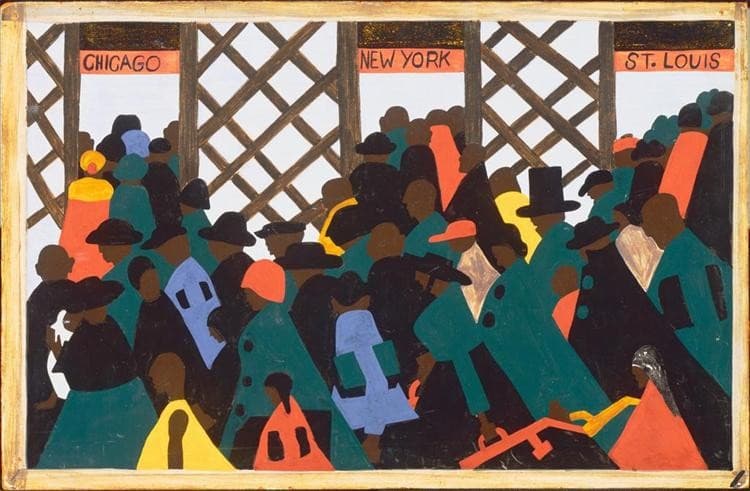
Lawrence painted The Migration Series in 1940 and 1941. It is sixty panels on the Great Migration, the movement of hundreds of thousands of African Americans out of the rural South to the cities of the North after the First World War. He titled it The Migration of the Negro, and it has also been shown as And the Migrants Kept Coming. Every panel carries a caption of about one sentence explaining what the scene shows.

Tempera dries fast and cannot be reworked once it is down, so Lawrence planned the whole sequence before he started. He laid the panels out together and applied one color to every board that needed it, beginning with black and moving towards the lighter tones, then mixed the next color and went round again. The panels are casein tempera on hardboard, twelve by eighteen inches, over a gesso ground of rabbit-skin glue and whiting.

On 24 July 1941 Lawrence married the painter Gwendolyn Knight, who had also studied with Augusta Savage. Knight prepared the gesso panels he painted on and worked with him on the captions for his series.

The series was exhibited at the Downtown Gallery in Greenwich Village, which made Lawrence the first African American artist represented by a New York gallery. Fortune printed a selection of the panels in 1941. The Phillips Collection in Washington and the Museum of Modern Art in New York then bought the set together and split it in 1942, the Phillips taking the odd-numbered panels and the Museum of Modern Art the even-numbered ones. All sixty were shown together again at the Phillips Collection in an exhibition that opened in October 2016.

A second biographical set followed in 1941 and 1942: twenty-two panels on the abolitionist John Brown. When those paintings grew too fragile to exhibit, Lawrence was commissioned to remake them as a portfolio of silkscreen prints, which he finished in 1977.

The Coast Guard, the lost paintings, and Hillside Hospital, 1943–1950

Lawrence was drafted into the United States Coast Guard in October 1943 and served as a public affairs specialist. He was posted to the USCGC Sea Cloud under Carlton Skinner, the first racially integrated crew in the service. He painted and sketched throughout, and reached the rank of petty officer third class.

He made forty-eight paintings during the war and all of them are lost. In October and November 1944 the Museum of Modern Art showed the sixty Migration panels together with eight of the Sea Cloud paintings, and Lawrence was photographed in uniform beside the exhibition sign. The Coast Guard then sent those eight works out to exhibitions around the country, and they went missing in the disorder and staff changes of demobilization at the end of the war.

The Guggenheim Foundation gave him a fellowship in the fine arts in 1945. The following year Josef Albers recruited him to teach in the summer art program at Black Mountain College in North Carolina.

Back in New York, Lawrence went on painting and became depressed. In 1949 he admitted himself to Hillside Hospital in Queens, where he stayed for eleven months. He painted there, and the resulting Hospital Series is unlike the rest of his work in attending to the emotional states of the patients around him.

Struggle, teaching, and the children's books, 1954–1970

Between 1954 and 1956 Lawrence painted Struggle: From the History of the American People, thirty panels covering the years 1775 to 1817. He had planned sixty and stopped halfway. Instead of giving the panels titles he labeled each one with a quotation, and the choices are pointed.

For the panel on Patrick Henry he took a less familiar line from the same speech: "Is life so dear, or peace so sweet, as to be purchased at the price of chains and slavery." A panel showing a slave revolt carries the words of a man who sued for his freedom in 1773: "We have no property! We have no wives! No children! We have no city! No country!" The series also reaches subjects rarely painted, among them Margaret Cochran Corbin in combat and the wall built by enslaved workers that protected the American position at the Battle of New Orleans.

No museum bought the series in the political climate of the mid-1950s. The panels went instead to a private collector, who sold them on one by one. Three of them, panels 14, 20 and 29, have never been found, and three others were traced in 2017, 2020 and 2021. The Peabody Essex Museum in Salem, Massachusetts, gathered the surviving panels for an exhibition that opened in January 2020 and traveled to the Metropolitan Museum of Art, the Birmingham Museum of Art, the Seattle Art Museum and the Phillips Collection.

The Brooklyn Museum of Art mounted a retrospective in 1960. Lawrence taught at the New School for Social Research, the Art Students League, Pratt Institute and the Skowhegan School during these years. In 1969 he was one of about two hundred Black artists in a show sponsored by the Philadelphia School District and the Pennsylvania Civic Center Museum.

He also worked for children. Harriet and the Promised Land, published in 1968, used the paintings from his Harriet Tubman series, and The New York Times listed it among the year's best illustrated books. Two more volumes followed, drawn from the John Brown and Migration series. In 1970 he illustrated eighteen of Aesop's Fables for Windmill Press, and the University of Washington Press published his full set of twenty-three in 1998.

Seattle and the University of Washington, 1970–1999

Lawrence arrived at the University of Washington in Seattle as a visiting artist in 1970 and was professor of art there from 1971 to 1986. He and Gwendolyn Knight settled in the city. Among his graduate students was the lithographer and abstract painter James Claussen.

Soon after the move he painted five pictures on the westward journey of George Washington Bush, an African American pioneer who settled in the Pacific Northwest; they belong to the State of Washington History Museum. In 1980 he finished Exploration, a mural of porcelain on steel forty feet long in twelve panels, installed in the Blackburn Center at Howard University.

Asked to illustrate a new edition of a book of his own choosing, Lawrence chose John Hersey's Hiroshima of 1946 and made eight screen prints in 1983, showing survivors at the moment of the bombing. The University of Washington commissioned the painting Theater in 1985 for the main lobby of Meany Hall for the Performing Arts. In the early 1990s he painted Events in the Life of Harold Washington for the Harold Washington Library in Chicago.

The Whitney Museum of American Art surveyed his whole career in 1974 and the Seattle Art Museum did the same in 1986. He received the National Medal of Arts in 1990 and the Washington Medal of Merit, the state's highest honor, in 1998. In 1999 Lawrence and Gwendolyn Knight set up the Jacob and Gwendolyn Knight Lawrence Foundation, which holds their estates and supports the study of American art, with an emphasis on work by African American artists.

How Jacob Lawrence painted

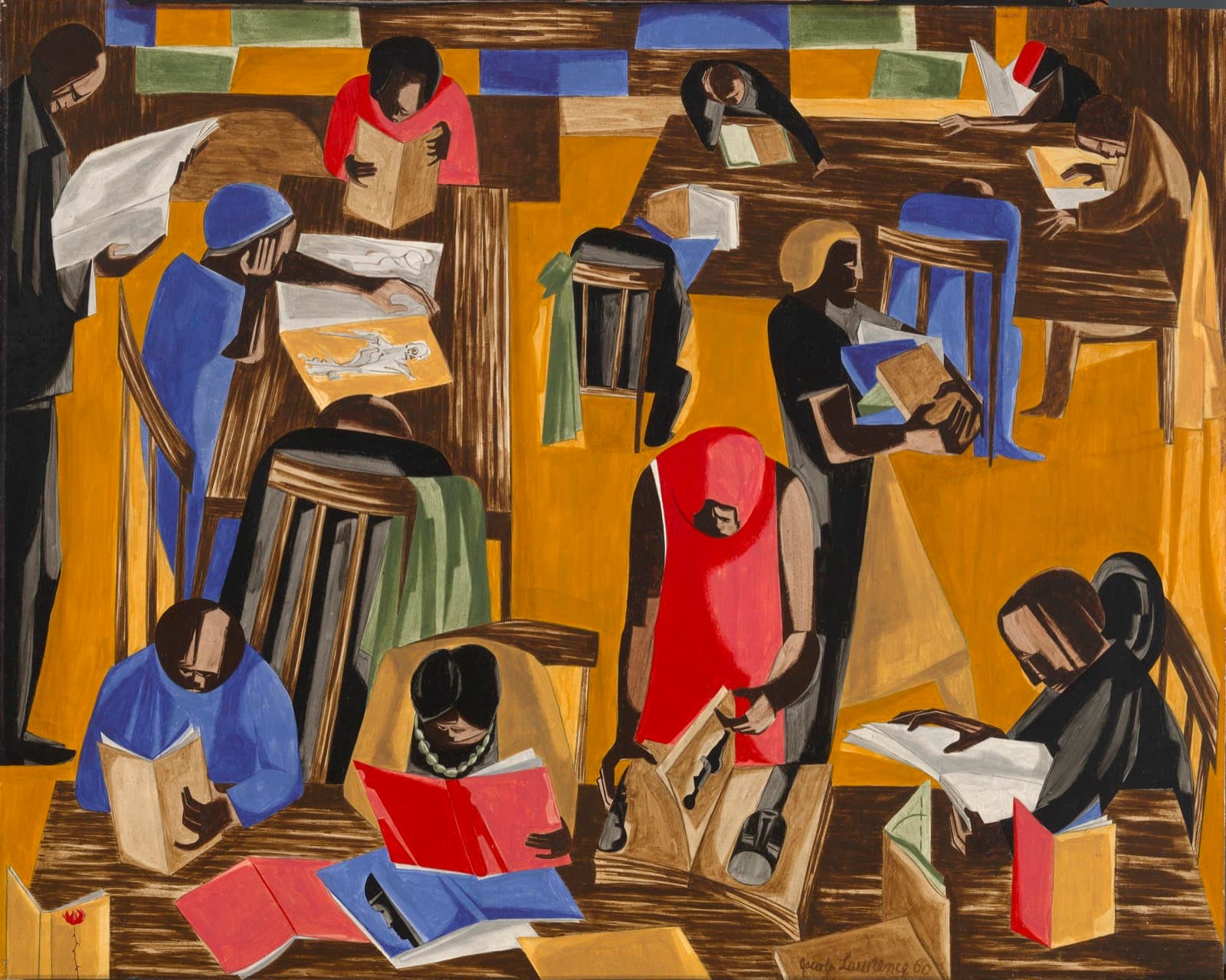
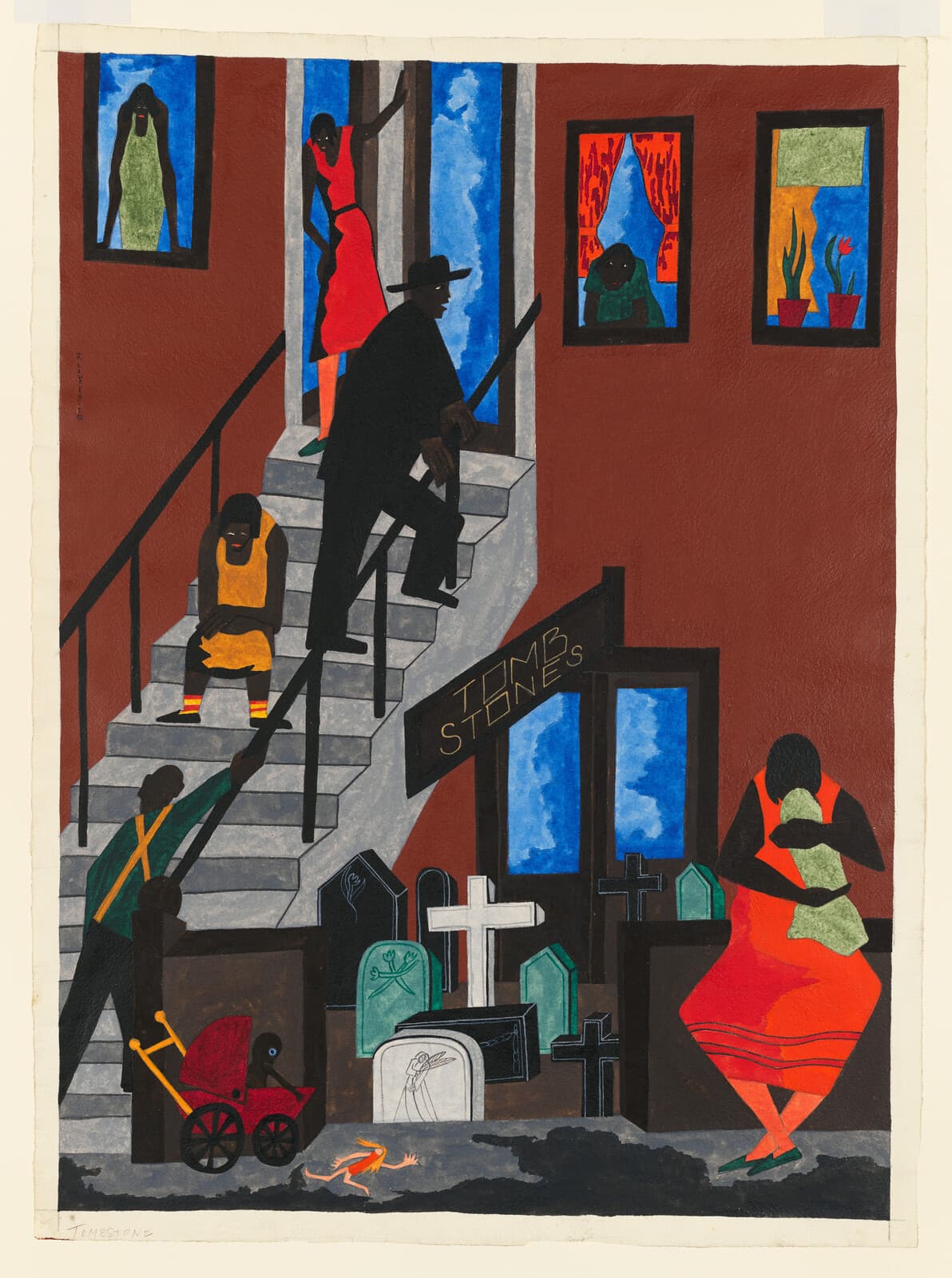
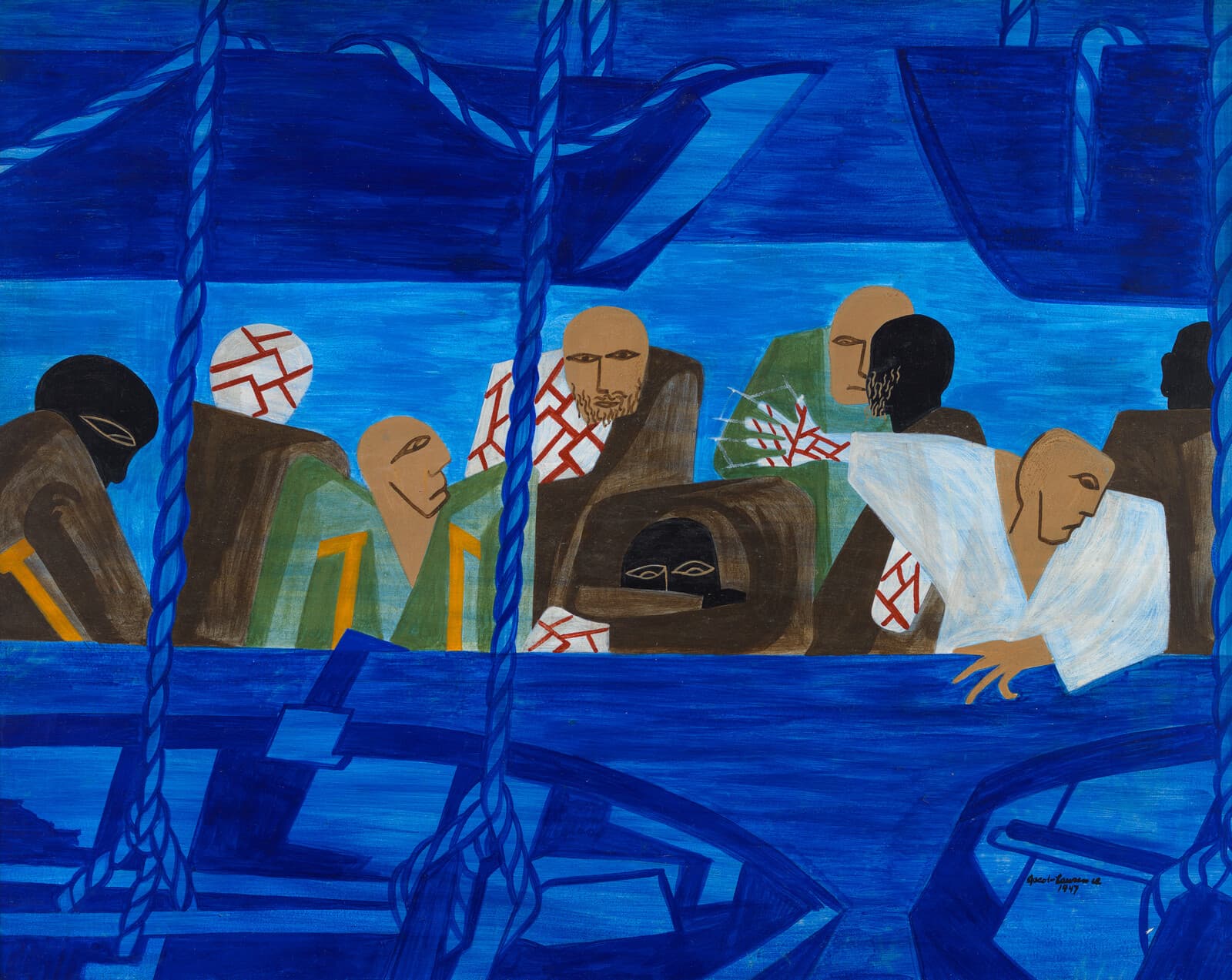
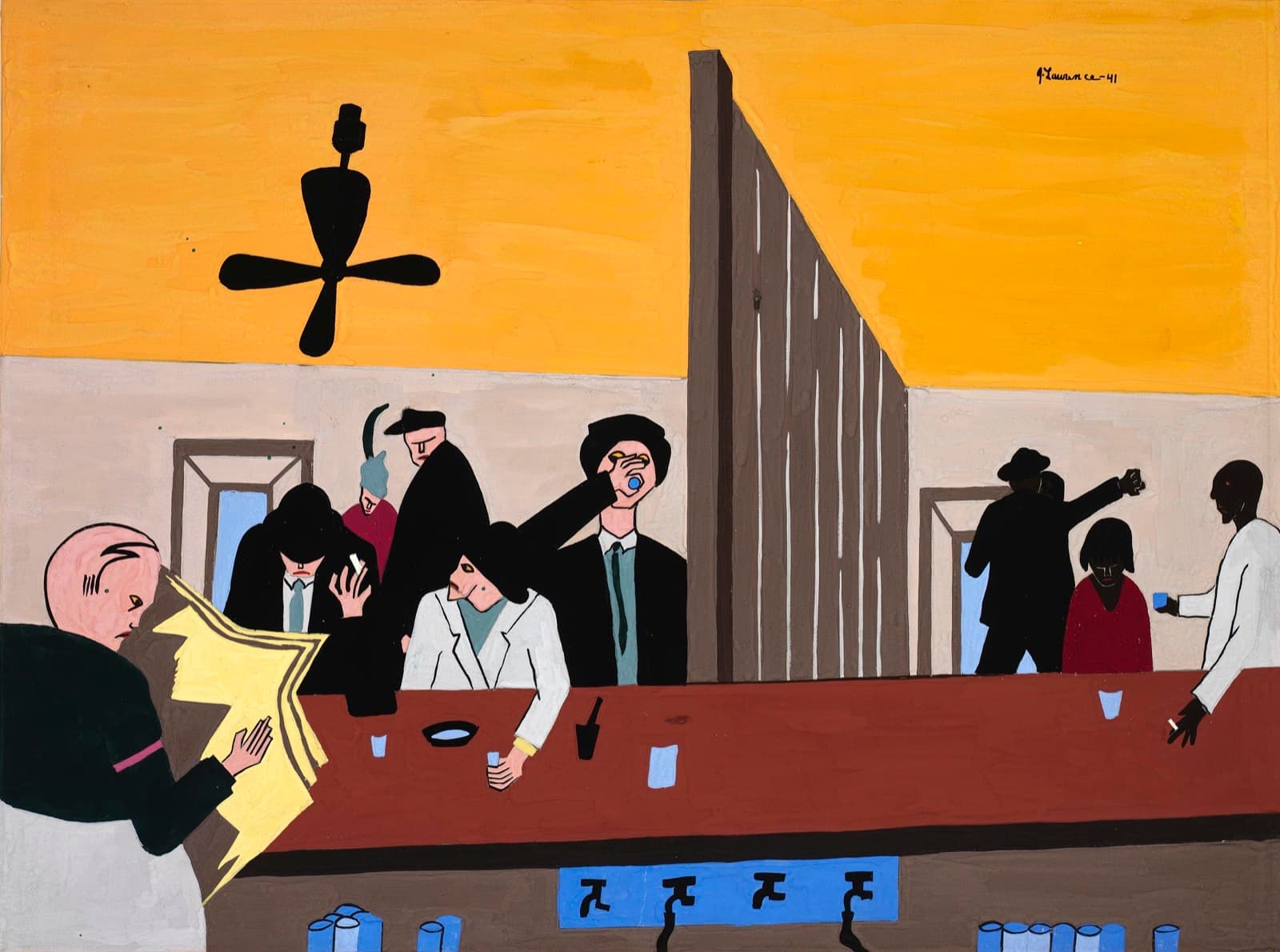
Lawrence used water-based paint for his whole career, most often casein tempera on hardboard panels prepared with a gesso ground. Tempera dries quickly and will not blend once it is on the board, and the pictures show it. Shapes are flat and unmodelled, edges are hard, and there is almost no shading to round a figure out.

The palette is short and applied in a fixed order. Working on a series, he set out every panel at once and carried a single color through all of them before mixing the next, starting with black and working towards the lighter tones. The effect is that sixty pictures read as one object: the same few reds, ochres and greens recur from panel to panel, and no scene drifts away from the others in tone.

Within those limits he built compositions out of repeated shapes. Rows of heads, stacked bundles, ladders, staircases and station platforms are arranged into patterns that carry the eye across the panel, and the figures deliver the meaning through posture and gesture rather than facial expression. Lawrence called the manner dynamic cubism, and he connected it both to the European movement and to the West African and Meso-American art the Cubists had drawn on.

The subjects came from Harlem and from African American history, and he worked in sets rather than single pictures from the start of his career. A series was planned as a whole before any paint went down: the sequence of events fixed first, then a short caption written for each panel. Gwendolyn Knight prepared the panels and worked with him on those captions.

for me, a painting should have three things: universality, clarity and strength. Clarity and strength so that it may be aesthetically good. Universality so that it may be understood by all men.

Jacob Lawrence, shortly before his death in 2000

Reception and changing reputation

Recognition came early, and from inside Harlem first. Charles Alston wrote in 1938 that Lawrence had escaped both academic training and current fashion, and praised the color he got out of flat tempera. The Migration Series made him nationally known at twenty-three, and within a year Fortune, the Downtown Gallery and two major museums had all taken it up.

Reviewing a further set of thirty Harlem paintings in The New York Times in 1943, Howard Devree called the group "an amazing social document" and wrote that Lawrence had grown "in his use of rhythm as well as in sheer design and fluency." Devree also noted a strong semi-abstract approach and color he judged fitting for the subjects.

The path was not straight. Struggle found no museum buyer in the mid-1950s, was sold to a private collector and broken up panel by panel, and three of its thirty paintings are still missing. Honours accumulated later. The NAACP awarded him the Spingarn Medal in 1970. He was elected to the National Academy of Design in 1978 and to the American Academy of Arts and Letters in 1983, and received the National Medal of Arts in 1990. Eighteen institutions gave him honorary degrees, among them Harvard, Yale, Howard, Amherst and New York University.

A retrospective planned before his death opened at the Phillips Collection in May 2001 and traveled to the Whitney Museum of American Art, the Los Angeles County Museum of Art and the Museum of Fine Arts, Houston. A catalogue raisonné of the paintings, drawings and murals appeared the same year. His last public commission, a mosaic in Murano glass called New York in Transit, was installed in the Times Square subway station in October 2001.

The market followed. The White House Historical Association bought The Builders, painted in 1947, for $2.5 million at auction in May 2007, and the picture has hung in the Green Room of the White House since 2009. In 2018 The Businessmen sold for $6.1 million. His obituary in The New York Times called him "one of America's leading modern figurative painters" and "among the most impassioned visual chroniclers of the African-American experience."
Death in Seattle, June 2000

Jacob Lawrence died of lung cancer on 9 June 2000, in Seattle. He was eighty-two, and he had gone on painting until a few weeks before his death.

Gwendolyn Knight outlived him by five years and died in 2005, aged ninety-one. The foundation Lawrence and Knight set up in 1999 holds both estates and keeps a searchable archive of close to a thousand images of their work.

Two awards carry his name. The Seattle Art Museum gives the Gwendolyn Knight and Jacob Lawrence Fellowship, worth $10,000, to artists and scholars whose work reflects the concerns of the two painters. The Jacob Lawrence Gallery at the University of Washington School of Art runs an annual residency.

Life events

  1. 1917

    Born Jacob Armstead Lawrence in Atlantic City, New Jersey, on 7 September.

    Jacob Lawrence — Union List of Artist Names (ULAN)

  2. 1924

    His parents divorce; his mother places Lawrence and his two younger siblings in foster care in Philadelphia.

    Jacob Lawrence: Exploring Stories (2002)

  3. 1930–1931

    Moves to New York City at thirteen, rejoins his mother in Harlem, and begins after-school art classes at the Utopia Children's Center.

    Jacob Lawrence: Exploring Stories (2002)

  4. 1937

    Studies at the Harlem Art Workshop in New York.

    Jacob Lawrence

  5. 1938–1939

    Shows forty-one paintings on Toussaint L'Ouverture at the Baltimore Museum of Art, at twenty-one, in an exhibition of African American artists.

    Patricia Hills, Painting Harlem Modern: The Art of Jacob Lawrence (2019)

  6. 1938–1940

    Paints series on the lives of Harriet Tubman and Frederick Douglass.

    Peter T. Nesbett, Michelle DuBois and Patricia Hills, Over the Line: The Art and Life of Jacob Lawrence (2000)

  7. 1940–1941

    Paints The Migration Series, sixty panels in casein tempera on hardboard, one color at a time across the whole set.

    The Migration Series

  8. 1941

    Marries the painter Gwendolyn Knight on 24 July.

    Christopher Lehmann-Haupt, Gwendolyn Knight, 91, Artist Who Blossomed Late in Life, Is Dead (2005)

  9. 1941

    The Migration Series is shown at the Downtown Gallery in New York, making Lawrence the first African American artist represented by a New York gallery; Fortune prints a selection of the panels.

    Leah Dickerman and Elsa Smithgall (editors), Jacob Lawrence: The Migration Series (2015)

  10. 1941–1942

    Paints twenty-two panels on the abolitionist John Brown.

    Peter T. Nesbett, Michelle DuBois and Patricia Hills, Over the Line: The Art and Life of Jacob Lawrence (2000)

  11. 1942

    The Museum of Modern Art and the Phillips Collection buy The Migration Series jointly and divide the sixty panels between them.

    The Migration Series

  12. 1943

    Drafted into the United States Coast Guard in October; serves aboard the USCGC Sea Cloud under Carlton Skinner, the service's first racially integrated crew.

    Jacob Lawrence, USCG biography

  13. 1944

    The Museum of Modern Art shows all sixty Migration panels with eight of his Coast Guard paintings, in October and November.

    Leah Dickerman and Elsa Smithgall (editors), Jacob Lawrence: The Migration Series (2015)

  14. 1945

    Awarded a fellowship in the fine arts by the Guggenheim Foundation.

    Jacob Lawrence

  15. 1946

    Josef Albers recruits him to teach in the summer art program at Black Mountain College.

    Jacob Lawrence

  16. 1949

    Admits himself to Hillside Hospital in Queens, stays eleven months, and paints the Hospital Series there.

    Peter T. Nesbett, Michelle DuBois and Patricia Hills, Over the Line: The Art and Life of Jacob Lawrence (2000)

  17. 1954–1956

    Paints Struggle: From the History of the American People, thirty panels on the years 1775 to 1817, each labeled with a quotation instead of a title.

    Elizabeth Hutton Turner and Austen Barron Bailly (editors), Jacob Lawrence: The American Struggle (2019)

  18. 1960

    The Brooklyn Museum of Art mounts a retrospective of his work.

    Holland Cotter, Jacob Lawrence Is Dead at 82; Vivid Painter Who Chronicled Odyssey of Black Americans (2000)

  19. 1968

    Publishes the children's book Harriet and the Promised Land, using paintings from his Harriet Tubman series.

    Jacob Lawrence

  20. 1970

    Awarded the Spingarn Medal by the NAACP, and becomes a visiting artist at the University of Washington in Seattle.

    Holland Cotter, Jacob Lawrence Is Dead at 82; Vivid Painter Who Chronicled Odyssey of Black Americans (2000)

  21. 1971–1986

    Professor of art at the University of Washington.

    Holland Cotter, Jacob Lawrence Is Dead at 82; Vivid Painter Who Chronicled Odyssey of Black Americans (2000)

  22. 1980

    Completes Exploration, a porcelain-on-steel mural forty feet long, for the Blackburn Center at Howard University.

    Paul Richard, The Artist's Universe (1980)

  23. 1990

    Awarded the National Medal of Arts.

    Jacob Lawrence

  24. 1999

    Sets up the Jacob and Gwendolyn Knight Lawrence Foundation with Gwendolyn Knight.

    Holland Cotter, Jacob Lawrence Is Dead at 82; Vivid Painter Who Chronicled Odyssey of Black Americans (2000)

  25. 2000

    Dies of lung cancer in Seattle on 9 June, aged eighty-two.

    Holland Cotter, Jacob Lawrence Is Dead at 82; Vivid Painter Who Chronicled Odyssey of Black Americans (2000)

  26. 2001

    New York in Transit, his mosaic in Murano glass, is installed in the Times Square subway station in October.

    Lawrence Van Gelder, For Jacob Lawrence, a Subway Showcase (2001)

People they knew

Documented connections — every one carries its source.

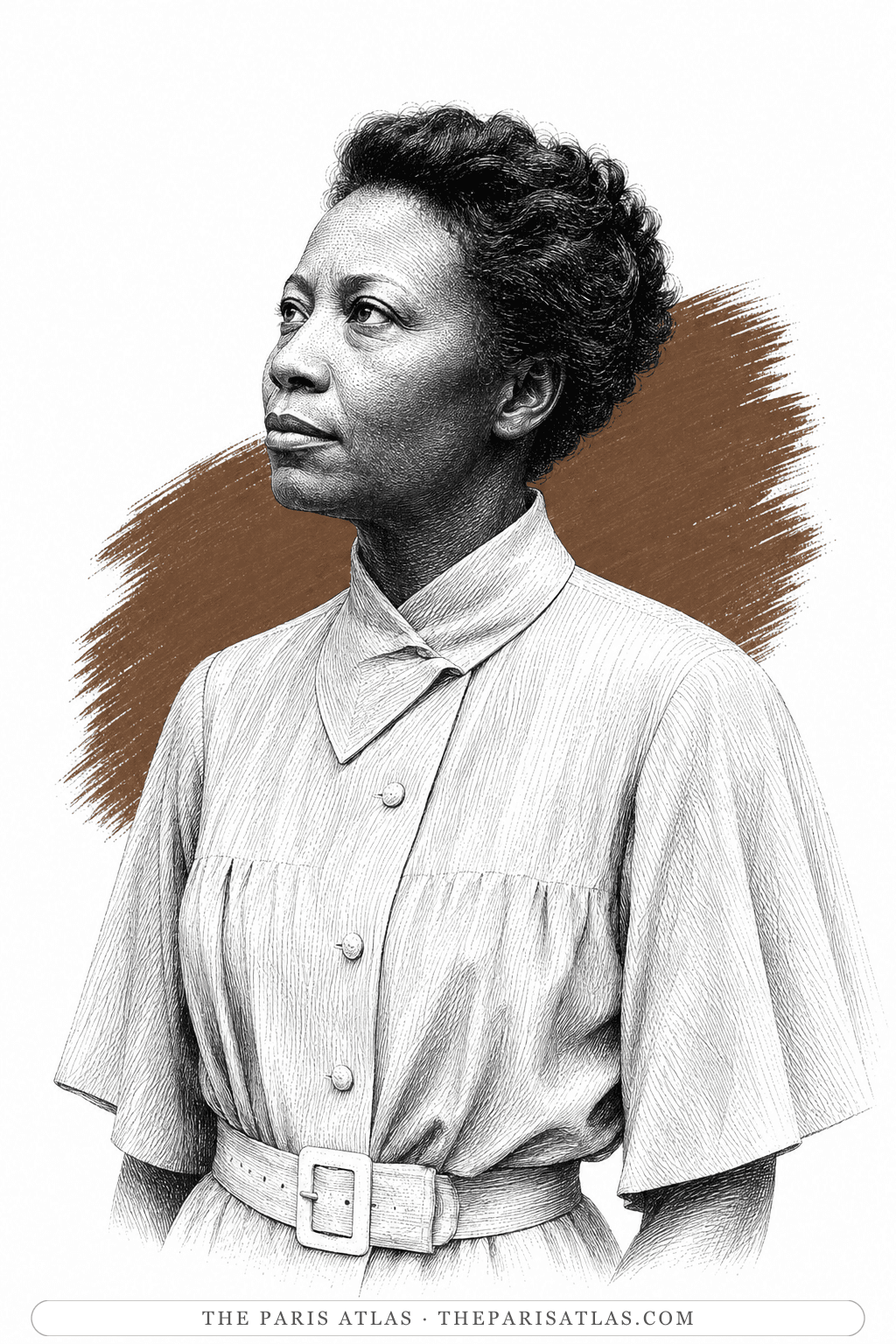
Illustrated portrait of Augusta Savage

Augusta Savage

  • Sculptor
  • Educator

Studied under · 1930

Lawrence attended Savage's Harlem art school as a teenager; Savage became one of the teachers who opened the city's arts institutions to him.

Augusta Savage — artist biography

Questions about Jacob Lawrence

Who was Jacob Lawrence?

Jacob Lawrence (1917–2000) was an American painter who told African American history and Harlem life in series of small captioned panels. He grew up in Harlem, trained there under Charles Alston and Augusta Savage, and finished his best-known work, the sixty-panel Migration Series, in 1941 at the age of twenty-three. He later spent sixteen years as a professor of art at the University of Washington in Seattle.

What is Jacob Lawrence's painting style?

Flat shapes, hard edges and a short palette, painted in water-based tempera on small hardboard panels. Lawrence did almost no shading, so figures read as silhouettes built from a few colors, and he arranged repeated shapes such as rows of heads, ladders and staircases into patterns that move the eye across the picture. He called the manner dynamic cubism and connected it to the European movement and to the West African and Meso-American art the Cubists had drawn on.

What is The Migration Series?

A set of sixty paintings Jacob Lawrence made in 1940 and 1941 about the Great Migration, the movement of hundreds of thousands of African Americans from the rural South to the cities of the North after the First World War. Each panel is casein tempera on a hardboard board twelve by eighteen inches and carries a caption of about a sentence. The Museum of Modern Art and the Phillips Collection bought the series together and divided it in 1942.

How did Jacob Lawrence die?

Jacob Lawrence died of lung cancer on 9 June 2000, in Seattle, at the age of eighty-two. He had continued painting until a few weeks before his death. His wife, the painter Gwendolyn Knight, outlived him and died in 2005 at ninety-one.

Where can you see The Migration Series?

The panels are split between two museums. The Phillips Collection in Washington holds the thirty odd-numbered panels and the Museum of Modern Art in New York holds the thirty even-numbered ones, a division made when they bought the series jointly in 1942. All sixty have been reunited for exhibitions, most recently at the Phillips Collection from October 2016.

What did Jacob Lawrence do in the Second World War?

He was drafted into the United States Coast Guard in October 1943 and served as a public affairs specialist aboard the USCGC Sea Cloud, under Carlton Skinner, in the first racially integrated crew in the service. He painted throughout and reached the rank of petty officer third class. All forty-eight paintings he made during the war are lost, including eight that the Coast Guard sent on tour after a 1944 exhibition at the Museum of Modern Art.

Who was Gwendolyn Knight?

A painter, and Jacob Lawrence's wife from 24 July 1941 until his death in 2000. She had studied with Augusta Savage in Harlem, as Lawrence had, and she prepared the gesso panels he painted his series on and worked with him on their captions. Knight died in 2005 at ninety-one, and the Seattle Art Museum's Gwendolyn Knight and Jacob Lawrence Fellowship is named for both painters.

Why was the Struggle series broken up?

No museum would buy it. Lawrence painted the thirty panels of Struggle: From the History of the American People between 1954 and 1956. No institution bought the set in the political climate of the decade. It went instead to a private collector, who sold the panels individually. Three of the thirty are still missing, three more were traced in 2017, 2020 and 2021, and the Peabody Essex Museum brought the survivors together in an exhibition that opened in January 2020.

Sourced claims

Every connection the graph holds for Jacob, with the evidence behind it.

Studied under · 1930

Augusta Savage

Lawrence attended Savage's Harlem art school as a teenager; Savage became one of the teachers who opened the city's arts institutions to him.

Augusta Savage — artist biography

References

References

The sources below include biographies, scholarly essays, interviews, and primary materials that informed this page. They reflect both the historical record and ongoing critical conversations about Jacob Lawrence and their work.

  1. 1Jacob Lawrence

    Website
    Wikipedia
    Used for

    Reference article cross-checked for the dates, the family, the Harlem training, the series, the war service, the teaching posts and the awards.

    View source
  2. 2The Migration Series

    Website
    Wikipedia
    Used for

    Used for the physical facts of the sixty panels: casein tempera on hardboard, the gesso ground, the panel size, the color-by-color order beginning with black, and the 1942 division between the two museums.

    View source
  3. 3Jacob Lawrence Is Dead at 82; Vivid Painter Who Chronicled Odyssey of Black Americans

    Periodical
    The New York Times, 2000
    Used for

    The obituary of 10 June 2000: the death from lung cancer in Seattle, the teaching career, the retrospectives, the honorary degrees, and the two phrases quoted here.

  4. 4From a Reviewer's Notebook

    Periodical
    The New York Times, 1943
    Used for

    The contemporary review of the thirty Harlem paintings, and the source of the phrases quoted in the reception section.

  5. 5Painting Harlem Modern: The Art of Jacob Lawrence

    Nonfiction
    University of California Press, 2019
    Used for

    Monograph on Lawrence's Harlem years and working method; the source of his remark to the historian Paul Karlstrom about color in Harlem homes.

  6. 6Over the Line: The Art and Life of Jacob Lawrence

    Biography
    University of Washington Press, 2000
    Used for

    The standard life-and-work volume, published alongside the catalogue raisonné project.

  7. 7Jacob Lawrence: Paintings, Drawings, and Murals (1935–1999): A Catalogue Raisonné

    Nonfiction
    University of Washington Press, 2001
    Used for

    The catalogue of the paintings, drawings and murals from 1935 to 1999, published to coincide with the posthumous retrospective.

  8. 8Jacob Lawrence: The American Struggle

    Exhibition catalogue
    Peabody Essex Museum, 2019
    Used for

    Catalogue of the touring exhibition that reassembled the Struggle panels, including the ones relocated after 2017.

  9. 9Jacob Lawrence: The Migration Series

    Exhibition catalogue
    Museum of Modern Art, 2015
    Used for

    The museum's catalogue for the series, used for the Downtown Gallery showing, the Fortune feature and the 1944 exhibition.

  10. 10Jacob Lawrence, American Painter

    Biography
    University of Washington Press, 1986
    Used for

    The monograph published with the Seattle Art Museum's 1986 retrospective.

  1. 11Jacob Lawrence: Exploring Stories

    Website
    Whitney Museum of American Art, 2002
    Used for

    The museum's teaching resource, used for the Atlantic City and Philadelphia years and for how Lawrence constructed a narrative series.

  2. 12Jacob Lawrence

    Website
    John Simon Guggenheim Memorial Foundation
    Used for

    The foundation's fellow record, confirming the fine arts fellowship of 1945.

  3. 13Jacob Lawrence, USCG biography

    Official record
    United States Coast Guard
    Used for

    The service's biography: the October 1943 draft, the posting to the USCGC Sea Cloud under Carlton Skinner, and the rank of petty officer third class.

  4. 14Jacob Lawrence — Union List of Artist Names (ULAN)

    Website
    Getty Research Institute
    Used for

    Getty authority record confirming the birth and death dates and places and the roles.

    View source
  5. 15The Artist's Universe

    Periodical
    The Washington Post, 1980
    Used for

    Review of Exploration, the porcelain-on-steel mural at Howard University, with its dimensions and panel count.

  6. 16Jacob Lawrence Painting, Missing for Decades, Is Found by Met Visitor

    Periodical
    The New York Times, 2020
    Used for

    Report on the Struggle panel identified by a visitor to the Metropolitan Museum of Art in 2020.

  7. 17For Jacob Lawrence, a Subway Showcase

    Periodical
    The New York Times, 2001
    Used for

    Report on the installation of New York in Transit at the Times Square subway station.

  8. 18Green Room Makeover Incorporates a Colorful Past

    Periodical
    The Washington Post, 2007
    Used for

    Report on the White House Historical Association's purchase of The Builders and its placement in the Green Room.

  9. 19Crushing Decade-Old Auction Record, 'The Businessmen' by Jacob Lawrence Soars to $6.1 Million, Placing Him Among the Most Expensive African American Artists

    Periodical
    Culture Type, 2018
    Used for

    Report on the 2018 sale of The Businessmen, used for the auction figure.

  10. 20Gwendolyn Knight, 91, Artist Who Blossomed Late in Life, Is Dead

    Periodical
    The New York Times, 2005
    Used for

    Obituary of Gwendolyn Knight, used for the marriage date and for her death in 2005.

i
Why these sources are here

These references anchor the page in the documented record and in the scholarly conversations around Jacob Lawrence. Every claim on this page traces back to one or more of the works listed here.

Explore more resources