War Series
Fourteen small panels on what the Second World War did to the men who fought it, from Shipping Out to Victory. Jacob Lawrence had served in the Coast Guard, first as a steward's mate and then as a combat artist, and all the paintings he made during the war were lost. He painted the War Series in 1946 and 1947, soon after he came home. Mr. and Mrs. Roy R. Neuberger gave all fourteen panels to the Whitney Museum of American Art.
- 1946–1947
- Tempera on composition board, fourteen panels
- Whitney Museum of American ArtNew York, United States
About Jacob Lawrence
Fourteen panels
The War Series is fourteen panels in tempera on composition board, each about 41 by 51 centimetres, some upright and some horizontal. The Whitney Museum of American Art, which owns all fourteen, says the story runs from Shipping Out to Victory.
In between come the waiting and the fighting and what they left behind. The titles tell the story: Another Patrol, Alert, Docking — Cigarette, Joe?, The Letter, On Leave, Beachhead, How Long?, Purple Hearts, Casualty — The Secretary of War Regrets, Going Home, Reported Missing. One more panel is called Prayer.
The last panel, Victory, is a single soldier with his head bent so that his face cannot be seen. The Whitney's audio guide asks what a soldier would be expected to feel when the war is won, and whether he looks it.
The Coast Guard
Jacob Lawrence was drafted into the United States Coast Guard in October 1943. The Whitney says he served his first year in St. Augustine, Florida, in a segregated unit, with the rank of steward's mate, the only rank then open to Black Americans.
The museum's audio guide describes the job plainly: essentially a servant for white officers.
His captain on the weather ship Sea Cloud, Lieutenant Commander Carlton Skinner, made it the first fully integrated vessel in the United States Navy, according to the Whitney. Carlton Skinner helped Jacob Lawrence get a public relations rating, which let him paint on duty as the ship's artist.
Jacob Lawrence later served on a troop transport and, as the Whitney puts it, documented the war in Italy, England, Egypt and India. Those wartime paintings are lost.
Jacob Lawrence began the War Series soon after he was discharged in December 1945. He worked with a Guggenheim Fellowship that the foundation's own record dates to 1945. The Whitney's guide calls the series his way of coming to terms with what he had seen.
"We would come back a hospital ship"
Jacob Lawrence talked about the troopship on the Whitney's audio guide. "We would go over carrying 5,000 troops—young, American troops—and we would come back a hospital ship. Many of these cases were horrible."
He said he could not put the experience into words, "because I would only cheapen the experience."
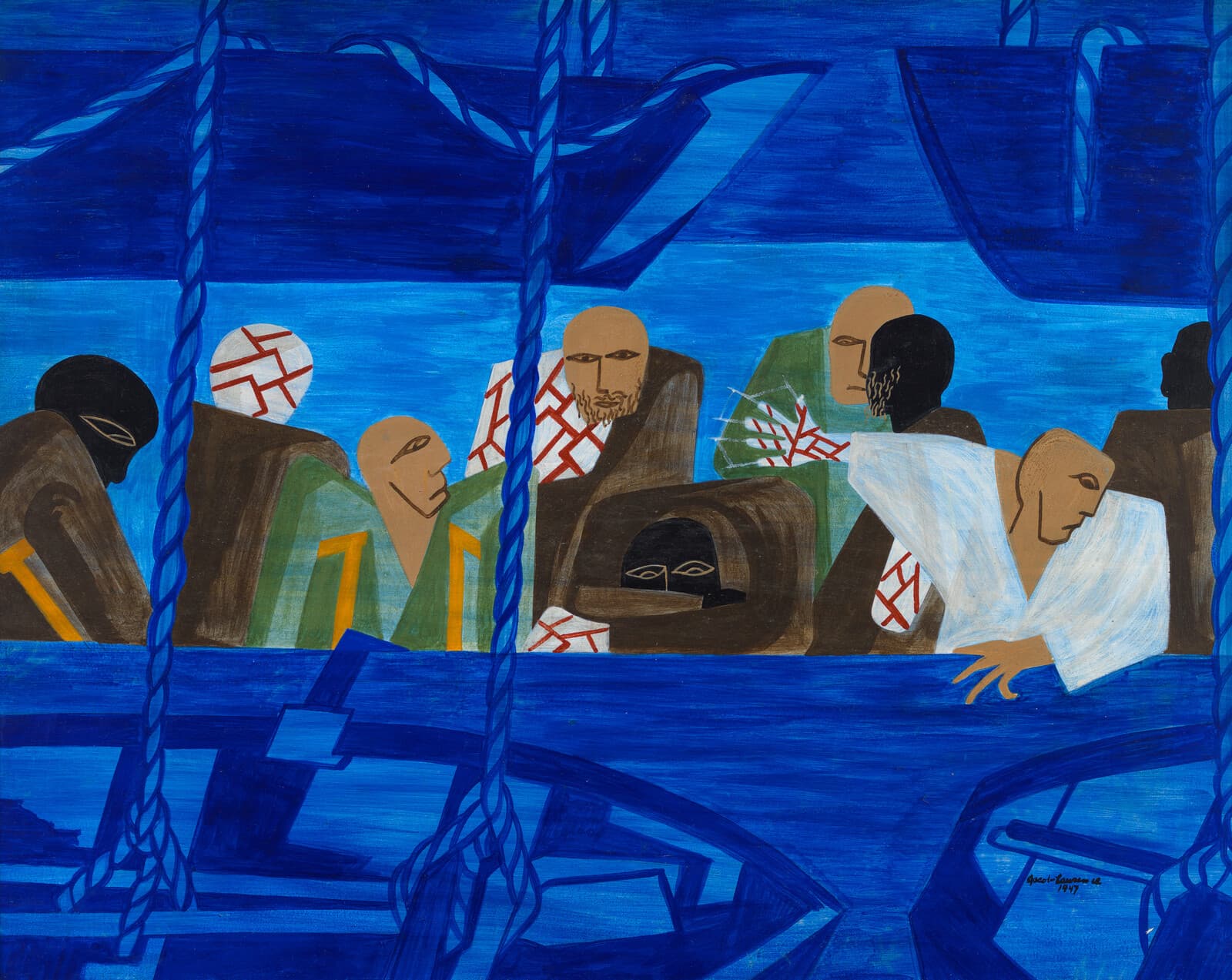
Going Home is that return trip. Men wrapped in blankets and bandages are packed along a ship's rail under hanging lifeboats. Hands and heads are bound in white cloth marked with red. One man's face is wrapped up to the eyes, and another leans out over the rail with his head down.
Jacob Lawrence also made a point, the Whitney says, of showing Black and white servicemen together, as he had served with them. In Going Home they sit side by side, some faces painted light tan and some black, with no line between them.
How the panels are painted
The Whitney points to Egyptian wall painting: silhouetted figures, prominent eyes and simple overlapping profiles. Like the ancient painters, Jacob Lawrence turns groups of people into a pattern across the surface instead of modelling them in the round. In Going Home the eyes are flat almond shapes even on faces seen from the side.
For his series, the Whitney's teaching resource says, Jacob Lawrence laid all the panels out on his studio floor so they could be painted at the same time. He applied one colour to every panel that needed it before moving to the next, working from black toward the lighter tones.
He used colours unmixed so they would not change from panel to panel. Going Home shows what that discipline can do. Almost everything that is not a man is one blue, from the lifeboats to the hull, so the blankets, jackets and bandages carry all the warmth in the picture.
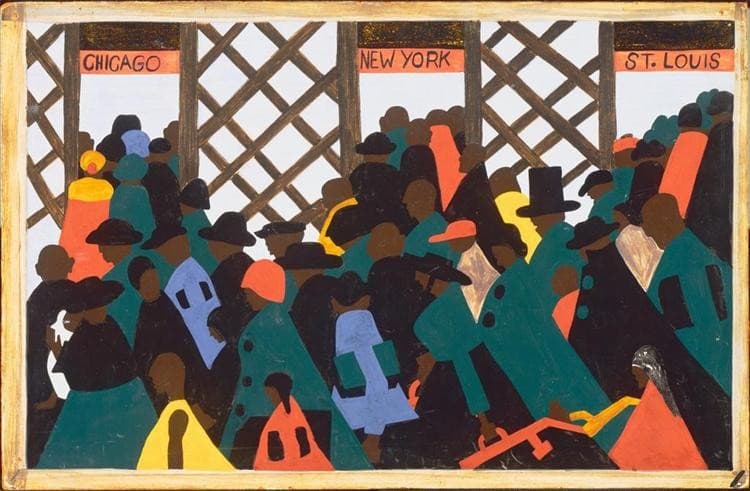
The Whitney adds that the series alternates upright and horizontal panels, single figures and crowds, action and stillness. The museum reads that as proof of Jacob Lawrence's belief that you cannot tell a story in a single painting. The Migration Series had made the same case six years earlier.
At the Whitney
All fourteen panels were given to the Whitney Museum of American Art by Mr. and Mrs. Roy R. Neuberger. They carry accession numbers 51.6 to 51.19, and Going Home is 51.17a-b. The Whitney's record lists a second painting on the back of the same board, catalogued as (Rejoice).
The panels have been shown at the Whitney in Over the Line: The Art and Life of Jacob Lawrence in 2001–03 and America Is Hard to See in 2015. They hung again in The Whitney's Collection: Selections from 1900 to 1965, from 2019 to 2025.
In September 2026 several panels were listed on view on the museum's seventh floor, but Going Home was not. Jacob Lawrence died in 2000 and the series is in copyright.
One panel of the fourteen is reproduced here, the museum's own photograph, under fair use for commentary.
Close reading
Reading the work, detail by detail
These details all come from one panel of the fourteen, Going Home, painted in 1947. Wounded men are packed along the rail of a ship. Up close there are bandaged hands and heads, a face wrapped to the eyes, Black and white soldiers side by side, lifeboats hanging overhead, and Jacob Lawrence's signature on the hull.
1.Men packed along the rail
The men sit shoulder to shoulder in one row across the middle of the panel, between the rail below and the boats overhead. Brown blankets, green jackets and white cloth overlap so closely that it is hard to say where one man ends and the next begins. The Whitney Museum of American Art says Jacob Lawrence turned groups of figures into surface patterns, the way Egyptian wall painters did.
2.The man who looks at us
At the centre a bald man with a short brown beard looks straight out at us, wrapped in a brown blanket over white cloth marked with red lines. His eyes are drawn as flat almond shapes. The Whitney traces those prominent eyes to Egyptian wall painting. He is the only man in the row facing the viewer.
3.A head wrapped in bandage
At the left, a head is entirely white and crossed with red lines, with no face showing. The head looks as if it is wrapped in bandages, the red perhaps blood coming through. Jacob Lawrence puts the same white cloth with red lines on several of the men, so the pattern may be his sign for a wound dressing rather than a picture of any one bandage.
4.A bandaged hand
A hand held up in the middle of the group is wrapped in the same white and red, with its fingers spread. Fine white scratched lines stand out around the bandaged hand, like a tremor, or like light. Jacob Lawrence remembered these crossings on the Whitney's audio guide: the troopship went out carrying 5,000 young soldiers, "and we would come back a hospital ship."
5.A Black soldier and a white soldier
Two heads almost touch here: a white soldier's face painted light tan and seen in profile, and in front of it a Black soldier with a beard drawn in pale wavy lines. The Whitney says Jacob Lawrence made a point of showing Black and white servicemen together. He had served on the Sea Cloud, which its captain, Carlton Skinner, made the first fully integrated vessel in the United States Navy.
6.A man leaning over the rail
On the right a bald man with a white cloth over his shoulders leans out over the rail, head down. He could be looking down at the water, feeling sick, or simply resting his weight. His face is a few brown lines on flat tan.
7.A hand gripping the rail
The leaning man's hand hangs over the dark blue rail with its fingers bent, holding on. The knuckles are drawn with a few brown lines on flat tan. Just above, another arm is wrapped in the white and red of a dressing.
8.A face wrapped to the eyes
At the front of the group a Black man is wrapped in a brown blanket pulled up over his nose, so only a pair of eyes looks out. The eyes are drawn in pale lines on the black face. In front of him lies a smaller white bundle marked with red lines, perhaps a bandaged hand or foot.
9.A man with his eyes closed
At the far left a Black man with a hood or blanket over his head sits with his eyes closed and his head bowed. He might be asleep, or in pain. The closed eye is a single pale almond with a line drawn through it.
10.A yellow crutch, perhaps
Below the man with closed eyes, a yellow bar crosses the brown blanket at an angle, ending in a short crosspiece. The yellow bar looks like the top of a crutch. The shape is cut off by the edge of the panel, so it is not certain.
11.A man in a green jacket
A bald man in a green jacket turns his head to the right, his mouth set in a flat line. Two yellow shapes stand out on the green jacket. The shapes could be the frame of a chair or a stretcher, or markings on his uniform; it is not clear which.
12.Ropes in front of the men
Thick twisted ropes, painted bright blue with darker spirals, hang straight down in front of the men and cut the row into sections. The ropes come down from the boats overhead. The men seem fenced in by them.
13.Boats hanging overhead
Across the top of the panel hang big dark blue shapes with ropes looped round them. The shapes look like lifeboats slung above the deck, seen from below. The boats press down on the heads of the men underneath.
14.One blue for the whole ship
At the top right a second dark boat hangs from its ropes. Jacob Lawrence paints everything above and below the men in shades of one blue. The only warm colours in the panel are the men themselves: brown blankets, green jackets, tan and black faces, and the red of the bandages.
15.The ship below the rail
The lower third of the panel is all blue: the ship's side or deck, drawn as curves and angled planks in dark blue on bright blue, with coils of rope hanging down into it. Jacob Lawrence gives the ship no detail that would name it. On the Whitney's audio guide he names the two ships he served on, the Sea Cloud, a weather patrol ship, and a troop transport.
16.A man cut off at the edge
At the right edge a dark head and shoulder are cut off by the frame. The row of men seems to carry on past the edge of the picture, so there are more wounded on this deck than the panel shows.
17.The signature
Jacob Lawrence signed and dated the panel at the lower right in black paint on the blue hull: Jacob Lawrence 1947. The Whitney dates two panels of the series, The Letter and Another Patrol, to 1946, and the other twelve, Going Home among them, to 1947.
Timeline
1943
Jacob Lawrence is drafted into the United States Coast Guard in October and serves first as a steward's mate.
1944–45
Serves on the Sea Cloud, which the Whitney calls the first fully integrated vessel in the United States Navy, and on a troop transport. The paintings he makes in service are later lost.
1945
Awarded a Guggenheim Fellowship; discharged in December.
1946
Begins the War Series. The Letter and Another Patrol are dated this year.
1947
Finishes the series. The other twelve panels, including Going Home and Victory, are dated 1947.
2015
Shown at the Whitney in America Is Hard to See, 1 May to 27 September.
Where to see it
Whitney Museum of American Art
New York, United States
A public viewing address has not yet been confirmed for this holding.
The Whitney shows a changing selection of the fourteen panels. In September 2026 several were listed on view on Floor 7 and Going Home was listed as not on view. Check the museum's own records before making a special visit.
Frequently asked questions
What is Jacob Lawrence's War Series?
Fourteen small tempera panels he painted in 1946 and 1947 about the Second World War, running from Shipping Out to Victory. Jacob Lawrence had served in the Coast Guard, and he began the series soon after he was discharged in December 1945.
Where is the War Series?
All fourteen panels are at the Whitney Museum of American Art in New York, given by Mr. and Mrs. Roy R. Neuberger. The museum shows some panels at a time, so check its collection pages before a visit.
What does Going Home show?
Wounded men packed along the rail of a ship under hanging lifeboats, wrapped in blankets and bandages. Jacob Lawrence remembered that the troopship went over carrying 5,000 soldiers and came back a hospital ship.
Why do the figures look Egyptian?
The Whitney Museum of American Art says Jacob Lawrence borrowed from Egyptian wall painting: silhouetted figures, prominent eyes and overlapping profiles. The figures are arranged as a flat pattern across the surface rather than modelled in depth.
What happened to the paintings Jacob Lawrence made during the war?
They are lost. The War Series was painted afterwards, once he was home.
More by Jacob Lawrence
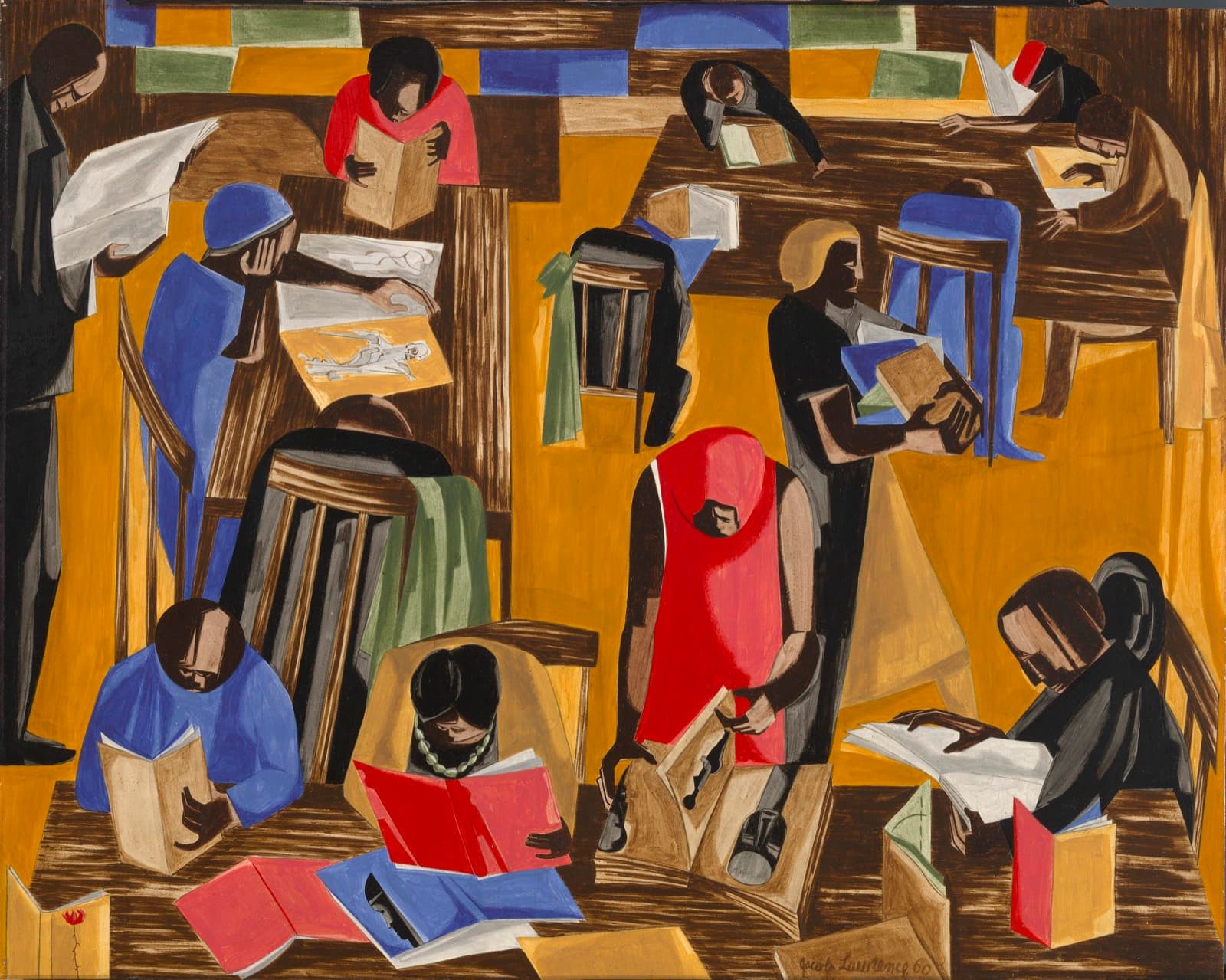
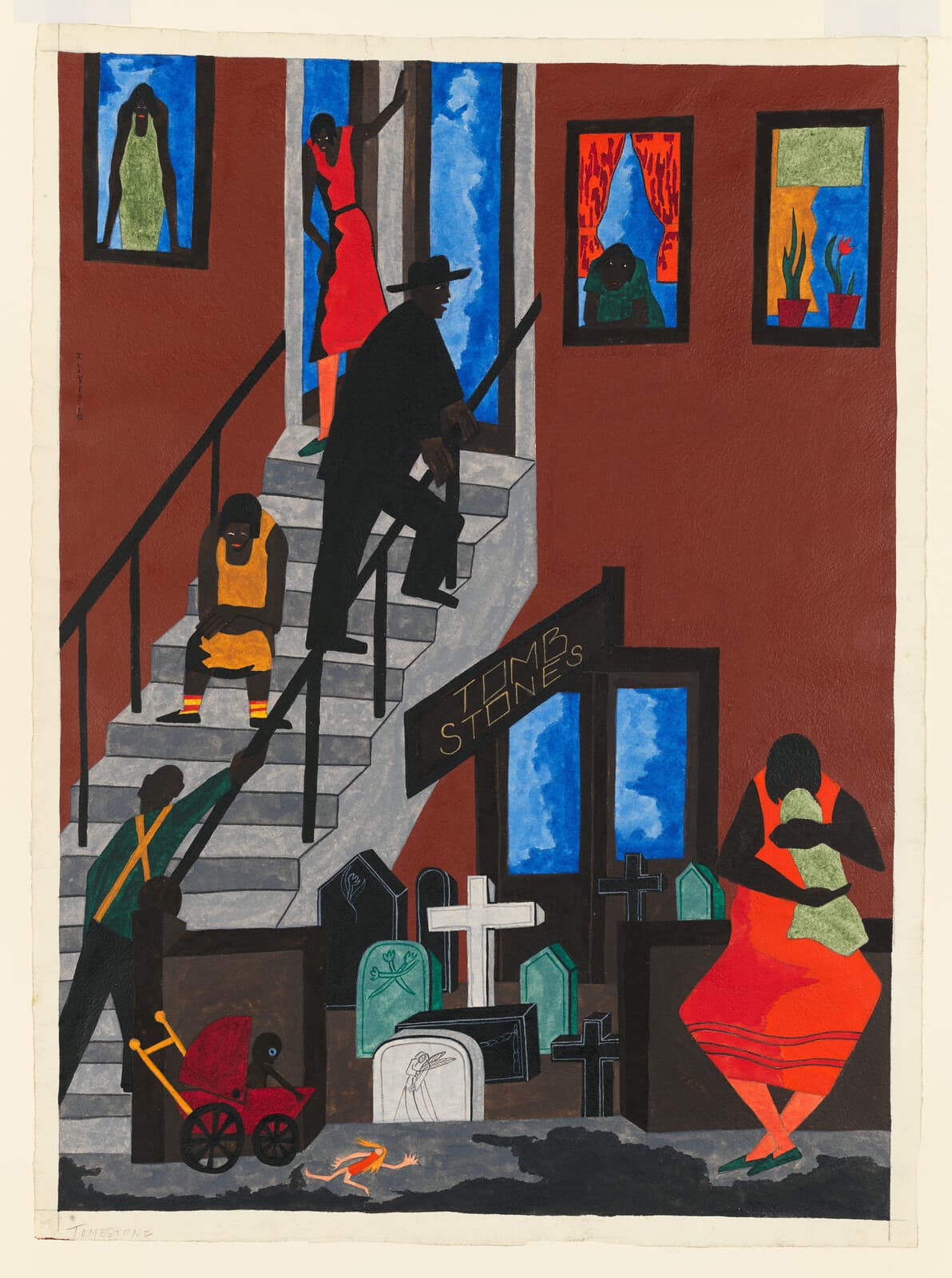
If you like Jacob Lawrence
Explore painters from the same movements and circles.
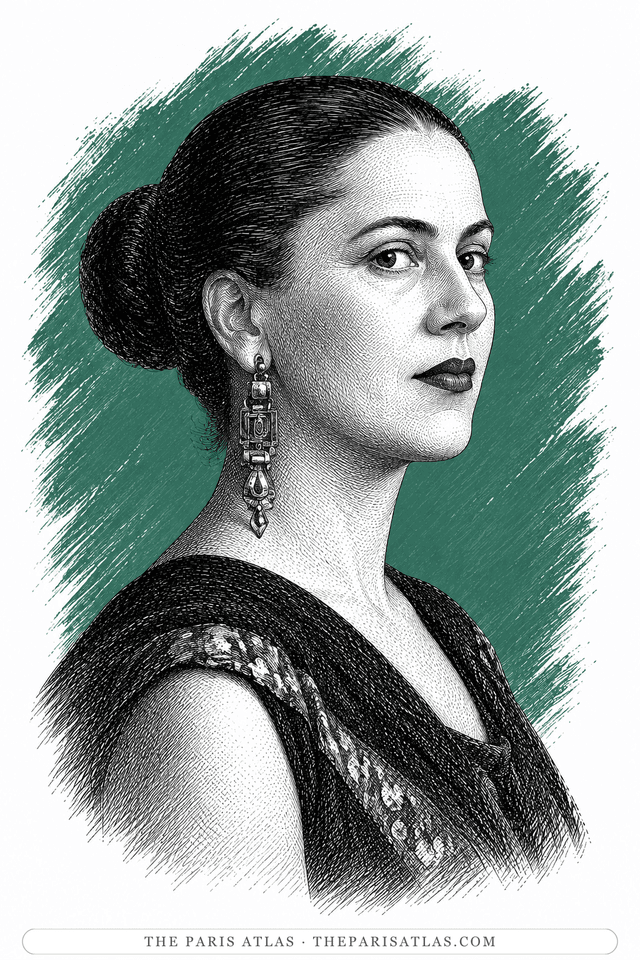
Tarsila do Amaral
Brazilian painter who spent the 1920s moving between São Paulo and Paris, studied Cubism under André Lhote, Albert Gleizes and Fernand Léger, and used what she learned to paint Brazilian towns, railways, plants and bodies. Her 1928 painting Abaporu prompted the manifesto that gave the Anthropophagic movement its name.
View artist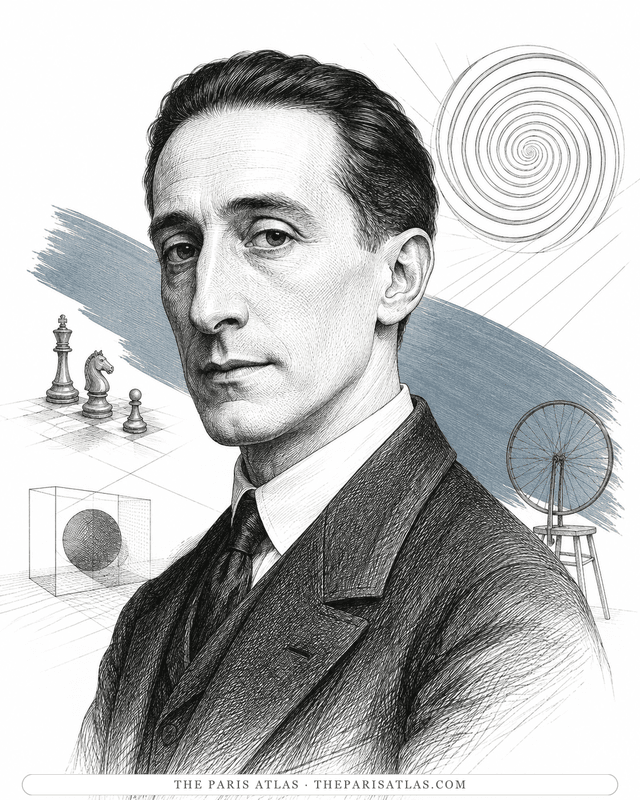
Marcel Duchamp
The century's quietest revolutionary — readymades, the abandonment of painting, chess on a Paris rooftop in Entr'acte, and one anemic film of spinning puns signed Rrose Sélavy.
View artist
Vincent van Gogh
Dutch painter who lived in Montmartre with his brother Theo from March 1886 to February 1888 — the two years in which his dark Dutch palette turned into colour. He painted more than 200 pictures in Paris and died at Auvers-sur-Oise, north of the city, in 1890.
View artist
References
The sources below include collection records, catalogues, scholarly research, and primary materials that informed this page. They document War Series, its making, and its place in cultural history.


1Jacob Lawrence, War Series: Going Home (1947) — object record, 51.17a-b
Official recordWhitney Museum of American Art, New YorkUsed forThe holding museum's record for the panel reproduced here, with Jacob Lawrence's own account of the troopship.
2Jacob Lawrence, War Series: Victory (1947) — object record, 51.19
Official recordWhitney Museum of American Art, New YorkUsed forThe Whitney's audio on the series: the steward's mate rating, Carlton Skinner and the Sea Cloud, the December 1945 discharge, and Victory.

3Jacob Lawrence — artist page (16 works in the collection)
WebsiteWhitney Museum of American Art, New YorkUsed forThe Whitney's list of all fourteen panels with their dates, and its record of exhibitions.
4Jacob Lawrence: Exploring Stories
WebsiteWhitney Museum of American Art, 2002Used forHow Jacob Lawrence laid out and painted a series, one colour at a time.
5Jacob Lawrence
WebsiteJohn Simon Guggenheim Memorial FoundationUsed forThe fellowship year, 1945, which the Whitney's label gives as 1946.
6Jacob Lawrence, USCG biography
Official recordUnited States Coast GuardUsed forThe October 1943 draft and the posting to the Sea Cloud under Carlton Skinner.
7Images and permissions
WebsiteWhitney Museum of American Art, New YorkUsed forWeb source consulted for documented facts and historical context presented on the War Series page.
8Represented artists
WebsiteArtists Rights Society, New YorkUsed forWeb source consulted for documented facts and historical context presented on the War Series page.
These references provide the documented foundation for this work's history and interpretation. Claim-level citations remain attached to the specific claims they support.
 Explore more resources