Jacob Lawrence painted The Migration Series in 1940 and 1941, when he was twenty-three: sixty small panels, each with a caption, following the movement of African Americans from the rural South to the cities of the North. He worked across all sixty at once, one colour at a time. The panels are divided between the Phillips Collection in Washington and the Museum of Modern Art in New York.
The Migration Series is a sequence of sixty painted panels with accompanying captions, created by Jacob Lawrence in 1940 and 1941. It recounts the movement of African Americans from the rural South toward northern cities during the Great Migration. Completed when Lawrence was twenty-three, it is divided between the Phillips Collection in Washington, D.C., and the Museum of Modern Art in New York.
A Collective History
Rather than following a single named protagonist, the series constructs a history through many related scenes. Stations, trains, families, workers, and people carrying luggage recur throughout it. These repeated elements connect individual situations to the larger movement of a population.
The narrative includes both the pressures encouraging departure and the uncertainties of arrival. Migration is not presented as one simple journey from hardship to permanent security. The broader project concerns struggle, aspiration, adversity, and the possibilities people create through movement.
Lawrence's Personal Connection
Lawrence was the son of southern migrants and grew up within communities shaped by the experience he would later depict. After moving to Harlem as a teenager, he developed as an artist through local educational and cultural networks. The series therefore joined historical research with a subject already embedded in his family and neighborhood experience.
By the time he began the migration paintings, he had already created narrative series about major figures in Black history. The new project extended that historical ambition while shifting its emphasis toward a collective movement. The achievement was not simply to illustrate an existing story but to find a visual structure capable of carrying a complicated social history.
How He Painted Sixty Panels as One Work
Lawrence researched the subject and prepared captions before completing the paintings. He then worked across the entire sequence color by color, rather than finishing one panel before starting the next. This method helped maintain a consistent palette and encouraged him to regard the sixty panels as parts of a single composition.
That unity remains visible even when the panels depict different situations. Simplified figures, repeated shapes, and emphatic color relationships create a rhythm across the sequence. The captions guide interpretation without exhausting what the images communicate; words and paintings work together rather than duplicating one another.
Reception and Historical Importance
The series attracted national attention after its exhibition at Edith Halpert's Downtown Gallery in 1941. Its reception helped establish Lawrence while he was still a young artist, demonstrating that a formally inventive account of Black history could command attention within the modern American art world.
Its significance also challenges a narrow definition of modernism as the abandonment of recognizable subjects. Lawrence used simplified shapes and strong design to make a historical narrative more powerful, not less legible. The work shows how modern painting could sustain storytelling while reconsidering who deserved to occupy the center of history.
Close reading
Reading the work, detail by detail
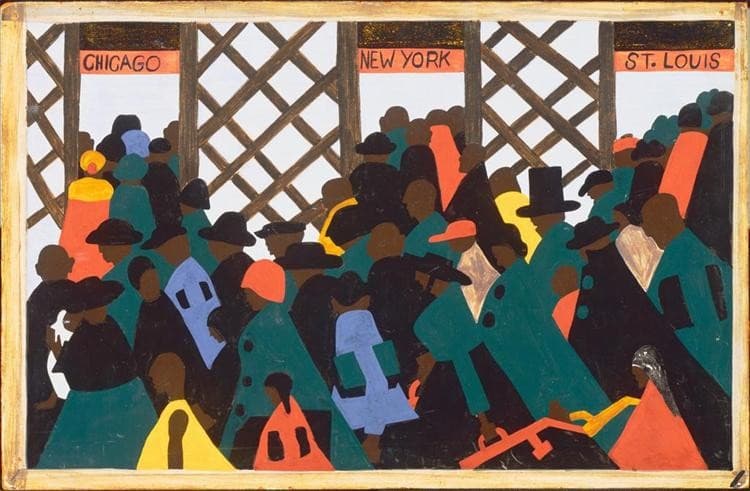
These six details examine Panel 1, the station scene reproduced here, rather than six separate panels of the sixty-part series. Lawrence groups travelers beneath destination signs and uses repeated colors, overlapping bodies, and luggage to organize the crowd.
1.The destinations are written overhead
Three destination signs divide the top of the panel. Their lettering gives the movement of the crowd a specific direction: the travelers are heading toward named cities. The signs also establish a horizontal sequence across the image, while the bodies below gather into less regular groups.
2.The lattice divides the crowd
Brown diagonal slats form repeated X shapes between the entrances. Their open pattern lets pale areas show through, but the strong outlines still act as barriers. The station is organized into separate routes before any individual traveler reaches a gate. These rigid diagonals contrast with the rounded hats and shoulders beneath them.
3.Color marks the line toward Chicago
Small patches of orange, yellow, teal, and blue distinguish bodies within the dark mass. Their heads rise in a narrowing group beneath the Chicago sign. The people are simplified, but the changes in height and clothing keep the line from becoming a uniform row. Color provides much of the information that facial detail would otherwise supply.
4.Hats are clearer than individual faces
Brimmed hats cut across adjacent faces and shoulders. Most people are seen partly from behind or through other bodies, so the crowd is easier to read as a shared movement than as a collection of portraits. The differing hat shapes and head angles nevertheless preserve small differences within that collective subject.
5.Bags make the journey concrete
At the lower edge, a bright orange bag is reduced to a flat shape with two dark handles. Nearby hands, sleeves, and another yellow form overlap it. These practical objects make departure tangible. The travelers carry possessions into the crowded space, and the bags add downward weight beneath the movement of heads and shoulders.
6.The foreground body leans into the crowd
The large teal figure at the right leans across a diagonal made by sleeves and luggage. Its scale brings the crowd close to the viewer, while smaller bodies continue toward the St. Louis entrance above. Lawrence creates a sense of depth through overlap and changing size despite the broad, flat application of color.
Jacob Lawrence begins the sixty panels at twenty-two, researching the Great Migration and writing the captions before he paints.
1941
He finishes the series, having worked across all sixty panels one colour at a time so they would hold together as a single composition.
1941
The series is exhibited at Edith Halpert's Downtown Gallery in New York and draws national attention.
Where to see it
The Phillips Collection and the Museum of Modern Art
A public viewing address has not yet been confirmed for this holding.
The sixty panels are divided between the Phillips Collection in Washington, D.C. and the Museum of Modern Art in New York, so the series is not held complete in one place. Displays change; check each museum's own record before making a special visit.
Frequently asked questions
What is The Migration Series about?
The Great Migration, in which African Americans left the rural South for cities in the North. Jacob Lawrence's sixty panels follow stations, trains, families, workers and people carrying luggage, showing both what pushed people to leave and how uncertain arrival could be.
How many panels are in The Migration Series?
Sixty, each with a caption Lawrence wrote himself. The horizontal panels are 30.5 by 45.7 centimetres and the vertical ones the same measurements turned the other way. He was twenty-three when he finished.
How did Jacob Lawrence paint sixty panels?
One colour at a time, across the whole sequence, instead of finishing each panel before starting the next. That kept the palette consistent and made the sixty panels behave as parts of a single composition rather than sixty separate pictures.
Did Jacob Lawrence have a personal connection to the Great Migration?
Yes. He was the son of southern migrants and grew up among people shaped by that movement, later moving to Harlem as a teenager. The series joined historical research to a subject already present in his own family and neighbourhood.
Where can you see The Migration Series?
The sixty panels are divided between two museums. The Phillips Collection in Washington, D.C. holds the odd-numbered panels and the Museum of Modern Art in New York holds the even-numbered ones. Displays change, so check each museum's own record before making a special trip.
In the atlas
What the graph records about this work — every claim carries its citation.
Jacob Lawrence painted sixty captioned panels in 1940 and 1941, working across the whole sequence one colour at a time so it would hold together as a single composition. It shows that modern painting could carry a historical narrative rather than abandon recognizable subjects.
— Jacob Lawrence: The Migration Series; One-Way Ticket: Jacob Lawrence's Migration Series and Other Visions of the Great Movement North
Explore painters from the same movements and circles.
Tarsila do Amaral
Brazilian painter who spent the 1920s moving between São Paulo and Paris, studied Cubism under André Lhote, Albert Gleizes and Fernand Léger, and used what she learned to paint Brazilian towns, railways, plants and bodies. Her 1928 painting Abaporu prompted the manifesto that gave the Anthropophagic movement its name.
The century's quietest revolutionary — readymades, the abandonment of painting, chess on a Paris rooftop in Entr'acte, and one anemic film of spinning puns signed Rrose Sélavy.
Dutch painter who lived in Montmartre with his brother Theo from March 1886 to February 1888 — the two years in which his dark Dutch palette turned into colour. He painted more than 200 pictures in Paris and died at Auvers-sur-Oise, north of the city, in 1890.
The sources below include collection records, catalogues, scholarly research, and primary materials that informed this page. They document The Migration Series, its making, and its place in cultural history.
1Jacob Lawrence: The Migration Series
Website
The Phillips Collection
Used for
The Phillips Collection's account of the series: the sixty panels, the captions, the colour-by-colour method, and the division of the panels between two museums.
Lawrence as the son of southern migrants, his move to Harlem, the earlier narrative series on figures in Black history, and the 1941 Downtown Gallery exhibition.
These references provide the documented foundation for this work's history and interpretation. Claim-level citations remain attached to the specific claims they support.


 View source