The Library
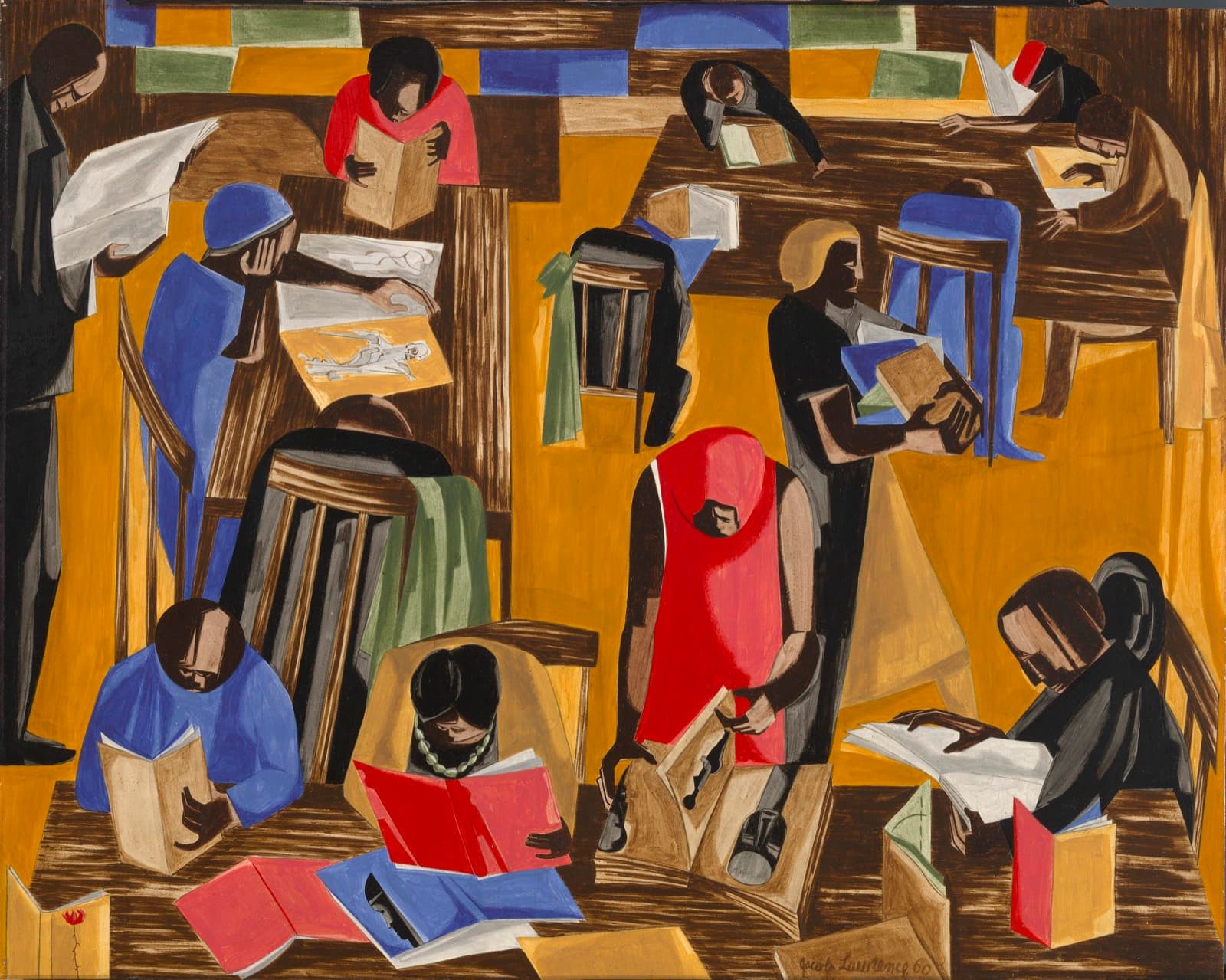
A crowded reading room, painted in flat blocks of red, blue, ochre and brown, where almost everyone has their head down in a book. Jacob Lawrence painted The Library in 1960. The Smithsonian American Art Museum thinks the room may be the 135th Street library in Harlem, now the Schomburg Center for Research in Black Culture. The museum also suggests the reader standing at the front with a book of African sculpture may be Jacob Lawrence himself as a young man.
- 1960
- Tempera on fiberboard
- Smithsonian American Art MuseumWashington, D.C., United States
About Jacob Lawrence
What the painting shows
A reading room seen from above and slightly to one side, so the tables tilt up toward us. About a dozen people fill the room. Most sit at long brown tables with books open in front of them.
One man stands at the left edge reading a newspaper. One figure walks through the room with an armful of books. One reader in a long red garment stands at the front, holding a big book open.
Nobody looks up. Heads are bowed, and faces are hidden by hair, hats and the angle of the head. Hands do most of the talking: a hand pressed to a forehead, a hand spread flat to hold a page down. The Smithsonian American Art Museum's label says everybody appears absorbed in their books.
The painting is 60.9 by 75.8 centimetres, tempera on fiberboard. Jacob Lawrence signed it along the edge of a book at the bottom: Jacob Lawrence 60.
A library in Harlem
The museum does not say for certain which library this is. Its label says the room may show the 135th Street Library in Harlem, now the Schomburg Center for Research in Black Culture.
The New York Public Library opened a Division of Negro Literature, History and Prints in that building on 8 May 1925. The museum calls it the country's first significant collection of African American literature, history and prints.
Jacob Lawrence grew up in Harlem. The Smithsonian's teaching guide says the library played a critical role in his development as an artist. There he could read about John Brown, Harriet Tubman and Frederick Douglass, all of whom became subjects of his series.
He had to go looking. Jacob Lawrence remembered that in high school Black culture was "never studied seriously like regular subjects," so he taught himself by visiting libraries and museums. The museum quotes that line from a statement he wrote in 1940, now in the Downtown Gallery papers at the Archives of American Art.
The reader at the front
The one reader standing at the front, in red, holds open a book of dark carved figures. The Smithsonian's teaching guide calls it a book on African sculpture. The museum's label suggests the standing figure may represent Jacob Lawrence as a young man, digging into his own heritage.
Jacob Lawrence gives this reader the strongest colour in the picture and puts the figure near the centre. The head is bowed so low that only a small patch of face shows. The reader is known by what they are looking at, not by a face.
How it is painted
Jacob Lawrence called his way of painting dynamic cubism, according to the Smithsonian American Art Museum. The Library shows what he meant. The room is broken into flat, hard-edged pieces of colour that lock together like a puzzle: the red of a garment against the ochre floor, a blue sweater against a brown chair.
There is almost no shading. Where Jacob Lawrence wants light on a face, he paints stripes of light and dark brown side by side. Tables and chairs are all the same streaky brown, brushed on so the strokes look like wood grain.
The colours themselves came, Jacob Lawrence said, from Harlem. Robert Hughes quotes him remembering how families decorated their tenements in bright colour, and how on Seventh Avenue in the depths of the Depression you would see "all these colors" in the windows.
The Smithsonian's teaching guide suggests the bright colours and patterning in The Library may also echo kente. Kente is a West African woven cloth that became an emblem of Black pride in the 1960s.
Where to see it
The Library belongs to the Smithsonian American Art Museum in Washington, D.C., accession number 1969.47.24, a gift of S.C. Johnson & Son, Inc. The museum lists the painting as not on view, so check its page before a visit.
Jacob Lawrence died in 2000 and the painting is in copyright. The reproduction here is the museum's own photograph, shown reduced under fair use for commentary.
Close reading
Reading the work, detail by detail
The Library is a crowded reading room where nearly everyone has their head down in a book. Up close there are a dozen readers, a man reading standing up, a book of African sculpture held open at the front, chairs with coats left on them, and Jacob Lawrence's signature painted along the edge of a book.
1.The reader standing at the front
One reader stands at the front of the room in a long red garment, head bent so low that only a small patch of face shows. The Smithsonian American Art Museum suggests this figure may be Jacob Lawrence himself as a young man. The red of the garment is the strongest colour in the painting, and it sits near the middle, so the eye keeps coming back to the standing reader.
2.A book of African sculpture
The standing reader holds open a big tan book. On its pages are dark carved figures: a tall, thin standing figure on one page and what looks like a carved head on the other. The Smithsonian's teaching guide calls it a book on African sculpture. Jacob Lawrence remembered that at school Black culture was "never studied seriously like regular subjects," so he taught himself in libraries and museums.
3.A man reading standing up
At the far left a tall man in dark clothes stands reading a big white newspaper, or a folder of papers. He is the only reader not sitting at a table. His long dark body runs down most of the left edge of the painting like a post.
4.A reader with his head in his hand
A man in a blue cap and a blue coat presses one hand to his forehead and spreads the other across a large pale sheet on the table. People make that gesture when they are concentrating hard, or when they are tired. Jacob Lawrence gives him no face to speak of. The gesture does the work that an expression would do in another painter's picture.
5.A drawing of a skeleton
On the table lie two big sheets. The yellow sheet carries a white drawing of a skeleton lying on its side, with a small skull for a head. The grey sheet above it shows more pale figures, too faint to make out. The sheets may be pages from an anatomy book. What the man in the blue cap is studying is not clear.
6.A reader in red at the back
At the back, a reader in a red top holds a tan book up close and bends over it. Jacob Lawrence gives the head no features beyond the curve of the hair and a sliver of cheek. Almost everyone in the room is painted the same way, eyes on the page, so the reading itself hides the faces.
7.Blocks of colour along the top
Along the top edge runs a band of flat rectangles in blue, green, ochre and cream. The rectangles could be books on shelves, or the tops of more tables further back. The Smithsonian's teaching guide suggests that the bright colours and patterning may echo kente, the woven strip cloth of West Africa that became an emblem of Black pride in the 1960s.
8.A reader leaning across the table
At the long table at the back a man in black leans far forward over a small open book, one arm stretched across the tabletop. The table is painted in streaky strokes of dark brown over lighter brown, like wood grain. Jacob Lawrence uses the same streaked brown for every table and chair in the room.
9.Two readers squeezed into the corner
In the top right corner a reader in a red cap props a white book upright on the table. Next to the reader in the red cap, a man in a long brown robe bends over an open book with both hands flat on the pages. The edge of the painting cuts both readers off, so the room seems fuller than the frame can hold.
10.Someone carrying an armful of books
A figure with a pale gold cap of hair walks through the room with an armful of books pressed to the chest: a tan book on top, blue and green ones underneath. The figure with the books is the only person on the move. Whether the figure is a librarian or another reader is not clear.
11.A chair with a coat left on it
An empty wooden chair stands in the middle of the room with a black coat over its back and a green scarf, or a sleeve, hanging down one side. The owner of the coat has stepped away. A second chair nearer the front has a green cloth over it too, so the room holds more people than we can see.
12.A bald man in a blue sweater
In the front row a bald man in a blue sweater holds a tan book open in front of him. His head is bowed so far that we see the top of his head and his lowered eyes, and little else. One dark hand is spread across the cover of the book.
13.A woman in a necklace of big beads
Beside the bald man a woman reads a bright red book. She wears a necklace of large pale green beads, painted as a row of oval stones. A tan shape wraps round her, which could be her coat or a deep armchair; the painting could be read either way. The beads are one of the very few ornaments anyone in the room wears.
14.Open books on the table
In front of the woman in the bead necklace, more books lie open on the table: a pink one, and a blue one with a dark head in profile on its page. The head might be a photograph or a picture of a carving; the page is too small to tell. Books lie open all over the painting, as if everyone has several going at once.
15.A red flower on a pale book
In the lower left corner a pale yellow book stands half open. On its cover is a single red flower on a thin dark stem. The flower could be a printed design or a bookplate. Whether it means anything is not clear.
16.A reader in black at the right
At the right, a reader in a black coat bends over a big white book with one hand spread flat to hold the pages down. The reader's face is painted in stripes of light and dark brown. The stripes are how Jacob Lawrence shows light falling across a face without any soft shading.
17.The signature on a book's edge
Jacob Lawrence signed the painting along the edge of a book lying at the bottom of the picture: "Jacob Lawrence 60", in dark brown paint, for 1960. The signature is painted onto the book's edge as if printed there, so the signature is part of the room rather than floating on top of it.
Timeline
1925
The New York Public Library opens its Division of Negro Literature, History and Prints at the 135th Street Branch in Harlem on 8 May.
1940
In a statement now in the Downtown Gallery papers, Jacob Lawrence recalls that Black culture was never studied seriously at school, so he taught himself in libraries and museums.
1960
Jacob Lawrence paints The Library in tempera on fiberboard and signs it Jacob Lawrence 60.
1969
S.C. Johnson & Son, Inc. gives the painting to the Smithsonian, accession number 1969.47.24.
Where to see it
Smithsonian American Art Museum
Washington, D.C., United States
A public viewing address has not yet been confirmed for this holding.
Listed as not on view by the Smithsonian American Art Museum in September 2026. Displays change, so check the museum's own record before making a special visit.
Frequently asked questions
Which library is The Library?
The Smithsonian American Art Museum says the painting may show the 135th Street Library in Harlem, now the Schomburg Center for Research in Black Culture. A collection of African American literature, history and prints opened there in 1925. The museum does not say for certain.
Is Jacob Lawrence in the painting?
Possibly. The museum suggests the reader standing at the front, looking at a book of African sculpture, may represent Jacob Lawrence as a young man. Nothing in the painting names the reader.
What is The Library painted with?
Tempera on fiberboard, 60.9 by 75.8 centimetres. Jacob Lawrence used water-based paint for his whole career, laid on in flat areas with hard edges and almost no shading.
What is dynamic cubism?
The name Jacob Lawrence gave his own style, according to the Smithsonian American Art Museum. A scene is broken into flat, sharp-edged shapes of strong colour that fit together like a puzzle. In The Library the readers, tables and books all lock together that way.
Where is The Library?
The Smithsonian American Art Museum in Washington, D.C., accession number 1969.47.24, a gift of S.C. Johnson & Son, Inc. The museum lists the painting as not on view, so check before a visit.
More by Jacob Lawrence
If you like Jacob Lawrence
Explore painters from the same movements and circles.
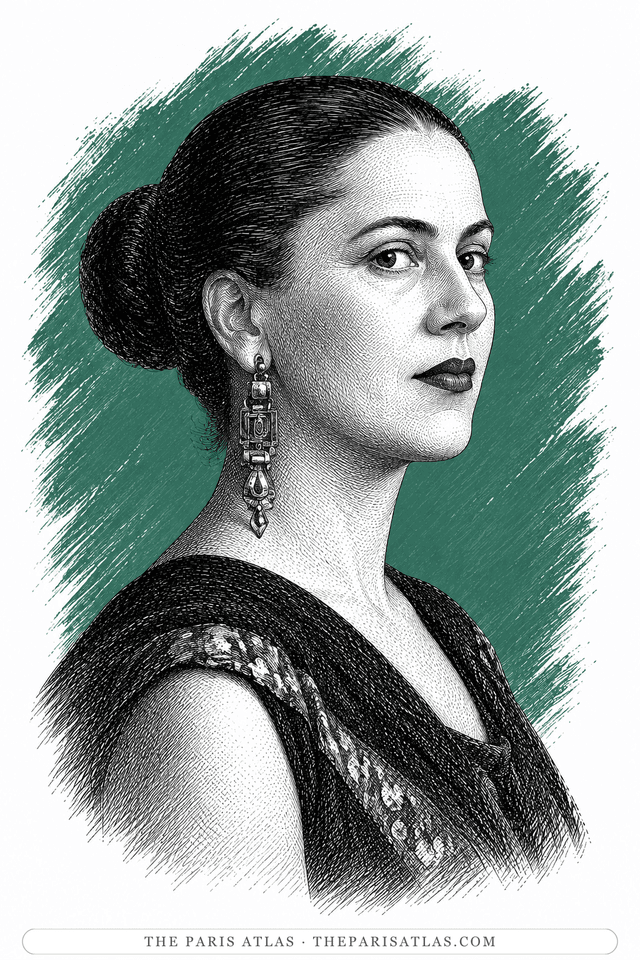
Tarsila do Amaral
Brazilian painter who spent the 1920s moving between São Paulo and Paris, studied Cubism under André Lhote, Albert Gleizes and Fernand Léger, and used what she learned to paint Brazilian towns, railways, plants and bodies. Her 1928 painting Abaporu prompted the manifesto that gave the Anthropophagic movement its name.
View artist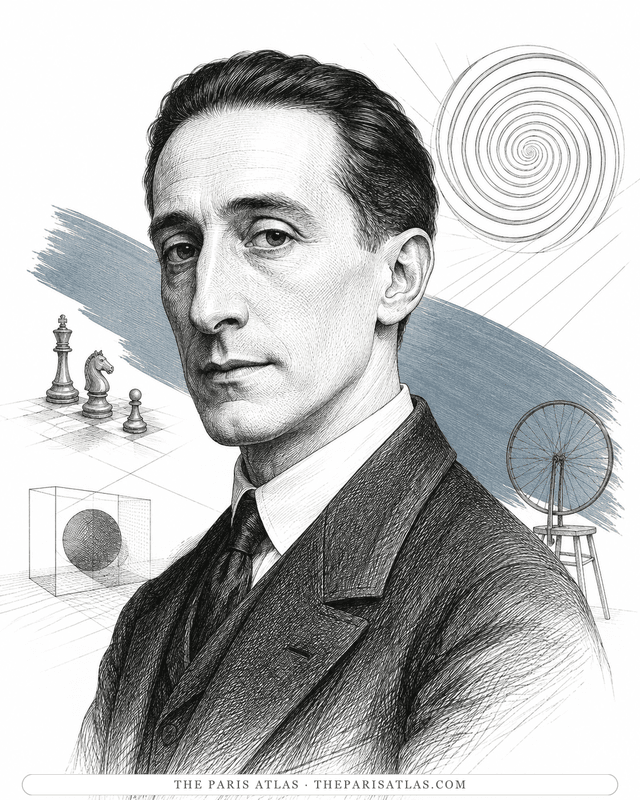
Marcel Duchamp
The century's quietest revolutionary — readymades, the abandonment of painting, chess on a Paris rooftop in Entr'acte, and one anemic film of spinning puns signed Rrose Sélavy.
View artist
Vincent van Gogh
Dutch painter who lived in Montmartre with his brother Theo from March 1886 to February 1888 — the two years in which his dark Dutch palette turned into colour. He painted more than 200 pictures in Paris and died at Auvers-sur-Oise, north of the city, in 1890.
View artist
References
The sources below include collection records, catalogues, scholarly research, and primary materials that informed this page. They document The Library, its making, and its place in cultural history.

1Jacob Lawrence, The Library (1960) — object record, 1969.47.24
Official recordSmithsonian American Art Museum, Washington, D.C.Used forThe holding museum's record, with its label on the 135th Street library, the standing reader and Jacob Lawrence's 1940 recollection.

2Jacob Lawrence, The Library, 1960 — The American Experience in the Classroom
WebsiteSmithsonian American Art MuseumUsed forThe museum's teaching poster: the book of African sculpture, the library's part in Jacob Lawrence's development, and the possible echo of kente cloth.
3Schomburg Center Centennial Timeline
WebsiteThe New York Public LibraryUsed forThe date the Division of Negro Literature, History and Prints opened at the 135th Street Branch.
4Jacob Lawrence, American Painter
BiographyUniversity of Washington Press, 1986Used forWhere the museum found Jacob Lawrence's 1940 statement about teaching himself in libraries and museums.
5The Best of Ask Joan of Art: Jacob Lawrence
WebsiteSmithsonian American Art Museum, 2011Used forJacob Lawrence's name for his style, dynamic cubism, and his memory of Harlem's colours as quoted by Robert Hughes.
These references provide the documented foundation for this work's history and interpretation. Claim-level citations remain attached to the specific claims they support.
 Explore more resources