Bar and Grill
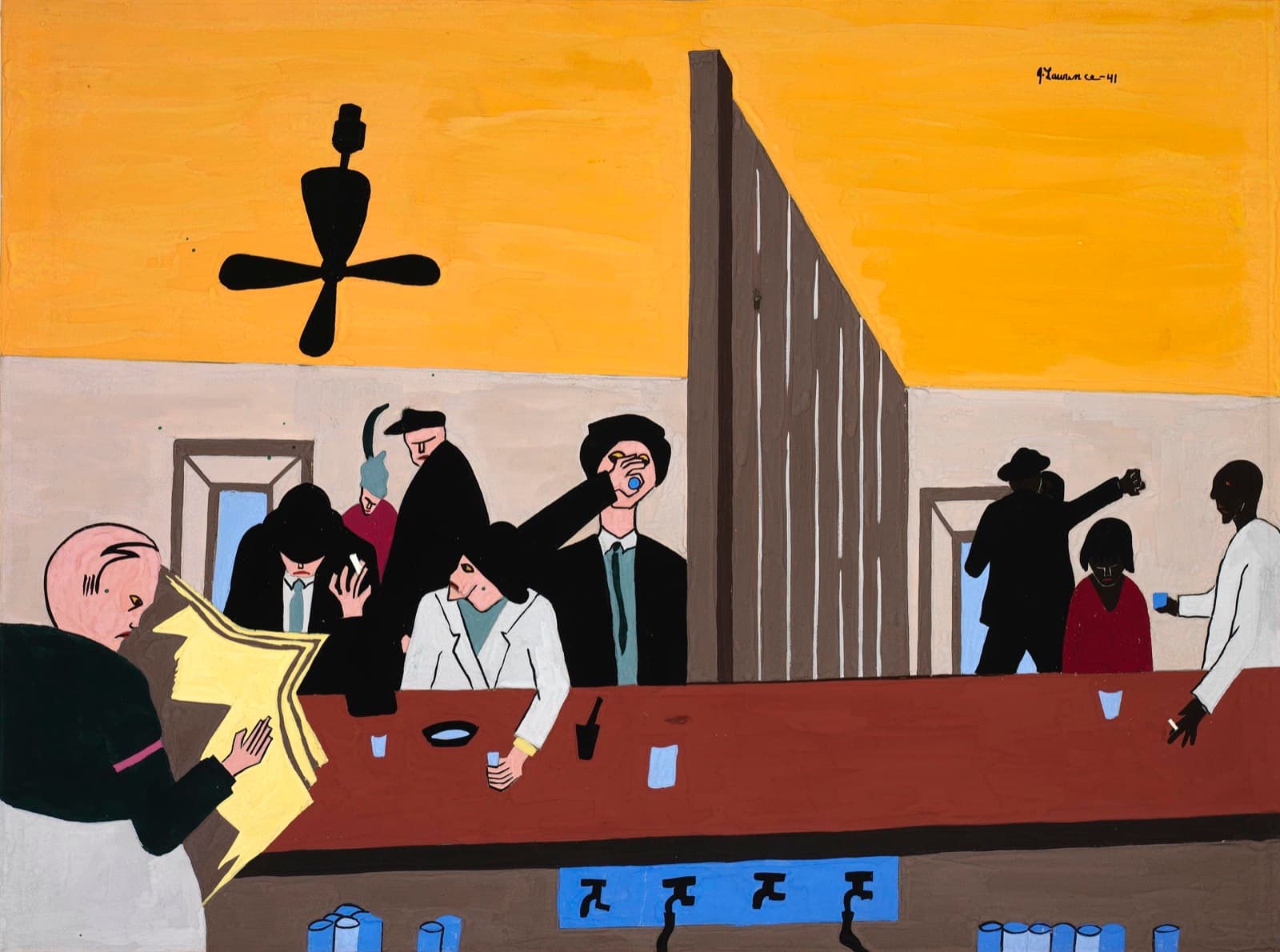
A café in New Orleans, split down the middle by a wall of wooden boards. On the left, white customers drink under a ceiling fan while the bartender reads his paper. On the right, a smaller room of Black customers has no fan and no ashtray. Jacob Lawrence painted Bar and Grill in 1941, soon after arriving in the South for the first time. The painting belongs to the Smithsonian American Art Museum.
- 1941
- Gouache on paper
- Smithsonian American Art MuseumWashington, D.C., United States
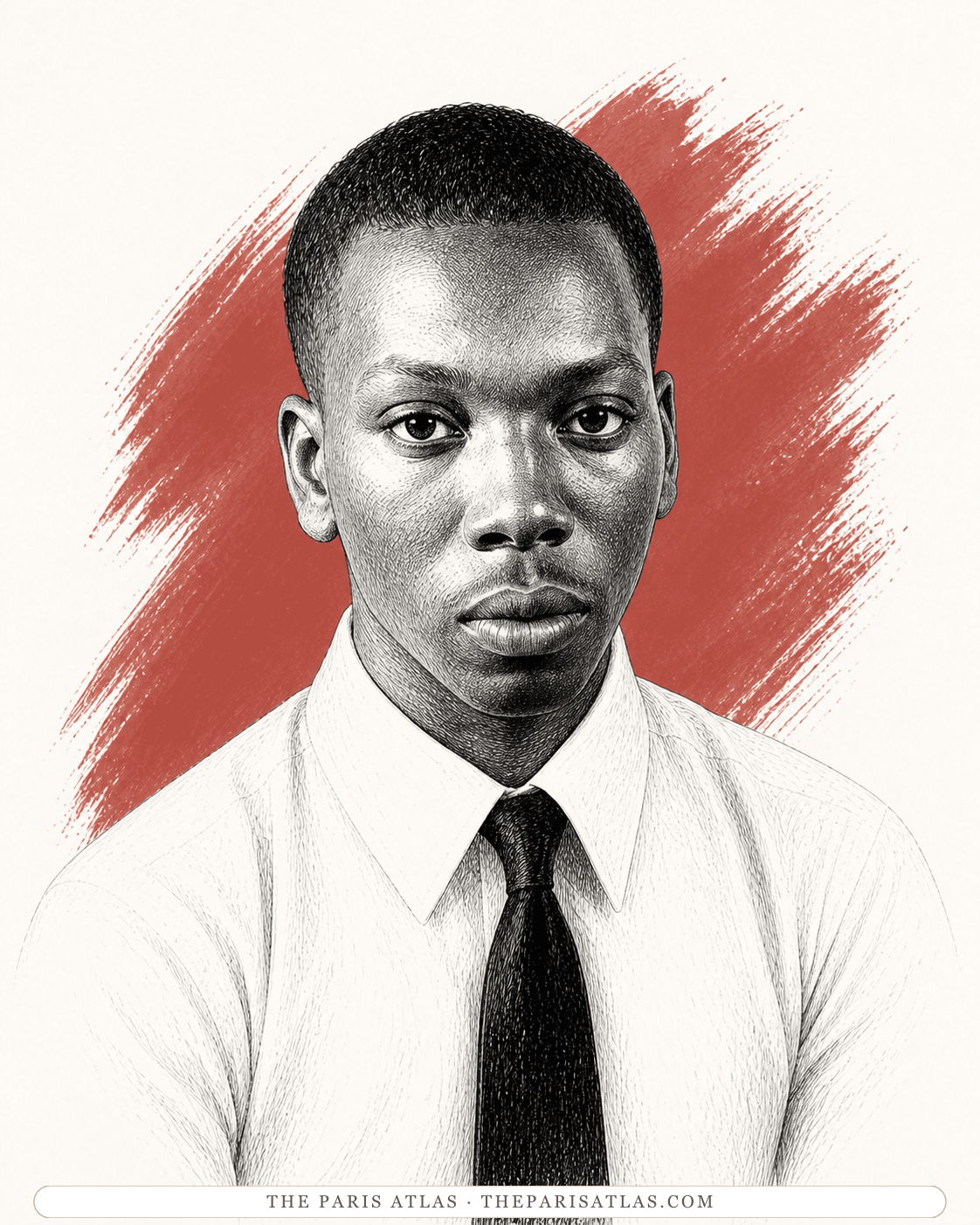
About Jacob Lawrence
What the painting shows
The inside of a bar, seen from behind the counter. A long red-brown bar runs across the whole picture. Above the bar, a wall of grey-brown boards runs down from the ceiling and cuts the room in two.
On the left are the white customers: men in dark suits and hats, one throwing back a drink, one holding a cigarette to his cheek, and a customer in a white jacket leaning on the bar. A bald bartender reads a yellow newspaper in the foreground, and a black ceiling fan hangs above them.
On the right are the Black customers, painted smaller and darker, almost as silhouettes. A woman in a dark red dress sits with her eyes down. A man in a white jacket smokes at the end of the bar. By the door, two figures stand pressed together with an arm raised, perhaps dancing.
New Orleans, 1941
Jacob Lawrence grew up in Harlem and had never been to the South. His mother came from Virginia and his father from South Carolina. Jacob Lawrence later said that in 1941, "if you weren't born in the South, your parents were." The South was never quite foreign to him, even before he saw it.
In 1941, just after finishing the sixty panels of the Migration Series, he and his wife, the painter Gwendolyn Knight, went to New Orleans. The Smithsonian American Art Museum says the law there made him ride at the back of city buses and live in a segregated neighbourhood.
He painted what he called "the life of Negroes in New Orleans," and Bar and Grill was among the first of those pictures. The museum says his anger is plain in the painting. Jacob Lawrence says almost nothing about the people as individuals, only their colour and how they are treated.
One room, two rooms
Everything on the two sides of the wall is doubled and unequal. The Smithsonian's teaching guide counts two doors, so the two groups never pass through the same entrance, and two sets of taps under the bar. The glasses are kept apart, stacked in a pile on one side and lined up on the other.
The white side has an ashtray and the fan. The Black side has neither.
The wall is not even in the middle. The white side is larger, and the bar tilts up a little at the right while the ceiling slopes down, so the Black side looks cramped. The museum adds that the number of people on each side matched the proportions of white and Black residents in the city.
We look at all of this from behind the bar, where the bartender stands. The museum says that odd, skewed point of view is what makes the two separate worlds look so artificial.
Jacob Lawrence had already painted a room like this once, from history rather than from life. Panel 49 of the Migration Series shows a restaurant in the North with Black and white diners divided by a zigzag yellow barrier.
Jacob Lawrence's caption for panel 49 reads: "They also found discrimination in the North although it was much different from that which they had known in the South."
How it is painted
Bar and Grill is gouache, a water-based opaque paint, on a sheet of paper 42.5 by 57.8 centimetres. The colour goes on flat, in hard-edged shapes with thin black outlines, and there is no shading at all.
Jacob Lawrence keeps the colours few: a hot yellow ceiling, a pale wall, the red-brown bar, and black for coats, hats and the fan. Small touches of pale blue mark the glasses, the doors and the taps.
The pale blue shows up on both sides of the wall, tying the two rooms together even as the wall splits them. Jacob Lawrence signed the painting on the yellow ceiling at the right: J Jacob Lawrence –41.
Shown in New York, kept in Washington
Several of the New Orleans paintings went on show with panels from the Migration Series at Edith Halpert's Downtown Gallery in New York in December 1941. The Smithsonian says the exhibition opened on 8 December, the day after the attack on Pearl Harbor.
The museum adds that critics both Black and white praised Jacob Lawrence.
The painting came to the Smithsonian American Art Museum in 2010 through the bequest of the painter Henry Ward Ranger. Henry Ward Ranger left his estate to the National Academy of Design to buy paintings by living American artists. The museum's accession number is 2010.52.
The museum showed the painting in 2012 in African American Art: Harlem Renaissance, Civil Rights Era, and Beyond, and lists it as not on view today. Jacob Lawrence died in 2000 and the painting is in copyright.
The reproduction here is the museum's own photograph, shown reduced under fair use for commentary.
Close reading
Reading the work, detail by detail
Bar and Grill is one room split in two by a wooden wall. Up close, the white customers' side has a ceiling fan, a bartender, an ashtray and a pyramid of glasses. The Black customers' side is smaller and has none of them.
1.The ceiling fan
A black ceiling fan hangs over the left half of the bar, where the white customers sit. The right half of the room has no fan. The Smithsonian American Art Museum points to the fan as the plainest sign of what the painting is about: the customers on the left are cooled, and the customers on the right are not.
2.The wall down the middle
A wall of grey-brown boards runs from the ceiling down to the bar and splits the room in two. Thin white lines between the boards look like light coming through the cracks, and the Smithsonian's teaching guide reads them that way. The wall is not in the middle of the room: the white side gets more of the space.
3.The signature
Jacob Lawrence signed the painting high on the yellow ceiling at the right, in small black letters: "J Jacob Lawrence –41". He painted the picture in New Orleans in 1941, soon after arriving there and just after finishing the sixty panels of the Migration Series.
4.The bartender and his newspaper
In the left foreground a bald man with a few strands of black hair across his head reads a yellow newspaper. The Smithsonian's teaching guide identifies him as the bartender, standing behind the bar on the white side. He does not look up. The newspaper's edges are cut into sharp zigzags, like a flash of lightning.
5.A man throwing back a drink
A man in a dark suit and tie tips a small blue glass into his mouth, head back, eyes narrowed to yellow slits. His raised arm is one long black shape that reaches across the man beside him. On the white side, he is the only person caught in the middle of a movement.
6.A man with a cigarette at his cheek
Under a black hat, a man with a turned-down mouth holds a white cigarette up by his cheek. The other white customers are packed in close behind him. The Smithsonian's teaching guide describes their faces as serious and unwelcoming.
7.A customer in a white jacket
A customer with long dark hair and a white jacket leans on the bar with a small glass in one hand. A small dark dot sits on the customer's cheek, perhaps a beauty mark. The Smithsonian's guide counts three men drinking at the bar, and this customer may be one of them, though the long hair makes it hard to be sure.
8.A feathered hat and a scowl
Behind the drinkers stand two more people: someone in a dark red coat and a grey hat with a tall black feather, and a man in a black cap with a sour, down-turned face. The Smithsonian's guide calls them a figure in red and a scowling figure. Their eyes are no more than dots and slits, but the mouths are clear.
9.The door on the white side
At the back of the white side is a doorway, drawn as a box in brown outline with pale blue light inside. The Smithsonian's guide points out that the two sides have separate entrances. White and Black customers never have to pass through the same door.
10.The door on the Black side
The right side has its own doorway, with the same brown frame and the same pale blue light. The doorway is squeezed in between the dividing wall and the customers, and a man in a black hat half blocks it.
11.Two figures, perhaps dancing
Near the right-hand door a man in a black hat stands pressed against another figure, one arm raised high with a fist, or two hands joined, at the top. The Smithsonian's teaching guide suggests the man and his partner are dancing. The two figures might also be embracing or arguing; the shapes are nearly solid black, so the gesture is hard to read.
12.A woman in a dark red dress
A woman in a dark red dress with a V neckline sits at the bar with her eyes down and a glass in front of her. The Smithsonian's guide points out that her neckline repeats the shape of the glass. Everyone on this side is painted smaller than the white customers, which makes them look further away.
13.A man at the end of the bar
At the far right a man in a white jacket holds a blue glass in one hand, and his other hand hangs over the edge of the bar with a cigarette. The Smithsonian's guide notes that he smokes but has no ashtray. He may be a customer or someone working behind the bar; nothing in the painting settles which.
14.One long bar for both rooms
The long red-brown bar runs the full width of the painting and joins the two rooms. The Smithsonian's guide notes that the bar tilts up a little at the right end, and with the ceiling sloping down, the right-hand room looks smaller and more crowded. We see the whole scene from behind the counter, where the bartender stands.
15.Four taps below the bar
Below the bar, four black taps stand in a row on a pale blue panel. The Smithsonian's guide counts two taps for each side of the wall, each with a black tube running down out of the picture. Even the taps are divided.
16.Glasses in a pile on the white side
On the shelf under the bar, on the white side, blue glasses stand stacked close together. The Smithsonian's guide describes them as a pyramid.
17.Glasses in a line on the Black side
On the Black side the glasses stand in a single row. The Smithsonian's teaching guide reads the two arrangements as separate glassware for Black and white customers, one more thing the wall divides.
18.An ashtray on the white side
On the white side of the bar sit a black oval dish with a pale blue centre, probably an ashtray, and a small black object shaped like a bottle or a shaker. The Smithsonian's guide lists the ashtray with the fan as comforts the Black customers do not get.
Timeline
1941
Jacob Lawrence and Gwendolyn Knight travel to New Orleans in the late summer. Jacob Lawrence paints Bar and Grill soon after arriving and signs it J Jacob Lawrence –41.
1941
Several New Orleans paintings are shown with Migration Series panels at Edith Halpert's Downtown Gallery in New York in December.
2010
The painting enters the Smithsonian American Art Museum through the Henry Ward Ranger bequest, accession number 2010.52.
2012
Shown in African American Art: Harlem Renaissance, Civil Rights Era, and Beyond at the Smithsonian American Art Museum, 27 April to 3 September.
Where to see it
Smithsonian American Art Museum
Washington, D.C., United States
A public viewing address has not yet been confirmed for this holding.
Listed as not on view by the Smithsonian American Art Museum in September 2026. Displays change, so check the museum's own record before making a special visit.
Frequently asked questions
What does Bar and Grill show?
A café in New Orleans divided by a wooden wall into a white side and a Black side. The white customers have a ceiling fan, an ashtray and the bartender's attention. The smaller Black side has none of them. Jacob Lawrence painted it in 1941.
Why is there a fan on only one side?
Because the fan is the point. The Smithsonian American Art Museum singles out the fan: the customers on the left are cooled and the customers on the right are not. The fan is the simplest sign in the painting of how segregation worked in daily life.
Where did Jacob Lawrence paint Bar and Grill?
In New Orleans, soon after he and Gwendolyn Knight arrived there in the late summer of 1941. The trip was Jacob Lawrence's first time in the South, and his first direct experience of segregation laws.
Is Bar and Grill part of the Migration Series?
No. Bar and Grill is a single painting made just after Jacob Lawrence finished the series. Panel 49 of the Migration Series shows a similar divided dining room in the North, which he had painted from history before he saw one in the South.
Where is Bar and Grill?
The Smithsonian American Art Museum in Washington, D.C., accession number 2010.52, a bequest of Henry Ward Ranger through the National Academy of Design. The museum lists the painting as not on view, so check before a visit.
More by Jacob Lawrence
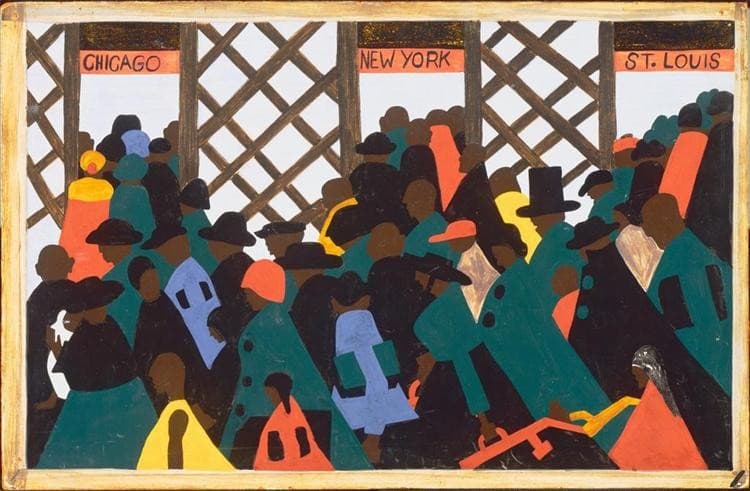
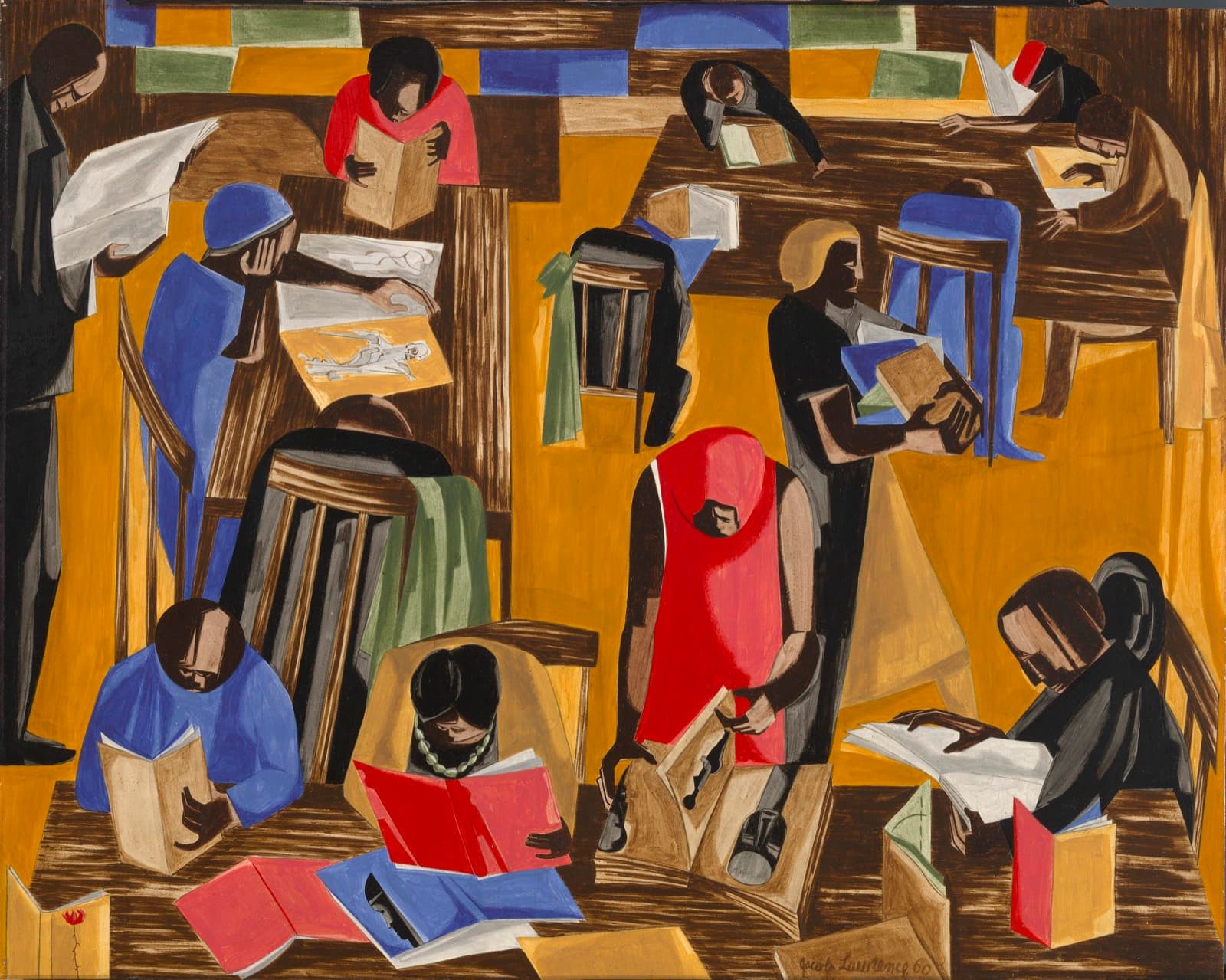
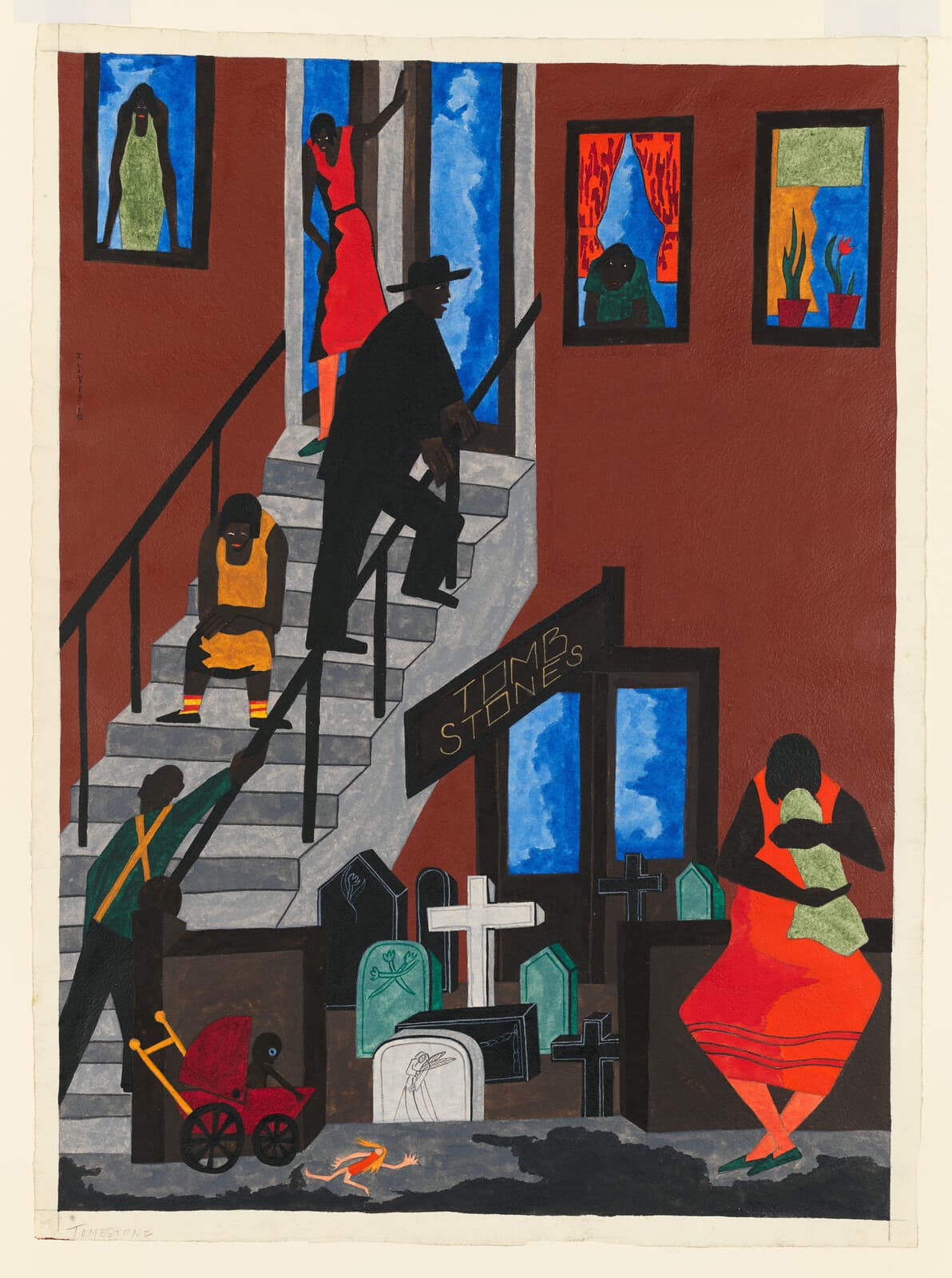
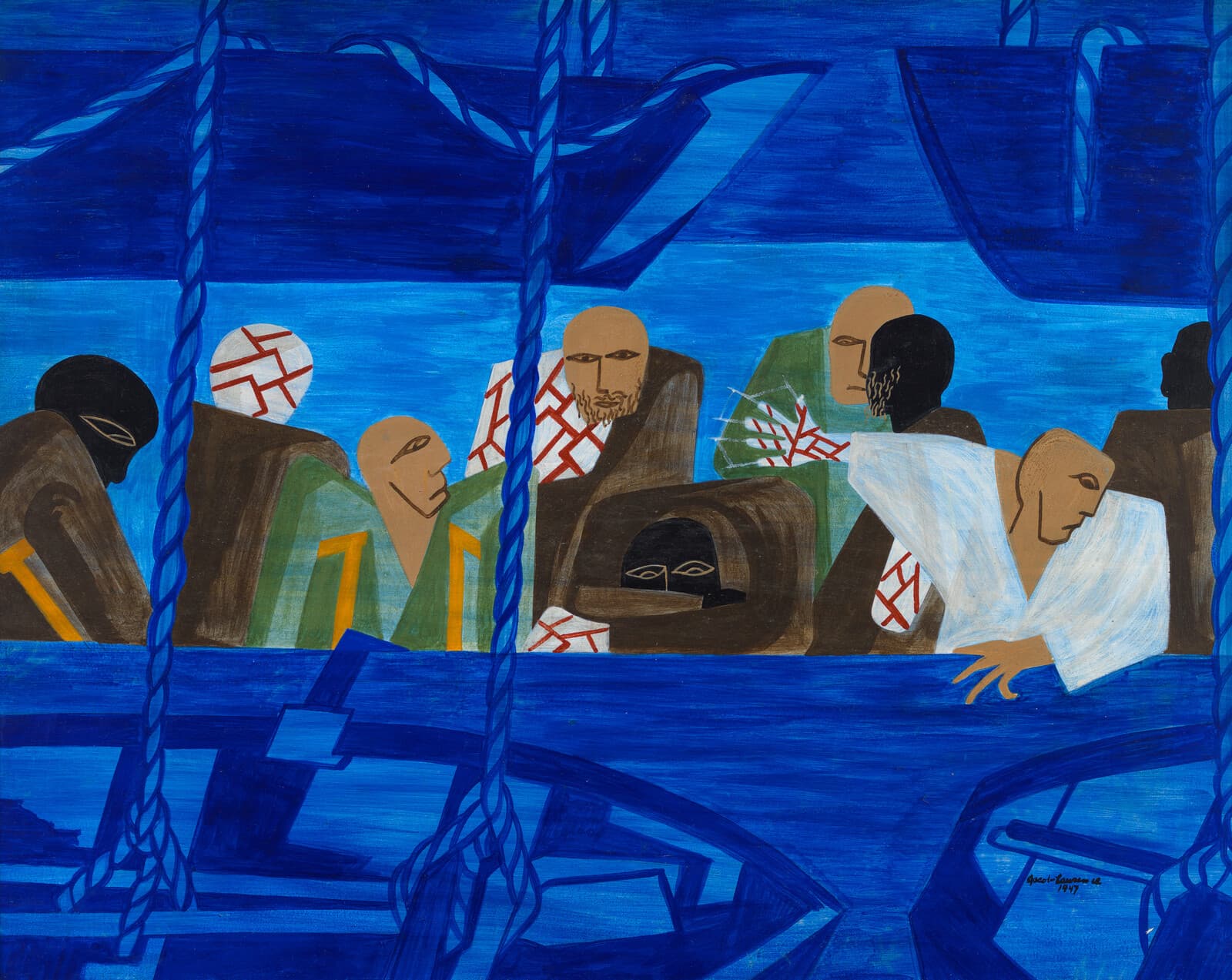
If you like Jacob Lawrence
Explore painters from the same movements and circles.
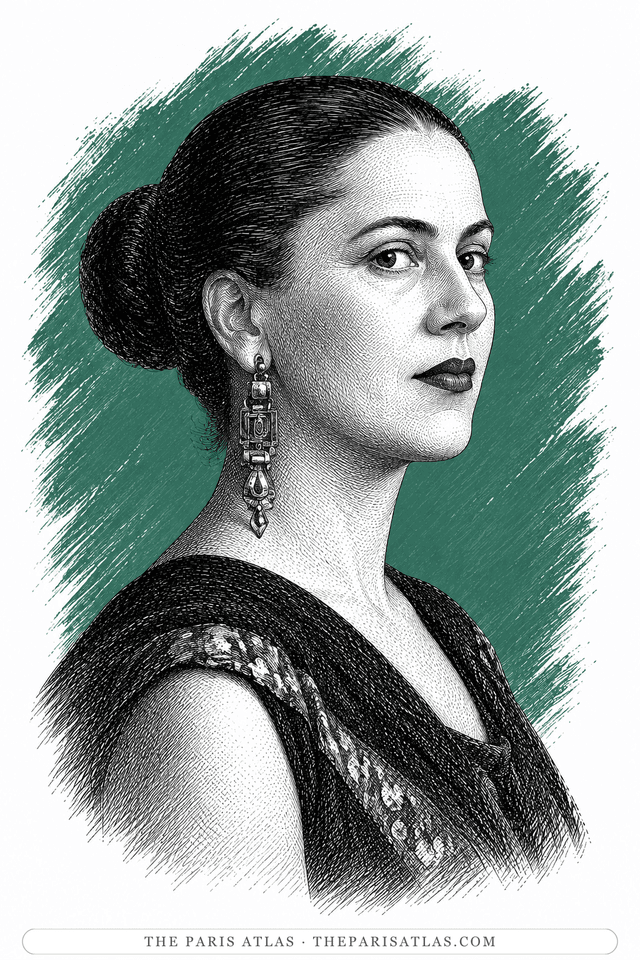
Tarsila do Amaral
Brazilian painter who spent the 1920s moving between São Paulo and Paris, studied Cubism under André Lhote, Albert Gleizes and Fernand Léger, and used what she learned to paint Brazilian towns, railways, plants and bodies. Her 1928 painting Abaporu prompted the manifesto that gave the Anthropophagic movement its name.
View artist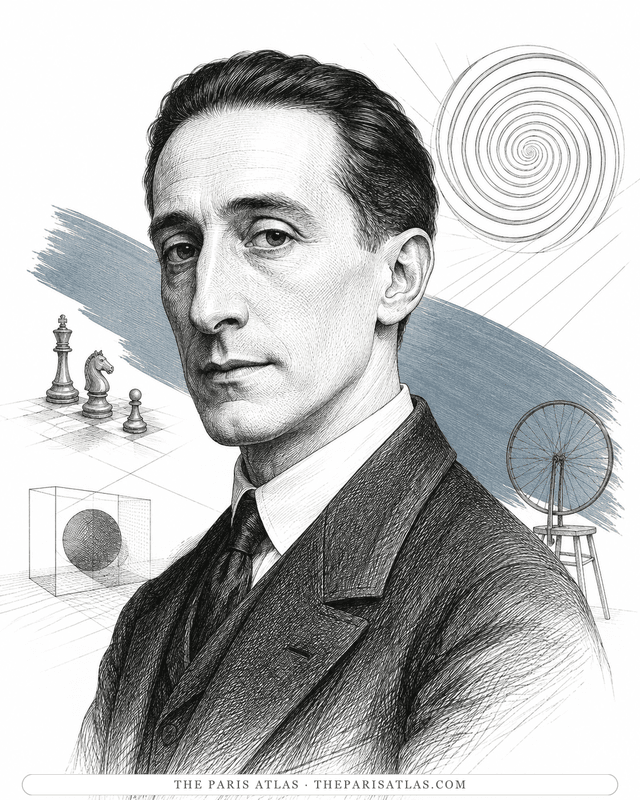
Marcel Duchamp
The century's quietest revolutionary — readymades, the abandonment of painting, chess on a Paris rooftop in Entr'acte, and one anemic film of spinning puns signed Rrose Sélavy.
View artist
Vincent van Gogh
Dutch painter who lived in Montmartre with his brother Theo from March 1886 to February 1888 — the two years in which his dark Dutch palette turned into colour. He painted more than 200 pictures in Paris and died at Auvers-sur-Oise, north of the city, in 1890.
View artist
References
The sources below include collection records, catalogues, scholarly research, and primary materials that informed this page. They document Bar and Grill, its making, and its place in cultural history.

1Jacob Lawrence, Bar and Grill (1941) — object record, 2010.52
Official recordSmithsonian American Art Museum, Washington, D.C.Used forThe holding museum's record: the New Orleans trip, Jacob Lawrence's 1961 remark about the South, the divided café, the ceiling fan and the December 1941 Downtown Gallery show.

2Bar and Grill — Activity: Observe and Interpret (The American Experience in the Classroom)
WebsiteSmithsonian American Art MuseumUsed forThe museum's teaching sheet: the separate doors, taps and glassware, the tilted bar, the missing ashtray and the figures on each side.
3Heat
WebsiteSmithsonian American Art Museum, Eye Level, 2012Used forHoward Kaplan on the fan as the dividing line between the two scenes.
4Jacob Lawrence: Exploring Stories
WebsiteWhitney Museum of American Art, 2002Used forThe Migration Series panel of a divided dining room in the North, with Jacob Lawrence's caption.
5Henry Ward Ranger — artist biography
WebsiteSmithsonian American Art MuseumUsed forThe terms of the Ranger bequest through which the painting reached the museum.
These references provide the documented foundation for this work's history and interpretation. Claim-level citations remain attached to the specific claims they support.
 Explore more resources