Life and Times of Frederick Douglass
How Frederick appears in its pages: The older Douglass reviews his enslavement, activism, public service, travels, and political decisions.
Read the character guideAmerican abolitionist — a campaigner for the abolition of slavery — orator and newspaper publisher, born into slavery in Maryland in 1818, who escaped north in 1838 and spent the next half-century arguing for Black citizenship in books, newspapers and federal office. In 1859 the American minister in London, the senior United States diplomat in Britain, refused him a passport for France on the ground that he was not a citizen of the country he had been born in: American law at the time held that no Black person could be one. The French minister in London issued him a permit to enter France at once. Twenty-seven years later he reached Paris anyway, aged sixty-eight, and spent weeks in its galleries.
Frederick Douglass was born into slavery in Talbot County, Maryland, in February 1818, escaped north disguised as a sailor in 1838, and spent the next half-century arguing — in books, in newspapers, and from thousands of platforms — that the country which had owned him owed him citizenship. His Narrative of the Life of Frederick Douglass, published in 1845, was written to prove that a man who spoke that well had really been a slave. He recruited Black soldiers for the Union Army — the army of the northern states in the American Civil War of 1861–65, fought over the survival of slavery — pressed President Abraham Lincoln on their pay and treatment, and later held two federal offices in the District of Columbia, the capital district around Washington: United States Marshal, its chief federal law officer, and Recorder of Deeds, the official who kept its register of property.
His Paris is a single late season, and its meaning is in how long it took to arrive. In 1859 he was sheltering in England after the raid on Harpers Ferry — an attempt by the white abolitionist John Brown to seize a federal arsenal in Virginia and arm an uprising of enslaved people, which failed, and in which Douglass was suspected of having had a hand. From England, France was a few hours away. Douglass asked the American minister in London — the senior United States diplomat in Britain, and the only man who could issue him a passport — for one, and was told he could not have it because he was not a citizen of the United States. The French minister in London gave him a permit to enter France without argument. Douglass finally saw the city in the winter of 1886–87, on a European tour taken with his second wife, Helen Pitts Douglass — his first time on the continent at all, at sixty-eight[1], holding the citizenship the refusal had denied him.
He was born Frederick Augustus Washington Bailey in Talbot County, Maryland, in February 1818, into slavery, and never knew the date; in adult life he chose Valentine's Day for it. On 3 September 1838, dressed as a sailor and carrying a borrowed ticket, he boarded a northbound train and was in New York City within a day. He took the name Douglass, married Anna Murray, and began speaking for the abolitionist movement — the campaign to end American slavery — with such fluency that audiences doubted he had ever been enslaved at all.
The Narrative of the Life of Frederick Douglass, published in 1845, was his answer to the doubters: names, places and dates, printed at the risk of identifying him to the man who legally owned him. Under the law of the time an escaped slave remained his owner's property anywhere in the United States, so publishing the book made recapture a real danger. Douglass sailed for the British Isles and spent almost two years lecturing and selling it in England, Ireland and Scotland. While he was there, two English Quakers, Anna Richardson and her sister-in-law Ellen Richardson — the Quakers being a Protestant church that had led the British campaign against slavery — raised seven hundred and fifty dollars, paid the man who owned him and bought his freedom outright, and he came home legally free. He met both women again forty years later, in their eighties, on the 1886 tour.
In 1859 Douglass was in England again, and not by choice. He was suspected of complicity in John Brown's raid on the federal arsenal at Harpers Ferry, in Virginia — Brown was a white abolitionist, and the raid was his failed attempt to seize the government's guns and arm an uprising of enslaved people. Douglass left the country ahead of arrest. The governor of Virginia, the state where the raid had happened and where Brown was tried and hanged, announced that if a ship could overtake the one carrying Douglass he would have him taken off its deck at any cost. Douglass crossed in fourteen days of foul weather and landed at Liverpool, the English port, a wanted man.
He had wanted to see France for years, and from England it was a short crossing. So he wrote to George M. Dallas, the American minister at the British court — the United States's senior diplomat in London, and the only official who could issue him a passport — and asked for one. Dallas refused, on the ground that Douglass was not a citizen of the United States. That was not a remark about Douglass's paperwork. It was the law of the country as the courts then read it: a Black American, free or enslaved, was not a citizen and could hold none of a citizen's rights. Douglass set the refusal down to the politics of the minister's party, to the slaveholding policy of his country, to a recent decision of the Supreme Court — the Dred Scott judgment of 1857, which had ruled that people of African descent could never be citizens of the United States — and, he added, perhaps to the petty meanness of the man's own nature.
I did not beg or remonstrate with this dignitary further, but simply addressed a note to the French minister in London asking for a permit to visit France, and that paper came without delay.
A foreign government put in writing the permission his own government refused: he wrote to the French minister in London — France's senior diplomat in Britain — and the permit to enter France came back at once. He never used it. News arrived from home that his young daughter Annie had died, and he took the first outgoing steamer for Portland, Maine — seventeen days, back into the reach of the men hunting him. He called the refusal a galling disappointment, and wrote that he mentioned it not to belittle his country but because it was part of the story of his life.
The American career the refusal interrupted was already large and got larger. He had bought a printing press and moved to Rochester, New York, to run his own newspaper, The North Star — named for the star by which people escaping slavery steered north — on the principle that Black Americans should argue their own case in their own pages rather than have it argued for them. During the Civil War, fought from 1861 to 1865 between the slaveholding southern states and the northern states of the Union, he recruited Black soldiers for the Union army — two of his sons served in the 54th Massachusetts Infantry, one of the first Black regiments raised in the North — and met President Abraham Lincoln to press him on the unequal pay and treatment those soldiers received.
After the war the government that had once refused him a passport gave him its offices. He was United States Marshal for the District of Columbia — the chief federal law officer for the capital district — from 1877 to 1881, and Recorder of Deeds for the District, the official responsible for its register of property, from 1881 to 1886. Anna Murray Douglass, his wife of more than forty years, died in 1882. In 1884 he married Helen Pitts, an activist and the daughter of an abolitionist, who was white and twenty years younger; a marriage between a Black man and a white woman was a scandal to both communities in 1884, and this one was attacked from every direction. They left the country together two years later.
"September, 1886, was quite a milestone in my experience and journey of life," he wrote. He had twice been to England, but never to the continent of Europe, and this time he had his wife with him. In London he sat in the House of Commons, the elected chamber of the British Parliament, and heard William Ewart Gladstone — leader of the Liberal Party and three times prime minister — argue for the indefinite postponement of a coercion bill for Ireland, one of the emergency laws that suspended ordinary legal rights there to put down resistance to British rule. Douglass watched the old man point straight at the government benches and demand to know what they were fighting for. Almost everyone he had met in Parliament forty years earlier, on his first lecture tour of Britain, was dead.
Then France — the country his own government had refused to let him enter twenty-seven years before. He is careful in Life and Times of Frederick Douglass, the last and fullest of his three autobiographies, to say that he will not attempt a full account of the travels — the shelves were crowded with such books already — and what he keeps of Paris is short and physical: that he was permitted to visit France and see something of life in Paris, to walk the streets of that splendid city, and to spend days and weeks in her charming art galleries. He puts the sentence next to the story of Dallas's refusal on purpose. The word that matters in it is permitted: this time nobody stopped him.
Leaving Paris, the Douglasses passed the grounds of Fontainebleau — the royal palace south of the city, which the French Republic, the elected government that had replaced the monarchy, had taken over from the princes and kept in excellent order, its trees clipped to straight lines by what he called a remorseless plummet and pruning-hook, meaning the plumb line and the shears. They went down through the provincial cities of Dijon and Lyons to Avignon, where the popes lived for some seventy years in the fourteenth century instead of in Rome, and to the Roman amphitheatre at Arles, a stone arena two thousand years old and still standing, and reached Marseilles, the great French port on the Mediterranean, in midwinter to find the sea blue. On the road he noticed something he had been told was proof of Black inferiority — the carrying of burdens on the head — being done all over the south of France by white peasants, and wrote that it might as well be welcomed as proof of a common brotherhood instead.
The Douglasses were not the only famous Americans in Paris in the course of that year. Elizabeth Cady Stanton, the veteran campaigner for women's suffrage — the right of women to vote, which no American woman then had — spent from the spring to October of 1887 in the[2] city with her son Theodore Stanton, an American journalist settled there, and held receptions on Wednesday afternoons all through the stay. She and Douglass had known each other since the first women's rights convention held in the United States, at Seneca Falls, New York, in July 1848, where her resolution demanding the vote for women was the one demand the meeting nearly struck out: it passed, she wrote, "with the help of Frederick Douglass, and after a heated discussion," and when the national press turned on the convention he defended it both in the hall and in his newspaper. Thirty-nine years later, in her Paris drawing room, the whole record of their meeting is one line of her diary — "several pleasant interviews with Frederick Douglass and his wife" — and it is the closest thing we have to a record of the Douglasses at their ease in the city.
The tour ran on far past France — Nice, then the Italian cities of Genoa, Pisa, Rome and Naples, then a ship from Naples to Port Said, the Egyptian harbour at the mouth of the Suez Canal, and into Egypt, where he climbed the Great Pyramid and sailed the Nile; then Greece and the Acropolis, the ancient temple citadel above Athens; then back to Rome, and to Florence, where the first thing he and Helen did on arrival was visit the graves of Theodore Parker, the Boston preacher who had spoken for the slave when the pulpits around him were silent, and of the English poet Elizabeth Barrett Browning, who lie near each other there. He came home in 1887 after a year abroad.
He set the whole tour against the Maryland farm on Chesapeake Bay where, as an enslaved boy, he had spent his Sundays watching the sails go out to sea, and thought the contrast was the point: that a man once a slave on the eastern shore of Maryland was now enjoying what the wisest and best of the world have bestowed for the wisest and best to enjoy. He served from 1889 to 1891 as Minister Resident and Consul General to Haiti — the senior American diplomat in the Caribbean republic that enslaved people had founded by revolution — and died at Cedar Hill, his house in Washington, on 20 February 1895, aged seventy-seven.
Paris became a destination for Black American writers in the century after him, and for reasons he would have recognized: the novelist Richard Wright moved there in 1946 and the essayist James Baldwin followed in 1948, both of them leaving a country whose treatment of them they had stopped expecting to change. Douglass had no such option and never sought one. He went abroad for a single year at the end of a long life, spent weeks of it in Paris, looked at the pictures, and came home to the argument.
Born Frederick Augustus Washington Bailey in Talbot County, Maryland, in February, into slavery.
Escapes on 3 September, dressed as a sailor, and reaches New York City within a day. Marries Anna Murray.
Publishes Narrative of the Life of Frederick Douglass, then sails for the British Isles to avoid recapture.
Lectures across England, Ireland and Scotland. Anna and Ellen Richardson, English Quakers, open a correspondence with the man who still legally owned him, raise seven hundred and fifty dollars and buy his freedom; he returns to the United States legally free.
Buys a printing press, moves to Rochester, New York, and begins publishing his own newspaper, The North Star.
Flees to England after John Brown's raid on the federal arsenal at Harpers Ferry. George M. Dallas, the American minister in London and the senior United States diplomat in Britain, refuses him a passport for France on the ground that he is not a citizen of the United States — the position the Supreme Court had taken in the Dred Scott judgment of 1857, which held that no Black American could be a citizen. The French minister in London issues him a permit to enter France at once.
Learns of his daughter Annie's death and sails home without using the French permit — seventeen days to Portland, Maine.
Recruits Black soldiers for the Union Army, the army of the northern states in the Civil War, two of his sons among them in the 54th Massachusetts — one of the first Black regiments raised in the North — and meets President Abraham Lincoln over their unequal pay and treatment.
United States Marshal for the District of Columbia, then Recorder of Deeds for the District.
Two years after Anna's death, marries Helen Pitts; the interracial marriage is attacked from all sides.
Sails in September with Helen Pitts Douglass for his first journey to the European continent, hearing the Liberal leader William Ewart Gladstone speak in the House of Commons before crossing to France.
Paris: walks the city and spends weeks in its art galleries, then travels south past Fontainebleau, Avignon and Arles to Marseilles, and on to Italy, Egypt and Greece. Elizabeth Cady Stanton records "several pleasant interviews with Frederick Douglass and his wife" during her Paris stay. Home after a year abroad.
Serves as Minister Resident and Consul General to Haiti.
Dies on 20 February at Cedar Hill, his house in Washington, D.C., aged seventy-seven.
How Frederick appears in its pages: The older Douglass reviews his enslavement, activism, public service, travels, and political decisions.
Read the character guide
How Frederick appears in its pages: Douglass revisits his childhood and describes becoming a lecturer, editor, and independent political advocate.
Read the character guide
How Frederick appears in its pages: The narrator recalls his childhood, education, enslavement, and emergence as a public speaker.
Read the character guide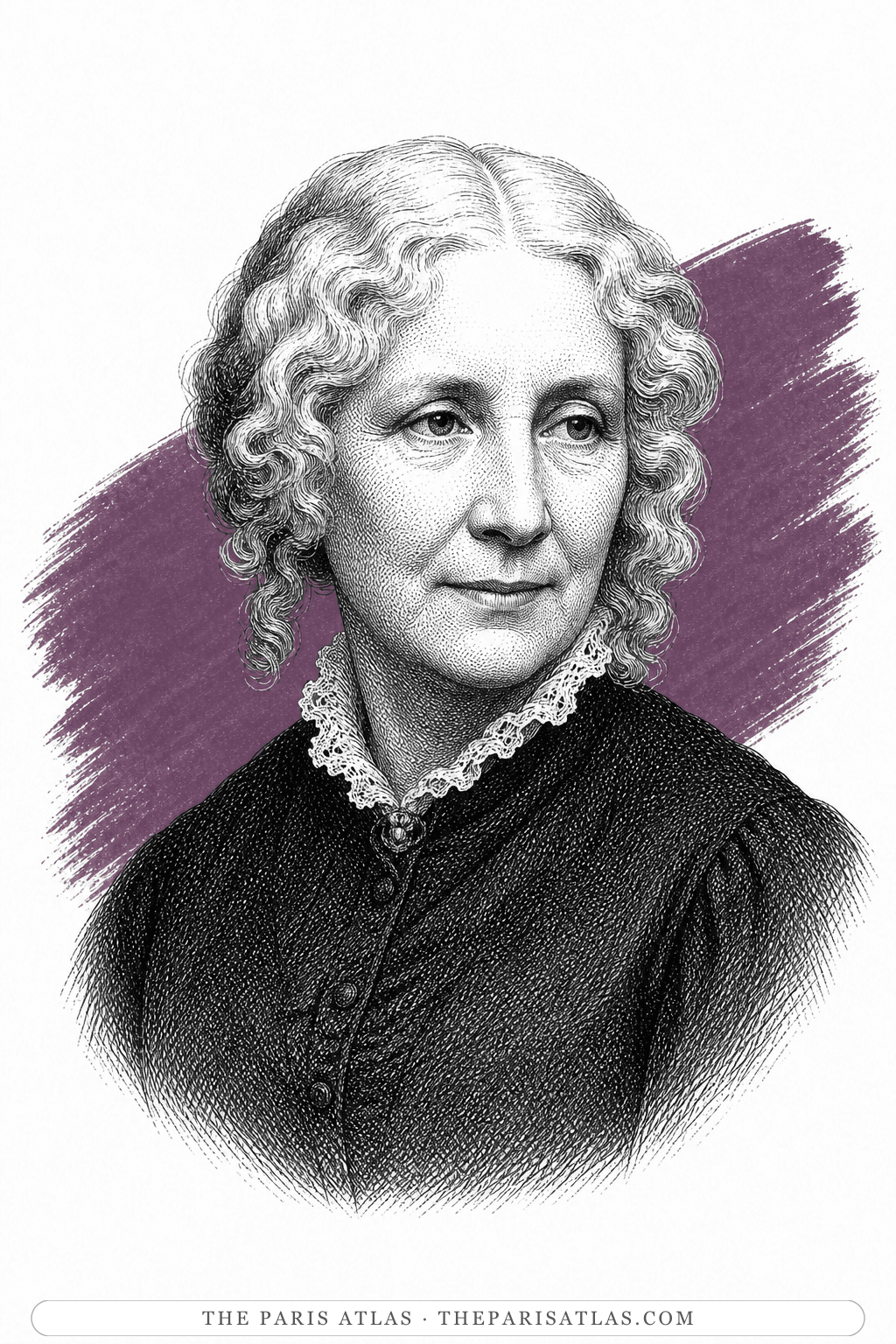
Met · 1853
Shortly before sailing for Europe in 1853, Stowe sent to Rochester for Douglass and asked him to spend a day at her house in Andover, Massachusetts. Her question was what to do with the money British admirers were raising for her; she wanted a monument to Uncle Tom's Cabin that would outlast the book's first effect. Douglass argued against a purely academic institution and for workshops where free Black Americans could learn trades alongside a plain English education, on the ground that poverty was the root of everything else, and she asked him to put it in a letter she could carry to England — dated Rochester, 8 March 1853. He then defended her in print while she was abroad, against American papers accusing her of pocketing British money. On her return she reconsidered, and the school was never founded; he recorded the disappointment in his autobiography without softening it.
Douglass's first autobiography follows his childhood in slavery, secret education, and beginnings as an abolitionist speaker.

Frederick Douglass's Independence Day speech of 1852: praise for the men who signed the Declaration, then a charge that the country had betrayed it.

Frederick Douglass's only work of fiction: a novella about Madison Washington, who led nineteen enslaved men in taking over the slave ship Creole in 1841.
Douglass revisits his childhood and explains how freedom led him into public speaking, newspaper editing, and political disagreement.
Douglass's final autobiography follows his life from slavery into abolition, the Civil War, public office, and diplomacy.
Yes, once, late in his life. He and his second wife, Helen Pitts Douglass, left the United States in September 1886 for a year in Europe, Egypt and Greece, and Paris came early in the itinerary, in the winter of 1886–87. It was his first time on the European continent — he had been to England, Ireland and Scotland twice before, but never to France. In his autobiography he says he walked the streets of the city and spent days and weeks in its art galleries.
Because the American minister in London said he was not a citizen — which, under American law as the courts then read it, no Black person was. In 1859 Douglass was in England, having left the United States under suspicion of involvement in John Brown's raid on the federal arsenal at Harpers Ferry, and he wrote to George M. Dallas, the American minister at the British court and the only official who could issue a United States passport in Britain, asking for one so that he could visit France. Dallas turned him down on the ground that Douglass was not a citizen of the United States; the Supreme Court's Dred Scott judgment of 1857 had ruled exactly that of every American of African descent. Douglass then asked the French minister in London for a permit to enter France and, as he put it, "that paper came without delay" — a foreign government granted in days what his own country refused outright.
No. Before he could travel, word reached him that his daughter Annie had died at home, and he took the first outgoing steamer for Portland, Maine — a seventeen-day crossing back into the country where he was still wanted for questioning. He did not set foot in France for another twenty-seven years.
The one meeting on record is with Elizabeth Cady Stanton, the American women's suffrage campaigner, who spent the spring to October of 1887 in Paris with her son Theodore Stanton and held weekly receptions for the Americans and French reformers in the city. In the memoir published after her death she writes: "We had several pleasant interviews with Frederick Douglass and his wife." Douglass's own published account of the tour names no one he met in Paris.
Less than he wrote about anywhere else on the tour, and he says why: he had decided not to attempt a full travel account, since the shelves were already crowded with them. What he does record of France is mostly the country between Paris and Rome — Fontainebleau's clipped avenues, the popes' palace at Avignon, the Roman amphitheatre at Arles, the vineyard villages of the south where men and women went out to the fields in gangs at dawn. He also noted that carrying loads on the head, which he had seen alleged as a mark of Black inferiority, was ordinary practice across southern France, and wrote that it might be welcomed as proof of a common brotherhood.
Escaping slavery in 1838 and becoming the most prominent Black American of the nineteenth century: the author of the 1845 Narrative of the Life of Frederick Douglass, the account of his own enslavement and escape; the publisher of the abolitionist newspaper The North Star in Rochester, New York; the recruiter of Black troops for the Union Army in the Civil War and the man who pressed President Abraham Lincoln on their treatment; and later United States Marshal and Recorder of Deeds for the District of Columbia, two federal offices in the American capital, and Minister to Haiti.
He died on 20 February 1895 at Cedar Hill, his estate in the Anacostia neighbourhood of Washington, D.C., aged seventy-seven. The house is now the Frederick Douglass National Historic Site and holds thousands of objects that belonged to the family.
Visited · 1886–1887
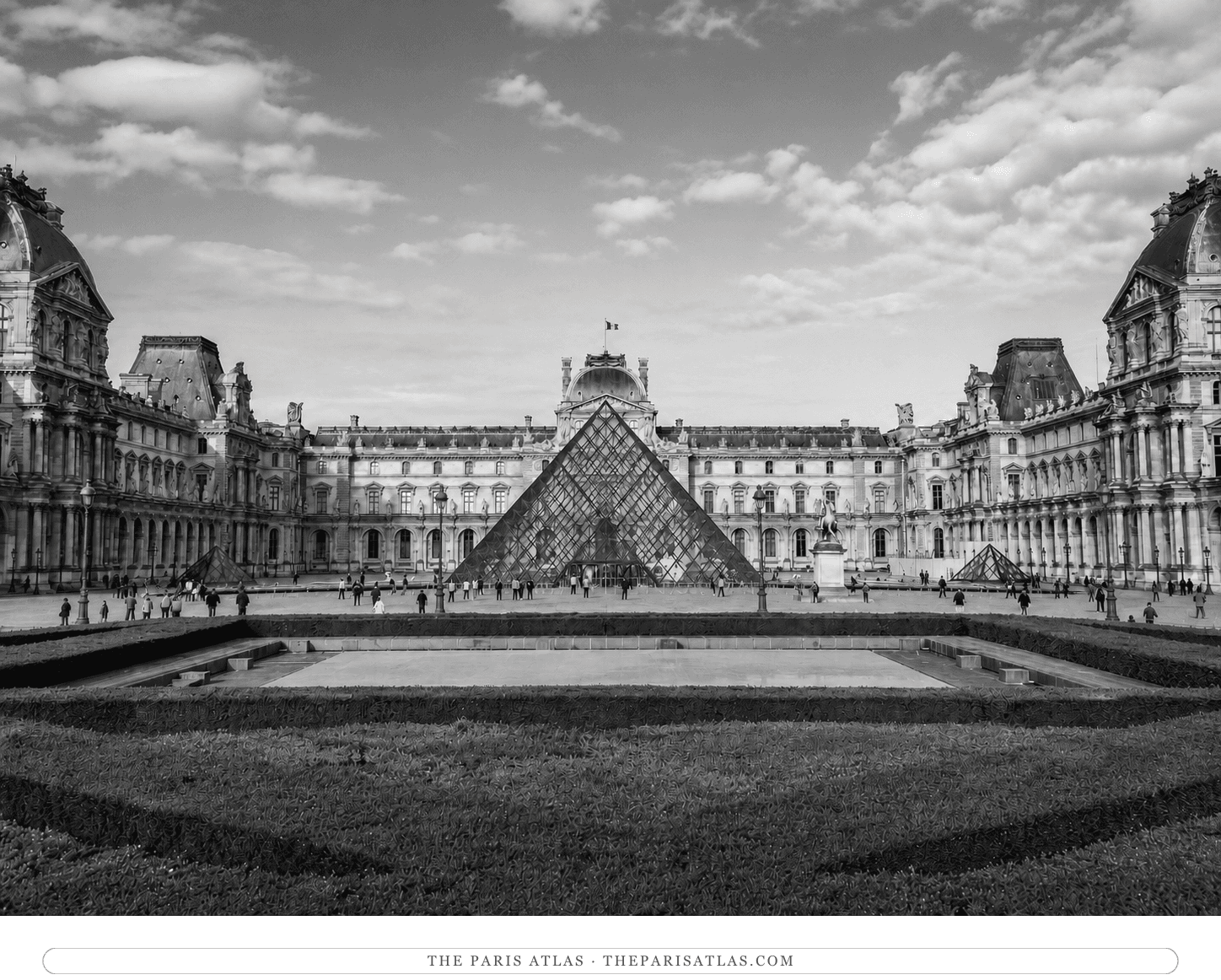
The 1892 Life and Times says only that Douglass spent "days and weeks in her charming art galleries" and names none of them. The Louvre is named in his own voice five years earlier, in the two Washington addresses on his foreign travels he gave in December 1887, where he says he viewed its collections repeatedly — and where the church of Saint-Germain-l'Auxerrois opposite it is a fixed point he says he never passed without stopping. He was in Paris in the winter of 1886–87, aged sixty-eight, on his first journey to the European continent — the continent an American minister in London had refused him a passport for in 1859 on the ground that he was not a citizen. The same passage names the Luxembourg alongside the Louvre; that is the Musée du Luxembourg, the palace gallery of living French artists, and not the Jardin du Luxembourg, the garden beside it.
Met · 1853
Shortly before sailing for Europe in 1853, Stowe sent to Rochester for Douglass and asked him to spend a day at her house in Andover, Massachusetts. Her question was what to do with the money British admirers were raising for her; she wanted a monument to Uncle Tom's Cabin that would outlast the book's first effect. Douglass argued against a purely academic institution and for workshops where free Black Americans could learn trades alongside a plain English education, on the ground that poverty was the root of everything else, and she asked him to put it in a letter she could carry to England — dated Rochester, 8 March 1853. He then defended her in print while she was abroad, against American papers accusing her of pocketing British money. On her return she reconsidered, and the school was never founded; he recorded the disappointment in his autobiography without softening it.
The sources below include biographies, scholarly essays, interviews, and primary materials that informed this page. They reflect both the historical record and ongoing critical conversations about Frederick Douglass and their work.

Douglass's own account of the 1886–87 tour, and of the 1859 passport refusal, in the last revision of his autobiography.
Elizabeth Cady Stanton's Paris chapter, which records meeting the Douglasses there.
The National Park Service life summary — dates of the escape, the newspapers, the federal offices, the marriages and the death.
The Frederick Douglass National Historic Site's fuller biography of its subject.
These references anchor the page in the documented record and in the scholarly conversations around Frederick Douglass. Every claim on this page traces back to one or more of the works listed here.
 Explore more resources