The Heroic Slave
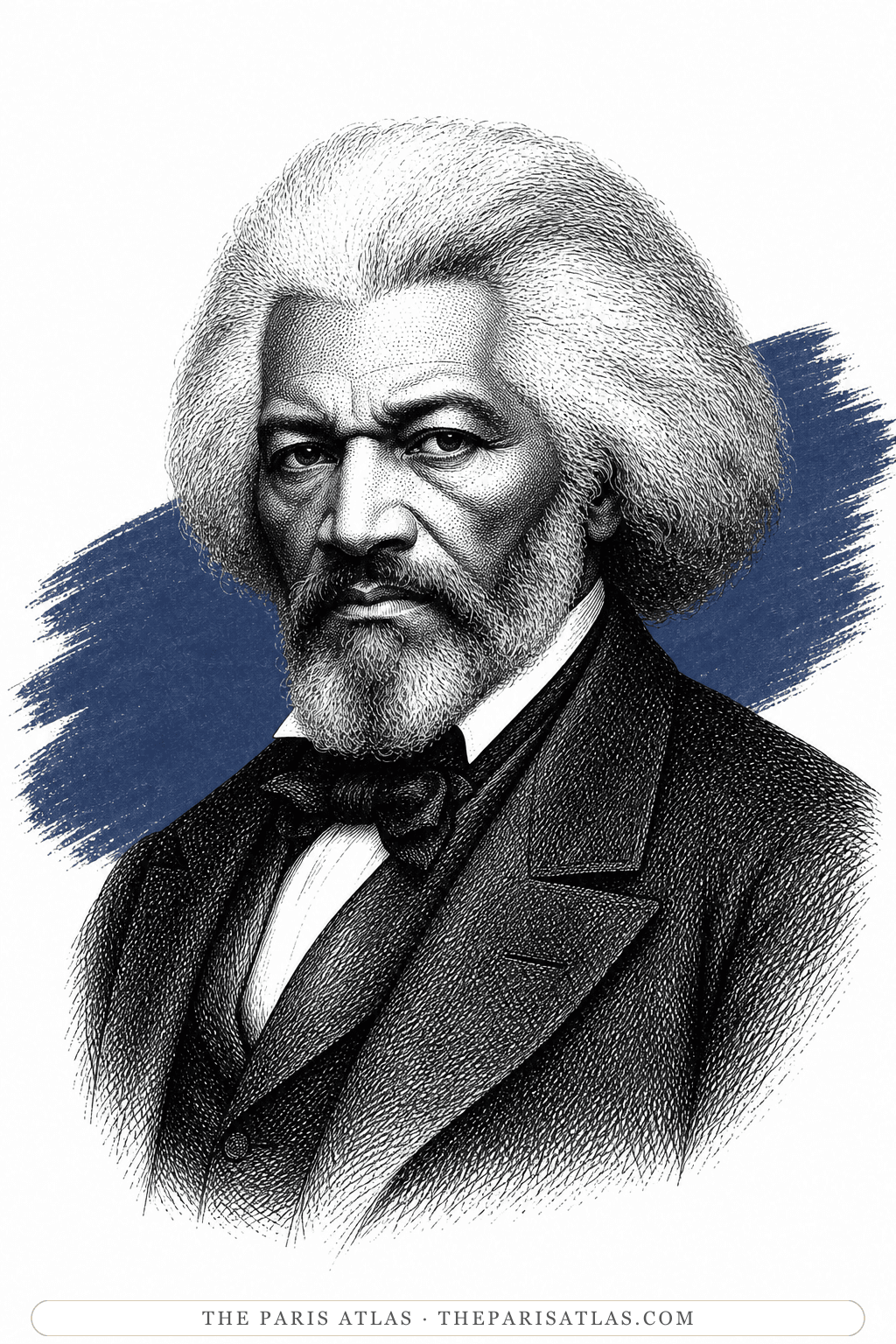
Frederick Douglass
The Heroic Slave
Douglass's novella of the following year makes the same argument in a story. A white sailor admits that the leader of a slave revolt was acting on the principles of 1776.
Read our takeWhat to the Slave Is the Fourth of July?
Frederick Douglass
Frederick Douglass's Independence Day speech of 1852: praise for the men who signed the Declaration, then a charge that the country had betrayed it.
Frederick Douglass gave this speech on Monday 5 July 1852 in Corinthian Hall in Rochester, New York. The occasion was an Independence Day meeting organized by the Rochester Ladies' Anti-Slavery Society, and between 500 and 600 people came.[1] He begins by praising the men who signed the Declaration of Independence. Then he asks why a man born into slavery has been invited to celebrate their freedom. The rest of the speech answers that question. He attacks the slave trade inside the United States, the Fugitive Slave Act and the churches that defended slavery, and he ends with hope.[2] The speech was printed as a pamphlet the same year. Penguin Classics calls it his most famous speech.[3]
Douglass had lived in Rochester since 1847, when he started his newspaper, The North Star, there.[4] He knew the hall well. In the speech he tells the audience he has often spoken there, and in his last autobiography he recalls lecturing in Corinthian Hall every Sunday evening for a whole winter.[2][5]
The Fourth of July fell on a Sunday in 1852, and the Rochester meeting was held the next day. Douglass opens modestly. He says anyone who could face this audience without nerves has stronger nerves than he does. The distance between this platform and the plantation he escaped from, he adds, is considerable.[2]
For the first few pages he sounds like any Independence Day speaker. He tells the story of 1776, reads aloud the resolution for independence passed by the Continental Congress on 2 July 1776, and calls the signers brave and great men. Then he turns to the audience and asks what their national independence has to do with him.[2]
The printed speech is divided by headings, and the pamphlet runs to about forty pages.[2] Douglass printed the speech in his own newspaper as well. The University of Rochester reports that he published 700 copies of the pamphlet.[1]
An opening apology for nerves, then the history of 1776: the colonists' grievances, the resolution for independence of 2 July 1776, and warm praise for the signers of the Declaration.[2]
The Present. Douglass warns against praising the fathers to excuse the present. He asks why he has been invited to speak, and answers with the question the speech is named for.[2]
The Internal Slave Trade. A description of slave gangs driven south, his boyhood memories of the Baltimore slave market, and an attack on the Fugitive Slave Act.[2]
Religious Liberty, The Church Responsible, and Religion in England and Religion in America. The American churches are charged with defending slavery. He compares them with the English churches that campaigned to end slavery in the British West Indies.[2]
The Constitution. Douglass argues that the Constitution, read plainly, contains no warrant for slavery. He closes with hope, and with a poem by William Lloyd Garrison.[2]
Douglass spends the first quarter of the speech on the founders, and he means the praise. He calls the signers statesmen, patriots and heroes. He says that for the good they did, he will join the audience in honoring their memory. The pamphlet's first section, headed The Present, then begins with a warning. He quotes the writer Sydney Smith, who said that men praise their fathers mainly to excuse their own faults.
Listen to the pronouns. Through the opening, Douglass keeps saying your fathers, your nation and your national independence. Then he asks outright why he has been called on to speak. Are the principles of the Declaration of Independence extended to us? The answer is no. A few lines later he says it plainly. The pamphlet reads: This Fourth July is yours, not mine. You may rejoice, I must mourn.
What, to the American slave, is your 4th of July? I answer; a day that reveals to him, more than all other days in the year, the gross injustice and cruelty to which he is the constant victim.
The famous question comes about halfway through. Douglass answers it with a list. To the slave, he says, the celebration is a sham, the boasted liberty an unholy license, and the prayers and hymns mere bombast, fraud and hypocrisy. He adds that no nation on earth is guilty of practices more shocking and bloody than the United States at this very hour.
Douglass expects an objection. Abolitionists, someone will say, would win more people over if they argued more and denounced less. He answers that there is nothing left to argue. Must I undertake to prove that the slave is a man? he asks. The slaveholders' own laws already admit it.
His evidence is the law of Virginia. He says the state lists seventy-two crimes that carry the death penalty for a Black man, and only two of them carry it for a white man. Southern states also make it a crime to teach an enslaved person to read. Nobody passes laws like that about animals, he says. When the dogs in the street cannot tell a slave from a brute, he will argue the point.
So he announces a change of method. At a time like this, scorching irony, not convincing argument, is needed. What the country needs, he says, is not light but fire, not the gentle shower but thunder. The famous question follows directly after this passage.
The section headed The Internal Slave Trade is where Douglass stops speaking about principles and describes what he saw. He asks the audience to picture a trader on the road south with a hundred people in chains. He points out an old man, a young mother with a baby, and a girl of thirteen crying for the mother she has been taken from. Then comes the crack of a whip.
Then he tells them he was born amid such scenes. As a boy he lived on Philpot Street in Fell's Point, Baltimore, and watched slave ships in the harbor waiting for a wind to carry them down Chesapeake Bay. A slave dealer named Austin Woldfolk kept a market at the head of Pratt Street. At midnight, Douglass remembers, he was woken by the footsteps and cries of chained gangs passing the door.
From there he moves to the Fugitive Slave Act, which Congress had passed, he says, less than two years before. The law let slave catchers seize Black people anywhere in the country. Under the law, Douglass says, an American judge got ten dollars for every person he sent into slavery and five when he set one free. He says no fewer than forty Americans had been hunted down and sent into slavery in those two years.
The churches get the longest attack. Douglass names ministers in Buffalo, New York, Auburn, Brooklyn, Boston and Washington who had taught that obeying the Fugitive Slave Act was a Christian duty. He also names exceptions: Henry Ward Beecher of Brooklyn, Samuel J. May of Syracuse, and the Reverend R. R. Raymond, who was on the platform beside him.
The last section is headed The Constitution, and it restates a break with his old allies. William Lloyd Garrison and his followers taught that the Constitution was a proslavery document. Robert S. Levine notes that Douglass rejected that view when he left Garrison's camp in 1850.
In Rochester he says so from the platform. Read the Constitution as it ought to be read, he argues, and it is a Glorious Liberty Document. He asks why, if the framers meant to protect slavery, the words slavery, slaveholding and slave appear nowhere in it. He names the writers he thinks have proved the case: Lysander Spooner, William Goodell, Samuel E. Sewall and Gerrit Smith.
He admits he has run out of time to make the full argument. Then he closes where he began. I, therefore, leave off where I began, with hope, he says. Steamships, the telegraph and trade are tying the world together, he says, and no nation can hide its abuses any longer. The pamphlet ends with a poem by Garrison, The Triumph of Freedom.
The speech has nothing to do with Paris, but one name in it leads there. Arguing that ordinary citizens have the right to read the Constitution for themselves, Douglass cites Ex-Vice-President Dallas. The man he meant was George M. Dallas, vice president of the United States from 1845 to 1849. Dallas, Douglass says, had called the Constitution plain and intelligible, meant for the home-bred understandings of ordinary citizens.
Seven years later the same man was the American minister in London, a post he held from 1856 to 1861. In 1859 Douglass was in England and wanted to visit France. He wrote to Dallas for a passport. Dallas refused it, on the ground that Douglass was not a citizen of the United States. The French minister in London sent him a permit to enter France without delay.
Douglass did not reach Paris until the winter of 1886–87. Writing about that journey in 1892, he came back to Dallas. The man was now dead and generally forgotten, Douglass wrote, but he himself had lived to see himself everywhere recognized as an American citizen. The full story of that visit is on Frederick Douglass's own page.
What, to the American slave, is your 4th of July? I answer; a day that reveals to him, more than all other days in the year, the gross injustice and cruelty to which he is the constant victim.
This Fourth of July is yours, not mine. You may rejoice, I must mourn.
The sunlight that brought life and healing to you, has brought stripes and death to me.
Most readers meet one paragraph. The full text shows how Douglass builds to it: several pages of praise for the founders, then the turn, then the evidence.
The section on the internal slave trade includes his boyhood in Fell's Point, Baltimore, watching chained gangs driven to the ships at night.
The closing section calls the Constitution a Glorious Liberty Document. The phrase put him at odds with the followers of William Lloyd Garrison, who called it proslavery.
The pamphlet runs to about forty pages, and the 1852 printing is free online.
1847
Douglass settles in Rochester, New York, and starts his newspaper, The North Star.
1850
Congress passes the Fugitive Slave Act. Douglass announces publicly that he no longer follows William Lloyd Garrison, and rejects Garrison's view that the Constitution protects slavery.
1852
On Monday 5 July, Douglass gives the speech in Corinthian Hall, Rochester, at a meeting organized by the Rochester Ladies' Anti-Slavery Society. Between 500 and 600 people attend.
1852
Lee, Mann & Co. of Rochester prints the speech as a pamphlet, Published by Request. Douglass also prints it in his newspaper.
1855
Two extracts are reprinted in the appendix of My Bondage and My Freedom. One carries the heading What to the Slave Is the Fourth of July?
1859
George M. Dallas, whom the speech quotes on the Constitution, is now the American minister in London. He refuses Douglass a passport to visit France, saying he is not a citizen.
2015
Slate publishes a piece titled The Best Fourth of July Speech in American History.
2016
Penguin Classics prints the full speech in The Portable Frederick Douglass, edited by Henry Louis Gates Jr. and John Stauffer.


The Heroic Slave
Frederick Douglass
Douglass's novella of the following year makes the same argument in a story. A white sailor admits that the leader of a slave revolt was acting on the principles of 1776.
Read our take
His 1855 autobiography, which reprints two extracts from the speech in its appendix and explains his change of mind about the Constitution.
Read our take
The book that made Douglass famous, and the fullest account of the Baltimore childhood the speech recalls.
Read our take
James Baldwin's two letters for the hundredth anniversary of emancipation ask the same question of the country a century later.
Read our takeOn Monday 5 July 1852, in Corinthian Hall in Rochester, New York. The meeting was an Independence Day celebration organized by the Rochester Ladies' Anti-Slavery Society, and between 500 and 600 people attended.
In 1852 the Fourth of July fell on a Sunday. The Rochester meeting was held the next day, Monday 5 July.
The speech argues that the Fourth of July celebrates a freedom the country denies to millions of enslaved people. Douglass praises the founders and their Declaration, then says the nation has betrayed it. He describes the domestic slave trade, the Fugitive Slave Act and the churches that defended slavery. He ends by arguing that the Constitution, read properly, is against slavery.
No. The 1852 pamphlet was called Oration, Delivered in Corinthian Hall, Rochester. The title used today comes from the heading of an extract reprinted in his 1855 autobiography, My Bondage and My Freedom.
The 1852 pamphlet runs to about forty pages. Read aloud, the full text takes well over an hour, which was normal for a nineteenth-century oration.
Not by 1852. In the speech he calls it a Glorious Liberty Document and asks why the words slavery, slaveholding and slave never appear in it. Earlier, as a follower of William Lloyd Garrison, he had accepted the view that it was a proslavery document. He broke with that view in 1850.
The 1852 pamphlet is scanned on the Internet Archive from Emory University's copy. The Portable Frederick Douglass from Penguin Classics prints the full speech. The 1855 extracts are in the appendix of My Bondage and My Freedom, free on Project Gutenberg.
Only an indirect one. The speech quotes George M. Dallas, the former vice president, on the Constitution. In 1859, as American minister in London, Dallas refused Douglass a passport to visit France on the ground that he was not a citizen. Douglass finally saw Paris in the winter of 1886–87.
Explore authors with a similar voice, perspective, and influence.
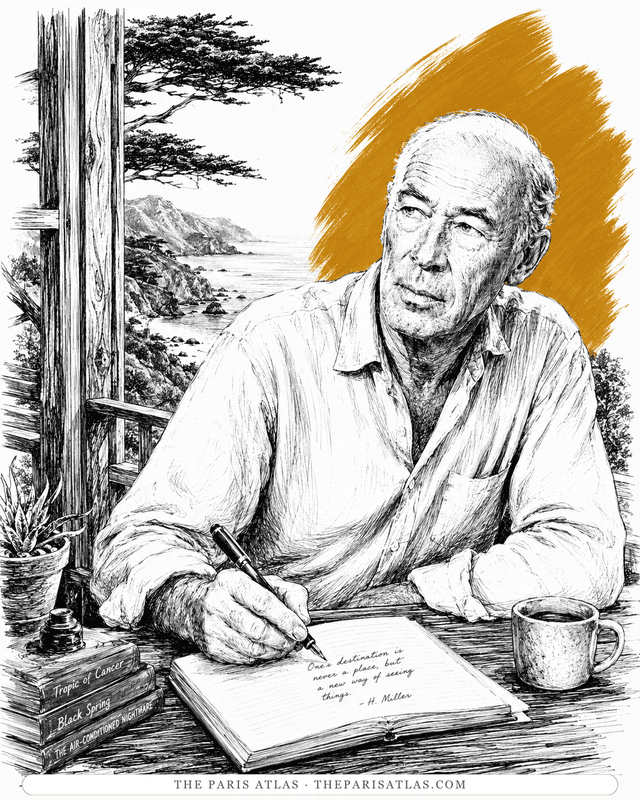
The Brooklyn dropout who arrived in Paris broke at thirty-eight and wrote the exuberant, banned books that ended American censorship.
View author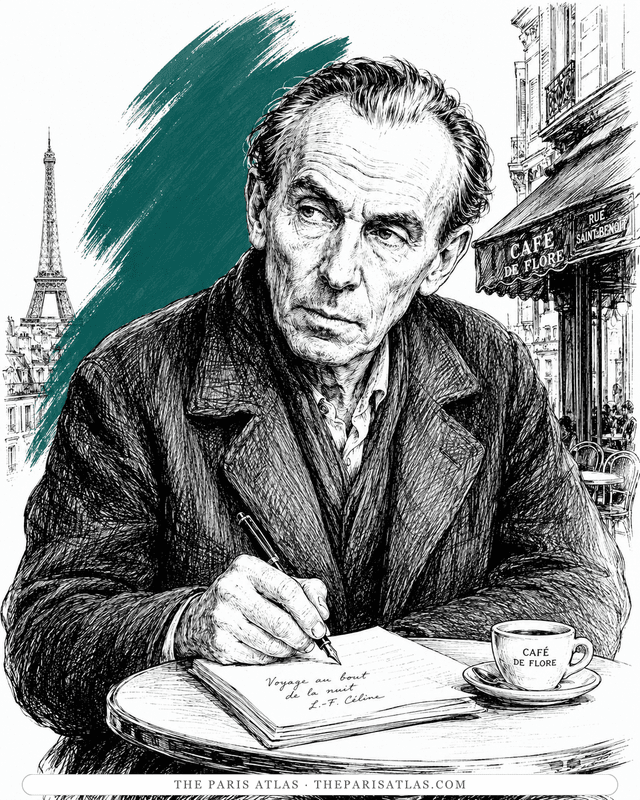
The doctor of the Paris slums who wrote the century's blackest, funniest novel — and changed the sound of French prose.
View author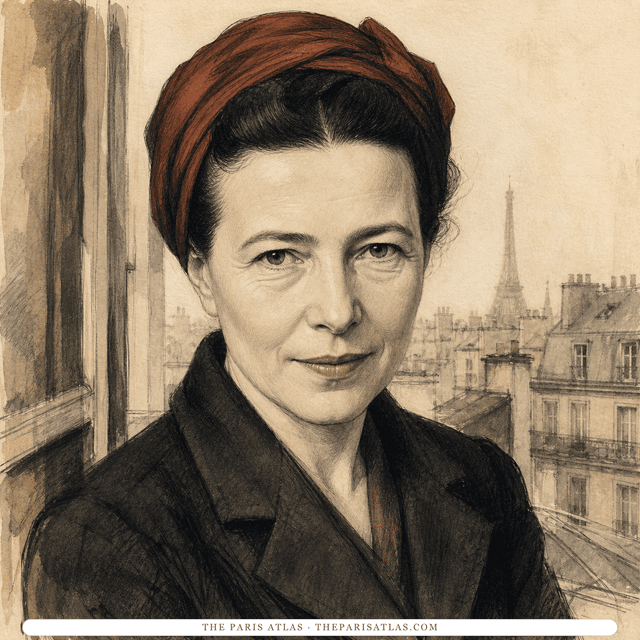
French writer and philosopher whose novels, memoirs, and social analysis examined freedom, gender, responsibility, aging, and the material conditions that shape a life.
View authorThe sources below include the primary text, editions, scholarship, archival materials, and other records that informed this page. They document What to the Slave Is the Fourth of July?, its publication, and its place in literary history.

The 1852 pamphlet, scanned from Emory University's copy, with the library's description of it. Every page reference and most quotations come from it.

Penguin's description of its 2021 edition, which calls this his most famous speech.

When Douglass began publishing in Rochester.
Douglass on the Corinthian Hall lectures, the 1859 passport refusal and the later Paris visit.
The 1855 reprint of two extracts, under the heading that became the speech's title.
Robert S. Levine on Douglass's 1850 break with Garrison, including over the Constitution.
George M. Dallas's offices: vice president 1845–49 and minister to Great Britain 1856–61.
Catalogue record for The Portable Frederick Douglass: ISBN, pages and contents.
The primary text is the baseline reference for every book page. Additional references document publication history, interpretation, and historical context where that evidence is available.
 Explore more resources