

Memoirs of a Dutiful Daughter
The first volume of Beauvoir's memoirs: a bourgeois Catholic Paris childhood, the loss of faith, philosophy at the Sorbonne, and a friendship whose ending she said cost her her freedom.
Read our take
Beauvoir's hundred-page account of her mother's month-long death from cancer in a Paris clinic — the shortest and most direct book she wrote, and the case study The Coming of Age would turn into general argument six years later.
Simone de Beauvoir's Une Mort très douce (1964) is the hundred-page account of her mother Françoise de Beauvoir's death from intestinal cancer in a Paris clinic, from her fall in the bathtub on 24 October 1963 to her death on 6 December of the same year. Beauvoir and her younger sister Hélène — the painter — took turns at the bedside for those six weeks; the book stays close to the hospital rooms, the tests, the pain, the operations, the nursing, the meals, the visits, and the specific medical decision the doctors and the daughters kept from her: that the cancer was incurable and this was her last illness. It is the shortest book Beauvoir published and, for many readers, the most affecting.
Beauvoir wrote Une Mort très douce in the winter and spring of 1964, in the six months after her mother's death, and Gallimard published it in Paris in November of the same year. Patrick O'Brian's English translation, A Very Easy Death, appeared from Putnam in New York in 1965 and from André Deutsch in London the same year. It is one of two books that grew out of her mother's death: the immediate memoir, and, six years later, the six-hundred-page argumentative volume La Vieillesse (The Coming of Age, 1970), which took the general condition Beauvoir had watched from the specific bedside and made it a political case.
The title is Beauvoir's ironic quotation of what the ward's nurse said the morning her mother died — 'she had a very easy death' — meaning that Françoise had not been in visible pain at the end. The book uses the phrase as a weight to argue against. No death, Beauvoir writes near the last page, is easy for the person living it. And no death is easy for the person watching it, either, when the person dying is the mother whose life shaped the daughter's own case against every value her mother had believed in. Memoirs of a Dutiful Daughter closes on Zaza's death in 1929; A Very Easy Death closes on Beauvoir's mother's death thirty-four years later. The pair are the two irreducibly personal books at the frame of the memoir project.
The book was written for a wider audience than the memoirs and reached one: it is Beauvoir's best-selling book after The Second Sex and The Mandarins, and remains the piece of her writing most often assigned to readers who have not yet read her at all. It is also the piece of her writing most read against the grain of her stated feminism — Beauvoir is looking after a mother whose Catholic bourgeois values she spent forty years writing against and whose body, in the last six weeks, becomes an object she can neither defend against nor argue with. The tension is the book.
Chapter I opens with the fall. On the evening of 24 October 1963 Françoise de Beauvoir, alone in her small flat on the rue Blomet in the 5th arrondissement of Paris, gets up in the middle of the night, falls in the bathroom, and cannot rise. She is not found until the morning, when a friend she was expecting knocks and — hearing no answer — has the concierge open the door. She is taken to a clinic in the boulevard du Montparnasse. Simone de Beauvoir is in New York; her sister Hélène, who lives outside Paris with her painter husband Lionel de Roulet, is called. An emergency operation reveals an intestinal cancer that has metastasised extensively. The surgeon, Dr N., speaks first to Hélène and then to Simone (arriving from New York the next day) and makes plain that this is Françoise's last illness. The sisters agree, on his advice, not to tell their mother. She is told that the operation went well and that she is recovering.
The middle chapters cover the six weeks between the operation and Françoise's death. Beauvoir describes the ward, the nursing, the small daily improvements and setbacks, the tests and the treatments, the food, the arrivals of her mother's friends, the return of small childhood memories in her mother's shortened hours of clarity. Françoise, believing she is convalescing, becomes, in the last three weeks, less anxious than she had been in years: she is being cared for, she is being fed, she is being visited, she is not alone. Beauvoir notes with terrible precision that her mother, at seventy-seven, has never in her life been so consistently attended to. Meanwhile she and Hélène adjust to what they are watching. Beauvoir describes the reappearance of the emotional map of her own childhood — the Catholic prohibitions, the frustrated intellectual ambitions of the mother, the arguments over Beauvoir's atheism in the 1920s, the fifty years of a difficult friendship built after her father's death in 1941. The chapter reserves its sharpest observations for what the six weeks show her about the value her mother's life had contained — which is not the value the philosophical argument of The Second Sex would have predicted.
The last three chapters cover the last week. Françoise's pain, which the ward has been managing with morphine, grows worse; the intervals of clarity shorten. On the night of 5 December she declines rapidly. On the morning of 6 December 1963, at about six a.m., Françoise de Beauvoir dies. Beauvoir is at the bedside. The nurse, coming in to prepare the body, tells her, in the phrase that will become the book's title: 'She had a very easy death.'
The last ten pages are Beauvoir's reckoning. She writes that the phrase the nurse used — 'a very easy death' — is exactly what one says when one wants to reassure the family, and exactly what is not true. No death is easy for the person living it, and this death was not, either: it took her mother six weeks, it required morphine, and the person on the bed was not the same person on the last day as on the first. Beauvoir writes about the moral question she and Hélène had answered — whether their mother should have been told. She does not conclude that they were right to withhold the diagnosis; she is not sure any of the possible decisions were right. She writes that the six weeks changed her relationship with her mother more than the previous thirty years had. She writes that watching a person die is a kind of last conversation with them, in a language you did not previously share.
The last sentence is one of the most quoted lines in Beauvoir's writing. Her mother's illness, she writes, was 'a very easy death, a privileged death.' By 'privileged' she means: the private clinic, the morphine, the two daughters in shifts, the friends who came, the specific medical care available to a Parisian widow with a bourgeois pension and a daughter with money. There is nothing easy about a death like this one, she writes. There are only unequally distributed forms of the same event. The Coming of Age, six years later, would turn that observation into a six-hundred-page political argument. A Very Easy Death is the observation itself.
At the first bedside visit, the mother's complaint about unanswered letters briefly restores a familiar family argument. Beauvoir records her own protest, then attends to details that resist an easy judgment: the burning hands, confused speech and incessant movement of the face. The repeated recollection of Olga's kindness is especially revealing. Small practical gifts matter because the mother receives them as affection rather than an obligation grudgingly fulfilled. The scene asks the daughter, and the reader, to notice a need for reassurance that cannot be reduced to the family's disagreements.
The opening constructs an emergency from messages passed between people. Before Bost finishes explaining the accident, Beauvoir has already imagined a car striking her mother; his next words correct the picture. Later, Olga's account of the doctor's refusal and Bost's observations add information the daughter did not witness. That distinction between seeing, hearing and supposing matters throughout this opening. Beside the imagined corridor handover, it makes communication part of care: another person's report can undo an assumption, but no single observer possesses the whole situation.
It is Beauvoir's shortest and most direct book — a mother's month-long death, watched at close range by a daughter who spent her adult life writing against everything her mother believed.
Read it after Memoirs of a Dutiful Daughter if you want to understand how the mother-daughter relationship changes across the two books.
Read it before The Coming of Age (1970) to see the specific case out of which Beauvoir's larger political argument about how Western societies treat their elderly was built. The book itself notes the medical inequality — the private clinic, the morphine, the two daughters in shifts, the friends — that is not available to most.
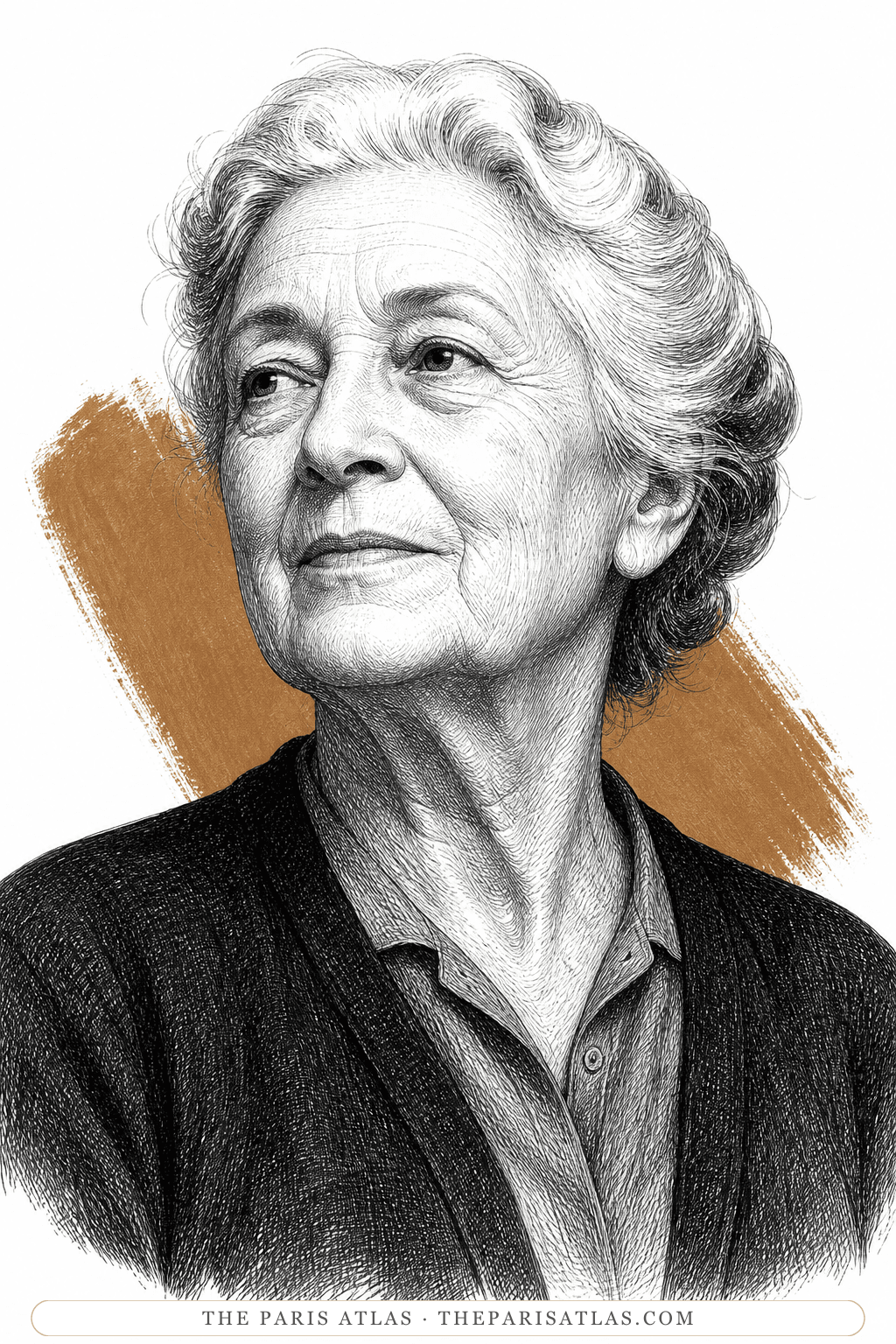
Beauvoir's mother. Widow of Georges de Beauvoir (who died in 1941). Catholic, seventy-seven years old at the time of the fall, living alone in a small flat on rue Blomet in the 5th arrondissement of Paris. The subject of the book.
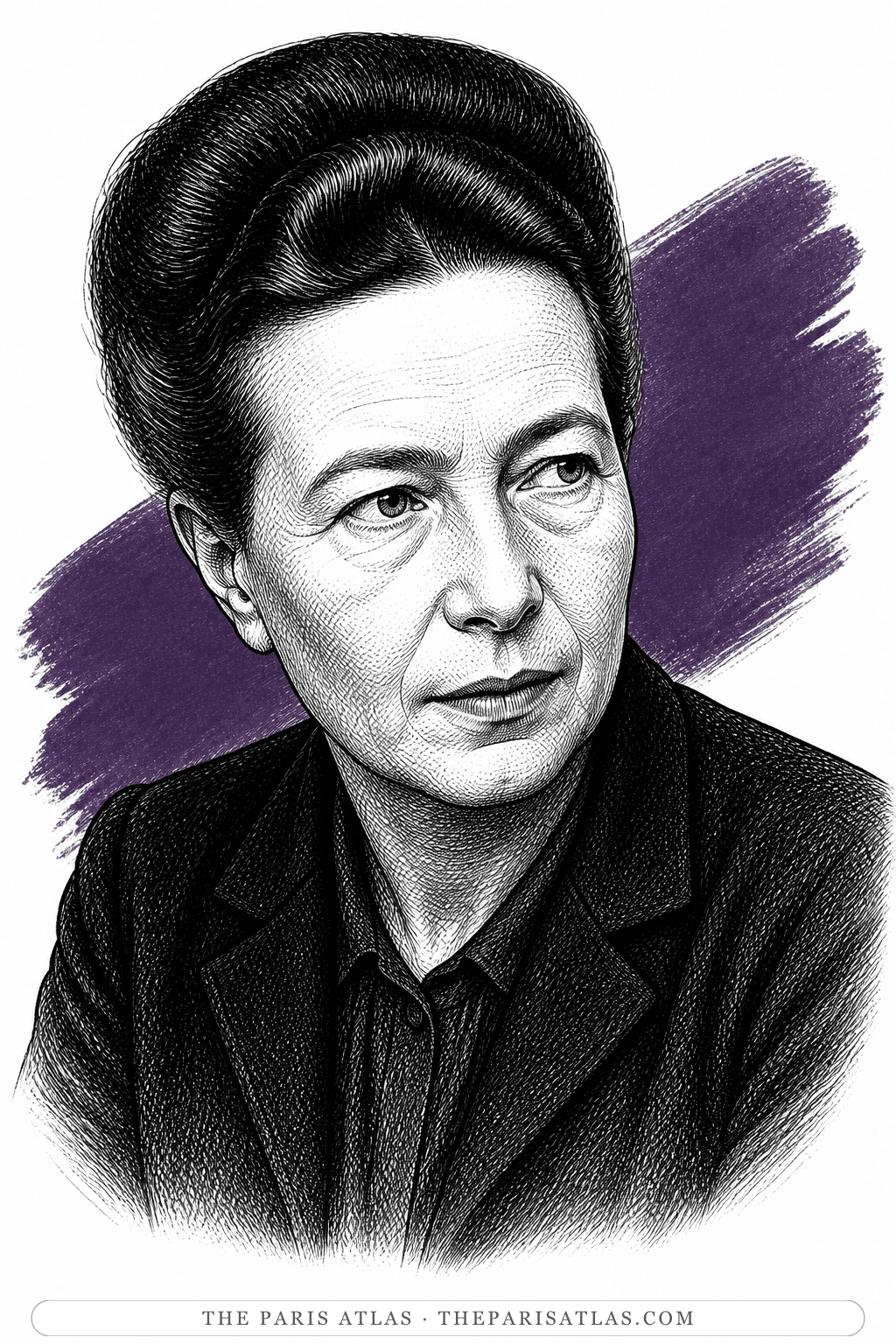
The book's first-person narrator. Fifty-five at the time of her mother's death. Cared for her mother alongside her sister Hélène in the six weeks between the fall on 24 October 1963 and the death on 6 December.
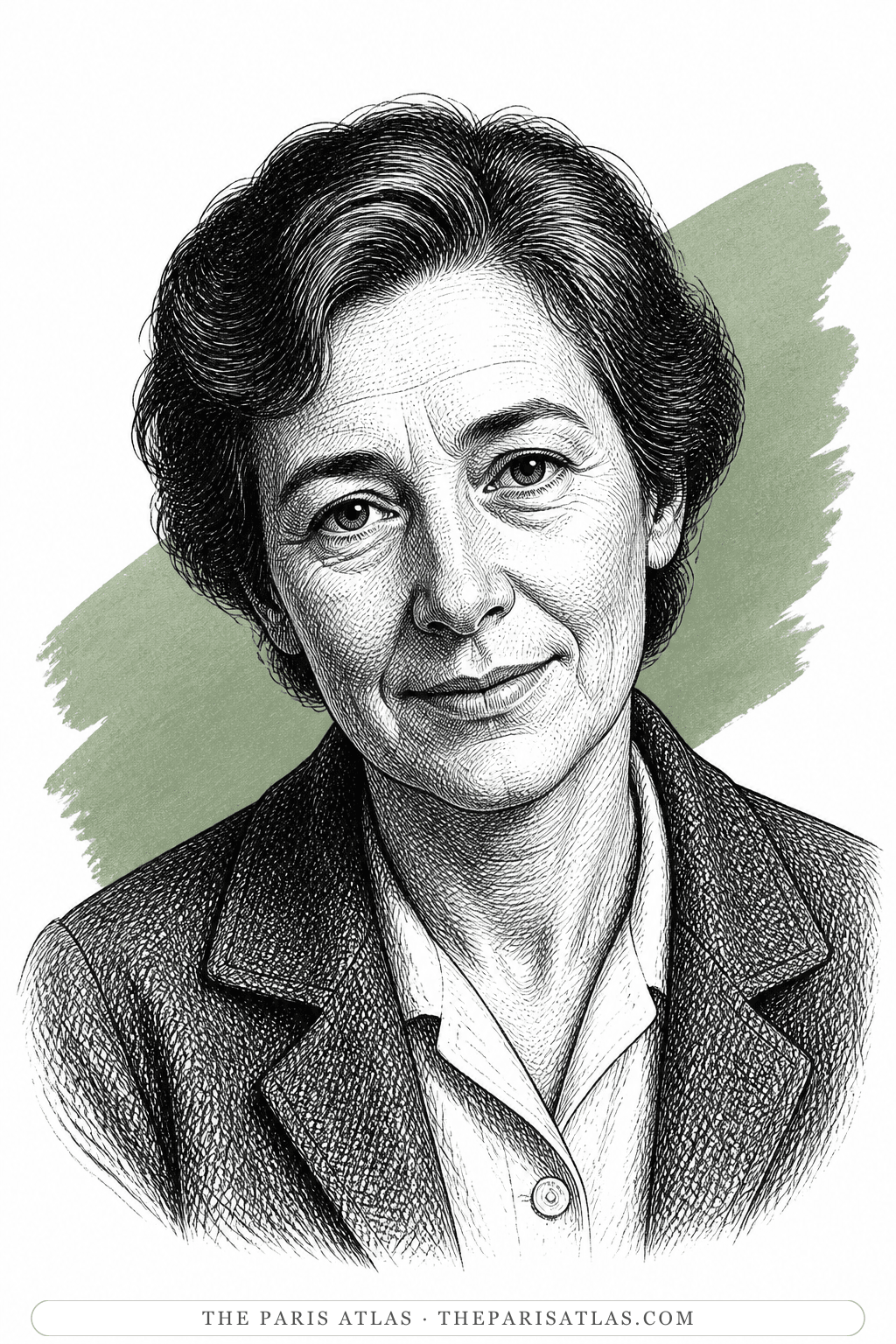
Beauvoir's younger sister, Poupette of Memoirs of a Dutiful Daughter, now a painter married to Lionel de Roulet and living outside Paris. Shared the shifts at the bedside with Simone through the six weeks.
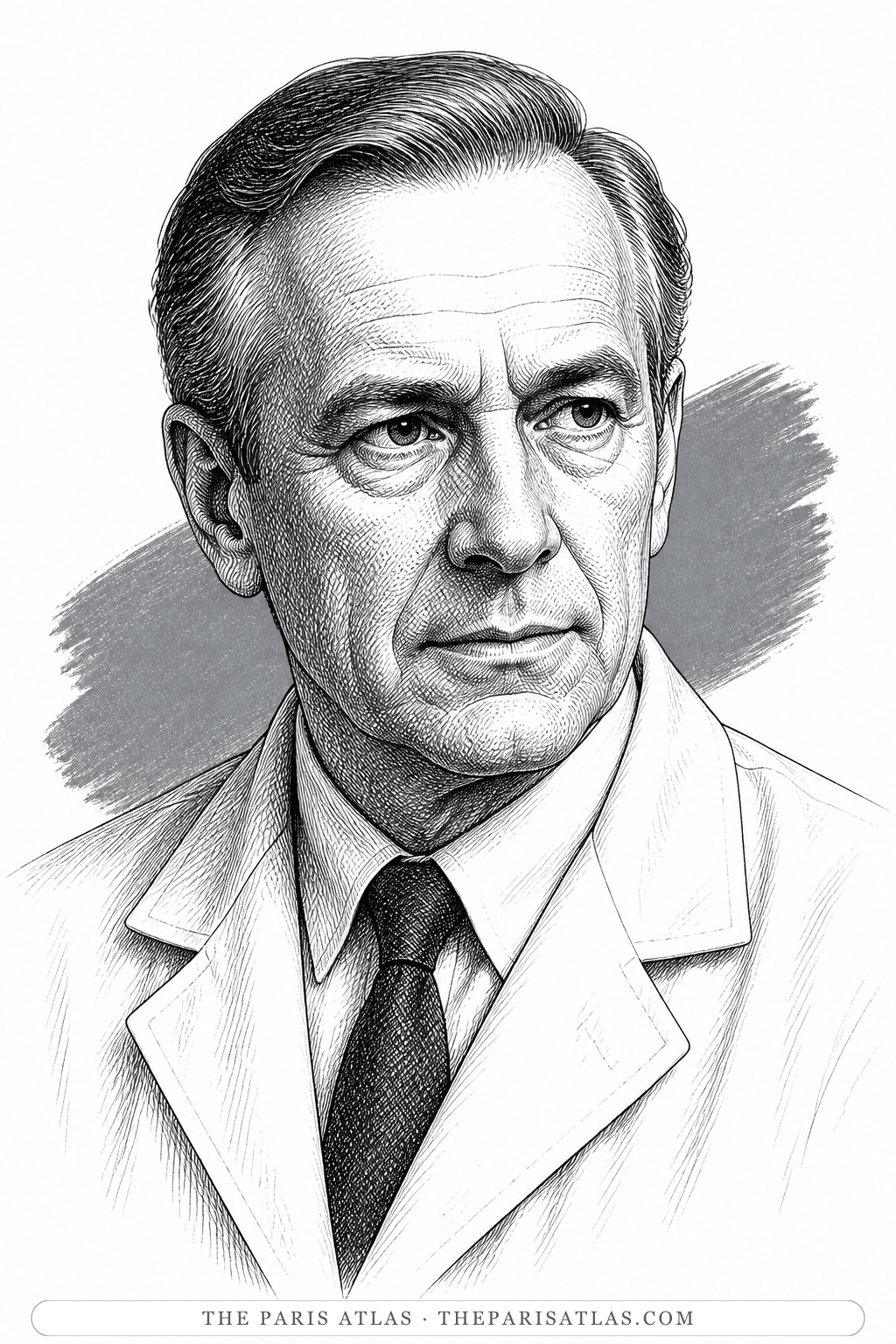
The surgeon at the clinic on the boulevard du Montparnasse who performs the emergency operation and manages Françoise's care. Beauvoir preserves his anonymity behind the initial. Advises the sisters not to tell their mother the diagnosis; the sisters agree.
24 October 1963
Françoise de Beauvoir falls in her bathroom on rue Blomet, Paris, and cannot rise. She is taken to a clinic on the boulevard du Montparnasse.
25 October 1963
Emergency operation reveals advanced intestinal cancer. The surgeon speaks to Hélène first, then to Simone (arriving from New York); the sisters agree not to tell their mother.
Late October–early December 1963
Simone and Hélène de Beauvoir take turns at the bedside for six weeks.
6 December 1963
Françoise de Beauvoir dies at the clinic around six a.m. The nurse tells Simone: 'She had a very easy death.'
Winter–Spring 1964
Beauvoir writes Une Mort très douce.
November 1964
Gallimard publishes Une Mort très douce in Paris.
1965
Patrick O'Brian's English translation, A Very Easy Death, appears from Putnam in New York and André Deutsch in London.
1970
Beauvoir publishes The Coming of Age (La Vieillesse), the six-hundred-page argumentative volume the memoir had prepared the ground for.

The first volume of Beauvoir's memoirs: a bourgeois Catholic Paris childhood, the loss of faith, philosophy at the Sorbonne, and a friendship whose ending she said cost her her freedom.
Read our take
Beauvoir's six-hundred-page 1970 study of old age — the companion volume to The Second Sex, arguing that Western societies treat their elderly as a scandal to be hidden and that this is a decision, not a fact.
Read our takeIt is Simone de Beauvoir's hundred-page memoir of her mother Françoise de Beauvoir's death from intestinal cancer in a Paris clinic, over six weeks in the autumn of 1963. Beauvoir and her younger sister Hélène took turns at the bedside; the book stays close to the hospital rooms, the operations, the treatments, the pain, and the specific moral question the sisters answered — that their mother should not be told her diagnosis. It is the shortest and most direct book Beauvoir published.
Gallimard published Une Mort très douce in Paris in November 1964, eleven months after Françoise de Beauvoir's death. Patrick O'Brian's English translation, A Very Easy Death, appeared from Putnam in New York and from André Deutsch in London in 1965.
It is Beauvoir's quotation of the phrase the ward's nurse used the morning her mother died — 'she had a very easy death' — meaning that Françoise had not been in visible pain at the end. Beauvoir uses the phrase as a weight to argue against: no death, she writes at the end, is easy for the person living it. The book's last line calls the death 'a very easy death, a privileged death,' with 'privileged' meaning the private clinic, the morphine, the two daughters in shifts, and the specific medical inequality most deaths take place under.
Beauvoir does not conclude that she and Hélène were right to withhold it; she is not sure any of the possible decisions were right. The doctors' recommendation, standard in 1963 French practice, was that the patient not be told. Françoise, believing she was convalescing, was less anxious in her last three weeks than she had been in years. Beauvoir writes that this fact does not settle the moral question.
A Very Easy Death (1964) is the immediate memoir; The Coming of Age (1970) is the six-hundred-page argumentative book Beauvoir wrote out of the same experience. Read together they show Beauvoir moving from the specific case — her mother's six weeks — to the general political argument about how Western societies treat their elderly. The 'privileged death' line at the end of the memoir is the seed of The Coming of Age.
Memoirs of a Dutiful Daughter (1958) covers Beauvoir's first twenty-one years and closes on the death of her childhood friend Zaza in 1929. A Very Easy Death (1964) covers a six-week period thirty-four years later, and closes on her mother's death in 1963. The two are the frame books of Beauvoir's memoir project: one grief the young person had, one grief the older person had, both about the same Catholic bourgeois Paris the memoirs describe.
Explore authors with a similar voice, perspective, and influence.

Both French writers used novels, essays, journalism, and public argument to ask how freedom and responsibility operate without a fixed moral system.
View author
The Brooklyn dropout who arrived in Paris broke at thirty-eight and wrote the exuberant, banned books that ended American censorship.
View author
The doctor of the Paris slums who wrote the century's blackest, funniest novel — and changed the sound of French prose.
View authorThe sources below include the primary text, editions, scholarship, archival materials, and other records that informed this page. They document A Very Easy Death, its publication, and its place in literary history.


Primary opening excerpt in Patrick O'Brian's translation; not a newly collated complete edition.

The publisher record verifies Patrick O'Brian's translation, the Pantheon paperback edition, its 1985 publication date, ISBN, and page count.
Used to place A Very Easy Death within Simone de Beauvoir's published work and verify its bibliographic context.
Used for independent biographical, archival, or historical context surrounding Simone de Beauvoir's career and the period in which A Very Easy Death appeared.
Used to cross-check authorship, chronology, and the work's place in Simone de Beauvoir's wider catalogue.
Used to verify Simone de Beauvoir's bibliography and place A Very Easy Death within the broader chronology of Simone de Beauvoir's career.
The primary text is the baseline reference for every book page. Additional references document publication history, interpretation, and historical context where that evidence is available.
 Explore more resources