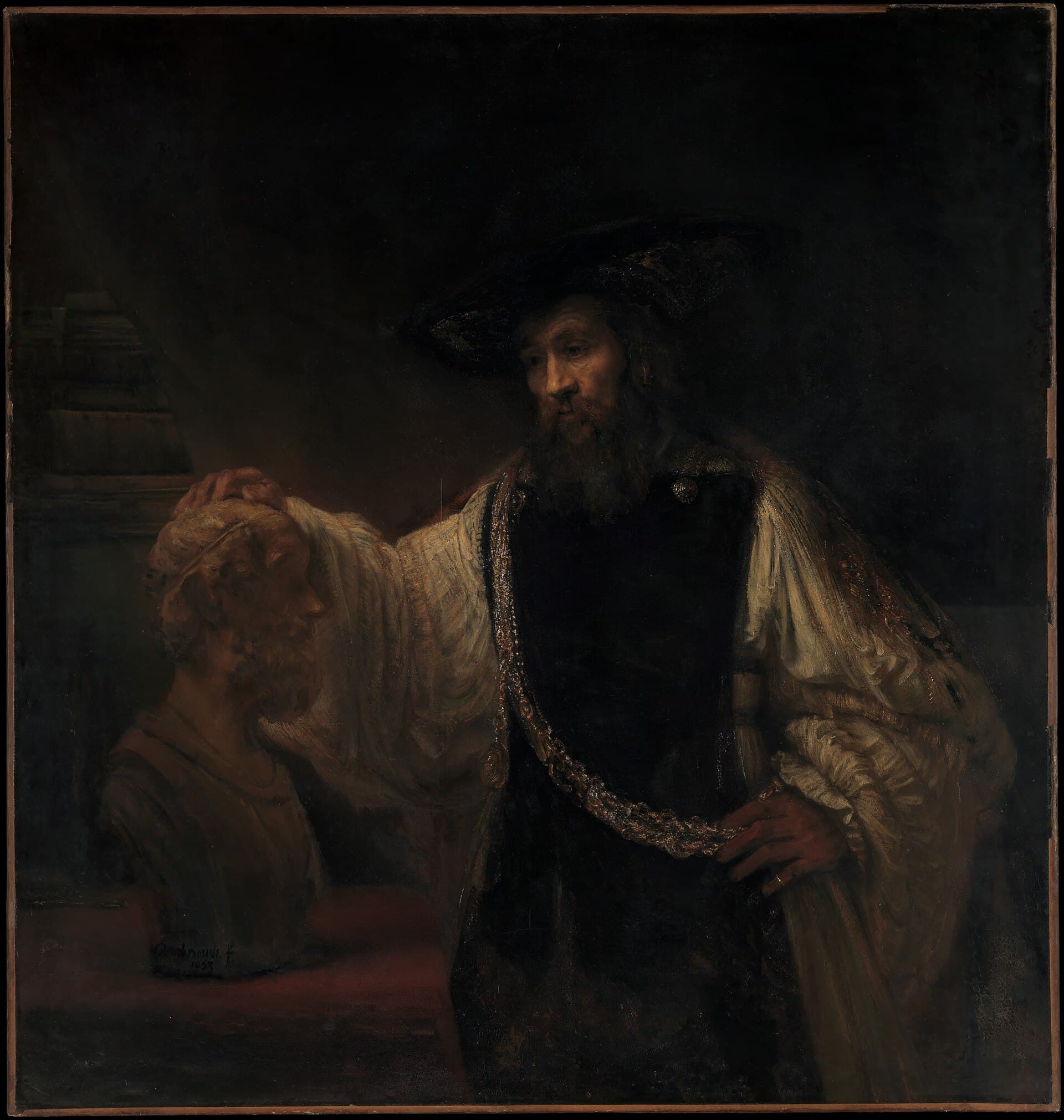
Aristotle with a Bust of Homer
The Greek philosopher Aristotle, in a wide black hat and a gold chain, rests his hand on a marble bust of the poet Homer. Rembrandt van Rijn painted the picture in 1653 for Don Antonio Ruffo, a nobleman in Messina, Sicily. The Metropolitan Museum of Art in New York bought it at auction in 1961 for $2.3 million.
- 1653
- Oil on canvas
- The Metropolitan Museum of Art, New YorkNew York, United States
About Rembrandt van Rijn
What the painting shows
A bearded man stands in a dark room, lit from the upper left. He wears a wide black hat, a black apron-like tunic and a long gown with huge pale sleeves. A heavy gold chain hangs from his right shoulder down to his left hip.
His right hand rests on the head of a marble bust. The bust shows an old man with a beard and a band around his hair. The Metropolitan Museum of Art identifies the man as the Greek philosopher Aristotle (384–322 BCE) and the bust as the poet Homer.
Aristotle does not look at the viewer. His eyes are turned down toward the bust, and his face is half in shadow. His left hand rests on his hip, near the end of the gold chain.
The Met says the chain carries a medallion with a portrait of Alexander the Great, Aristotle's powerful pupil. The art historian Menno Jonker notes that the head on the medal is shown in profile and could be Alexander or Athena, the goddess of wisdom. In photographs the medallion is very hard to make out in the shadow below his left hand.
A painting about fame
Homer had written the Iliad and the Odyssey centuries before Aristotle was born. The Met thinks the painting is about fame. Aristotle, rich and honored, may be weighing his own worldly success against Homer's lasting achievement.
The fame reading goes back to the art historian Julius Held. In an article of 1969, Held said Aristotle is comparing two sets of values. One is everything he admired in Homer. The other is wealth and worldly honor, shown by the gold chain and Alexander's medallion.
Adam Eaker, a curator at the Met, adds a personal layer on the museum's audio guide. When the commission came, Rembrandt was far less successful than he had been. He had been through bankruptcy, and his rough paint and somber colors had gone out of fashion. Eaker thinks Rembrandt may have put some of his own low mood into Aristotle.
Painted for a collector in Sicily
Don Antonio Ruffo (1610/11–1678) was a nobleman in Messina, Sicily, and a keen collector. When he died he owned 364 paintings. He rarely left Messina, so he ordered this picture through an agent, Giacomo di Battista, who did business with a wealthy Amsterdam merchant, Cornelis Gijsbrechtsz.
Rembrandt signed and dated the painting in 1653. The painting was shipped from Amsterdam to Ruffo's palace in Messina in the summer of 1654.
Ruffo's inventory lists it only as a half-length philosopher painted in Amsterdam, perhaps Aristotle or Albertus Magnus. The Met's catalogue follows the scholar Jeroen Giltaij in thinking Ruffo did not ask for a particular subject. He probably asked only for a half-length figure of a certain size.
The pictures ordered to go with it
In 1660 Ruffo asked the Bolognese painter Guercino for a companion picture and sent him a sketch of the Rembrandt. On October 6, 1660, Guercino wrote back that he took Rembrandt's figure for a physiognomist, a reader of faces. He planned a cosmographer, a mapper of the world, to hang beside it.
Guercino's painting is lost. The design is known from a drawing in the Princeton University Art Museum.
Ruffo also ordered two more paintings from Rembrandt himself. One was an Alexander the Great of 1661, now lost. The other was a Homer dated 1663, which survives only in part and hangs in the Mauritshuis in The Hague.
On November 1, 1662, Ruffo wrote to the Dutch consul in Messina. He was unhappy with the Alexander and noted that it had cost him more than the Aristotle.
A painting that lost its name
Menno Jonker points out that even in Ruffo's time the bust was not clearly recognized as Homer. Once the picture left the Ruffo family, its subject was forgotten. Buyers in England and elsewhere called it many things. When it was sold at Christie's in London in 1810 it was listed as Sculptor with a Bust.
Sir Abraham Hume, who owned it by 1815, catalogued it as a portrait of the Dutch writer Pieter Cornelisz Hooft. Other guesses named the Italian poets Ariosto and Tasso, the Roman poet Virgil, or simply an unnamed scholar. In New York in 1909 it was shown as The Savant.
The name came back in 1917. The Dutch scholar Hoogewerff linked the newly published Ruffo papers to this canvas and showed that it was the Aristotle.
Paris, Duveen and the 1961 sale
By 1897 the painting belonged to Rodolphe Kann, a collector in Paris. The painting stayed with Kann until his death in 1905. The art dealer Duveen bought it from his estate in 1907.
Duveen sold it to Arabella Huntington in New York. The painting then passed to her son, Archer M. Huntington, who sold it back to Duveen in 1928. After that it changed hands three more times between the dealer and one collector:
- 1928: Duveen sells it to the New York collector Alfred W. Erickson for $750,000.
- 1930: Erickson sells it back to Duveen for $500,000.
- 1936: Erickson buys it again for $590,000 and keeps it until his death that year.
- 1961: after the death of Erickson's widow, it is sold at Parke-Bernet in New York on November 15, and the Met buys it.
The Met paid $2.3 million, which CBS News later reported was then the most ever paid for a painting. More than 2,000 people came to the auction. The Met's director, James Rorimer, made his final bid by blinking his right eye.
The painting went on view in the Met's Great Hall soon after the sale. Aristotle drew more than 120,000 visitors in two days. The picture is the only painting by Rembrandt that the Met has bought, rather than received as a gift or bequest.
What conservators have found in the paint
The Met's conservators and scientists have studied the canvas many times. A strip of original woven edge survives along the left side, so the width has not been cut down. The height has lost at most a little at the bottom.
Scans of the chemical elements in the paint show that Rembrandt moved the gold chain and its medals several times. His first idea for the costume was a dark tunic with close-fitting sleeves. He tried a shorter tunic split in two, and in the end brought the tunic down to the bottom edge. He meant both the hat and the tunic to be deep black.
Rembrandt mixed large amounts of smalt into the dark paint. Smalt is ground blue glass, but the kind he used was barely blue at all. He added it to make deep browns that light could pass into.
Smalt breaks down over time. The Met found that this is causing a faint haze on the surface. The painting was cleaned in 1963 and again in 1980, and each time the haze went away for a while. By 1995 it was back, as a pale shape in the dark background at the right, just above Aristotle's elbow.
Where to see it
The painting belongs to the Metropolitan Museum of Art in New York, accession number 61.198. The Met's record lists it on view in Gallery 616, with its Self-Portrait of 1660 in the same room.
The Met's record says the painting may not be lent, so it does not travel to other museums.
Close reading
Reading the work, detail by detail
Most of Aristotle with a Bust of Homer is dark, and the details hide in it. Up close there is a face half in shadow, a hand resting on a poet's head, a gold chain that Rembrandt van Rijn moved several times, and a signature on the pedestal of the bust.
1.Aristotle's face, half in shadow
Light from the upper left falls on Aristotle's forehead, his nose and one cheek. The rest of his face sinks into shadow under the brim of his hat. His eyes are turned down toward the bust of Homer, not toward us. His mouth is half hidden in a long gray-brown beard.
2.A glint of gold at the ear
In the shadow beside Aristotle's face, a small streak of gold catches the light at his ear. The art historian Menno Jonker points to this earring, and the ring on his finger, as the only small clues to Aristotle in the costume, because old texts describe the philosopher wearing such jewelry. Jonker adds that Rembrandt gave the same kind of jewelry to other scholars he painted.
3.The wide black hat
Aristotle's hat is a huge, soft black disk, much wider than his head. Small flecks of gold and gray paint along the brim suggest a band of embroidery or jewels catching the light. Scans made by the Met show the hat clearly under the surface, and show that Rembrandt meant it to be a deep black.
4.A hand on Homer's head
Aristotle's right hand rests on the top of Homer's head, the fingers spread over the curls of the marble. The touch is light, as if he were patting the bust or feeling it. His cream-colored sleeve falls in heavy folds right beside the bust.
5.The bust of Homer
The bust shows an old man with a full beard and a band tied around his hair. His eyes are deep, dark hollows, so it is hard to tell whether they are open. The marble is painted in warm browns and creams rather than cold white, so the bust almost glows in the dark room.
6.The great white sleeve
The sleeve of Aristotle's right arm is painted in long, streaky strokes of cream and white. The ridges of paint stand up from the canvas and catch the light. The Met describes Rembrandt's paint at this time as an almost sculptural buildup, and the sleeve shows it plainly.
7.A round gold clasp
Just below Aristotle's beard, a round gold clasp or button sits on the black tunic. A few dabs of bright paint make it glint. At the left, the heavy gold chain starts its long run down the edge of the tunic.
8.The chain ends at his hand
The gold chain is built from knots and dabs of thick paint, not drawn link by link. The chain ends at Aristotle's left hand, which rests on his hip with a thin gold ring on one finger. The Met says the chain carries a medallion of Alexander the Great, and Menno Jonker notes that the profile head on it could also be Athena. In this photograph the medallion cannot really be made out. A dark round shape below the fingers may be it. The Met's scans show that Rembrandt moved the chain and its medals several times.
9.The other sleeve
Aristotle's other sleeve puffs out at his left side and gathers in soft folds above the wrist. Over his shoulder hangs a brown gown sprinkled with small flecks of gold. The pale sleeve stands out sharply against the dark background at the right edge.
10.A stack in the shadows
In the dark at the upper left, behind Homer's head, a tall stepped shape rises in bands of brown. The bands look like a pile of large books, or books lying on a shelf, but they are too dim to be sure. The books, if that is what they are, are the only other objects in the room.
11.The signature on the pedestal
Rembrandt signed the front of the pedestal under Homer's bust. The Met records the inscription as Rembrandt.f. / 1653. The f. stands for fecit, Latin for made it. The dark letters sit just above the red tablecloth.
12.The red tablecloth
The bust stands on a table covered with a deep red cloth. The Met's scientists found that the red comes partly from cochineal, a dye made from crushed insects, mixed into the paint. A thin pale strip runs along the bottom and left edges. The strip seems to be the bare edge of the canvas, outside the painted picture.
13.The long black tunic
Aristotle's black tunic runs straight down to the bottom edge of the canvas. The Met's scans show that Rembrandt tried a shorter tunic split in two before settling on this long one, and that he meant it to be a deep black from the start.
14.The dark wall behind his shoulder
The background at the right, above Aristotle's elbow, looks like plain dark brown. The Met's conservators say this is where a faint haze keeps coming back on the surface. Rembrandt mixed ground glass pigment called smalt into the dark paint here, and the smalt is slowly breaking down. The haze was cleaned off in 1980 and had returned by 1995.
Timeline
1653
Rembrandt signs and dates the painting on the bust's pedestal.
1654
The painting is shipped from Amsterdam to Don Antonio Ruffo in Messina, Sicily.
1660
Guercino, asked for a companion picture, writes that he takes Rembrandt's figure for a physiognomist.
1810
Sold at Christie's in London as Sculptor with a Bust.
1897
Owned by Rodolphe Kann in Paris by this year. He keeps it until his death in 1905.
1917
Hoogewerff connects the Ruffo papers to the painting and restores the name Aristotle.
1961
The Metropolitan Museum of Art buys it at Parke-Bernet in New York for $2.3 million.
1995
A faint haze, cleaned off in 1980, is seen returning in the dark background.
Where to see it
The Metropolitan Museum of Art, New York
1000 Fifth Avenue, New York, NY 10028, United States
The Met's record listed the painting on view in Gallery 616 in September 2026. Displays can change, so check before a visit.
Plan your visit on the museum’s official website (opens in a new tab)Frequently asked questions
Who is the man in the painting?
The Greek philosopher Aristotle, according to the Metropolitan Museum of Art. He rests his hand on a bust of the poet Homer and wears a gold chain with a medallion of Alexander the Great, his former pupil.
Who ordered the painting?
Don Antonio Ruffo, a nobleman and collector in Messina, Sicily. He ordered it through an agent, and Rembrandt sent it from Amsterdam in the summer of 1654.
How much did the Met pay for it?
$2.3 million, at the Parke-Bernet auction house in New York in November 1961. CBS News later reported that this was then the most ever paid for a painting.
Why was it once called other names?
The subject was forgotten after the painting left the Ruffo family. The painting was sold in 1810 as Sculptor with a Bust, catalogued as a portrait of the writer Pieter Cornelisz Hooft, and shown in 1909 as The Savant. In 1917 the Ruffo papers proved it was the Aristotle.
Where is the signature?
On the front of the pedestal under Homer's bust, at the lower left. The Met records it as Rembrandt.f. / 1653.
Can I see it in person?
Yes. The Metropolitan Museum of Art lists it on view in Gallery 616 at the Met Fifth Avenue. The museum does not lend it, so New York is the only place to see it. Check the museum's page before a visit, since displays can change.
More by Rembrandt van Rijn
If you like Rembrandt van Rijn
Explore painters from the same movements and circles.
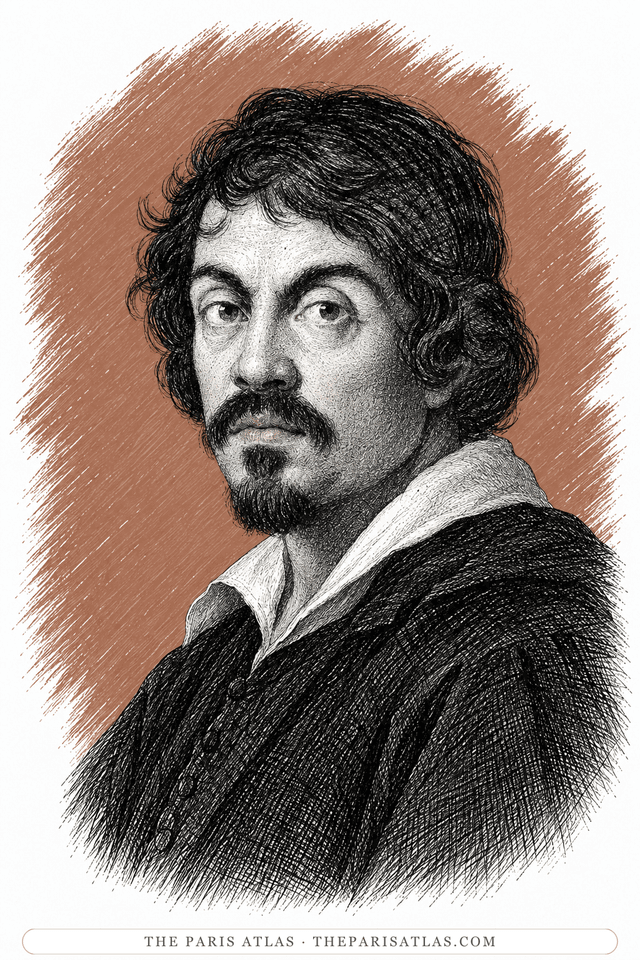
Caravaggio
Italian painter who worked from live models straight onto the canvas, without preparatory drawings, and lit them with a single hard light against a dark ground. He killed a man in Rome in May 1606, spent his last four years as a fugitive in Naples, Malta and Sicily, and died at thirty-eight.
View artist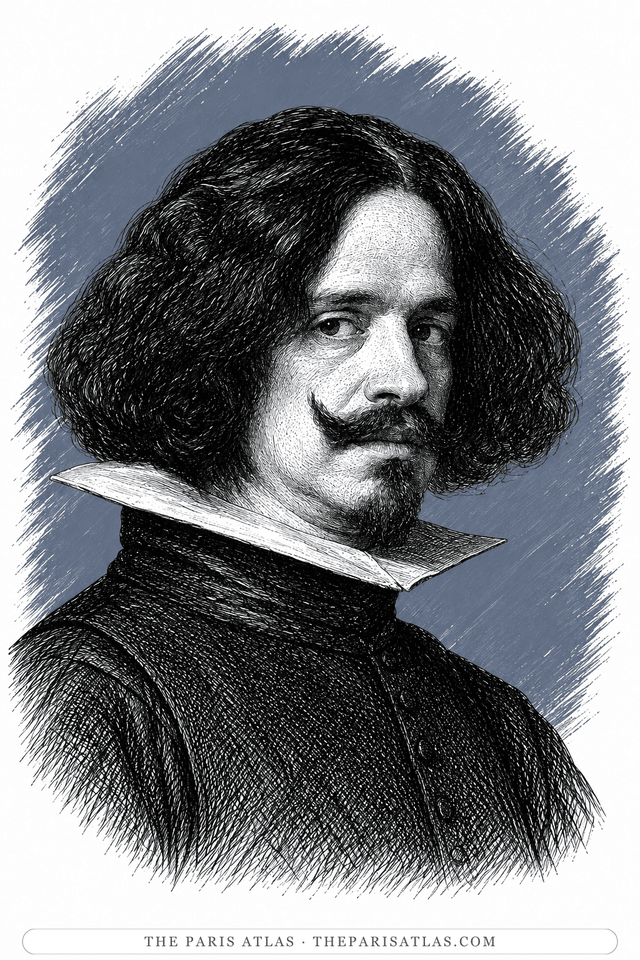
Diego Velázquez
Spanish painter who spent thirty-seven years in the household of Philip IV, painting the king, his family and the dwarfs and jesters of the palace, and who ended his career as the official responsible for housing and moving the court.
View artist
Johannes Vermeer
Dutch painter who worked in Delft and left fewer than forty paintings, most of them small scenes of one or two people in a quiet room lit from a window. Girl with a Pearl Earring, The Milkmaid and View of Delft are the best known.
View artist
References
The sources below include collection records, catalogues, scholarly research, and primary materials that informed this page. They document Aristotle with a Bust of Homer, its making, and its place in cultural history.


1Rembrandt, Aristotle with a Bust of Homer, 1653 — collection record (61.198)
WebsiteThe Metropolitan Museum of ArtUsed forThe holding museum's record. Its catalogue entry is adapted from Walter Liedtke's 2007 catalogue of the Met's Dutch paintings.

2Rembrandt's Aristotle with a Bust of Homer revisited: technical examination and new insights, in Rembrandt Now: Technical Practice, Conservation and Research, pp. 52–62
Exhibition catalogueArchetype Publications, for the National Gallery, London (eds. Marika Spring and Ashok Roy), 2022Used forThe Met's conservators and scientists on the canvas size, the 1963 and 1980 cleanings, the smalt haze, the moved chain and the changed tunic, and the scene at the 1961 auction.
3A Master Among Masters At The Met
PeriodicalCBS News, 2007Used forReports the $2.3 million price as the most then paid for a painting.
4Rembrandt's Philosopher: Aristotle in the Eye of the Beholder
PeriodicalJournal of Historians of Netherlandish Art 9, no. 1 (doi:10.5092/jhna.2017.9.1.12), 2017Used forMenno Jonker on the earring, the profile head on the medal, the Ruffo inventory entry and why the bust went unrecognized.
These references provide the documented foundation for this work's history and interpretation. Claim-level citations remain attached to the specific claims they support.
 Explore more resources