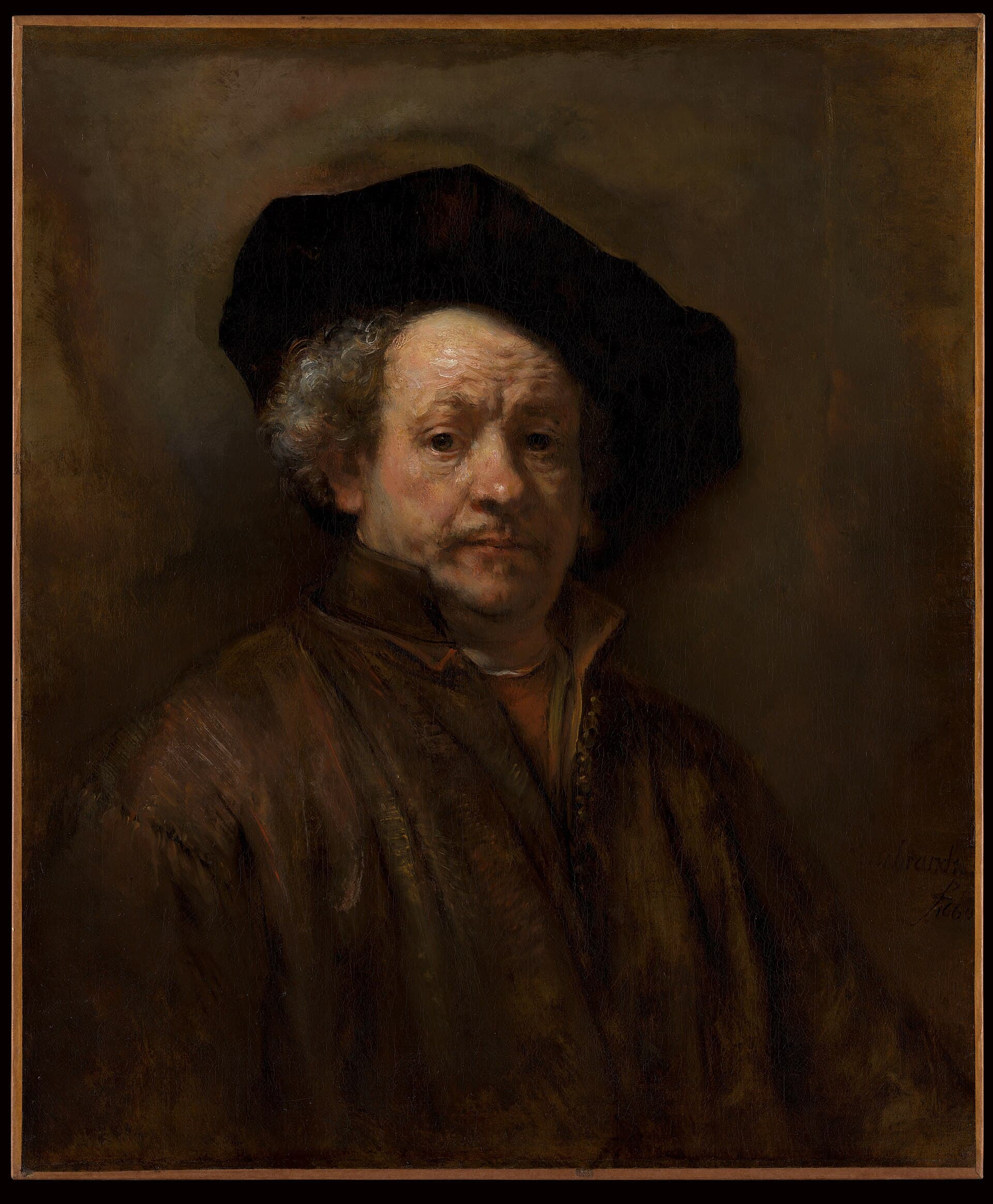
Self-Portrait
Rembrandt van Rijn looks straight out from under a black beret, in a brown work gown with a red waistcoat at the neck. He painted himself in 1660, the year he turned 54. The Metropolitan Museum of Art in New York has owned the painting since Benjamin Altman left it to the museum in 1913.
- 1660
- Oil on canvas
- The Metropolitan Museum of Art, New YorkNew York, United States
About Rembrandt van Rijn
What the painting shows
Rembrandt van Rijn shows himself from the chest up, looking straight at the viewer. His gray hair sticks out in thick curls from under a wide, soft black hat, like a beret.
Light falls from the upper left. The light catches his forehead, his nose and the left side of his face as we see it. The other side of his face drops into brown shadow.
He wears a loose brown gown with a high turned-up collar. Under it, at the neck, are a red waistcoat and a thin line of white shirt. The background is plain brown, a little lighter around his head on the left.
Nothing hidden about age
The Metropolitan Museum of Art says Rembrandt was unsparing with the signs of age in his own face. He built up the paint in high ridges for his furrowed brow, the heavy pouches under his eyes and his double chin.
Walter Liedtke, a curator at the Met, told CBS News in 2007 that the picture was made by looking in a mirror for a very long time. In the painting you can see every furrow in the brow and the aging in the eyes, Liedtke said.
The Met's catalogue calls the face remarkable for its quality and candor, and says it is the best-preserved part of the painting.
How the paint was put on
A synthetic varnish was removed from the painting in recent years. The Met says this made Rembrandt's working method easier to see. In the curls at the left, he turned his brush around and scratched into the paint with the handle end.
Rembrandt first painted a smaller cap and then painted the wide hat over it. The hat now looks flat, but the Met says that is because the black paint has darkened with age. Special images called autoradiographs, made by turning the paint briefly and harmlessly radioactive, still show folds in the hat.
The brown gown looks sketchy today, with the gray first coat of the canvas showing through in places. The Met's catalogue warns that this is partly damage. Heavy cleaning in the past wore away some of the brown paint. Rembrandt did paint his work clothes broadly, but the gown once looked fuller and rounder.
One of about forty painted self-portraits
Rembrandt painted himself all his life. The Met counts roughly forty painted self-portraits that survive. English Heritage counts about eighty self-portraits in all when etchings and drawings are included.
The Met's catalogue traces a line of portraits in which he shows himself plainly as a working painter. The first is the standing self-portrait of 1652 in the Kunsthistorisches Museum in Vienna. The closest to this one are a small self-portrait in Vienna, one in the National Gallery of Scotland in Edinburgh, and one dated 1659 in the National Gallery of Art in Washington.
He painted another self-portrait in the same year, 1660: the Self-Portrait at the Easel now in the Louvre in Paris. There he shows himself at work with his palette and brushes.
Rembrandt in 1660
The years before 1660 had been hard for Rembrandt. The Rijksmuseum says that after money troubles in the 1650s he moved to a rented house on the Rozengracht in Amsterdam, and the city's rich families came to him less often.
CBS News pointed out that he painted this portrait nine years before he died. Rembrandt died in Amsterdam in 1669.
From Paris to New York
The first owner the Met lists is the duc de Valentinois in Paris. The painting then went to England. Admiral William Waldegrave, 1st Baron Radstock, owned it until he died in 1825, and it was sold at Christie's in London in 1826 for £299.
Alexander Baring, later 1st Baron Ashburton, bought it at that sale. The portrait stayed with the Barons Ashburton in London until about 1907.
The Paris dealer Sedelmeyer had it next, and in 1909 sold it to the New York collector Benjamin Altman. Altman died in 1913 and left it to the Met in his will.
Where to see it
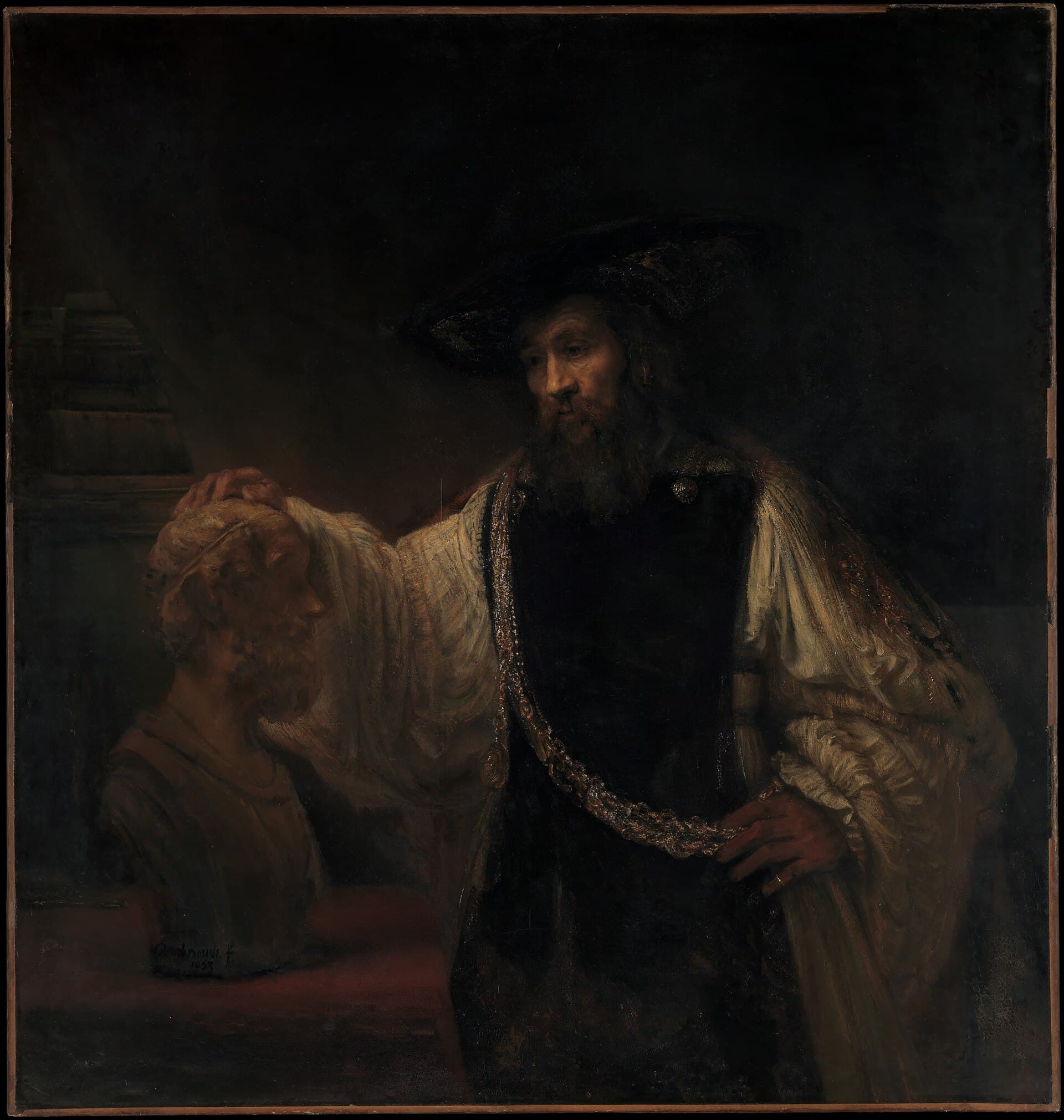
The painting belongs to the Metropolitan Museum of Art in New York, accession number 14.40.618. The Met's record lists it in Gallery 616, the same room as Aristotle with a Bust of Homer.
The Met's record says the terms under which the museum received the painting do not allow it to be lent, so it stays in New York.
Close reading
Reading the work, detail by detail
Rembrandt van Rijn painted his own face at 54 with thick paint and no flattery. Up close you can see the ridges of paint on his forehead, the curls he scratched with the handle of his brush, the dark hat that has lost its folds, and the signature fading at the edge.
1.The eyes
Rembrandt's eyes look straight out, with heavy bags of loose skin below them. His eyebrows are lifted, which pushes lines up across his forehead. The eye on the left is lit, and the eye on the right sits in soft shadow.
2.Paint thick enough to catch the light
The forehead is painted in short, raised strokes of pink, cream and white. The strokes stand up from the canvas like real wrinkles and catch the light. The Met says Rembrandt built up the paint in high relief to show his furrowed brow.
3.Curls scratched with the brush handle
Gray curls spring out from under the hat on the left side of his head. Thin lines run through the gray paint. The Met says Rembrandt turned his brush around and scratched them in with the handle end, which is easier to see since a synthetic varnish was removed.
4.Moustache and double chin
A small gray moustache sits over closed lips. Below them the chin softens into a second chin that rests on the high brown collar. The Met lists the double chin among the signs of age Rembrandt chose not to hide.
5.The black hat over a smaller cap
The wide black hat now looks almost flat, like a dark cutout. The Met says Rembrandt painted it over a smaller cap, and that the black paint has darkened with age. Special images called autoradiographs still show folds in the hat that the eye can no longer see.
6.The edge of the hat
On the right, the black hat curves down past the ear and melts into the dark background. Only one eye shows at the edge of the view. Where the hat stops and the shadow starts is hard to say.
7.The side of the face in shadow
The side of Rembrandt's face away from the light is painted in warm browns. Only the tip of his nose and a little of his cheek catch any light. The shadow is not black but a deep, warm brown.
8.The red waistcoat under the collar
The high collar of the brown gown opens at the throat. Inside is a red waistcoat and a thin line of white shirt. The Met's catalogue reads the costume as a long gown worn over a doublet with a turned-up collar and a red waistcoat.
9.A row of small buttons
A column of small round buttons runs down the front of his clothes, each one a single dab of gold-brown paint. Beside them is the red waistcoat and a pale fold of cloth.
10.The signature at the right edge
The signature is painted in dark brown on the brown background near the right edge. The end of the name, randt, and the date below it, f.1660, are easy to read. The first letters are very faint. The Met records the whole inscription as Rembrandt / f.1660.
11.The broad strokes of the gown
The shoulder of the gown is painted in long, fast diagonal strokes of lighter brown. In places a gray layer underneath shows through. The Met's catalogue says some of this rough look is damage from old cleaning, which wore away part of the brown paint.
12.Light behind the head
The brown background is lighter just behind his head on the lit side, and darker toward the edge. The lighter patch sets the gray curls apart from the wall. Nothing else appears in the background.
Timeline
1660
Rembrandt, aged 54, signs and dates the portrait at the lower right. He also paints the Self-Portrait at the Easel now in the Louvre.
1826
Sold at Christie's in London after the death of Admiral William Waldegrave, 1st Baron Radstock, and bought by Alexander Baring.
1829
Shown at the British Institution in London, lent by Alexander Baring.
1909
The Paris dealer Sedelmeyer sells it to Benjamin Altman in New York.
1913
Benjamin Altman dies and leaves it to the Metropolitan Museum of Art.
1972
Shown at the Met in Portrait of the Artist.
Where to see it
The Metropolitan Museum of Art, New York
1000 Fifth Avenue, New York, NY 10028, United States
The Met's record listed the painting on view in Gallery 616 in September 2026. Displays can change, so check before a visit.
Plan your visit on the museum’s official website (opens in a new tab)Frequently asked questions
How old was Rembrandt when he painted it?
54. The painting is dated 1660, and the Met notes that Rembrandt turned 54 in the summer of that year.
How many self-portraits did Rembrandt paint?
About forty paintings survive, according to the Metropolitan Museum of Art. With etchings and drawings, English Heritage counts roughly eighty self-portraits in all.
Why is the year in the web address?
Because Rembrandt made many works called Self-Portrait. The painting here is the one from 1660 at the Metropolitan Museum of Art.
What are the scratches in his hair?
Marks from the handle end of his brush. The Met says he turned the brush around and scratched into the paint to make the curls at the left of his hat.
Where is the signature?
At the lower right, against the brown background. The Met records it as Rembrandt / f.1660. The start of the name is faint.
Can I see it in person?
Yes. The Metropolitan Museum of Art lists it on view in Gallery 616 at the Met Fifth Avenue. The terms under which the museum received it do not allow loans, so it stays in New York. Check the museum's page before a visit.
More by Rembrandt van Rijn
If you like Rembrandt van Rijn
Explore painters from the same movements and circles.
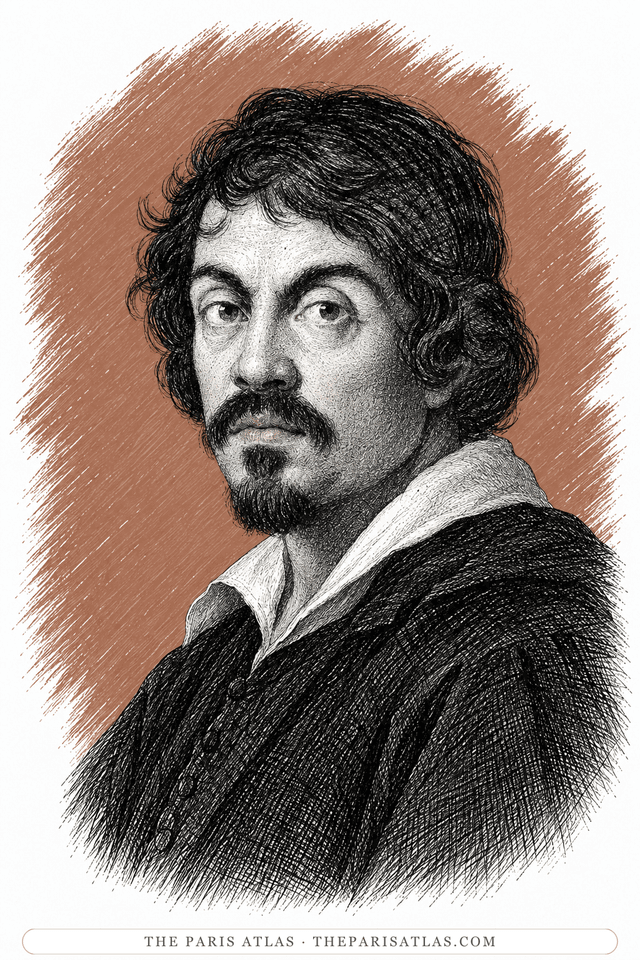
Caravaggio
Italian painter who worked from live models straight onto the canvas, without preparatory drawings, and lit them with a single hard light against a dark ground. He killed a man in Rome in May 1606, spent his last four years as a fugitive in Naples, Malta and Sicily, and died at thirty-eight.
View artist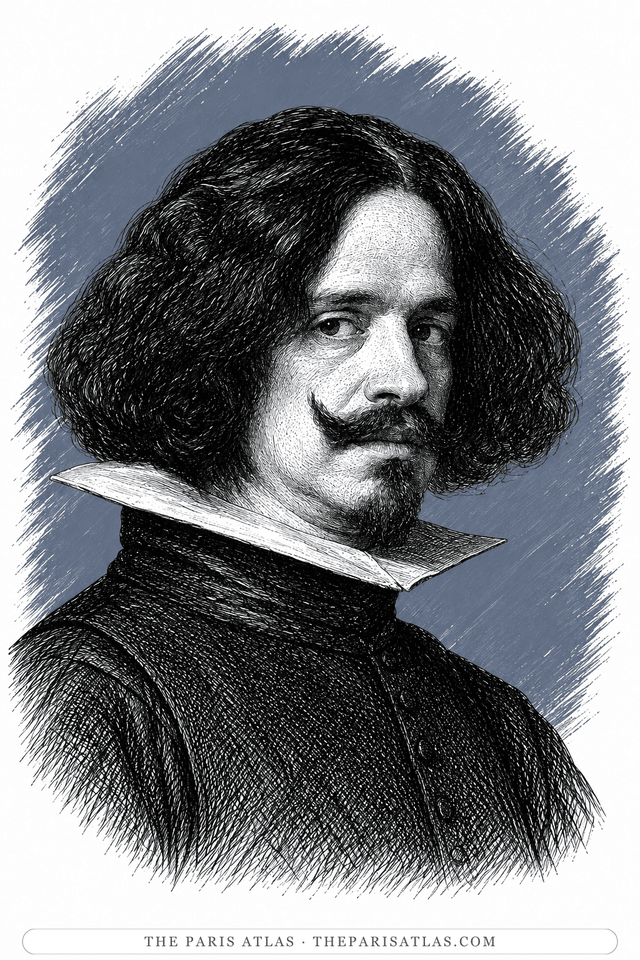
Diego Velázquez
Spanish painter who spent thirty-seven years in the household of Philip IV, painting the king, his family and the dwarfs and jesters of the palace, and who ended his career as the official responsible for housing and moving the court.
View artist
Johannes Vermeer
Dutch painter who worked in Delft and left fewer than forty paintings, most of them small scenes of one or two people in a quiet room lit from a window. Girl with a Pearl Earring, The Milkmaid and View of Delft are the best known.
View artist
References
The sources below include collection records, catalogues, scholarly research, and primary materials that informed this page. They document Self-Portrait, its making, and its place in cultural history.


1Rembrandt, Self-Portrait, 1660 — collection record (14.40.618)
WebsiteThe Metropolitan Museum of ArtUsed forThe holding museum's record. Its catalogue entry is adapted from Walter Liedtke's 2007 catalogue of the Met's Dutch paintings.

2A Master Among Masters At The Met
PeriodicalCBS News, 2007Used forWalter Liedtke on the mirror, the furrows and the aging eyes.
3Rembrandt's Self-Portrait with Two Circles — Kenwood, the Iveagh Bequest
WebsiteEnglish HeritageUsed forThe count of roughly eighty self-portraits across paintings, etchings and drawings.
4Rembrandt, Autoportrait au chevalet et à l'appuie-main de peintre, 1660 — collection record (INV 1747)
WebsiteMusée du LouvreUsed forThe other self-portrait of 1660.
5The Sampling Officials of the Amsterdam Drapers' Guild, known as 'The Syndics', 1662 — collection record (SK-C-6)
WebsiteRijksmuseumUsed forThe Rijksmuseum on Rembrandt's move to the Rozengracht after the money troubles of the 1650s.
These references provide the documented foundation for this work's history and interpretation. Claim-level citations remain attached to the specific claims they support.
 Explore more resources