A strip of linen about 68 metres long, embroidered in coloured wool, that tells the story of how William, Duke of Normandy, took the English throne in 1066.
The Bayeux Tapestry is a long strip of linen cloth embroidered in coloured wool, telling the story of the Norman conquest of England in 1066. It runs about 68.3 metres — roughly 224 feet — and stands about 70 centimetres tall, of which the bottom 50 centimetres carry the embroidery itself.[1] It is one continuous picture, read left to right, the way you would read a sentence.
It is not a tapestry. A tapestry is woven, which means the picture and the cloth are made at the same time, on a loom, from threads crossing at right angles. The Bayeux Tapestry was made the other way round: the linen was woven first, and the pictures were then stitched onto it in wool. The Bayeux Museum, which holds it, calls the technique "unquestionably embroidery" and describes the object as a narrative embroidery.[1] UNESCO opens its register entry with the same correction.[2] The name stuck anyway, and every institution keeps using it.
The cloth is nine separate panels of linen sewn end to end.[1] The wool was dyed with three plants: woad for the blues, madder for the reds, pinks, oranges and browns, and dyer's rocket, also called weld, for the yellow.[1] That gives ten colours in total. The colours are not realistic and were never meant to be — horses come in blue and green as readily as brown.[2]
Four stitches do all the work: stem stitch for the outlines, couching stitch for filling in the figures, and chain stitch and split stitch to raise certain letters and objects, such as arrows, spears and ropes.[1][2] The couching stitch used here is known as Bayeux stitch, after this object.[1]
Including its lining, the whole thing weighs close to 350 kilograms.[3]
What it shows
The story starts in 1064, two years before the battle. Edward the Confessor, King of England, sends his brother-in-law Harold Godwinson across the Channel to Normandy, to tell Duke William that the English throne will be his.[4]
Harold's crossing goes badly, he is captured and released, and he eventually delivers the message. Before going home he swears an oath of loyalty to William on holy relics at Bayeux.[4] That oath is the hinge of everything that follows. When Edward dies, Harold breaks it: on 6 January 1066 he accepts the English crown for himself.[4]
William assembles a fleet and crosses on the night of 28 September 1066, landing at Pevensey in Sussex and moving on Hastings.[4] At the battle he splits his army into three — Bretons on the left, Normans in the centre, Franks and Flemish on the right, with archers and foot soldiers going in first.[5] Harold holds the high ground. Ten of the embroidery's scenes are given to the fighting.[4]
Halfway through, a rumour runs through the Norman ranks that William is dead, and his men start falling back towards the sea. William pulls off his helmet so his face can be seen and rides forward to turn them around.[5] Harold is killed, the English break, and the embroidery stops in the middle of the rout. William was crowned at Westminster Abbey on 25 December 1066, but that scene is not there.[5]
The numbers
Simone Bertrand, curator of the museum from 1948 to 1978, counted what is on it: 626 people, 202 horses and mules, 55 dogs, 505 animals of all kinds, 37 buildings or fortresses, and 41 ships.[2] Mont-Saint-Michel is one of the buildings.[4]
There are 58 scenes in all. Twenty-five are set in France and thirty-three in England.[4] Latin captions run along the top of the picture, naming people and saying what is happening; the museum counts 380 Latin words across the whole length.[4] Reading Museum, which holds a full-size Victorian copy, counts 57 separate inscriptions.[6]
Above and below the main story run two narrow borders filled with animals, some of them illustrating Aesop's fables such as The Fox and the Crow, others showing ordinary work: catching birds with slings, ploughing a field with a harrow.[2] At moments of high tension the main picture breaks its frame and spills up into the top border.[2]
Who made it, and where
Nobody knows. There is no contemporary account of who ordered the embroidery, who designed it, or who stitched it.[2] UNESCO lists three open questions: who instigated it, whether it was made in Normandy or England, and when.[2]
The usual answer to the first is Odo, Bishop of Bayeux, William's half-brother, who became bishop in 1050 and fought at Hastings.[7] Reading Museum notes that he was made bishop at nineteen and swung a mace in the battle rather than a sword.[6] The case for him rests largely on how often he appears in the embroidery, where he is named several times.[2][7] The Bayeux Museum's own wording is careful: it says the work was probably commissioned by Odo to decorate his new cathedral, which was consecrated on 14 July 1077.[1]
The second question has a surprising answer. The embroidery is named for a Norman town and celebrates a Norman victory, but the evidence points to it having been made in England, by the losing side. UNESCO puts it in the south of England, perhaps at Canterbury or Winchester, both centres of manuscript painting and embroidery at the time.[2] The composition of the scenes resembles Canterbury manuscripts, the Latin spellings look English, and the colour range — brown, beige, bronze green, dark blue, yellow highlights — is common in Anglo-Saxon manuscripts and rare in Norman ones before about 1100.[2] The City of Bayeux, announcing the loan to London in 2025, described the embroidery as returning to the place where it was probably made.[8]
On who held the needles, UNESCO separates the design from the stitching. The consistency of the drawing across 68 metres, and the Latin, suggest a single supervisor, probably a cleric. The embroidery itself was probably done by women, since professional embroideresses are known to have worked in the south of England then.[2]
The Queen Matilda story
In French the embroidery has a second name: the Tapestry of Queen Matilda. The tradition holds that William's wife Matilda and her ladies-in-waiting stitched it themselves. It is embedded deeply enough that UNESCO's own nomination form records the object's full name as "Bayeux Tapestry – an embroidery also known as Queen Matilda's Tapestry".[2]
The Bayeux Museum says plainly that this is not what happened, calling the belief popular and romantic and stating that the embroidery was probably not made by Matilda and her ladies.[1] No institutional account of the making names her.
The attribution appears to be modern rather than medieval. A book published in 1803 was titled a historical notice on the tapestry embroidered by Queen Matilda, wife of William the Conqueror — and 1803 is the year Napoleon had the embroidery brought to Paris.[2] Her name survives in Bayeux in one real place: the Matilda gallery, the room where the embroidery was first put on permanent display in 1842.[9]
The comet
After Harold's coronation, a crowd of men stand pointing up at a blazing star. It is Halley's Comet, which passed the Earth in 1066 and was read at the time as a warning.[10] NASA confirms the identification, noting that the comet features in the embroidery, and that it returns roughly every 76 years.[11]
Reading Museum describes what the scene does with it: people see the comet, grow frightened, and the news is carried to Harold, who is shown listening.[10] In the border beneath him a line of empty ships floats, a hint of the invasion fleet that has not sailed yet.[10] It is one of the moments where the embroidery is doing something more sophisticated than reporting.
The arrow in Harold's eye
The best-known fact about the Bayeux Tapestry is that it shows King Harold killed by an arrow through the eye. Whether it actually shows that is disputed, and the dispute is old.
The problem is that Harold appears to be shown twice in the same scene. One figure is pulling an arrow from his eye. Next to him, another figure is being cut down by a mounted Norman knight. The Latin caption above reads, in Reading Museum's translation, "here King Harold has been killed", and it stretches across both figures.[6] Reading Museum's own reading is that the tapestry is hard to interpret here and that the second figure is probably Harold.[12]
The Bayeux Museum states it both ways on different pages. One says Harold was struck in the eye by an arrow and killed.[4] Another says only that he is shown wounded in the face by an arrow, and that he died covered in mortal wounds while fighting in the front rank.[5]
English Heritage treats it as an open question and offers a motive for the arrow version: an anonymous arrow falling from the sky reflects better on William than his men hacking a king to pieces.[13] It also points to an early written account of Harold's death that describes a sword through the chest rather than an arrow at all.[14]
There is a further reading, which treats the wound as a symbol rather than a report. On this account the designer built the whole story on the Old Testament conquest of Judah by Babylon, and Harold's blinding answers the blinding of King Zedekiah by Nebuchadnezzar, the punishment of a king who swore a false oath.[2] The Bayeux Museum endorses that spiritual dimension, calling the work not only a military epic but an account of a broken oath being punished.[2]
The missing end
The embroidery is incomplete. It stops with the English fleeing the battlefield, and the final scene is gone.[4][15]
Reading Museum's suggestion for what it held is William's coronation, on the reasoning that it would mirror the opening, where Edward the Confessor sits enthroned.[15] Neither institution publishes a figure for how much length was lost, and the argument rests on the shape of the story rather than on physical evidence.
Separately from the lost ending, the cloth has been repaired 518 times over the centuries. A relining in the nineteenth century took two to three centimetres off the top edge.[2] Restorers' work can be told apart from original stitching by chemistry: the repairs use synthetic dyes, which dates them after 1860.[2]
How it survived nine hundred years
The first written record of the embroidery is an inventory of the Bayeux Cathedral treasury in 1476, which lists it as a church item.[2][9] For centuries it was hung in the cathedral nave once a year and kept in a wooden chest the rest of the time.[9] Two fires broke out in the cathedral during the Middle Ages and it escaped both.
It was effectively unknown outside Bayeux for seven hundred years, until Nicolas Joseph Foucault, the royal intendant at Caen between 1689 and 1704, brought it to notice.[9] It was shown and studied publicly at the Académie Royale in 1720.[2]
In 1792 it came close to destruction. Revolutionaries were about to cut it up for cart covers when a local man stopped them and locked it in his office.[9] The Bayeux Museum publishes his name two ways, as Léonard Lambert-Leforestier and as Lambert Léonard Le Forestier, and describes him once as a lawyer and once as captain of the national guard. In 1794 the district Arts Commission seized it for the Nation, which is how it became state property.[9][2] It still is: the French state owns it and the town of Bayeux keeps it.[2]
Napoleon Bonaparte had it fetched to Paris in 1803, where it hung in the Louvre's Apollo Gallery from 6 December 1803 to 18 February 1804.[9] Vivant Denon's letter returning it recorded that the First Consul had been very interested to see this precious commemoration of French history.[9] Napoleon was assembling an invasion force against England at the time.
From 1812 it was kept at the town hall and unrolled by hand for visitors; from 1842 it went on permanent display in the Matilda gallery, and in 1913 it moved to the Hôtel du Doyen.[9]
The Second World War
Protective measures started in September 1938, before the war began. In 1939 the embroidery went into an underground shelter at the Hôtel du Doyen for two years, and in 1941 it was driven to the national museums' store at Sourches in the Sarthe, where it stayed until 26 June 1944.[16]
German research teams from the Ahnenerbe, the SS institute, studied it during the occupation because of what it showed: a successful cross-Channel invasion.[16] As the Allies advanced, the German authorities requisitioned it and sent it to the Louvre, where it was exhibited from 10 November to 15 December 1944 in the Italian Primitives room.[16] It returned to Bayeux on 2 March 1945.[16]
Two pieces did not come back. In 1941 Dr Karl Schlabow, a textiles specialist directing part of the German study, removed small fragments of the linen. Nobody at Bayeux knew. They surfaced during archival cataloguing in Germany in late 2024, and on 14 January 2026 the Schleswig-Holstein Archives handed them to the French state, their director delivering them to Bayeux himself. They are a few centimetres across and carry no embroidery.[17]
A second wartime loss turned into a gain. A German survey of the embroidery made in 1941 was never published and was forgotten. In April 2019 the family of the Berlin artist Herbert Jeschke gave his record of it to the town of Bayeux: four notebooks of sketches, fifteen sheets of watercolour reproductions, and fifty black-and-white photographs. Conservators can now compare the embroidery's condition across eighty years.[18]
The Victorian copies
In 1872 and 1873 the photographer Joseph Cundall photographed the whole embroidery for Britain's Department of Science and Art. It took over two months and more than 180 glass plates, each 20 by 15 inches, and the result is the largest photographic panorama made in the nineteenth century.[19][20] The prints were made life-size and hand-coloured by art students, and sold at £216 a set.[19] The Victoria and Albert Museum holds two: one continuous roll 214 feet long, and one set cut into 25 parts.[19][20]
Those photographs then produced an object of their own. Elizabeth Wardle of the Leek Embroidery Society in Staffordshire used the 25-part set as her pattern, and with thirty-four other women re-embroidered the entire thing at full size. They finished at Whitsuntide 1886.[21] After it was shown in Reading's town hall in 1895, a former mayor, Alderman Arthur Hill, bought the replica and gave it to the town.[21] It is over 70 metres long and hangs in Reading Museum today.
The Victorians did finish the story. In 2018 the artist Jan Messant made the ending the original lost, William crowned on 25 December 1066, and it was added to the Reading replica.[15]
A third copy came home by an unlikely route. In 2023 the Bayeux Museum bought a life-size Victorian replica made in 1874 from the collection of Charlie Watts, the Rolling Stones' drummer, who died in 2021. It went for £16,000 at Christie's on the fourteenth and final bid, and will go on show when the new museum opens.[22]
Where to see it
The Bayeux Tapestry Museum is closed. It shut on 31 August 2025 for a rebuild and will not reopen until autumn 2027.[23][24] Anyone planning a trip to Normandy to see it should check the museum's own site before booking.
The embroidery itself is in London. The British Museum is showing it from September 2026 to June 2027, in a loan announced by the French and British governments.[8] A loan was first proposed at the Sandhurst summit in January 2018 and then held back; the museum's curator, Antoine Verney, explained that in 2018 they did not yet know enough about the physical state of the work.[8]
Before this, the embroidery had left Bayeux for exhibition exactly twice in nine hundred years: for Napoleon in 1803, and for the Louvre in 1944 and 1945, where its display was treated as a tribute to the liberating armies.[8]
Reading Museum in Berkshire shows the full-size Victorian replica free of charge, and it is the only place to see the whole story at full length, ending included.[21][15]
When Bayeux reopens in 2027 the display changes. The embroidery has hung vertically since 1842; the new museum, designed by the British practice RSHP, will lay it on an inclined stand so that conservators can lower it flat and visitors can see its whole length.[8][23]
Close reading
Reading the work, detail by detail
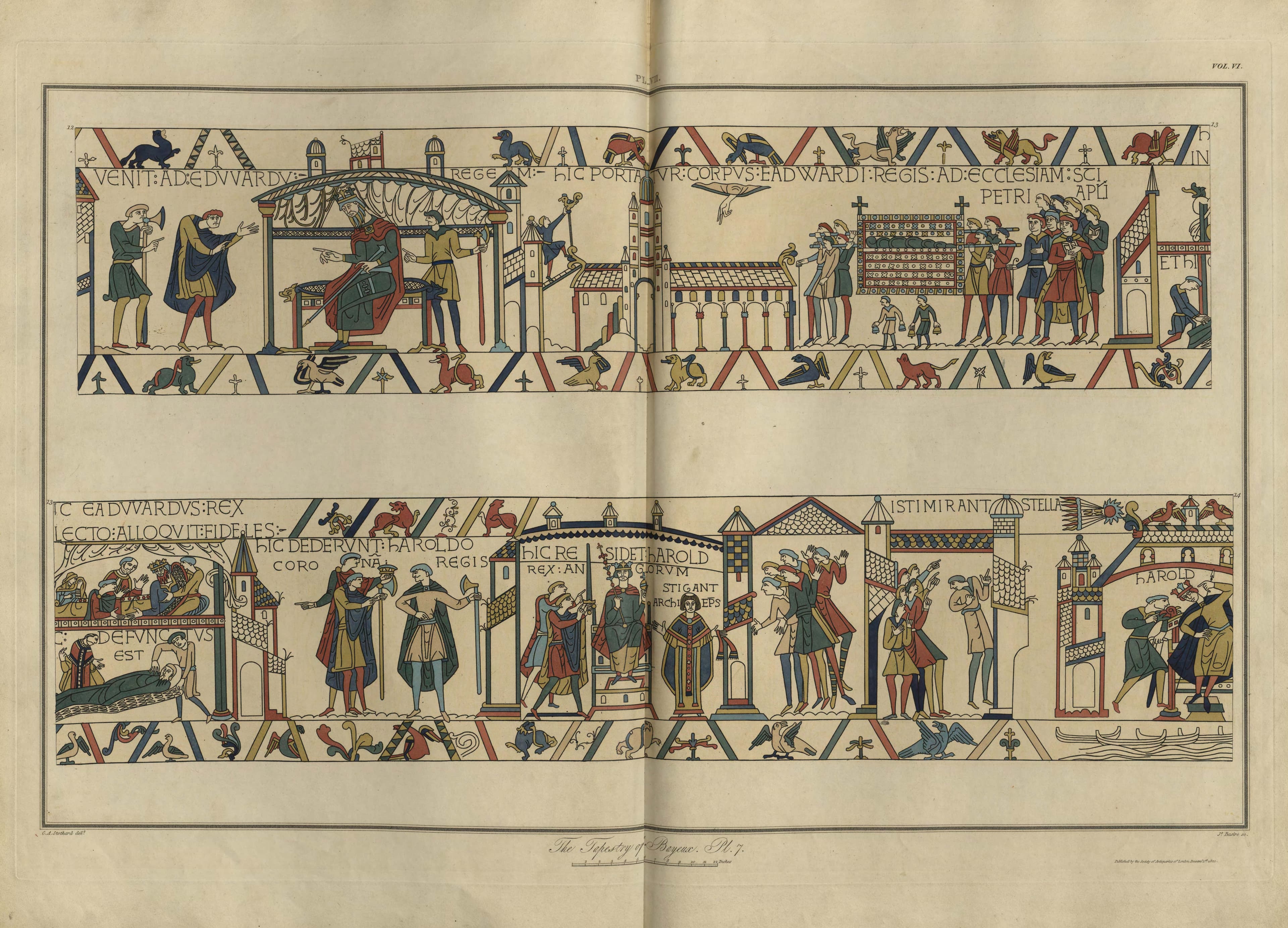
These details come from Charles Alfred Stothard's engraved record of the embroidery, drawn at Bayeux and published by the Society of Antiquaries of London on 1 December 1821. The sheet covers the run of scenes from Harold's return to King Edward through to the comet, and it carries the Latin captions, which are how the embroidery tells you what you are looking at.
1.Harold reports back: VENIT AD EDVVARDV REGEM
Harold Godwinson has come back from Normandy and is reporting to Edward the Confessor. The caption reads VENIT AD EDVVARDV REGEM, meaning he came to King Edward. Edward sits under a canopy with a sword across his lap, and Harold leans in with both hands out. What the embroidery does not show is what he said. This is the moment after the oath to William, and the story from here on depends on an argument about whether that oath bound him.
2.Westminster Abbey, and a hand out of the sky
The building is the abbey church at Westminster, shown with a man setting a weathercock on the roof. Above it a hand comes out of the sky and points down. The hand of God is standard medieval shorthand for divine approval, and here it settles on the church Edward built rather than on any person. Edward died a few days after its consecration, and the embroidery puts the building and the funeral next to each other for that reason.
3.The funeral: HIC PORTATVR CORPVS EADWARDI REGIS
Edward's body is carried to the church, the caption naming it as such: HIC PORTATVR CORPVS EADWARDI REGIS AD ECCLESIAM SCI PETRI APLI, here the body of King Edward is carried to the church of Saint Peter the Apostle. Look below the bier for two small figures ringing hand bells. They are drawn at a fraction of adult size, which is not a mistake about children but the usual medieval way of showing who matters least in the scene.
4.Two moments in one frame: the deathbed and the corpse
This one panel holds two separate moments stacked on top of each other. Above, Edward sits up in bed talking to the people around him, and the caption reads HIC EADWARDVS REX IN LECTO ALLOQVIT FIDELES, here King Edward in bed speaks to his followers. Below, the same man lies flat and wrapped, under the words ET HIC DEFVNCTVS EST, and here he died. Medieval narrative art does this routinely: time runs down the panel as well as across the strip.
5.Harold crowned: HIC RESIDET HAROLD REX ANGLORVM
Harold is crowned and enthroned with sceptre and orb, under the words HIC RESIDET HAROLD REX ANGLORVM, here sits Harold, king of the English. The bishop beside him with his arms spread is named in the embroidery as STIGANT ARCHIEPS, Archbishop Stigand. Naming him is not neutral. Stigand's position was disputed by the papacy, and he was deposed and imprisoned in 1070, dying a prisoner at Winchester in 1072. Putting him at the coronation puts a question mark over it.
6.The comet: ISTI MIRANT STELLA
A group of men point up at a blazing star while one crouches away from it. The caption reads ISTI MIRANT STELLA, these men wonder at the star. The star is Halley's Comet, which passed the Earth in 1066 shortly after the coronation, and NASA notes the embroidery among its appearances. Nobody in the scene treats it as astronomy. Beneath Harold, in the lower border, a line of empty ships is already floating, which is the embroidery telling you what the comet means before any of the people in it find out.
Harold Godwinson sails to Normandy on Edward the Confessor's orders and swears an oath to Duke William on relics at Bayeux. The embroidery opens here.
6 January 1066
Harold is crowned King of England, breaking the oath. Halley's Comet appears days later and is read as a warning.
28 September 1066
William crosses the Channel overnight and lands at Pevensey in Sussex.
14 October 1066
The Battle of Hastings. Harold is killed and the English break. The embroidery stops mid-rout; its final scene is lost.
14 July 1077
Bayeux Cathedral is consecrated. The Bayeux Museum's view is that Odo probably commissioned the embroidery to hang there.
1476
The first written record: an inventory of the Bayeux Cathedral treasury lists the embroidery as a church item.
1792
Revolutionaries move to cut it up for cart covers. A local official stops them and locks it in his office.
1803
Napoleon Bonaparte has it brought to Paris, where it hangs in the Louvre's Apollo Gallery while he plans an invasion of England.
1842
It goes on permanent public display for the first time, in the Matilda gallery at Bayeux.
1872–1873
Joseph Cundall photographs the whole embroidery on more than 180 glass plates for Britain's Department of Science and Art.
1886
Elizabeth Wardle and thirty-four other women finish a full-size embroidered replica at Leek in Staffordshire. It is now in Reading Museum.
1941
The embroidery is moved to a national store at Sourches. German researchers from the Ahnenerbe study it; fragments are quietly removed.
November 1944
Requisitioned by the German authorities and exhibited at the Louvre. It returns to Bayeux on 2 March 1945.
1983
It goes on display at the Centre Guillaume le Conquérant in Bayeux, hung vertically in a horseshoe-shaped case.
2 August 2007
Inscribed on UNESCO's Memory of the World Register, alongside the Declaration of the Rights of Man and the films of the Lumière brothers.
31 August 2025
The Bayeux museum closes for a rebuild costing about 40 million euros, designed by the British practice RSHP.
14 January 2026
The Schleswig-Holstein Archives return the linen fragments taken in 1941.
September 2026
The embroidery goes on show at the British Museum in London, only the third time it has left Bayeux for exhibition.
Where to see it
Bayeux Museum
A public viewing address has not yet been confirmed for this holding.
Frequently asked questions
Is the Bayeux Tapestry actually a tapestry?
No. It is an embroidery. A tapestry is woven, so the picture and the cloth form together on a loom. Here the linen was woven first and the pictures were stitched onto it afterwards in coloured wool. The Bayeux Museum calls the technique unquestionably embroidery, and UNESCO's register entry opens by making the same correction. The name has been in use too long to change.
How long is the Bayeux Tapestry?
About 68.3 metres, or roughly 224 feet, according to the Bayeux Museum's technical page. Published figures vary a little: the museum's 2025 press dossier gives 68.58 metres, UNESCO gives 68.80 metres, and general descriptions often round it to 70 metres. It is about 70 centimetres tall, of which the lower 50 centimetres carry the embroidery.
Who made the Bayeux Tapestry?
Nobody knows. No document from the time records who ordered it, designed it or stitched it. Odo, Bishop of Bayeux and William the Conqueror's half-brother, is the usual candidate as patron, largely because he appears and is named repeatedly in the embroidery itself. UNESCO suggests the design was supervised by one person, probably a cleric who knew Latin, and that the stitching was done by professional embroideresses.
Did Queen Matilda make the Bayeux Tapestry?
Almost certainly not, although the French name for it is the Tapestry of Queen Matilda. The Bayeux Museum calls the belief popular and romantic and says the embroidery was probably not the work of William's wife and her ladies-in-waiting. The attribution seems to date from around 1803, when Napoleon brought the embroidery to Paris and a book appeared describing it as Matilda's work.
Was the Bayeux Tapestry made in France or England?
The evidence points to England, which is the odd part, since it celebrates the conquest of England. UNESCO places its making in the south of the country, possibly Canterbury or Winchester. The scene compositions resemble Canterbury manuscripts, the Latin spellings look English, and the colour range matches Anglo-Saxon manuscript painting rather than Norman work of the period.
Does the Bayeux Tapestry show Harold killed by an arrow in the eye?
It shows a figure pulling an arrow from his eye and, beside him, a second figure being cut down by a Norman horseman. The Latin caption saying King Harold has been killed runs across both. Historians disagree about which figure is Harold, or whether both are. Reading Museum thinks the second one probably is. English Heritage notes that an arrow from the sky flatters William more than his knights killing a king, and points to an early account describing a sword wound instead.
What is the comet in the Bayeux Tapestry?
Halley's Comet, which passed close to Earth in 1066, shortly after Harold's coronation. The embroidery shows a crowd pointing up at it in alarm and the news being brought to Harold. Below him, in the border, a row of empty ships appears — the invasion fleet, still to come. NASA confirms the identification and notes the comet returns about every 76 years.
Where can I see the Bayeux Tapestry?
Not in Bayeux at the moment. The museum closed on 31 August 2025 for a rebuild and reopens in autumn 2027. The embroidery is at the British Museum in London from September 2026 to June 2027. Reading Museum in Berkshire shows a full-size Victorian embroidered replica, made in 1885 and 1886 by Elizabeth Wardle and thirty-four other women, and it is the only version with an ending.
In the atlas
What the graph records about this work — every claim carries its citation.
The Bayeux Tapestry is the best-known surviving narrative textile of the European Middle Ages, made around 1077 and probably commissioned by Odo, Bishop of Bayeux, for a cathedral consecrated on 14 July 1077. It is medieval art in the form the period actually took: not a framed painting but wool worked onto linen, made anonymously in a workshop, and built to be read by people who could not read. UNESCO inscribed it on the Memory of the World Register in 2007.
— Tapestry or embroidery?; Memory of the World Register nomination form no. 2006-44: Bayeux Tapestry; Memory of the World Register: Bayeux Tapestry
References
References
The sources below include collection records, catalogues, scholarly research, and primary materials that informed this page. They document The Bayeux Tapestry, its making, and its place in cultural history.
The holding museum's technical page: dimensions, the nine linen panels, ten wool colours, the four stitches, and why the object is an embroidery rather than a tapestry.
2abcdefghijklmnopqrstuvMemory of the World Register nomination form no. 2006-44: Bayeux Tapestry
Official record
UNESCO
Used for
France's 2006 nomination dossier — the fullest public account of the materials analysis, the origin debate, the border scenes and the conservation record.
These references provide the documented foundation for this work's history and interpretation. Claim-level citations remain attached to the specific claims they support.


 View source