
Slaughterhouse-Five
Kilgore Trout's earlier appearance, in the Kurt Vonnegut novel that made him famous four years before.
Read our takeBreakfast of Champions
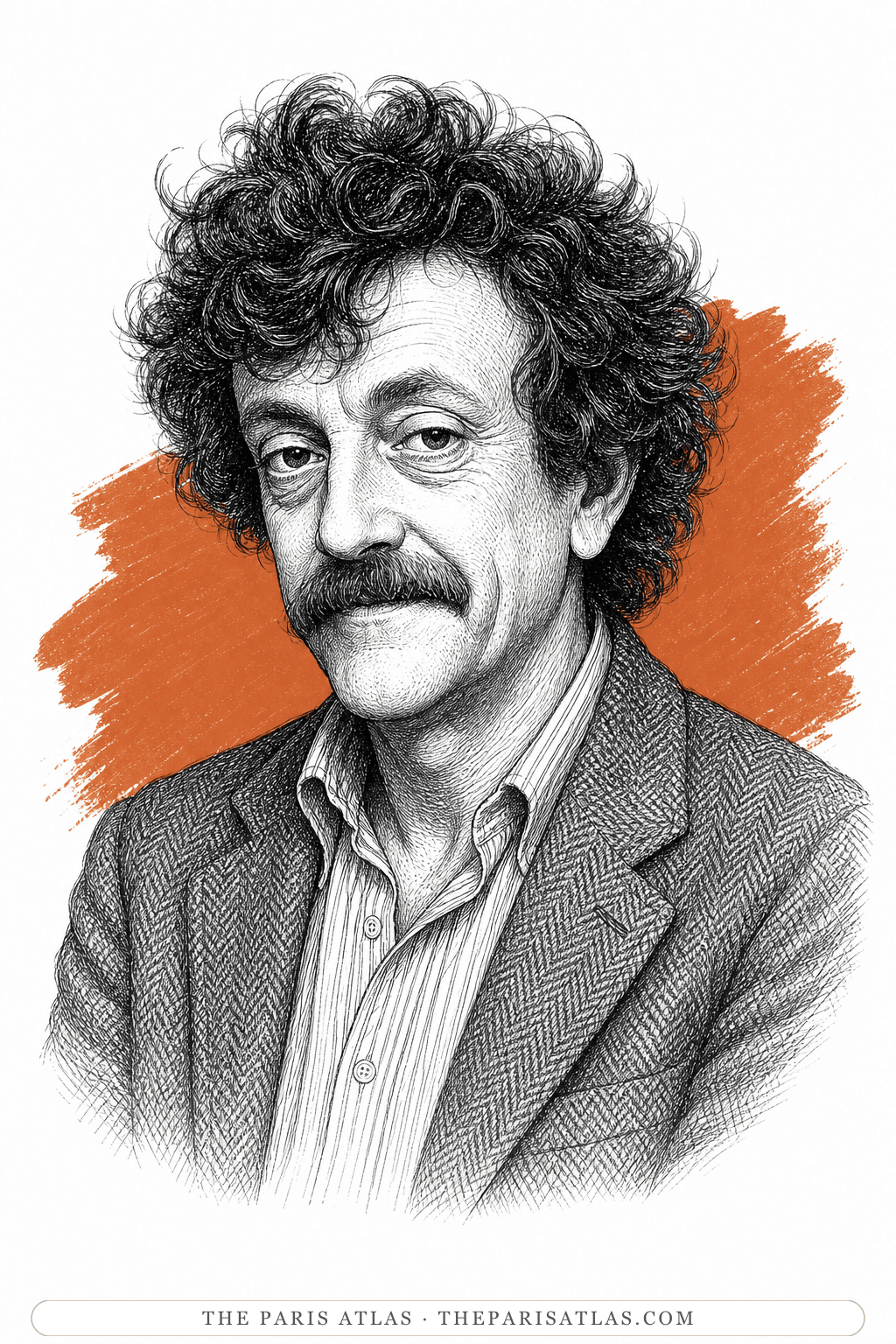
Kurt Vonnegut
Kurt Vonnegut's 1973 novel, with his own drawings, in which a forgotten science-fiction writer meets a car dealer who is losing his mind.
Breakfast of Champions is a novel by Kurt Vonnegut, published by Delacorte Press in New York in 1973 with drawings by the author.[1] Kilgore Trout, an old science-fiction writer nobody reads, hitchhikes to an arts festival in Midland City.[2] Dwayne Hoover, the Pontiac dealer who owns much of the town, is going insane.[3][2] When the two men meet, one of Trout's stories pushes Dwayne over the edge.[2] Vonnegut also puts himself in the book, watching his characters and finally setting them free.[4]
Kurt Vonnegut dedicated the book to Phoebe Hurty, who wrote advertisements for a department store in Indianapolis. When he was young she hired him to write advertising copy about teenage clothes, and he often visited her house.[4] The Kurt Vonnegut Museum and Library says he called the novel a present to himself for his fiftieth birthday.[4]
Chapter 2 introduces Dwayne Hoover and Kilgore Trout through their pets. Dwayne Hoover is a widower who lives alone in a dream house in Fairchild Heights, the best part of town. His only company at night is a Labrador called Sparky, who cannot wag his tail because of an old car accident, so he has to fight other dogs all the time.[5]
Kilgore Trout lives alone with a parakeet called Bill. Dwayne talks to his dog about love. Trout mutters to his bird about the end of the world, and jokes that the air will soon be too poisonous to breathe.[5]
In 1972 Trout lives in a basement apartment in Cohoes, New York, and installs aluminum storm windows for a living. He has written 117 novels and 2,000 short stories, and no respectable publisher has heard of him. His stories appear in pornographic magazines, used to fill out the pages between the pictures, and he is paid nothing.[5]
Trout's invitation to Midland City comes through Eliot Rosewater, the millionaire from Kurt Vonnegut's earlier novel God Bless You, Mr. Rosewater. On the road, Trout rides in a truck with PYRAMID painted on its side and wonders why anyone in fast transport would name trucks after buildings that have not moved in thousands of years.[2]
Kilgore Trout, a poor and unknown science-fiction writer living in Cohoes, New York, is invited to a Festival of the Arts in Midland City. The invitation comes through the millionaire Eliot Rosewater. Trout sets off across the country, hitchhiking.[5][2]
In Midland City, Dwayne Hoover sells Pontiacs and owns much of the town. His wife, Celia, died after eating the drain cleaner Drano. He lives alone with his dog, and a housekeeper named Lottie Davis cooks his supper.[3][2][5] Bad chemicals in his body are slowly driving him mad. His secretary, Francine Pefko, is also his mistress.[2][4]
The book calls itself the tale of a meeting of two lonesome, skinny, fairly old white men on a planet that is dying fast.[2] Kirkus Reviews explains the title: in the novel, Holiday Inn cocktail lounges serve a martini as the Breakfast of Champions.[3] Kurt Vonnegut is in Midland City too, as a character, watching the people he has made.[4]
Dwayne reads a story by Trout. The story is written as a message from the Creator of the Universe, telling the reader that he alone has free will and that everyone else is a robot. Dwayne believes it, and his madness breaks out.
Dwayne goes on a violent rampage and hurts people. Kirkus Reviews' early notice says two policemen finally stop him on the highway median.
Afterward Kurt Vonnegut meets Kilgore Trout face to face. He tells Trout he is freeing all the characters he has used in his books, as Leo Tolstoy freed his serfs and Thomas Jefferson his slaves. The one thing he cannot or will not do is make Trout young again.
The first edition says on its title page that the drawings are by the author. Kurt Vonnegut drew them with a felt-tip marker. They are simple, rough sketches of everyday things, from a Volkswagen to an electric chair.
The drawings go with a way of writing. Kurt Vonnegut often explains ordinary things as if the reader had never met them. In Chapter 2 he spells out what "take a leak" means, and defines charm as a scheme for getting strangers to trust you at once. Christopher Lehmann-Haupt, reviewing the book in The New York Times, liked the drawings at first and said they began to wear on him.
Kilgore Trout first appeared in God Bless You, Mr. Rosewater in 1965 and came back in Slaughterhouse-Five. The Encyclopedia of Science Fiction says Trout was based partly on the science-fiction writer Theodore Sturgeon, with parts of Vonnegut's own life mixed in. The Kurt Vonnegut Museum and Library notes that Vonnegut often described Trout as looking like his own father as an old man.
Breakfast of Champions gives Trout a leading role. He has odd habits. He calls mirrors leaks, pretending they are holes into another universe, and warns children not to get too close. The narrator adds that by the time Trout died, everybody called mirrors leaks.
The book also summarizes many of Trout's stories. One follows a bachelor scientist who learns to grow copies of himself in chicken soup and becomes famous as a family man. Christopher Lehmann-Haupt counted a dozen or so such summaries and wished some had been written out as whole books.
Kurt Vonnegut is a character in Breakfast of Champions. He moves Dwayne Hoover and Kilgore Trout around Midland City and arranges what happens to them. Kirkus Reviews noted that in his fiftieth year he announced he would stop telling stories and write about life instead.
At the end he meets Trout and tells him he is setting free all the characters who have served him in his books. He compares himself to Leo Tolstoy freeing his serfs and Thomas Jefferson freeing his slaves. The one thing he cannot or will not do, the museum's reader points out, is make Trout young again.
Not every reader was won over. Christopher Lehmann-Haupt admired the book's jokes and its satire of American racism, greed and wasted language. He was bothered by its repeated "Listen" and "And so on," and asked whether Vonnegut was just kidding his readers about giving up fiction.
Midland City, Ohio, is invented, and Kurt Vonnegut used it again as the setting of Deadeye Dick. Several people in Breakfast of Champions turn up in other books. Rabo Karabekian, a painter at the arts festival, later narrates Bluebeard. Dwayne's dead wife, Celia, appears in Deadeye Dick and Galápagos.
Because of these links, the Kurt Vonnegut Museum and Library's suggested reading order puts Breakfast of Champions last of the fourteen novels. A reader who knows the other books will catch more of the references.
The French translation came out in Paris a year after the original. Seuil published Guy Durand's translation in 1974 as Le Breakfast du champion, in its Fiction & Cie series. Forty years later the Paris publisher Gallmeister brought out a new translation by Gwilym Tonnerre, Le Petit Déjeuner des champions. The new French title uses the ordinary French word for breakfast.
Trout did another thing which some people might have considered eccentric: he called mirrors leaks.
Charm was a scheme for making strangers like and trust a person immediately, no matter what the charmer had in mind.
Dwayne Hoover had oodles of charm.
Here is what they paid him: doodleysquat.
The failed science-fiction writer who drifts through several Kurt Vonnegut novels finally gets a starring role, with a dozen or so of his strange story ideas summarized along the way.
Kurt Vonnegut walks into the story, decides what happens to his characters, and at the end sets them free.
Vonnegut describes ordinary American things, from charm to chemicals, as if the reader had never seen them. The New York Times said he made old complaints about America seem fresh and funny.
The author's own rough sketches run through the text and are part of the joke.
An old, unknown science-fiction writer from Cohoes, New York, invited to Midland City's arts festival.
A rich Pontiac dealer in Midland City, a widower who is slowly going insane.
The author himself, who watches his characters, steers them, and at the end sets them free.
Dwayne's secretary and mistress.
A painter at the Midland City arts festival, who later narrates Kurt Vonnegut's Bluebeard.
Dwayne's housekeeper, who cleans his house and cooks his supper every day.
1965
Kilgore Trout first appears in Kurt Vonnegut's novel God Bless You, Mr. Rosewater.
1973
Delacorte Press publishes Breakfast of Champions in New York, 295 pages with the author's drawings. Kirkus Reviews gives the publication date as 14 May.
1973
Christopher Lehmann-Haupt reviews the novel in The New York Times on 2 May, praising its jokes and doubting its farewell to fiction.
1974
Seuil publishes Guy Durand's French translation in Paris as Le Breakfast du champion.
1999
The Dial Press trade paperback, ISBN 9780385334204, goes on sale on 11 May.
2014
Gallmeister publishes Gwilym Tonnerre's new French translation in Paris, Le Petit Déjeuner des champions.


Kilgore Trout's earlier appearance, in the Kurt Vonnegut novel that made him famous four years before.
Read our takeCat's Cradle
Kurt Vonnegut
An earlier Kurt Vonnegut satire, shorter and more tightly plotted, with its own invented religion.
Read our take
Sherwood Anderson's portrait of a small Ohio town and its lonely, damaged people, told through many short episodes.
Read our take
Voltaire's satire also marches a hero through a string of absurd events to mock what a society takes for granted.
Read our takeTwo lonely men on their way to meet. Kilgore Trout is an old science-fiction writer nobody reads, hitchhiking to an arts festival in Midland City. Dwayne Hoover is a rich car dealer there who is going insane. When they meet, a story by Trout tips Dwayne into violence. Kurt Vonnegut appears in the book as himself.
Because of a drink. According to Kirkus Reviews, the novel's Holiday Inn cocktail lounges serve a martini as the Breakfast of Champions.
A science-fiction writer invented by Kurt Vonnegut. He first appeared in God Bless You, Mr. Rosewater and came back in Slaughterhouse-Five before starring in Breakfast of Champions. In the novel he has written 117 novels and 2,000 short stories, and hardly anyone has read them.
Yes. The first edition's title page says the drawings are by the author. They are rough felt-tip sketches of ordinary things, placed in the text.
Nowhere. Midland City, Ohio, is invented. Kurt Vonnegut used it again in his novel Deadeye Dick.
In 1973, by Delacorte Press in New York. Kirkus Reviews gives the date as 14 May 1973. The New York Times reviewed it on 2 May, shortly before it went on sale.
Probably not. The book is full of characters from Kurt Vonnegut's other novels. The Kurt Vonnegut Museum and Library suggests reading it last. Cat's Cradle or Slaughterhouse-Five is an easier start.
Explore authors with a similar voice, perspective, and influence.

The doctor of the Paris slums who wrote the century's blackest, funniest novel — and changed the sound of French prose.
View author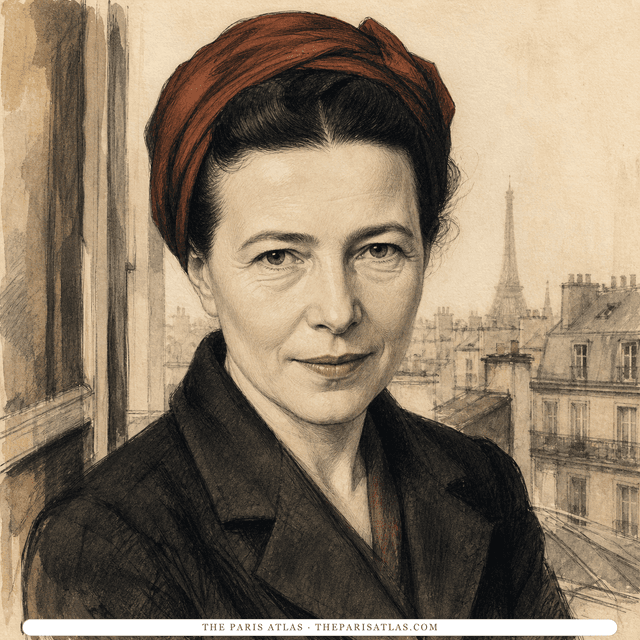
French writer and philosopher whose novels, memoirs, and social analysis examined freedom, gender, responsibility, aging, and the material conditions that shape a life.
View author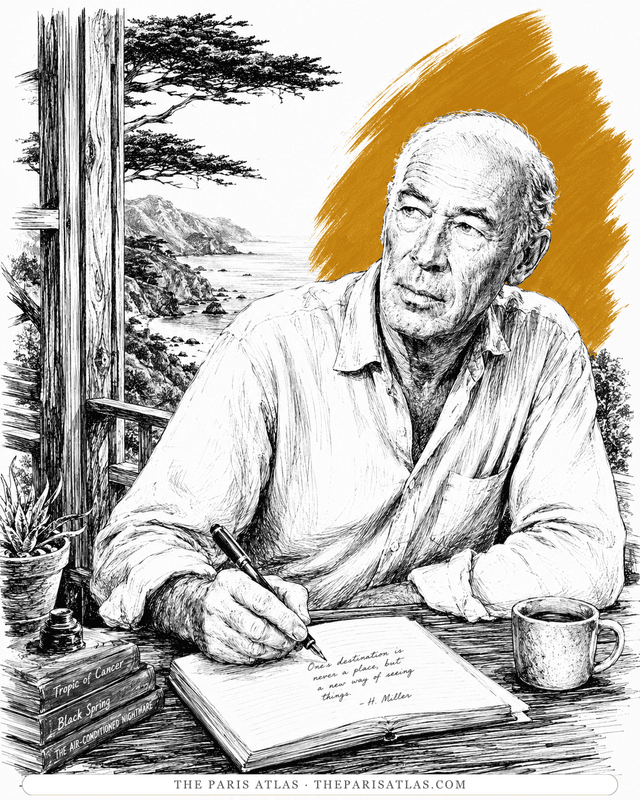
The Brooklyn dropout who arrived in Paris broke at thirty-eight and wrote the exuberant, banned books that ended American censorship.
View authorThe sources below include the primary text, editions, scholarship, archival materials, and other records that informed this page. They document Breakfast of Champions, its publication, and its place in literary history.


Library of Congress record for the first edition: New York, Delacorte Press, 1973, 295 pages, with drawings by the author.

The Encyclopedia of Science Fiction on Kilgore Trout.
Catalogue record for the 1974 Paris translation.
Library of Congress record for the same translation, in Seuil's Fiction & Cie series.
Catalogue record for the 2014 Paris translation.
Open Library edition records, used to confirm that each ISBN listed here resolves to Breakfast of Champions.
The primary text represented by this page, used for descriptions of the work’s contents and for any quoted passages shown here.
The primary text is the baseline reference for every book page. Additional references document publication history, interpretation, and historical context where that evidence is available.
 Explore more resources