
Slaughterhouse-Five
Kurt Vonnegut's best-known novel, published six years later, also sets a whole city's destruction beside flat, short jokes.
Read our takeCat's Cradle
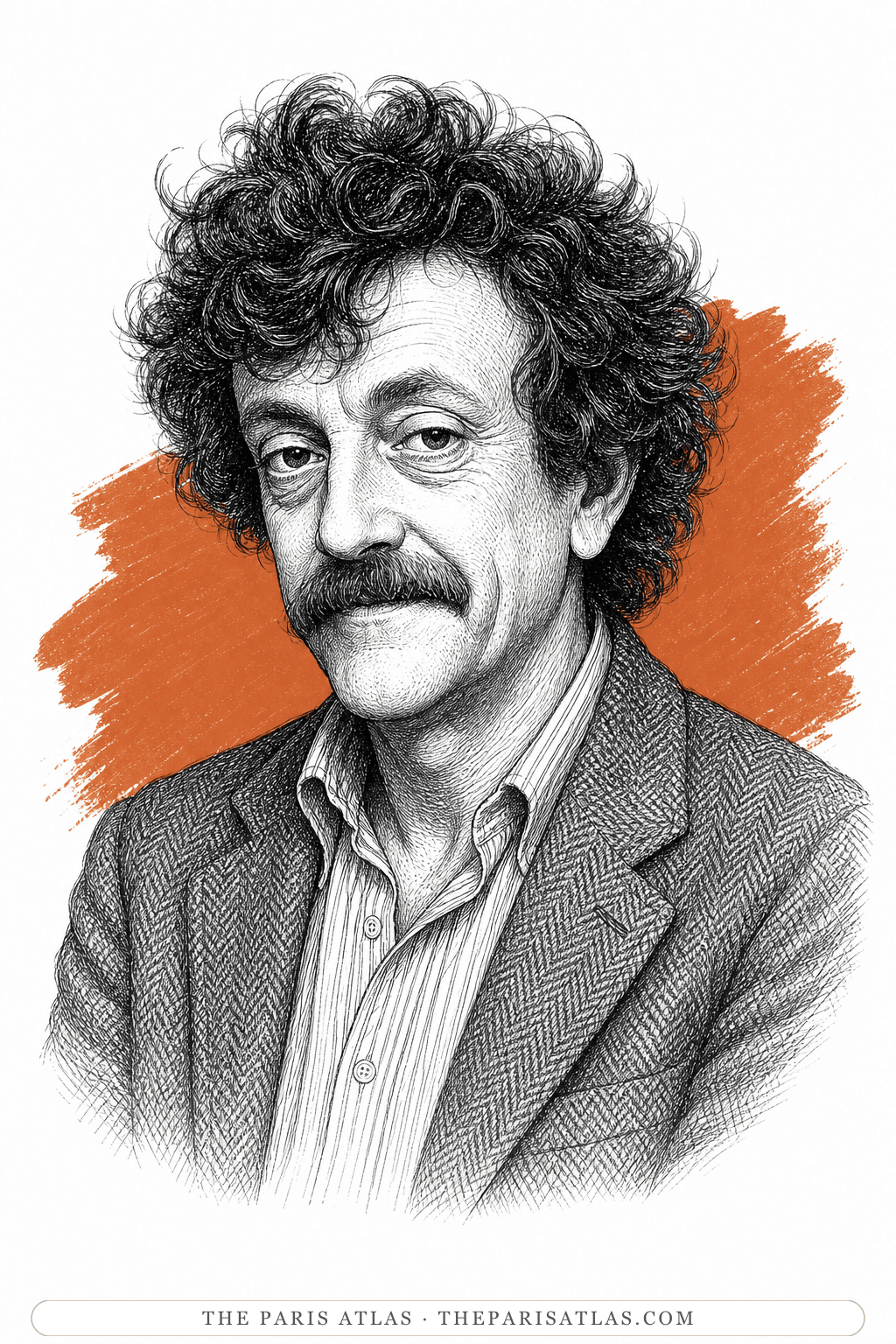
Kurt Vonnegut
Kurt Vonnegut's 1963 novel about a writer, the children of an atomic scientist, and a speck of ice that can freeze all the water on Earth.
Cat's Cradle is Kurt Vonnegut's fourth novel, published in 1963 by Holt, Rinehart and Winston in New York.[1][2] A writer named John sets out to report what the makers of the atomic bomb were doing on the day it fell on Hiroshima.[3] His research leads him to the three grown children of the physicist Felix Hoenikker, and to ice-nine, a kind of ice that freezes any water it touches.[4] The story ends on a small Caribbean island where most people follow a religion that admits it is made of lies.[3] The novel was a finalist for the 1964 Hugo Award for best novel.[5]
The first line is "Call me Jonah." The narrator explains that his parents called him John, but he feels he has been sent to certain places at certain times, whether he liked it or not.[3] He is telling the story after the fact, and he has changed. He was a Christian when he began his research. He is now a Bokononist.[3]
Bokononism is the religion of San Lorenzo, a small island in the Caribbean. The narrator quotes its holy book, The Books of Bokonon, from the first page. The first sentence of that book warns that all the true things in it are shameless lies.[3] Bokononists believe people are sorted into teams that do God's work without knowing it. Such a team is called a karass.[3]
The research starts with a letter. John writes to Newton Hoenikker, a student at Cornell and the youngest son of a Nobel Prize-winning physicist who helped build the bomb. Newt answers that he was six on the day of the bomb, playing on the carpet outside his father's study in Ilium, New York.[3]
Newt's letter is the source of the title. His father had taken a loop of string from a manuscript someone mailed him and made the string figure called a cat's cradle. Then, for the first time, the father got down on the floor to play with his son. He waved the string in the boy's face, and Newt ran out of the house in tears.[3]
In Ilium, John talks to Asa Breed, who worked beside Hoenikker at the research laboratory. Breed describes ice-nine, an idea Hoenikker had for freezing mud so soldiers would not have to fight in it. Breed insists it was only a theory.[4]
John, a freelance writer, plans a book called The Day the World Ended about the day the first atomic bomb fell on Hiroshima. He writes to Newt Hoenikker, the youngest son of the physicist Felix Hoenikker, and then visits Ilium, New York, where Hoenikker worked.[4] Asa Breed tells him about ice-nine and insists it was only a theory. In fact Hoenikker made it, was playing with a chip of it on the day he died, and his three children divided it.[4]
A magazine sends John to San Lorenzo to write about Julian Castle, a millionaire who runs a free hospital there. On the plane he meets Angela and Newt Hoenikker, the American ambassador Horlick Minton and his wife Claire, and a bicycle maker called H. Lowe Crosby and his wife Hazel. Hazel takes to John because they are both from Indiana.[4]
On the island the dying dictator, Papa Monzano, collapses during the welcome ceremony and names Frank Hoenikker to succeed him. Frank does not want the job and offers it to John. John accepts, partly because he has fallen for Mona, Papa's adopted daughter. A prophecy of Bokonon says Mona will marry the next president.[4]
Papa, in great pain, tells John that it does not matter who runs San Lorenzo. He tells John to kill Bokonon and put his faith in science.[4]
Papa kills himself by swallowing ice-nine from a small bottle he wore around his neck, and his body freezes solid. A doctor touches the ice to his own tongue and dies. Frank admits he gave Papa the ice-nine in exchange for his post. John and Frank agree to hide the truth and burn the bodies after the national holiday.
During the ceremony a plane in the air show crashes into the cliffs under the castle. Part of the castle falls into the sea with Papa's frozen body. The sea freezes at once, and tornadoes fill the sky.
John and Mona survive in a shelter beneath the castle. When they come out they find a valley full of frozen bodies, with a note saying Bokonon told the survivors to die. Mona laughs, touches the frozen ground, puts her finger to her lips, and dies.
Months later John is living with a few other survivors and writing the book the reader has been reading. He meets Bokonon, dressed in a hotel bedspread. Bokonon tells him the last sentence of his holy book. In it, a man writes a history of human stupidity, climbs the island's highest mountain, poisons himself with ice-nine, and dies thumbing his nose at God.
Bokonon is the island name of Lionel Boyd Johnson, a First World War veteran who was shipwrecked on San Lorenzo with a deserter from the United States Marines called Earl McCabe. McCabe made himself ruler, and Johnson made himself a prophet. By the time of the story the religion is against the law on San Lorenzo, yet nearly everyone practises it, including the dictator, Papa Monzano.
The religion comes with its own words. A karass is a group of people tied together for a purpose they do not see. A wampeter is the thing at the center of a karass, and a granfalloon is a false karass, such as a group of patriots bound only by a flag. Foma are the harmless untruths that help people live. Some of these words caught on outside the book.
Kurt Vonnegut puts a warning near the start of the book. The narrator says that anyone who cannot understand how a useful religion could be built on lies will not understand the book either. The novel never settles whether comforting lies are a good thing. Readers have argued about it since.
Before he wrote novels full time, Kurt Vonnegut worked in public relations for General Electric in Schenectady, New York. His brother worked in the company's research laboratory. In a 1977 interview with The Paris Review, Vonnegut said Felix Hoenikker was a caricature of Irving Langmuir, the laboratory's star chemist.
Some details went straight into the book. Langmuir once wondered aloud whether a turtle's spine bent or shrank when it pulled in its head. He once left a tip under his plate after his wife served him breakfast at home. Vonnegut said he put both in the novel.
The idea of ice-nine came from a story told around the laboratory. When H. G. Wells visited Schenectady, Langmuir offered him an idea for a science-fiction story about ice that stays frozen at room temperature. Wells never used it. After Wells and Langmuir had both died, Vonnegut decided the idea was his to take.
Felix Hoenikker's three children were lonely outsiders when they were young. They split the last chip of ice-nine between them after he died, and each one traded it for something they wanted. Angela, the tall, awkward daughter, gets a handsome husband. Newt, who is very short, has a brief affair with a Ukrainian dancer who turns out to be a spy.
Frank, who dropped out of high school and is good only at building models, ends up as a major general and San Lorenzo's minister of science and progress. Terry Southern's review in The New York Times in 1963 listed the trades with some glee. Angela's share, he wrote, bought her a handsome physicist.
Their father is the other half of the joke. Newt's letter says he never read novels or his mail, and that on the day of the bomb the only thing he cared about was a piece of string. Southern called the book an irreverent fantasy about "the playful irresponsibility of nuclear scientists."
After the Second World War, Kurt Vonnegut studied anthropology at the University of Chicago. Every idea he proposed for a thesis was rejected, and he left without a degree to take the job at General Electric.
About twenty years later, a new dean read his file. Under the university's rules, a published work of high quality could stand in for a thesis. The anthropology department read Cat's Cradle, judged it fair anthropology, and mailed him a master's degree. Vonnegut said he and Saul Bellow, also a Chicago anthropology student, both ended up inventing whole peoples in their novels instead of studying real ones.
French readers first got the novel in 1972. Éditions du Seuil in Paris published it as Le Berceau du chat, which means the cat's cradle, in a translation by Jacques B. Hess. The novel itself never goes to France.
Call me Jonah. My parents did, or nearly did. They called me John.
It was to be a Christian book. I was a Christian then. I am a Bokononist now.
All of the true things I am about to tell you are shameless lies.
Short chapters, plain sentences and a clear plot make Cat's Cradle a quicker read than Slaughterhouse-Five. Most of his habits are already here, including the jokes that sit next to disaster.
Bokononism comes with its own holy book, songs and vocabulary. Some of its words, like karass and granfalloon, caught on outside the book.
The scientist who helps make the atomic bomb spends the day it falls playing with string. The novel asks who is responsible when brilliant people do not think about what their work will do.
Kurt Vonnegut said the absent-minded Felix Hoenikker was drawn from Irving Langmuir, the Nobel Prize-winning chemist at General Electric, and that ice-nine began as a laboratory legend.
The narrator, a freelance writer who asks to be called Jonah. He starts out writing about the atomic bomb and ends up president of San Lorenzo.
A Nobel Prize-winning physicist who helped build the atomic bomb and made ice-nine. He is dead before the story starts.
Felix's youngest child, a very short student at Cornell whose letter tells the story of the cat's cradle.
Felix's elder son, a model builder who becomes a major general and minister of science on San Lorenzo.
Lionel Boyd Johnson, a shipwrecked veteran who founded San Lorenzo's outlawed religion and wrote The Books of Bokonon.
Felix's daughter, who raised her brothers after their mother died and later married a handsome husband.
The dying dictator of San Lorenzo, who bans Bokononism and secretly follows it.
Papa Monzano's adopted daughter. A prophecy says she will marry the next president.
Felix Hoenikker's colleague at the Ilium laboratory, who tells John that ice-nine was only a theory.
The wife of a bicycle maker, who greets everyone from Indiana as a fellow Hoosier.
1963
Holt, Rinehart and Winston publishes Cat's Cradle in New York, 233 pages.
1963
Terry Southern reviews the novel in The New York Times on 3 June, calling it an irreverent and highly entertaining fantasy.
1964
Cat's Cradle is a finalist for the Hugo Award for best novel, presented in Oakland, California. The award goes to Clifford D. Simak's Here Gather the Stars.
1972
Éditions du Seuil publishes the first French translation in Paris, Le Berceau du chat, by Jacques B. Hess.
1977
In The Paris Review, Kurt Vonnegut says Felix Hoenikker was a caricature of Irving Langmuir, and that the University of Chicago had accepted the novel in place of a thesis.
1998
The Dial Press trade paperback, ISBN 9780385333481, goes on sale on 8 September.


Kurt Vonnegut's best-known novel, published six years later, also sets a whole city's destruction beside flat, short jokes.
Read our takeThe Sirens of Titan
Kurt Vonnegut
Kurt Vonnegut's earlier novel invents a different made-up religion, the Church of God the Utterly Indifferent.
Read our take
Voltaire's short satire also sends a naive hero through one disaster after another and mocks the comforting beliefs people hold onto.
Read our take
Mary Shelley's novel is the older story of a scientist who makes something dangerous and does not think about who will pay for it.
Read our takeA writer researching the day the atomic bomb fell on Hiroshima tracks down the children of one of the bomb's makers. They have inherited ice-nine, a substance that freezes any water it touches. The trail leads to a Caribbean island, a dictator, an outlawed religion called Bokononism, and the end of the world.
An invented form of ice that stays frozen at room temperature and freezes any water it touches. In the novel Felix Hoenikker first thinks of it as a way to freeze mud for soldiers. Kurt Vonnegut said the idea came from a story Irving Langmuir once offered to H. G. Wells.
In Bokononism, a karass is a group of people linked together to do God's work without knowing it. The novel says a karass ignores national, family and class lines. A granfalloon is the false version, a group bound by something that only looks meaningful, like a flag.
Because of a string game. On the day of the bomb, Felix Hoenikker made the string figure called a cat's cradle and waved it in his young son's face. Newt ran out of the house crying. The scene comes in Newt's letter near the start of the book.
In 1963, by Holt, Rinehart and Winston in New York. Cat's Cradle was Kurt Vonnegut's fourth novel, after Player Piano, The Sirens of Titan and Mother Night. The book was a finalist for the 1964 Hugo Award for best novel.
Yes. He had left the University of Chicago's anthropology program without a degree. About twenty years later the department accepted Cat's Cradle in place of a thesis and mailed him a master's degree, as he told The Paris Review in 1977.
Yes. The novel is short, fast and funny, with very short chapters. Cat's Cradle shows his usual mix of disaster and jokes without the jumps in time that make Slaughterhouse-Five harder to follow.
Explore authors with a similar voice, perspective, and influence.
The doctor of the Paris slums who wrote the century's blackest, funniest novel — and changed the sound of French prose.
View author
French writer and philosopher whose novels, memoirs, and social analysis examined freedom, gender, responsibility, aging, and the material conditions that shape a life.
View author
The Brooklyn dropout who arrived in Paris broke at thirty-eight and wrote the exuberant, banned books that ended American censorship.
View authorThe sources below include the primary text, editions, scholarship, archival materials, and other records that informed this page. They document Cat's Cradle, its publication, and its place in literary history.

Library of Congress record for the first edition: New York, Holt, Rinehart and Winston, 1963, 233 pages.

The Encyclopedia of Science Fiction on Bokononism's vocabulary and the first edition.
The 1964 Hugo Award finalists for best novel.
Terry Southern's review in The New York Times, 3 June 1963.
Kurt Vonnegut on Irving Langmuir, ice-nine and his University of Chicago degree.
Catalogue record for the 1972 Paris translation.
Open Library edition records, used to confirm that each ISBN listed here resolves to Cat's Cradle.
The primary text represented by this page, used for descriptions of the work’s contents and for any quoted passages shown here.
The primary text is the baseline reference for every book page. Additional references document publication history, interpretation, and historical context where that evidence is available.
 Explore more resources