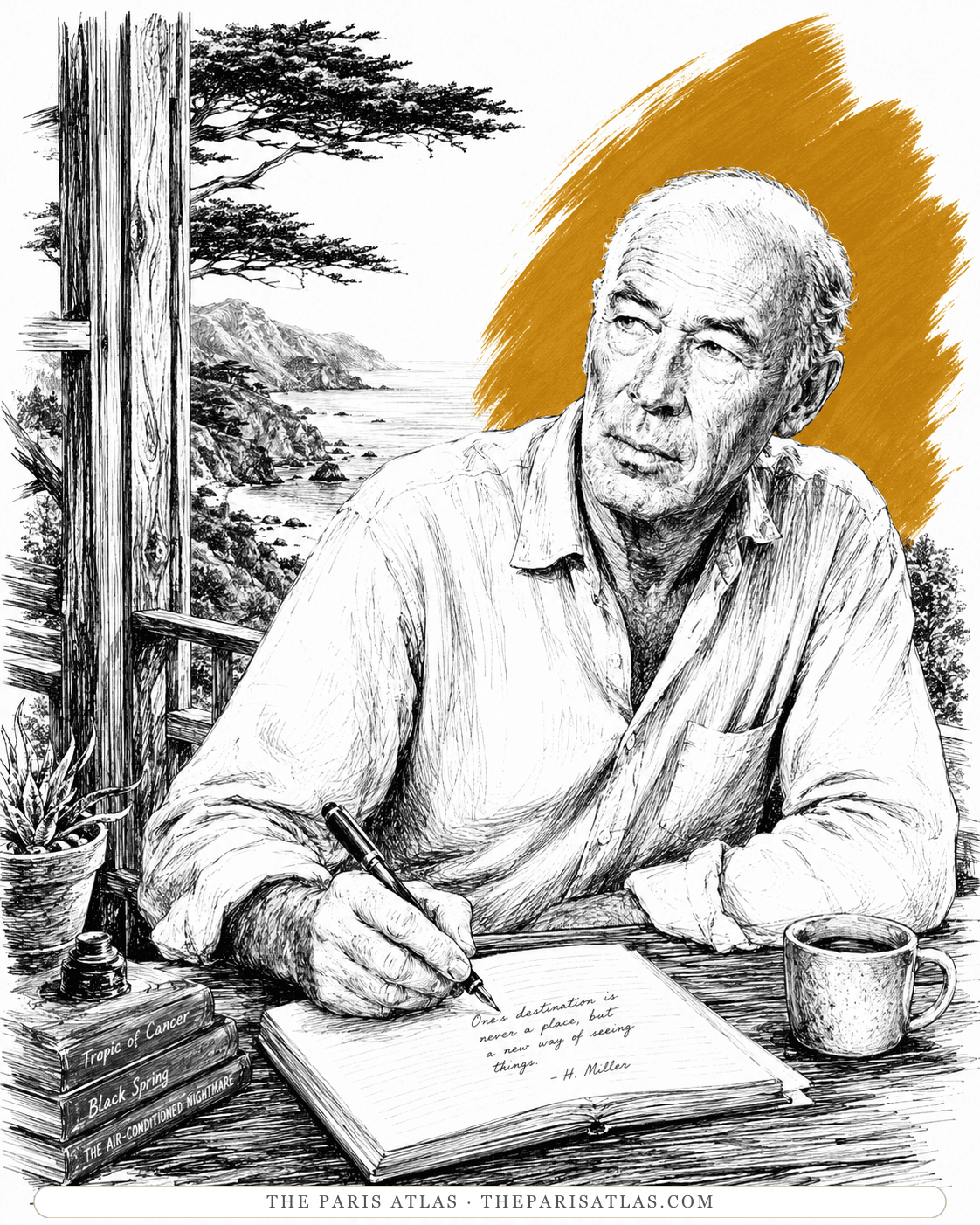

Stand Still Like the Hummingbird
The larger late essay collection to read before this small-press miscellany.
Read our take
by Henry Miller
Six late essays moving from the Florida wetlands to Picasso, Cabeza de Vaca, Marie Corelli, a Japanese stranger, and Jack Nicholson.
Lost Pleiade Press issued this six-essay collection in 1977. Its contents are unusually legible as a map of Miller’s late curiosity: “Gliding into the Everglades,” “The Mystery of the Japanese Woman,” “Picasso at 90,” “Cabeza de Vaca,” “Marie Corelli,” and “On Seeing Jack Nicholson for the First Time.” Nature writing, portrait, reading memory, and celebrity encounter sit together without pretending to be a unified argument. It is a compact late-career sampler rather than a new memoir or novel.
The title essay supplies the physical journey. Miller’s encounter with the Everglades becomes an exercise in surrendering ordinary scale and tempo. The remaining pieces travel by attention instead — toward an unidentified Japanese woman, a ninety-year-old Picasso, the sixteenth-century explorer Álvar Núñez Cabeza de Vaca, the once-famous novelist Marie Corelli, and actor Jack Nicholson.
The collection appeared in Lake Oswego, Oregon, in hardcover and wrappered issues. Indiana University’s catalogue records all six contents, seventy-six pages, one illustration, and the two original edition identifiers. Its small-press form is part of the appeal: a deliberately miscellaneous cabinet of late Miller enthusiasms.
The collection contains Gliding into the Everglades, The Mystery of the Japanese Woman, Picasso at 90, Cabeza de Vaca, Marie Corelli, and On Seeing Jack Nicholson for the First Time. These are six separate essays, not chapters in a sustained account of Florida.
The range is unusually wide even for Miller: a painter, a film actor, a novelist, an explorer, and a discussion of Japanese women share the book. The table of contents makes clear that an author’s interests, rather than a single subject or historical period, hold the collection together.
Pablo Picasso was the Spanish artist whose long career made old age and continued invention inseparable subjects. Jack Nicholson was an American film actor. Marie Corelli was a popular English novelist, while Álvar Núñez Cabeza de Vaca was a sixteenth-century Spanish explorer.
These figures are subjects of Miller’s attention, not a cast interacting in one story. Nor does a named subject necessarily indicate a personal meeting. The Nicholson title describes seeing an actor for the first time; it should not be expanded into an undocumented friendship.
In the LIFE version of Picasso at 90, Miller makes fame both a form of captivity and a source of extraordinary freedom. The artist is shut behind doors by his celebrity, yet his success supposedly lets him live as he chooses. Those claims sit close together without being reconciled. Their tension keeps the birthday tribute from becoming a simple celebration of longevity: the same public power that enlarges Picasso’s possibilities also makes ordinary contact difficult.
The closing paragraphs complicate admiration again. Miller treats Picasso’s weaknesses as a welcome bond with ordinary people, then admits that the paintings do not give him the tenderness he finds in Renoir or Bonnard. He ends with an uneasy mixture of gratitude and distrust. Read together, these turns make artistic greatness something the essay argues with, not a guarantee of moral goodness or happiness. Its portrait is deliberately less comfortable than the occasion of a ninetieth birthday might suggest.
Lost Pleiade Press published the book in Lake Oswego, Oregon, in 1977. The edition has seventy-six pages and an illustration. Miller was in his eighties when the volume appeared, decades after the Paris books that made his reputation.
The date places the collection alongside his later portraits and short reflections. It does not prove that all six pieces were composed at the same time. A collection’s publication date and the dates of its component essays are different kinds of information.
The appeal is the chance to follow Miller’s attention across unfamiliar as well as famous subjects. A reader coming from Tropic of Cancer will encounter a different scale: a handful of short essays instead of a long autobiographical narrative.
The Mystery of the Japanese Woman should be approached as Miller’s individual view, shaped by his period and experience. Its broad title does not make the essay an authoritative account of Japanese women. That distinction lets readers assess his observations without confusing personal writing with social research.
Six brief pieces show how quickly Miller could move between landscape, books, painting, history, and film.
Picasso, Corelli, Cabeza de Vaca, Nicholson, and the Everglades make a characteristically improbable company.
The six essays let readers compare Miller’s responses to art, other writers, and aging without beginning a long novel.
1971
Picasso turns ninety, the occasion named by one of the collection’s essays.
1977
Lost Pleiade Press publishes the six essays in a seventy-six-page collection.
January 1977
Miller inscribes a copy to Brenda Venus on January 31, a surviving record of the collection’s circulation among his friends.


The larger late essay collection to read before this small-press miscellany.
Read our take

The major American travel book behind Miller’s later responses to landscape.
Read our takeSix: the title essay, “The Mystery of the Japanese Woman,” “Picasso at 90,” “Cabeza de Vaca,” “Marie Corelli,” and “On Seeing Jack Nicholson for the First Time.”
Lost Pleiade Press published the seventy-six-page collection in Lake Oswego, Oregon, in 1977.
Not as a whole. The title essay is place-centered, but the remaining pieces are portraits and reflections.
It contains six essays, gathered in a seventy-six-page volume.
Yes. One essay marks Picasso’s ninetieth birthday, an occasion in 1971.
Explore authors with a similar voice, perspective, and influence.
Miller's acknowledged master at making literature out of the gutter. Journey gave him permission; Cancer is what he did with it.
View author
Pound read Cancer and sent Miller a famously backhanded postcard. Both believed literature's job was to wake the reader by any means necessary.
View author
French writer and philosopher whose novels, memoirs, and social analysis examined freedom, gender, responsibility, aging, and the material conditions that shape a life.
View authorThe sources below include the primary text, editions, scholarship, archival materials, and other records that informed this page. They document Gliding into the Everglades and Other Essays, its publication, and its place in literary history.


The primary text represented by this page, used for descriptions of the work’s contents and for any quoted passages shown here.
Official record used to verify names, dates, institutional details, or other factual information on this page.
Official record used to verify names, dates, institutional details, or other factual information on this page.

Biographical evidence used to verify chronology, relationships, and historical context connected to Gliding into the Everglades and Other Essays.
Biographical evidence used to verify chronology, relationships, and historical context connected to Gliding into the Everglades and Other Essays.
Web source consulted for documented facts and historical context presented on the Gliding into the Everglades and Other Essays page.
The LIFE magazine version reproduced in two scans by Biblioklept; used for the Picasso readings, not a complete reading of the 1977 collection.
The primary text is the baseline reference for every book page. Additional references document publication history, interpretation, and historical context where that evidence is available.
 Explore more resources