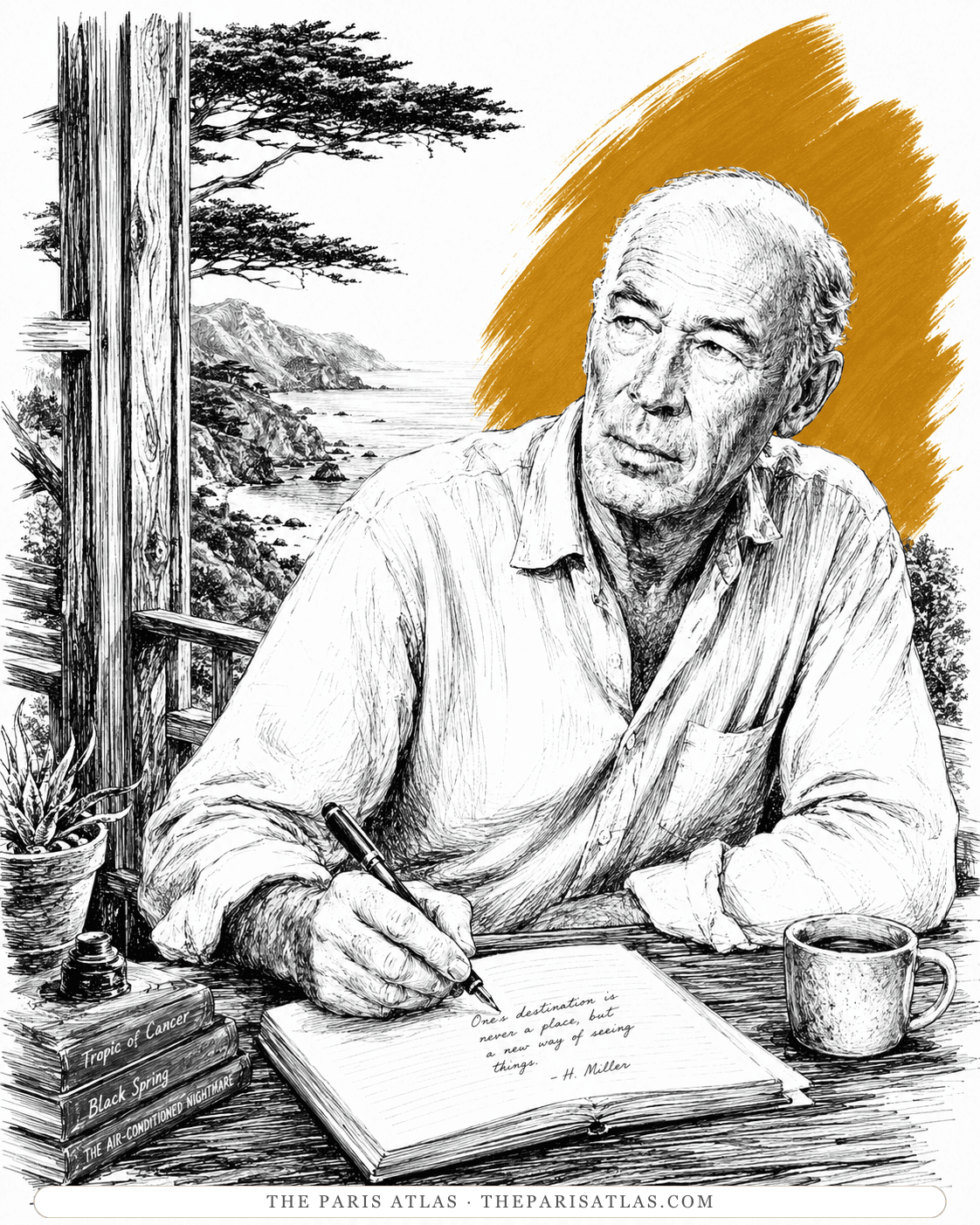
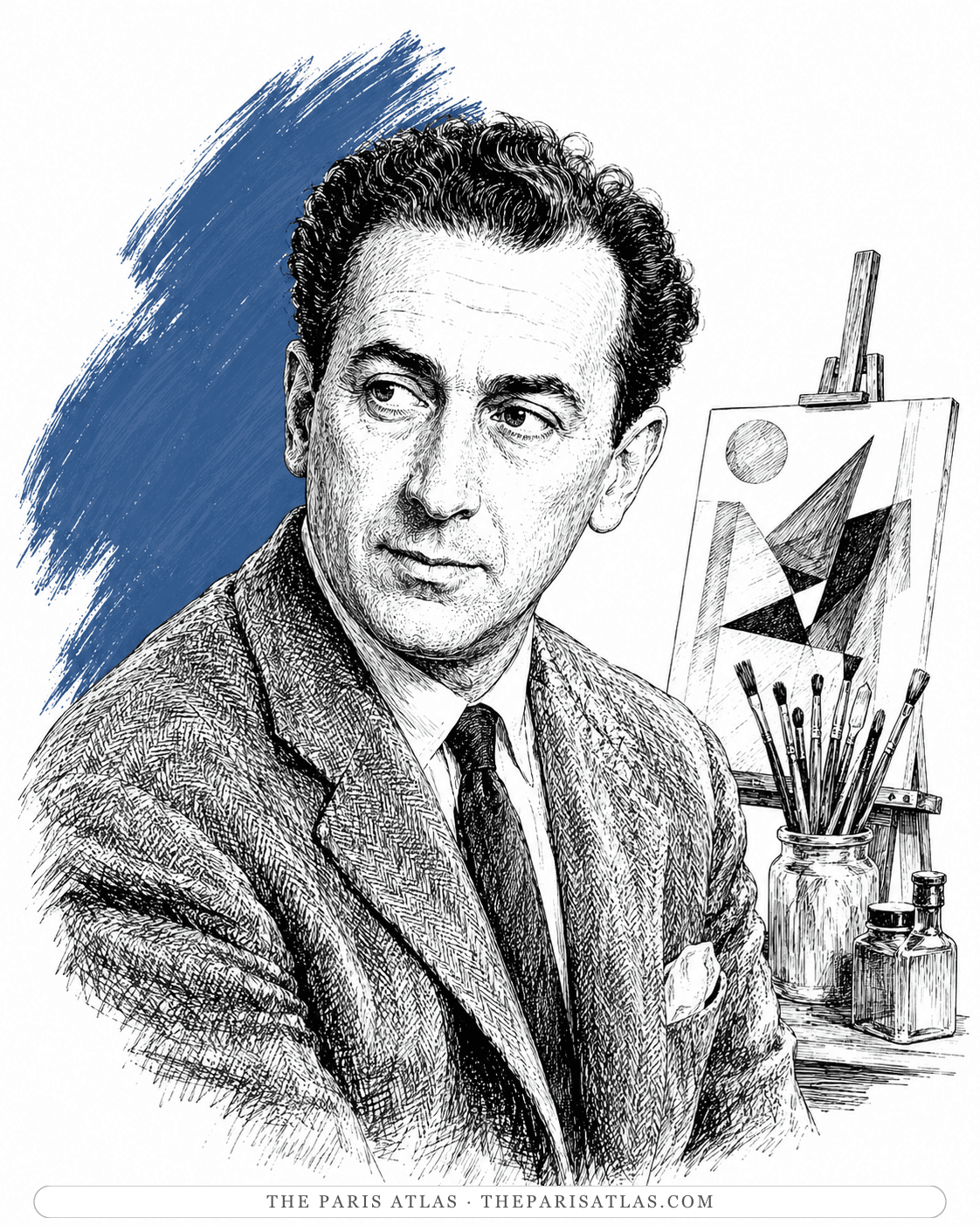
Abraham Rattner
- Painter
Depicts
The book's traveling companion in its early stretches — the painter's eye Miller borrowed while taking America's measure.

by Henry Miller
Henry Miller's 1945 account of driving across the United States for a year and disliking most of what he found.
The war forced Henry Miller home from Europe in 1940. With advance money for a book about rediscovering America, he bought a secondhand Buick, learned to drive, and spent a year crossing the country. The book he published in 1945 is a road book and an argument: the landscape amazed him, and American life — commercial, conformist, comfortable — did not. The title is his verdict. (A journey, not a plot — spoiler-free.)
Miller returned to the United States in 1940, after twelve years in Europe, and did not want to be back. With an advance for a book about rediscovering America, he set out from New York in October 1940 in a secondhand 1932 Buick, having only just gotten his driver's license, and spent the next year on the road: the South, New Orleans, the Southwest, the Pacific coast. For stretches of the drive his companion was the painter Abraham Rattner.[1]
The book alternates between attack and admiration. Miller argued that American life had been organized around sales and comfort at the cost of everything he valued; the title phrase is his summary of it. Against that he set the people he met who seemed to him to be living real lives — painters, craftsmen, small-town originals — and the landscape itself, which he wrote about with awe. He finished the manuscript by 1942, but a book this hostile to American life could not appear in wartime; New Directions published it in 1945.[1]
Miller leaves New York in October 1940 and drives south: Virginia, the Carolinas, New Orleans, Natchez, the Ozarks, then the Grand Canyon, the desert, and California. The chapters alternate between criticism of the cities and factories he passes through and portraits of the people who impress him — painters, preachers, drifters, craftsmen.[1]
The question he keeps asking, at diners and gas stations across the country, is what all of it is for. His answer — that America had traded living for the machinery of living — was finished by 1942 and published in 1945, just as the country won the war.[1]
Miller's tears at the Grand Canyon complicate the image of a traveler who can only find fault. In the passage quoted by Don Lago, the place exceeds what decades of expectation had prepared him to see. Comparing it to ancient Greek sites gives wonder a continuity across his travels, rather than making America wholly alien to him. Yet awe also makes him ready to credit fantastic explanations. The scene reveals both the generosity and the risk of his imagination: intense feeling can open perception without making every story it welcomes true.
The machinery of the journey follows Miller into his hotel room as a familiar voice on the radio. Bing Crosby's repeated presence makes distant stops sound interchangeable; even private rest comes with a ready-made soundtrack. Miller's socks draped around the radio turn irritation into a small, absurd protest. As Arnold G. Nelson explains, the chapter's final fragment sounds like an afterthought but brings commercial ownership back into the picture. The looseness of the voice is purposeful: the sentence cannot escape the system any more than the traveler can.
Miller drove the whole country and wrote down what he thought of it. Most later American road books are politer versions of this one.
The people Miller admired on the trip — painters, craftsmen, small-town originals — get the warmest pages in the book.
His case, that comfort had replaced experience in American life, has kept the book in print and in arguments since 1945.
Depicts
The book's traveling companion in its early stretches — the painter's eye Miller borrowed while taking America's measure.
1940
Home from Europe, Miller sets out from New York in October in a secondhand Buick, joined for stretches by the painter Abraham Rattner.
1942
The manuscript is finished, but it is too critical of American life to publish in wartime.
1945
New Directions publishes it just as the war ends.


Miller's earlier book about New York; this one extends the argument to the whole country.
Read our take
The official second volume, in which Miller remembers France against the American present.
Read our take
The Greece book he wrote just before returning; the two books are opposites in mood.
Read our takeHenry Miller. It was published in 1945, after the war sent him home to the United States from Europe.
Miller's year-long drive across the United States, begun in October 1940 after the war forced him home from Europe. He records the landscape, the people he met, and his argument with American life.
Miller came home unwillingly after twelve years abroad and found American life the opposite of what he valued. The book says so directly.
Yes. The landscape, and the artists and eccentrics he met on the way — their portraits are the warmest parts of the book.
The Colossus of Maroussi, written just before it, describes a world Miller loved; this book describes the one he came home to. He saw them as opposites.
Explore authors with a similar voice, perspective, and influence.

Miller's acknowledged master at making literature out of the gutter. Journey gave him permission; Cancer is what he did with it.
View author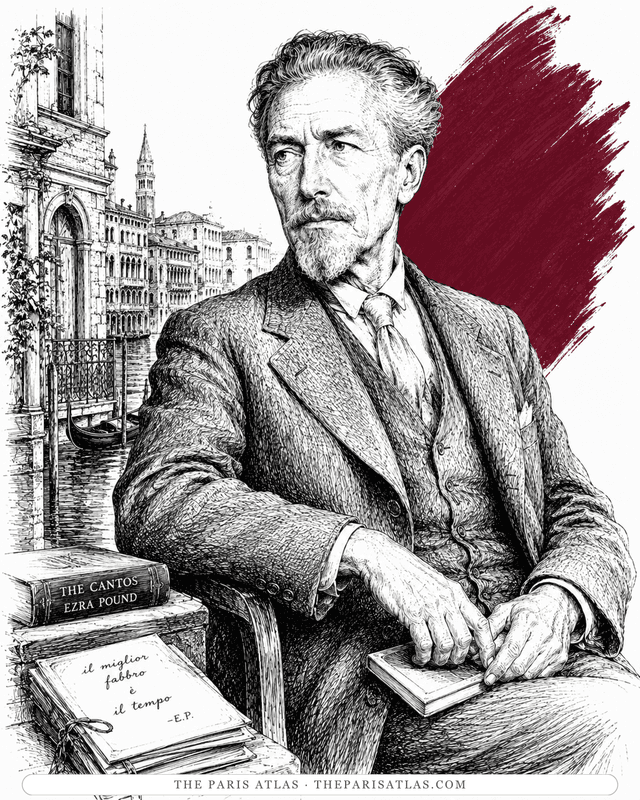
Pound read Cancer and sent Miller a famously backhanded postcard. Both believed literature's job was to wake the reader by any means necessary.
View author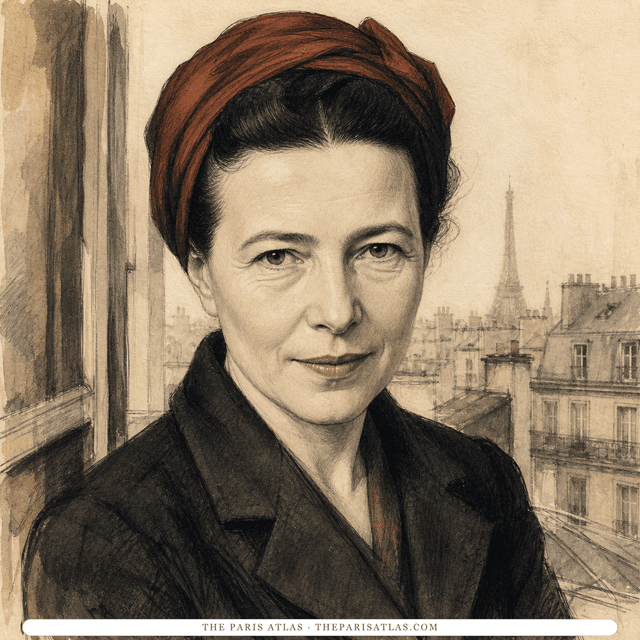
French writer and philosopher whose novels, memoirs, and social analysis examined freedom, gender, responsibility, aging, and the material conditions that shape a life.
View authorThe sources below include the primary text, editions, scholarship, archival materials, and other records that informed this page. They document The Air-Conditioned Nightmare, its publication, and its place in literary history.


For the canyon reading, limited to the primary passage quoted on p. 7 and identified in endnote 15; not a complete-book collation or evidence for the passage's speculative origin stories.

For the radio passage and Nelson's attributed analysis of the chapter-ending fragment in From Grand Canyon to Burbank.
Used to place The Air-Conditioned Nightmare within Henry Miller's life, travels, and published work.
Used for independent archival context surrounding Miller's career and correspondence.

Used for scholarly context on The Air-Conditioned Nightmare and Miller's wider literary legacy.
Used to verify Henry Miller's bibliography and place The Air-Conditioned Nightmare within the broader chronology of Henry Miller's career.
The primary text is the baseline reference for every book page. Additional references document publication history, interpretation, and historical context where that evidence is available.
 Explore more resources