The Paris AtlasCharting the artists, works, and places worth returning to.
Cover of Big Sur and the Oranges of Hieronymus Bosch by Henry Miller

Big Sur and the Oranges of Hieronymus Bosch

by Henry Miller

The scandalous exile finds his paradise: fog, cliffs, children, neighbors, pilgrims — and the question of whether paradise can be lived in.

Published
1957
Setting
Big Sur
Shelf rating
4.2

About Henry Miller

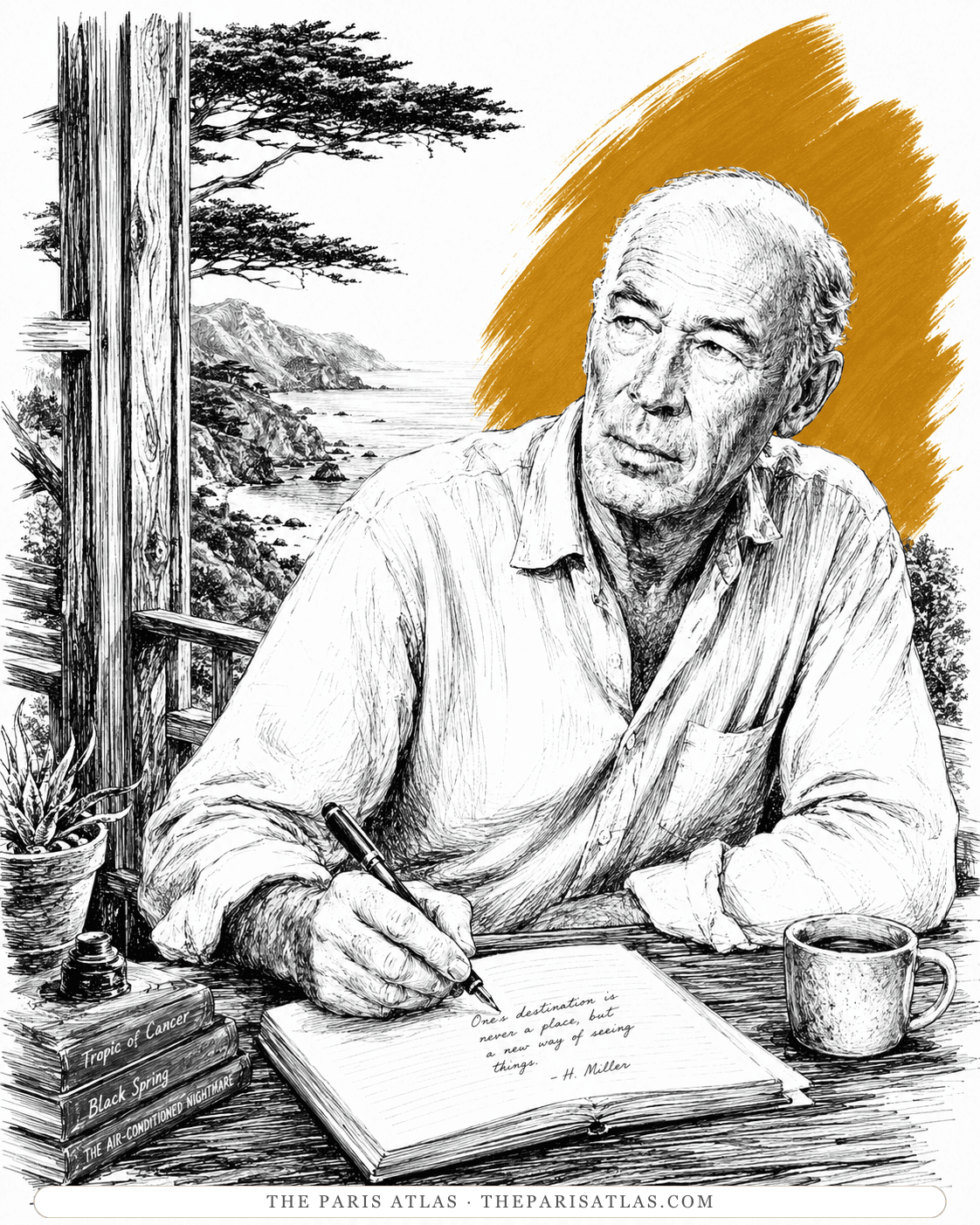
Illustrated portrait of Henry Miller
Henry Miller

39 books on our shelvesWhere to start

The story, briefly

Spoiler-free

Miller washed up on the Big Sur coast in 1944 and stayed for the happiest, strangest chapter of his life: a cabin on Partington Ridge, two small children, a scattered community of seekers and hermits, and a growing stream of pilgrims hunting the author of the banned books. His 1957 account of that life — its title borrowed from the fruit of Bosch's painted paradise — is the great book of his American years: part community portrait, part parenting memoir, part meditation on whether the good life survives being found. (The full story below — a life, not a plot.)

The story, in more detail

After the return from Europe and the American road-rage of the Nightmare, the coast caught him: from 1944 Miller lived above the Pacific at Big Sur, latterly in the cabin on Partington Ridge, poorer than legend allows — for years the watercolors and the kindness of neighbors carried the household — and, by his own account, content for the first time. The book he made of it in 1957 takes its title from Hieronymus Bosch's garden: the oranges of the painted paradise, fruit that exists only in vision — his emblem for the question the whole book turns over: whether paradise is a place you can live, or only a picture you carry.

It is built as a community book: portraits of the ridge's population of painters, hermits, astrologers, and homesteaders; the practical comedy of raising small children — Val and Tony — on a cliff without conveniences; and, increasingly, the problem the banned books shipped to his door: the pilgrims. By the fifties Big Sur meant Miller, and seekers arrived weekly expecting an orgiast, a guru, or both; his pages on being a legend's landlord are the funniest he wrote after Paris. The book closes with 'Paradise Lost' — the Moricand disaster, published separately as A Devil in Paradise — because, Miller insisted, an honest paradise keeps its devil on the books. It became the bible of a Big Sur that was about to be overrun by the generation reading it.

The full story

The shape is a year-round portrait of a place and its people. First the ground: the ridge, the fog, the impossible road, the mail three times a week, the cabin economy of barter, watercolors, and windfalls. Then the neighbors — the handful of originals scattered down the coast, rendered with the portraitist's warmth that is late Miller's best register — and the children, whose cliff-edge upbringing gives the book its comic spine and its tenderest pages.

Through it all runs the paradox the title announces: the sage of the banned books discovers that finding paradise is the easy part. The pilgrims arrive — admirers, cranks, would-be disciples, the occasional genuine soul — and the hermitage becomes a destination; the man who fled civilization finds it queuing at his gate. The final movement hands paradise its bill: the Moricand episode, the guest from the old Paris life who turns the gift of refuge into a comedy of damnation — Miller's proof that no Eden is complete without its serpent, invited in personally.

Why we recommend it

  1. The community portraits

    The ridge's hermits and originals get the Katsimbalis treatment — late Miller's genius for other people, at full generosity.

  2. The fame comedy

    What happens when the banned legend answers his own door — the funniest pages ever written about being a destination.

  3. The real ending of the story

    Brooklyn, Paris, the road, and finally the ridge — the shelf's long flight from civilization lands here.

What this book explores

Stories in its pages

Work inside this book that also had a life of its own.

A Devil in Paradise — standalone printing

A Devil in Paradise

The book's closing movement, 'Paradise Lost,' is the Conrad Moricand catastrophe entire — the Paris astrologer invited to Big Sur for life, and the year that gift took to curdle. Miller published it on its own in 1956 before folding it in here; it has its own page here, and either door leads to the same devil.

Timeline

  1. 1944

    Miller settles on the Big Sur coast, latterly in a cabin on Partington Ridge — two small children, a scattered community of seekers, and a growing stream of pilgrims hunting the author of his banned books.

  2. 1956

    He publishes the Conrad Moricand episode separately as A Devil in Paradise.

  3. 1957

    New Directions publishes the full account, its title borrowed from the fruit of Bosch's painted paradise, with the Moricand episode folded in as the closing movement, 'Paradise Lost.'

Book editions

Hardcover
Hardcover
New Directions
1957
First edition
Paperback edition cover
Paperback
New Directions
ISBN-13
9780811201070

Reader reviews

Loading reviews…

Recommended alongside Stand Still Like the Hummingbird and My Life and Times.

Big Sur and the Oranges of Hieronymus Bosch: frequently asked questions

Who wrote Big Sur and the Oranges of Hieronymus Bosch?

Henry Miller. It was published in 1957, and is the great book of his American years.

What is it about?

Miller's life on the Big Sur coast of California, where he settled in 1944 — a cabin on Partington Ridge, two small children, a scattered community of seekers, and a stream of pilgrims hunting the author of his banned books.

Is it a novel?

No. It is a memoir — part community portrait, part parenting memoir, part meditation on whether the good life survives being found.

Where does the title come from?

From the fruit in Hieronymus Bosch's painted paradise, which Miller borrows for the earthly one he found on the California coast.

How does it differ from his Paris books?

It is the calm counterpart to the Tropics — the record of his settled American life rather than the Paris scandal that made his name.