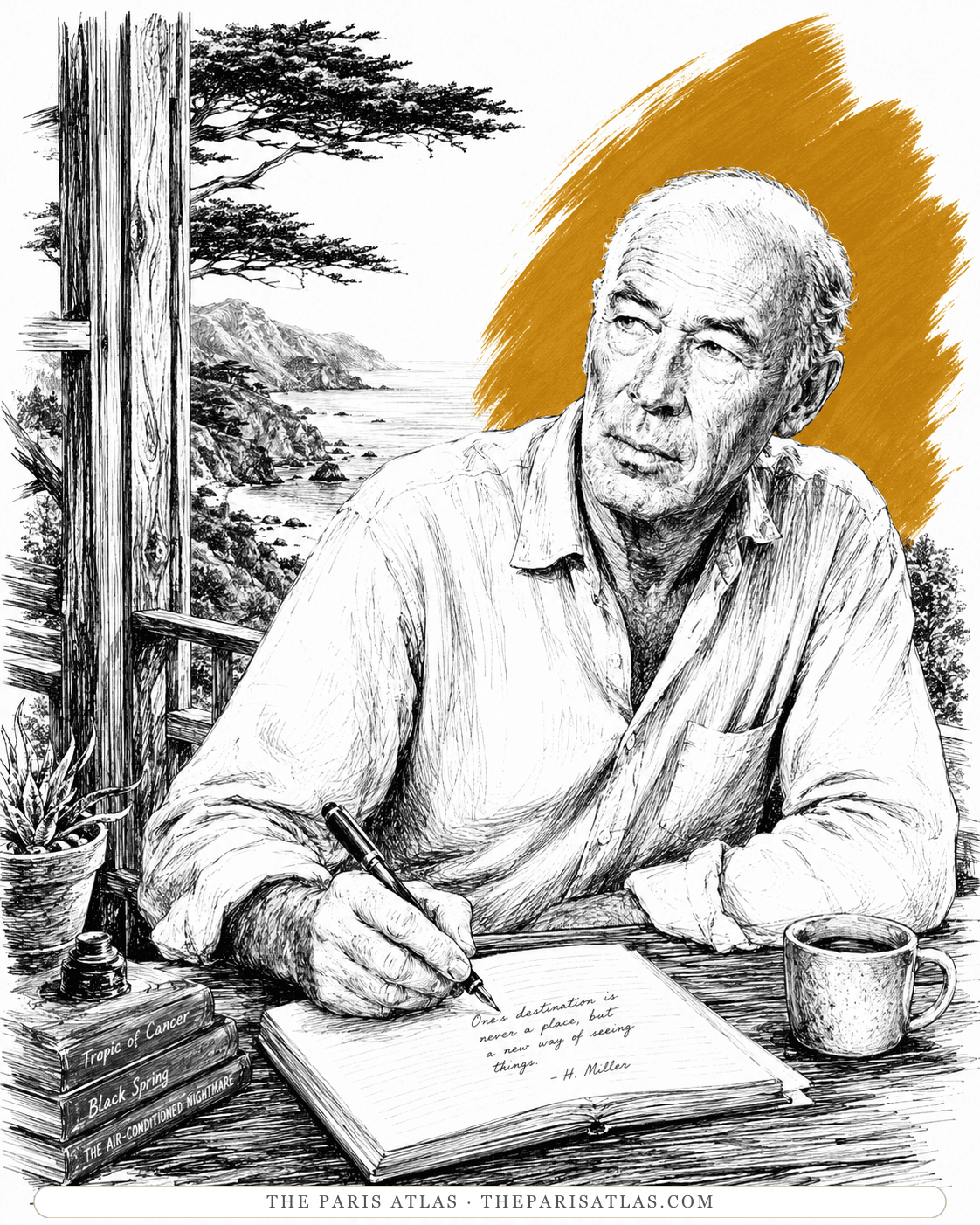

The Books in My Life
Miller’s broad account of the writers who formed him, including Powys.
Read our take
by Henry Miller
Miller’s four-page salute to John Cowper Powys: youthful idol, joyful philosopher, daily writer, and proof that age need not diminish imaginative life.
The Immortal Bard is Henry Miller’s very brief tribute to John Cowper Powys. First printed as an essay in A Review of English Literature in January 1963, it recalls Miller’s admiration beginning in his twenties, his later visit to Powys at Corwen, and the strange youthful vitality he found in the aging writer. Village Press issued the essay as a five-page pamphlet in 1973. It should not be confused with Isaac Asimov’s unrelated story of the same title.
Miller approaches Powys as a reader whose allegiance survived decades. He praises not only the large novels and Autobiography but the smaller philosophical books in which Powys taught sensual attention and everyday wisdom. The essay’s central image is the old writer at Corwen appearing younger, healthier, and gayer than the lecturer Miller had idolized in youth.
The Morgan Library preserves a proof copy with “H.M. Tribute to Powys” written on its envelope. The British National Bibliography records the Village Press pamphlet, its 1973 London publication, five-page extent, and subject heading for Powys.
The subject of The Immortal Bard is John Cowper Powys, the British novelist, lecturer, and philosophical writer. Miller describes an admiration that began when he was in his twenties and lasted almost fifty years. Hearing Powys lecture preceded their later friendship.
The tribute recalls a visit to Powys at Corwen in Wales. Miller finds the older writer still working every day and corresponding widely despite modest means. The encounter gives his praise a concrete starting point: a person whose way of living appears to confirm what Miller valued in his books.
The contrast between audiences of a dozen and a thousand makes the lectures a test of constancy, not popularity. In Miller’s account, Powys gives the small room the same fervor as a packed hall. The scale of the crowd changes; the speaker’s commitment does not. This is why the recollection belongs in a tribute to a way of living: Miller locates artistic value in the act of address rather than the public reward it earns.
Miller singles out Powys’s Autobiography and A Glastonbury Romance, while also valuing the shorter books about how to live. His praise concerns an ability to connect reading with everyday perception. Literature is useful here because it enlarges the experience of being alive.
The essay’s admiration extends beyond human society. Miller describes Powys’s imaginative sympathy with plants, creatures, legends, and invented worlds. That breadth helps explain the word bard: he presents Powys as a maker of imaginative worlds, rather than simply a successful novelist.
Miller’s praise of sympathy becomes most vivid when he turns scholarly occupations into verbs and follows them with a list of animal movements. Instead of standing outside nature to classify it, his Powys imaginatively enters its different forms of life. The quick succession of crawling, clinging and vanishing gives the prose the mobility it admires. His later self-portrait as a croaking bullfrog makes the same point comically: the admirer joins this creaturely company instead of speaking from above it.
This is an affectionate tribute, not a balanced survey of Powys’s strengths and weaknesses. Miller makes his own long attachment part of the argument. His personal voice tells readers why Powys matters to him before attempting anything like a general evaluation.
The essay is also short enough to show Miller’s literary enthusiasm in concentrated form. Readers seeking the disagreements and give-and-take of the friendship should turn to Proteus and the Magician. A tribute and an exchange of letters show different sides of the same relationship.
The Immortal Bard first appeared in A Review of English Literature in January 1963. Village Press issued it as a separate pamphlet in London in 1973. Library catalogues describe five pages, while the original journal essay occupies pages twenty-one through twenty-four.
The Morgan Library holds a proof associated with the Henry Miller Literary Society. These different objects document the essay’s circulation; they do not identify several independent works. The unrelated Isaac Asimov story called The Immortal Bard also needs to be kept separate.
Four pages compress nearly fifty years of admiration into a vivid encounter at Corwen.
The tribute gives the emotional key to Miller and Powys’s later published letters.
Miller’s memories of John Cowper Powys’s lectures connect the force of a spoken performance with the experience of reading his books.
1910s–early 1920s
In his twenties, Miller hears Powys lecture. The admiration begun in these encounters becomes the tribute’s personal foundation.
1963
The tribute appears in the January issue of A Review of English Literature.
1973
Village Press issues the essay as a five-page pamphlet.

Miller’s broad account of the writers who formed him, including Powys.
Read our take

A late book similarly concerned with friendship, philosophy, and sustaining imaginative life.
Read our takeJohn Cowper Powys, the British novelist, lecturer, autobiographer, and philosopher Miller had admired since his twenties.
It appeared in A Review of English Literature in January 1963; Village Press issued the pamphlet in 1973.
No. Asimov’s 1954 science-fiction story has the same title but is unrelated.
No. Miller’s essay is a tribute to John Cowper Powys.
No. Village Press published it as a five-page pamphlet in 1973.
Explore authors with a similar voice, perspective, and influence.
Miller's acknowledged master at making literature out of the gutter. Journey gave him permission; Cancer is what he did with it.
View author
Pound read Cancer and sent Miller a famously backhanded postcard. Both believed literature's job was to wake the reader by any means necessary.
View author
French writer and philosopher whose novels, memoirs, and social analysis examined freedom, gender, responsibility, aging, and the material conditions that shape a life.
View authorThe sources below include the primary text, editions, scholarship, archival materials, and other records that informed this page. They document The Immortal Bard, its publication, and its place in literary history.

The primary text represented by this page, used for descriptions of the work’s contents and for any quoted passages shown here.

Web source consulted for documented facts and historical context presented on the The Immortal Bard page.
Official record used to verify names, dates, institutional details, or other factual information on this page.
Official record used to verify names, dates, institutional details, or other factual information on this page.
Biographical evidence used to verify chronology, relationships, and historical context connected to The Immortal Bard.
Biographical evidence used to verify chronology, relationships, and historical context connected to The Immortal Bard.
The primary text is the baseline reference for every book page. Additional references document publication history, interpretation, and historical context where that evidence is available.
 Explore more resources