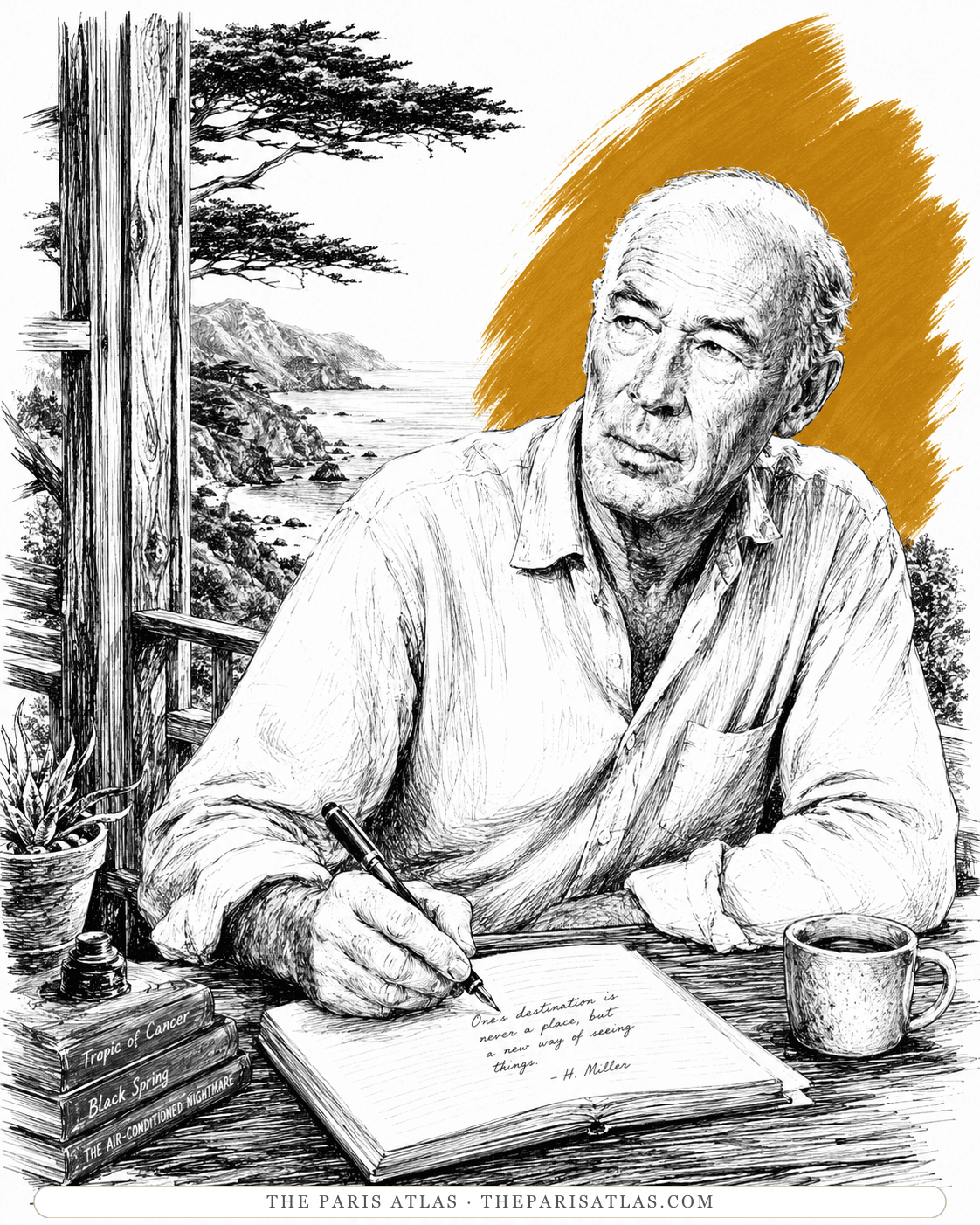


Four Visions of America
by Henry Miller
Miller, Kay Boyle, Erica Jong, and Thomas Sanchez offer four dissenting Americas: lunacy, imprisonment, migration, and the contested West.
- 1977
- 128
About Henry Miller
The story, briefly
Spoiler-freeFour Visions of America is a 1977 Capra Press anthology by Henry Miller, Kay Boyle, Erica Jong, and Thomas Sanchez. Miller contributes ‘A Nation of Lunatics’; Boyle, ‘Report from Lock-Up’; Jong, ‘East-West Blues: A New Yorker Goes West’; and Sanchez, ‘The Real Cowboys and Indians.’ The four essays are separate viewpoints rather than a coauthored argument. Capra issued 750 trade copies and 225 signed limited hardcovers.
The story, in more detail
The volume builds meaning through disagreement. Its writers approach America through institutional violence, geographic myth, migration, gender, and the outsider’s suspicion of national self-congratulation.
Miller’s contribution extends his long critique of American conformity, but the anthology resists making him its center. Boyle, Jong, and Sanchez supply independent histories, tonalities, and political pressures.
Themes and analysis
Four essays with four authors
Kay Boyle contributes Report from Lock-Up; Thomas Sanchez contributes The Real Cowboys and Indians; Erica Jong contributes East-West Blues: A New Yorker Goes West. Miller’s contribution is A Nation of Lunatics. Their separate authorship is essential: the volume is not Miller speaking on behalf of the other three.
The project grew from the occasion of America’s bicentennial. Its subjects include imprisonment, the history and claims surrounding the American West, life between coasts, and national self-delusion. The shared subject produces contrasts rather than a collectively agreed political platform.
Miller’s A Nation of Lunatics
Miller uses ridicule to attack the gap between national prestige and what he sees as actual behavior. In one anecdote, he mistakes displayed portraits of former vice presidents for photographs of wanted criminals. The reversal turns the official image of respectability into an accusation.
The essay extends his long argument with American public life into old age. Its sweeping title signals the scale of its polemic, not a clinical diagnosis. The other contributors keep that voice from becoming the sole measure of the country under discussion.
The contributors and the book’s making
Jong’s autobiographical perspective and Boyle’s and Sanchez’s political concerns remain their own. Readers should not look for a fictional cast joining the four authors in one narrative. They participate as writers of separate essays, each with a different relation to the national subject.
Capra Press published the volume in 1977, including a limited issue signed by all four contributors. The signatures register a shared publication, not shared authorship of each text. The Air-Conditioned Nightmare is the natural longer companion for Miller’s contribution, while the anthology gives it the pressure of neighboring voices.
Boyle’s Report from Lock-Up
Boyle opens Report from Lock-Up with a reversal, in the sentence quoted by Thomas Austenfeld: a prison may let someone escape the isolation of ordinary life. Her inclusive pronouns make this a problem shared with the reader, not a defect belonging only to people behind bars. The tentative “It may be that” invites consideration rather than issuing a rule. Fear, pride and loneliness appear before the iron and stone, so the inward barrier is encountered first. The sentence unsettles the distinction between free and confined without making imprisonment itself a kindness.
In another passage reproduced by Austenfeld, Boyle recalls separating crowded irises so that they do not choke one another. Calling their beds “ghettoes” prevents the garden from becoming a pleasant escape from the human world. The flowers bring the question of confinement back into view. Their struggle follows from overcrowding; the gardener must change the conditions, not condemn an individual plant. Read beside the opening, the image asks what room a life needs to develop. It gives a physical shape to the essay’s concern with restricted possibilities.
Why we recommend it
Four arguments, not one
The contributors’ competing positions prevent ‘America’ from becoming a single abstraction.
Miller in company
His familiar dissent reads differently beside Boyle’s, Jong’s, and Sanchez’s accounts.
Short essays suited to comparison
The separate contributions make the book useful for readers or groups comparing how different writers describe the same country.
What this book explores
Timeline
1967
Kay Boyle’s antiwar arrest supplies the experience behind Report from Lock-Up, her contribution to the later anthology.
1977
Capra Press publishes the four-author anthology in trade and signed limited states.
October 1977
Bill Baldwin reviews the anthology in The University Daily, discussing its four writers’ critiques of American life.
Book editions

- Hardcover
- Capra Press
- 1977
- 9780884961260
Paperback
- Paperback
- Capra Press
- 1977
Reader reviews
Readers may also like

The Plight of the Creative Artist in the United States of America
His wartime open letter on culture and conformity.
Read our take
On Turning Eighty
Late essays that place his continuing dissent beside age and survival.
Read our takeFour Visions of America: frequently asked questions
What did Henry Miller contribute?
His essay is ‘A Nation of Lunatics.’
Who are the other contributors?
Kay Boyle, Erica Jong, and Thomas Sanchez.
How many first-edition copies were issued?
Capra produced 750 trade copies and 225 signed limited hardcovers.
Is Four Visions of America a novel?
No. It is an anthology of four separate essays.
Did the contributors write one argument together?
No. Each writer contributes an individual viewpoint rather than a jointly authored essay.
If you like Henry Miller
Explore authors with a similar voice, perspective, and influence.
Louis-Ferdinand Céline
Miller's acknowledged master at making literature out of the gutter. Journey gave him permission; Cancer is what he did with it.
View author
Ezra Pound
Pound read Cancer and sent Miller a famously backhanded postcard. Both believed literature's job was to wake the reader by any means necessary.
View author
Simone de Beauvoir
French writer and philosopher whose novels, memoirs, and social analysis examined freedom, gender, responsibility, aging, and the material conditions that shape a life.
View author
References
References
The sources below include the primary text, editions, scholarship, archival materials, and other records that informed this page. They document Four Visions of America, its publication, and its place in literary history.


1Four Visions of America
NonfictionHenry Miller, 1977Used forThe primary text represented by this page, used for descriptions of the work’s contents and for any quoted passages shown here.

2Plaintive Cry Heard in Book — Four Visions of America review, October 7, 1977
WebsiteThe University Daily / Texas Tech University archiveUsed forWeb source consulted for documented facts and historical context presented on the Four Visions of America page.
3Four Visions of America — first-edition description
WebsiteThird Mind BooksUsed forWeb source consulted for documented facts and historical context presented on the Four Visions of America page.
4The Happiest Man Alive: A Biography of Henry Miller
BiographySimon & Schuster, 1991Used forBiographical evidence used to verify chronology, relationships, and historical context connected to Four Visions of America.
5Henry Miller: A Life
BiographyW. W. Norton, 1991Used forBiographical evidence used to verify chronology, relationships, and historical context connected to Four Visions of America.

6Henry Miller: An Inventory of His Collection
ArchiveHarry Ransom Center, The University of Texas at AustinUsed forArchival evidence used to document the historical record connected to Four Visions of America.
7Thomas Austenfeld — Kay Boyle’s prison writing and Four Visions of America
WebsiteUsed forWeb source consulted for documented facts and historical context presented on the Four Visions of America page.
8Locked Up Underground: Kay Boyle and Prisons
WebsiteSPELL: Swiss Papers in English Language and Literature, vol. 23, pp. 165–178, 2009Used forThe new readings use Boyle's passages as quoted in Austenfeld's study, not an independently inspected complete anthology.
i
Why these sources are here
The primary text is the baseline reference for every book page. Additional references document publication history, interpretation, and historical context where that evidence is available.
 Explore more resources