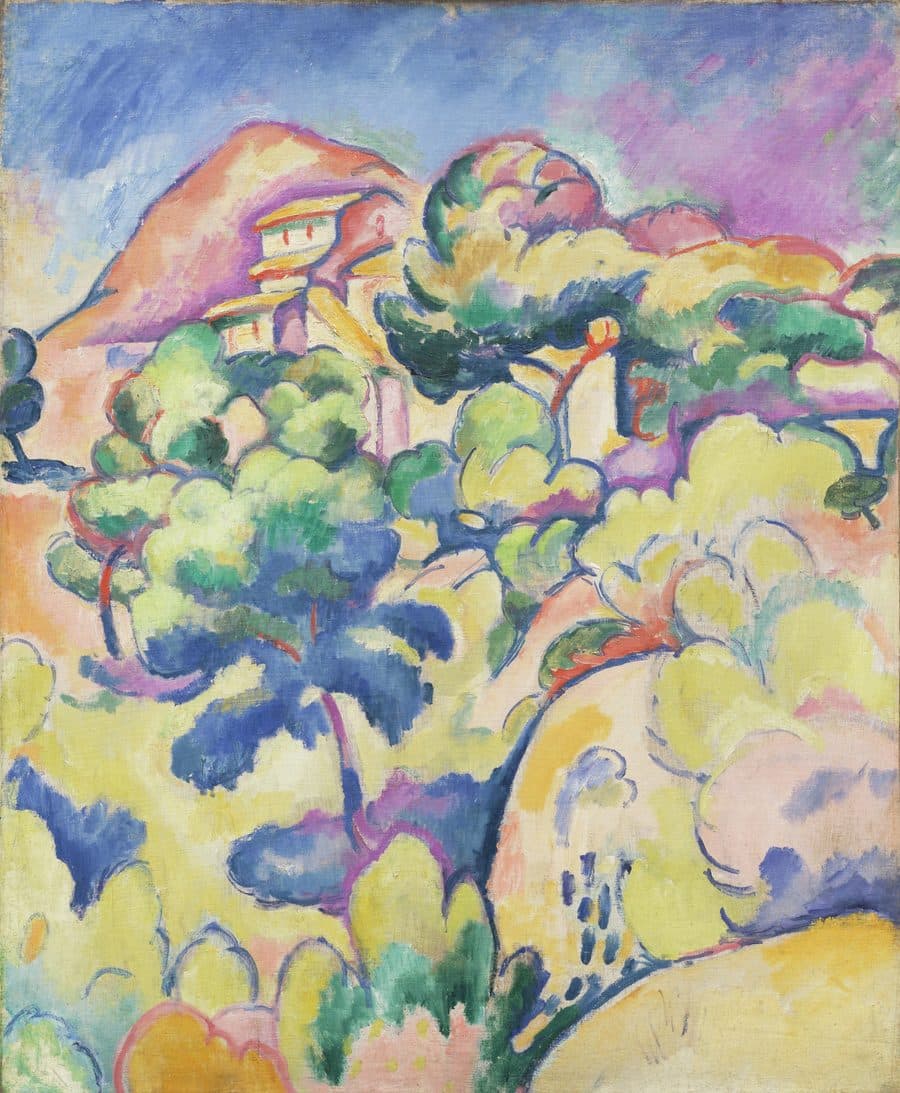
Landscape at La Ciotat
A southern French landscape with bold outlines, flattened space, and intense colour, painted before Braque developed Cubism.
- summer 1907
- Oil on canvas
About Georges Braque
A Fauvist summer on the Mediterranean
Braque worked in the resort town of La Ciotat, near Marseille, during the summer of 1907. He painted this landscape with heavy outlines, flattened space, and intense colours arranged in deliberate harmony.
The landscape remains legible, but colour and contour no longer submit to naturalistic depth. The compact canvas records Braque’s participation in the bright, anti-naturalistic approach associated with Matisse, Derain, Dufy, and the other Fauves.
Braque before Cubism
MoMA places Landscape at La Ciotat just before Braque met Pablo Picasso, with whom he would develop Cubism. The painting belongs to a moment when his work still shared the Fauves’ high-pitched palette.
Its heavy outlines and compressed depth also make the transition historically visible: the scene is already being reorganised into a strongly structured surface, even though its intense harmonic colour remains unmistakably Fauvist.
Close reading
Reading the work, detail by detail
Braque turns the southern landscape into overlapping masses whose colours drift between foliage, architecture, and shadow. The close views reveal a view built less by perspective than by nested contours and rhythmic repetitions.
1.The mountain and villas share one warm contour
The roofed buildings nest against a salmon mountain rather than standing clearly in front of it. Red-violet outlines bind architecture to geology, making settlement another fold in the landscape.
2.The canopy is made from interlocking patches
Rounded colour zones overlap without resolving into individual leaves. Their blue contours hold the canopy together while allowing every patch to retain its own temperature.
3.A pale trunk opens a path through the foliage
The light trunk cuts downward through crowded greens like a narrow interval of air. Its slight bend supplies direction without becoming a conventional perspectival line.
4.Yellow turns foliage into light
Large yellow masses are edged with lilac and blue, making brightness feel material rather than atmospheric. The colour describes both leaves and the sunlight saturating them.
5.Blue shadow gives the center its depth
Dense cobalt patches gather beneath the lighter crowns, creating depth through temperature rather than tonal gradation. A few red trunks pass through them, keeping the darkness porous.
6.The foreground remains an open field of decisions
Contours loosen and patches widen near the lower edge, where no single object claims priority. The foreground shows Braque testing how little description a landscape needs before colour can carry it.
Where to see it
Museum of Modern Art, New York
11 West 53 Street, New York, NY 10019, United States
Displays and loans can change. Check whether this work is on view before making a special trip.
Plan your visit on the museum’s official website (opens in a new tab)Frequently asked questions
When did Braque paint Landscape at La Ciotat?
He painted it during the summer of 1907 while working in La Ciotat near Marseille.
Is Landscape at La Ciotat a Cubist painting?
No. MoMA presents it as a Fauvist landscape painted before Braque met Picasso and helped develop Cubism.
What makes Landscape at La Ciotat Fauvist?
Its intense harmonic colours, anti-naturalistic rendering, heavy outlines, and flattened space place it within Braque’s Fauvist period.
How large is Landscape at La Ciotat?
The oil-on-canvas painting measures 71.7 by 59.4 centimetres.
Where is Landscape at La Ciotat?
It belongs to the Museum of Modern Art in New York and entered the collection through the Katherine S. Dreier and Adele R. Levy Bequests.
If you like Georges Braque
Explore painters from the same movements and circles.
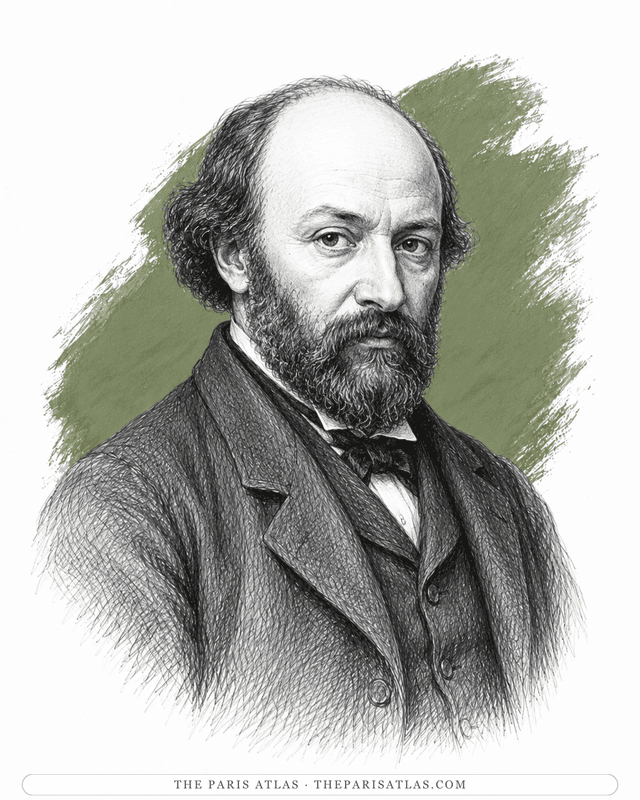
Paul Cézanne
Painter between Impressionism and everything after — shown in the independents' exhibitions, emulated by the Cubists, and present at the Orangerie through 15 works in the Walter-Guillaume collection.
View artist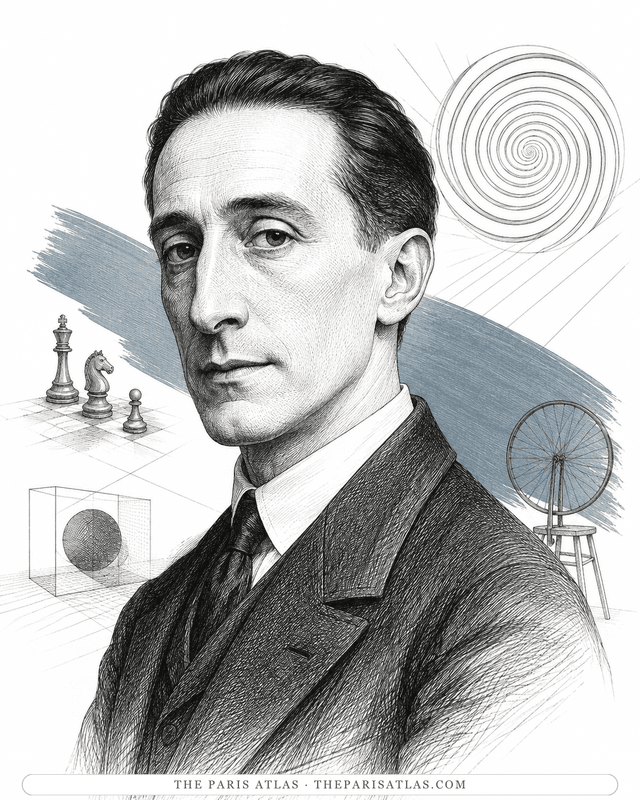
Marcel Duchamp
The century's quietest revolutionary — readymades, the abandonment of painting, chess on a Paris rooftop in Entr'acte, and one anemic film of spinning puns signed Rrose Sélavy.
View artist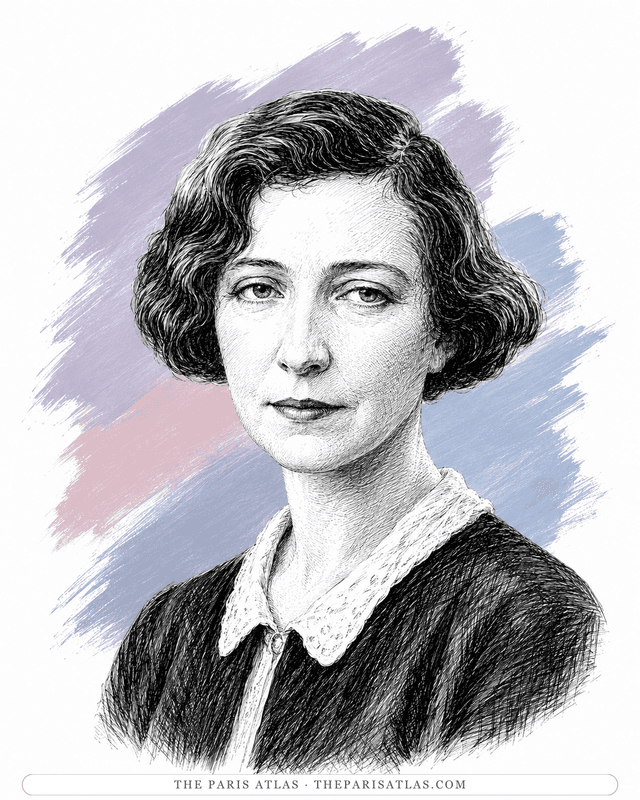
Marie Laurencin
Painter of pale, dark-eyed women who entered Picasso's Bateau-Lavoir circle in 1907, was Apollinaire's companion, and designed Les Biches for the Ballets Russes; the Musée de l'Orangerie holds six of her works.
View artist
References
The sources below include collection records, catalogues, scholarly research, and primary materials that informed this page. They document Landscape at La Ciotat, its making, and its place in cultural history.


1Georges Braque, Landscape at La Ciotat
WebsiteMuseum of Modern ArtUsed forWeb source consulted for documented facts and historical context presented on the Landscape at La Ciotat page.
2Georges Braque, Road near L’Estaque
WebsiteMuseum of Modern ArtUsed forWeb source consulted for documented facts and historical context presented on the Landscape at La Ciotat page.
3Georges Braque — artist record, Peggy Guggenheim Collection
WebsitePeggy Guggenheim Collection, VeniceUsed forWeb source consulted for documented facts and historical context presented on the Landscape at La Ciotat page.
4Fauvism
WebsiteThe Metropolitan Museum of ArtUsed forWeb source consulted for documented facts and historical context presented on the Landscape at La Ciotat page.
These references provide the documented foundation for this work's history and interpretation. Claim-level citations remain attached to the specific claims they support.
 Explore more resources