

At Terror Street and Agony Way
Published the same year — the first Black Sparrow book, the beginning of the consolidation this chapbook predates.
Read our take
A 400-copy Glendale chapbook of eighteen poems — four of which have never been reprinted anywhere since.
Poems Written Before Jumping Out of an 8 Story Window is a chapbook of eighteen Charles Bukowski poems published in Glendale, California in 1968, in an edition of 400 copies. Its imprint is recorded under two names — Poetry X/Change and Litmus, the operation of the poet Charles Potts, who had printed Bukowski in Litmus magazine. The project had a long fuse: it was first planned in 1965 with the Blitz/Mad Virgin Press and stalled for three years before Potts brought it out. Four of its eighteen poems have never been collected again, which gives the little book a standing the other 1960s chapbooks lack: it still holds work a reader cannot find anywhere else.
The chapbook sits in the last year before Black Sparrow Press consolidated Bukowski's publishing. Until 1968 his books were a scatter of small operations — Hearse, Loujon, and one-off imprints like this one — and the contents scattered with them. Most of it was later swept into the Black Sparrow collections; this book's four uncollected poems are the notable leak. A printed drawing for the poem "Cows in Art Class" runs as the chapbook's centerfold, and the title has become one of the most quoted in the catalogue — an early example of the deadpan-catastrophe naming that Play the Piano Drunk later perfected.
The orchard in “The Blackbirds are Rough Today” is one of several comparisons for a life that feels used up. Former productivity links it to the retired fighter and aging performer who follow. The speaker's complaint then becomes a challenge to people whose homes, achievements or composure seem to promise an answer. He proposes correspondence, turning isolation into an address to someone else, but does not expect the exchange to settle the question. Stamps and ideas might both run out. The poem keeps communication possible while refusing to make either social success or a final religious guess into reliable consolation.
“Thermometer” repeatedly returns to wrinkling skin while the speaker's attention moves among advertising, news, insects and remembered cities. The mice's dispute over food gives this restless world a miniature social drama; it is part of the poem's associative movement, not a separate animal fable. Drinking water briefly changes the quality of attention from warning to wonder. Yet returning to the chair does not produce a calm conclusion: the closing heat image gathers the preceding strain into sensation. The poem's changing temperature belongs to its language and perception, rather than to a literal measurement of illness.
The rare case of a 1960s chapbook whose contents were never fully absorbed into the later collections.
One of the most quoted Bukowski titles — the deadpan-catastrophe naming style, already fully formed in 1968.
Eighteen poems give the chapbook a different scale from the later retrospective collections that usually introduce this period.
1965
The chapbook is planned with the Blitz/Mad Virgin Press; the project stalls.
1968
Published in Glendale in 400 copies under the Litmus / Poetry X/Change imprint.
1975
Litmus issues a second printing, expanded to include correspondence.
Published the same year — the first Black Sparrow book, the beginning of the consolidation this chapbook predates.
Read our take
The major collection of the following year, where the era's poems mostly settled.
Read our take
The in-print selected volume for the period — though this chapbook's four uncollected poems are not in it.
Read our takeA chapbook of eighteen Charles Bukowski poems, published in Glendale, California in 1968 in an edition of 400 copies.
The imprint is recorded under two names — Poetry X/Change and Litmus, the operation of the poet Charles Potts, who had printed Bukowski in Litmus magazine. The project had been planned since 1965 with a different press and stalled for three years.
Four of its eighteen poems have never been reprinted anywhere. Most chapbook contents were later absorbed into the Black Sparrow collections; these four were not.
It is Bukowski's deadpan register — catastrophe stated as routine. The title became one of his most quoted, well beyond readers of the chapbook itself.
Only via the rare-book market or library special collections. It has never been reprinted, and its four uncollected poems exist nowhere else.
Explore authors with a similar voice, perspective, and influence.
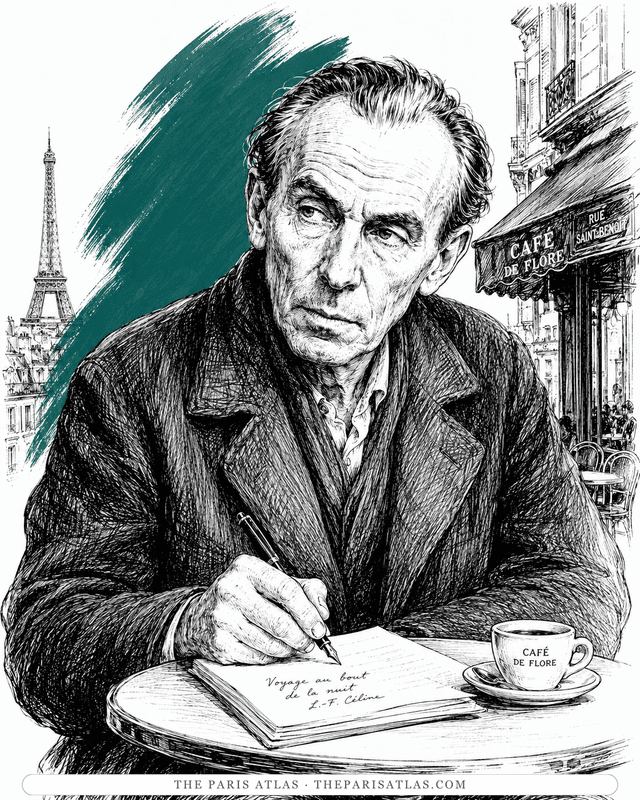
The doctor of the Paris slums who wrote the century's blackest, funniest novel — and changed the sound of French prose.
View author
The Brooklyn dropout who arrived in Paris broke at thirty-eight and wrote the exuberant, banned books that ended American censorship.
View author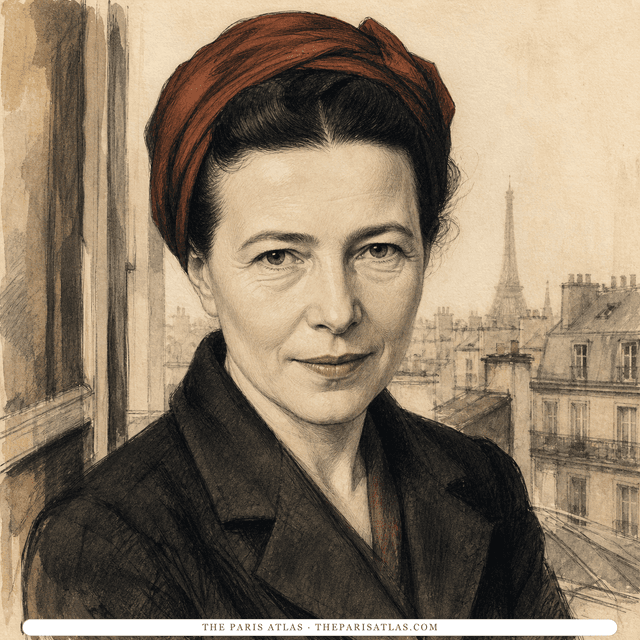
French writer and philosopher whose novels, memoirs, and social analysis examined freedom, gender, responsibility, aging, and the material conditions that shape a life.
View authorThe sources below include the primary text, editions, scholarship, archival materials, and other records that informed this page. They document Poems Written Before Jumping Out of an 8 Story Window, its publication, and its place in literary history.


The primary text represented by this page, used for descriptions of the work’s contents and for any quoted passages shown here.

The Bukowski papers, which hold manuscripts from the scattered small-press years.

Publication history, the 1965 stall, the print run, and the four uncollected poems.
Bibliographic details of the chapbook checked against the checklist.
The scattered small-press years before Black Sparrow consolidated the publishing.
Web source consulted for documented facts and historical context presented on the Poems Written Before Jumping Out of an 8 Story Window page.
Complete displayed English transcription of The Blackbirds are Rough Today, including the closing correspondence and locks images. Third-party text, not a facsimile of the 1968 chapbook or a documented autobiographical scene.
Complete English Thermometer on displayed journal page 44, publicly transcribed on ResearchGate. The reading uses the poem, not the adjoining critical commentary or Portuguese translation. The journal's Litmus 1966 attribution conflicts with the target collection's 1968 record; no resolution, first-edition collation, or original page-layout verification is claimed.
Specialist contents independently confirm The Blackbirds Are Rough Today on page 10 and Thermometer on page 27 in the 1968 Poetry X/Change collection. Used for membership, not every approximate chronology entry.
The primary text is the baseline reference for every book page. Additional references document publication history, interpretation, and historical context where that evidence is available.
 Explore more resources