The Paris AtlasCharting the artists, works, and places worth returning to.
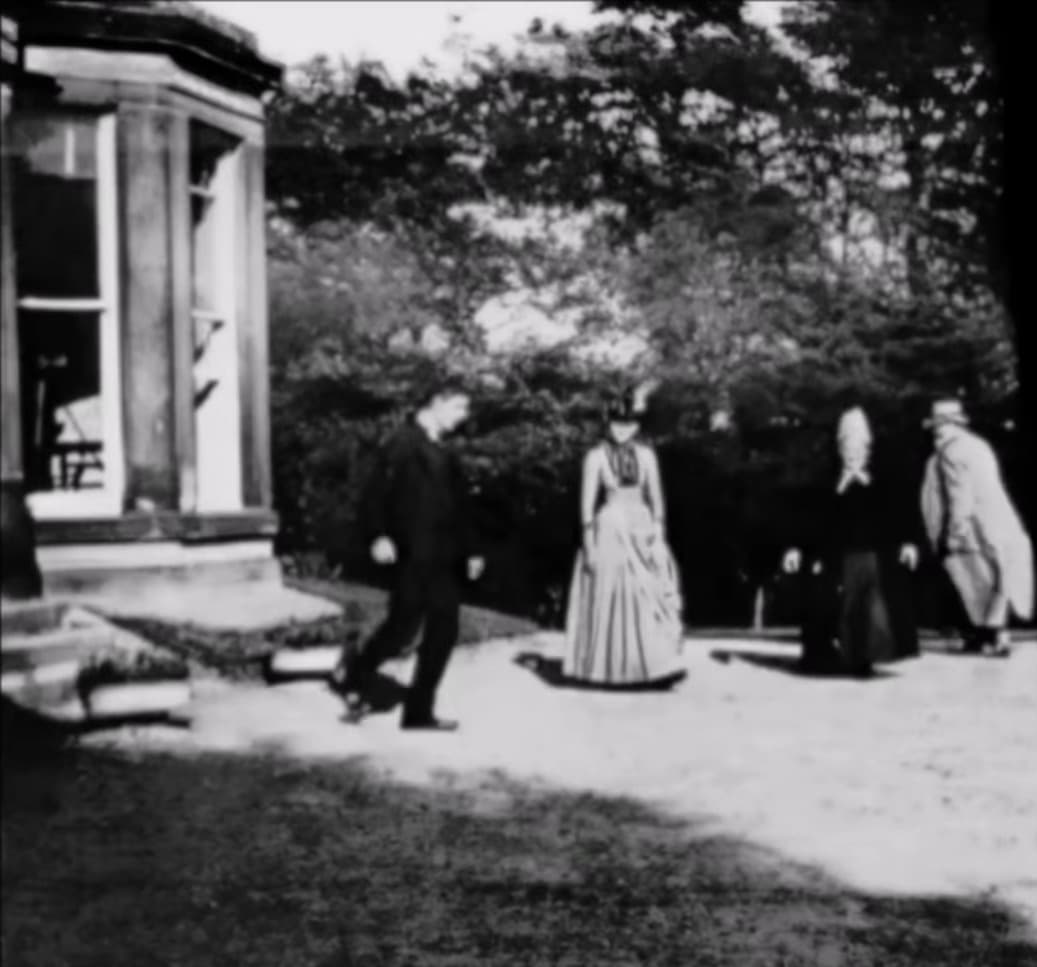
Frame from Roundhay Garden Scene showing four people in Victorian dress walking in a garden in Leeds in 1888

Artwork reproduction

Film

Roundhay Garden Scene

by Louis Le Prince

Four people walk in a garden for less than two seconds. French inventor Louis Le Prince recorded the scene in Leeds on 14 October 1888 with a single-lens camera. The surviving frames predate the films of Thomas Edison and Auguste and Louis Lumière. It is accurate to call this the earliest surviving motion picture made with a single-lens camera. It is not accurate to call it the first public movie screening: Le Prince never presented it to a paying audience.

Created
14 October 1888
Form
Silent motion-picture fragment; about 1.7 seconds at 12 frames per second

Watch the film

The surviving 20-frame reconstruction, shown at the 12 frames per second reported by Louis Le Prince's son Adolphe. Public-domain copy from Wikimedia Commons. Source and rights

What happens in the film

Louis Le Prince asked four people to walk in a circle so they would remain inside his fixed camera's narrow view. His son Adolphe Le Prince crosses the center. Annie Hartley and Sarah Whitley move at the front, while Joseph Whitley is partly hidden behind Hartley. They are not performing a story. Their movement is the experiment.

Only 20 copied frames survive. At the 10 to 12 pictures per second recorded by Adolphe Le Prince, they last less than two seconds. The familiar online clip repeats or stabilizes those frames; it is a reconstruction of a fragment, not an untouched modern film file from 1888.

Is it really the first film ever made?

It depends on what 'first film' means. Earlier inventors had created sequential photographs and moving-image devices. Roundhay Garden Scene is important because it is the earliest surviving sequence recorded on film through a single lens and intended to reproduce continuous movement.

It was not the first film shown to a paying public. Le Prince planned a public demonstration but disappeared in 1890 before it happened. The Lumière brothers later built a practical camera-and-projector system. Their program at the Grand Café in Paris on 28 December 1895 became the landmark first commercial screening for a paying audience.

How Louis Le Prince captured movement

Louis Le Prince was a French inventor, photographer, and trained artist who lived and worked in Leeds. His earlier camera used 16 lenses, which made it difficult to place every image in a smooth sequence. His single-lens design exposed successive pictures on paper-backed film, bringing the images into one consistent viewpoint.

The original camera could not pan or follow its subjects. The family therefore moved in a circle in front of it. That simple practical choice created the scene we can still watch: ordinary people moving together, made extraordinary because the camera could preserve their motion.

The unfinished journey to Paris

Le Prince was preparing to promote his invention in the United States when he visited family and friends in France. On 16 September 1890, he boarded a train from Dijon to Paris and disappeared. No reliable evidence explains what happened to him.

His disappearance matters to cinema history because he never completed the public demonstration that might have established his invention. Seven years after the garden film, the Lumière screening in Paris joined camera, projection, audience, and a commercial program. Roundhay records an earlier technical achievement; Paris marks the public institution of cinema that followed.

Timeline

  1. 14 October 1888

    Le Prince records Roundhay Garden Scene in the Whitley family garden in Leeds.

  2. Late 1888

    He records other surviving Leeds sequences, including Traffic Crossing Leeds Bridge.

  3. 16 September 1890

    Le Prince disappears while travelling by train from Dijon to Paris.

  4. 28 December 1895

    The Lumière brothers present the first commercial film program to a paying audience at the Grand Café in Paris.

  5. 1930

    The National Science Museum makes photographic copies of the surviving paper-film frames.

Frequently asked questions

What is Roundhay Garden Scene?

A surviving 1888 motion-picture fragment filmed by French inventor Louis Le Prince in a garden in Roundhay, Leeds. Four people walk in a circle for less than two seconds.

Is Roundhay Garden Scene the first movie?

It is the earliest surviving motion picture recorded with a single-lens camera. It was not the first film shown to a paying audience, and earlier moving-image experiments used other methods.

Who appears in Roundhay Garden Scene?

Louis Le Prince's son Adolphe Le Prince; Annie Hartley; and Le Prince's parents-in-law, Sarah and Joseph Whitley.

How long is Roundhay Garden Scene?

The surviving copy contains 20 frames. Played at the reported rate of 12 frames per second, it lasts about 1.7 seconds.

Who was Louis Le Prince?

Louis Le Prince was a French inventor, photographer, and moving-image pioneer. He developed a single-lens camera in Leeds and used it to record some of the earliest surviving moving pictures in 1888.

What happened to Louis Le Prince?

He disappeared on 16 September 1890 while travelling from Dijon to Paris. His fate remains unknown; claims that explain his disappearance are theories, not verified facts.