
The Illustrated Man
Ray Bradbury
The Illustrated Man
Mr. Dark, the tattooed carnival owner, comes from the framing story of Ray Bradbury's 1951 collection.
Read our takeSomething Wicked This Way Comes
Ray Bradbury
by Ray Bradbury
Ray Bradbury's 1962 novel about two boys, one father, and a carnival that comes to a small Illinois town in late October.
Something Wicked This Way Comes is a novel by Ray Bradbury, published by Simon and Schuster in New York in 1962.[1] A travelling carnival arrives in Green Town, Illinois, in the middle of an October night. Two neighbours, Will Halloway and Jim Nightshade, whose birthdays fall on either side of Halloween, find out what it really does.[2] Will's father, Charles Halloway, the janitor at the town library, is the one who stands up to it.[3] The book began as a screenplay Ray Bradbury wrote for Gene Kelly in 1958.[4] An EBSCO biography describes it as his favourite of his own books.[5]
The short prologue contains this sentence: "One year Halloween came on October 24, three hours after midnight." The line refers to the night the carnival arrives in Green Town.[3]
Will Halloway and Jim Nightshade are best friends and next-door neighbours, both nearly fourteen. Will is fair, open and happy to stay a boy. Jim is dark-haired and restless, and he wants to grow up fast.[3]
A lightning-rod salesman named Tom Fury warns the boys that a storm is coming and sells Jim a rod for his roof. That night a train pulls in at three in the morning, playing strange music on its calliope.[3] Cooger and Dark's Pandemonium Shadow Show has arrived, long after the summer carnival season.[3]
The carnival has a mirror maze, a freak show and a carousel. The boys find out what the carousel does. Ridden forward, it makes a person older. Ridden backward, it makes them younger.[3][2] Their teacher, Miss Foley, gets lost in the mirror maze, where she sees herself young again.[3]
One of the owners, Mr. Dark, is covered in tattoos.[2] Soon the boys have seen too much, and they turn to Will's father for help. Charles Halloway is a quiet, bookish man who thinks he is too old to be a proper father.[3]
Tom Fury, a lightning-rod salesman, sells Jim Nightshade a rod against a coming storm. That night Cooger and Dark's Pandemonium Shadow Show arrives in Green Town by train. The adults see nothing odd, but Will Halloway and Jim notice that a carnival has come in late October, in the middle of the night, with its calliope playing church music strangely.[3]
Their teacher, Miss Foley, gets lost in the Mirror Maze, which shows her younger self. Later the boys watch Mr. Cooger ride the carousel backward until he is a boy of eight. He then passes himself off as Miss Foley's nephew, Robert.[3]
Jim sees the carousel as a quick way to be grown up. Will fears for Miss Foley. When Mr. Cooger rides again to become a man, Will jams the controls, and Mr. Cooger turns into a withered old man.[3]
Now the carnival is after the boys, and the police are too. Will and Jim hide in their own town and go to Will's father for help. Charles Halloway looks into the carnival's past. He learns that it has toured for at least eighty years, living off people's fears and wishes and turning them into members of the show.[3]
Charles Halloway discovers that love and laughter are the only defence against the carnival. Miss Foley has betrayed the boys to Mr. Dark and the police, hoping to be made young. She gets her wish and ends up as a woman in a little girl's body, with nowhere left to go but the freak show.
The carnival tries to make Jim into Mr. Cooger's replacement by ageing him on the carousel. Charles Halloway destroys the carnival first, using laughter and his love for the boys.
The book ends with Green Town safe. Will and Jim have both grown older, not through the carousel, but in the ordinary way, and Jim is ready to grow up at his own pace.
The story started as "The Black Ferris", a short story Ray Bradbury published in 1948. In 1958 he turned it into a screenplay for the actor and director Gene Kelly, and delivered it to Kelly's house himself.
Gene Kelly agreed to make the film but could not raise the money. Ray Bradbury then turned the screenplay into a novel, published in 1962.
Pieces of other Ray Bradbury books are in it. Mr. Dark, the tattooed man, comes from The Illustrated Man, and Mr. Cooger and the carousel that changes a person's age had first turned up in "The Black Ferris". The Encyclopedia of Science Fiction suggests the book may also be a tribute to Charles G. Finney's The Circus of Dr. Lao (1935), which Ray Bradbury had put in an anthology in 1956.
The title is a line from William Shakespeare's Macbeth. In Act 4, scene 1, one of the three witches feels her thumbs prickle and says that something wicked is coming. The next person through the door is Macbeth.
The novel is divided the same way a visit from a carnival would be: a short prologue, then three parts called "Arrivals", "Pursuits" and "Departures".
The hero of the book is not one of the boys. Charles Halloway, Will's father, is the janitor of the town library. He married late and had his son late, and he worries that he is too old to be the father Will needs. He envies the boys their energy.
He is also the one who does the research. He finds out that Cooger and Dark's carnival has been touring the country for at least eighty years, and that it always arrives somewhere in October. Charles Halloway calls its people "autumn people", a phrase Ray Bradbury had already used in The October Country.
Anthony Bernardo, writing for EBSCO, calls Charles Halloway the most fully realised figure in the book. He is a hero who feels the carnival's pull himself and has to resist it.
Kirkus Reviews called the book an allegory of good and evil set in a haunted landscape. The reviewer said its allusions, such as "the October country" and "the autumn people", would be familiar to Ray Bradbury's readers, and recommended it to all his admirers.
Critics have been divided. Some find the story strong but say the heavy metaphors slow it down. The Encyclopedia of Science Fiction calls it episodic and rather heavily symbolic. Anthony Bernardo thinks the many links to Ray Bradbury's other books make the novel a good introduction to his work.
Getting the film made took more than twenty years. In January 1971 Ray Bradbury agreed to write a new screenplay for the English director Jack Clayton. A version to be produced by Kirk Douglas's company for Paramount was cancelled in January 1977.
Walt Disney Productions finally made it, with Jack Clayton directing from Ray Bradbury's screenplay. The cast included Jason Robards, Jonathan Pryce and Diane Ladd. Green Town was built on an acre of the Disney backlot, and filming began on 28 September 1981.
The film opened on 29 April 1983 in more than 800 cinemas. Reviews were mostly good, but ticket sales were disappointing. Ray Bradbury was reported to be pleased with it.
The Paris publisher Denoël, which had been publishing Ray Bradbury in its Présence du futur series since 1954, brought out the novel in 1964. The French title is La Foire des ténèbres, which means "the fair of darkness". Richard Walters translated it.
Gallimard in Paris reissued the translation in 2006 in its Folio science-fiction series, revised by Brigitte Mariot. The novel itself never leaves Illinois.
One year Halloween came on October 24, three hours after midnight.
Watching the boys vanish away, Charles Halloway suppressed a sudden urge to run with them, make the pack. He knew what the wind was doing to them, where it was taking them, to all the secret places that were never so secret again in life. Somewhere in him, a shadow turned mournfully over. You had to run with a night like this, so the sadness could not hurt.
a little woman lost somewhere in her gray fifties
By the pricking of my thumbs, Something wicked this way comes.
Most stories about boys and monsters leave the parents out. Here the hero is a tired, middle-aged library janitor who thinks he is too old for his son.
The carnival comes to town on 24 October, a week before Halloween, and the two boys were born on either side of Halloween night. The season is part of the story.
An EBSCO biography names Something Wicked This Way Comes as Ray Bradbury's favourite of his own books. Many of his usual subjects are in it: small towns, carnivals, boyhood and the fear of growing old.
The story began as a screenplay for Gene Kelly in 1958. Disney finally filmed it in 1983, from Ray Bradbury's own script.
A fair, open boy of nearly fourteen who would rather stay a child.
Will's best friend and neighbour, dark-haired and restless, who wants to grow up fast.
Will's father, the janitor of the town library, who stands up to the carnival.
One of the carnival's two owners, covered in tattoos. He is the Illustrated Man.
The other owner, who uses the carousel to change his age.
The boys' seventh-grade teacher, who longs to be young again.
A lightning-rod salesman who warns the boys that a storm is coming.
1948
Ray Bradbury publishes the short story "The Black Ferris", where the carousel that changes a person's age first appears.
1958
Ray Bradbury writes a screenplay from the story for Gene Kelly, who agrees to make it but cannot find the money.
1962
Simon and Schuster publishes Something Wicked This Way Comes in New York, 317 pages.
1964
Denoël publishes the French translation in Paris as La Foire des ténèbres, translated by Richard Walters.
1971
In January, Ray Bradbury agrees to write a new screenplay for the director Jack Clayton.
1977
In January, Paramount cancels a planned film to be produced by Kirk Douglas's company.
1983
Walt Disney Productions releases Jack Clayton's film on 29 April, with Jason Robards and Jonathan Pryce.
2017
Simon and Schuster issues a paperback with history, context and criticism edited by Jonathan R. Eller.


The Illustrated Man
Ray Bradbury
Mr. Dark, the tattooed carnival owner, comes from the framing story of Ray Bradbury's 1951 collection.
Read our takeThe Martian Chronicles
Ray Bradbury
Ray Bradbury's Mars stories share the novel's small-town settings and its sense that something is wrong under the surface.
Read our take
Anthony Bernardo counts the two as Ray Bradbury's only full-length novels of the fantastic. Both put books and readers at the centre of the fight.
Read our take
Oscar Wilde's novel is the older story of a person who stops ageing by magic and pays for it.
Read our takeTwo boys, Will Halloway and Jim Nightshade, discover that a carnival which has come to their Illinois town in late October is evil. Its carousel can make people younger or older, and its owners feed on people's wishes. Will's father, Charles Halloway, helps them fight it.
From William Shakespeare's Macbeth. In Act 4, scene 1, the Second Witch says, "By the pricking of my thumbs, Something wicked this way comes." Macbeth enters a moment later.
One of the carnival's two owners, a man covered in tattoos. Mr. Dark is the Illustrated Man, a figure Ray Bradbury had used before in his 1951 story collection of that name.
Yes. Walt Disney Productions released it on 29 April 1983. Jack Clayton directed, Ray Bradbury wrote the screenplay, and Jason Robards and Jonathan Pryce starred.
Both novels are set in Green Town, Illinois. They are not a series, but they can be read as the childhood and early-teenage chapters of the same imagined life.
Mostly a dark fantasy with frightening scenes. The Encyclopedia of Science Fiction describes it as a tale of Gothic transformations in a small town. The novel suits older children as well as adults.
Only through its French edition. Denoël in Paris published it in 1964 as La Foire des ténèbres, translated by Richard Walters.
Explore authors with a similar voice, perspective, and influence.

French writer and philosopher whose novels, memoirs, and social analysis examined freedom, gender, responsibility, aging, and the material conditions that shape a life.
View author
American novelist whose fiction combines satire, science fiction, and the experience of surviving the bombing of Dresden.
View author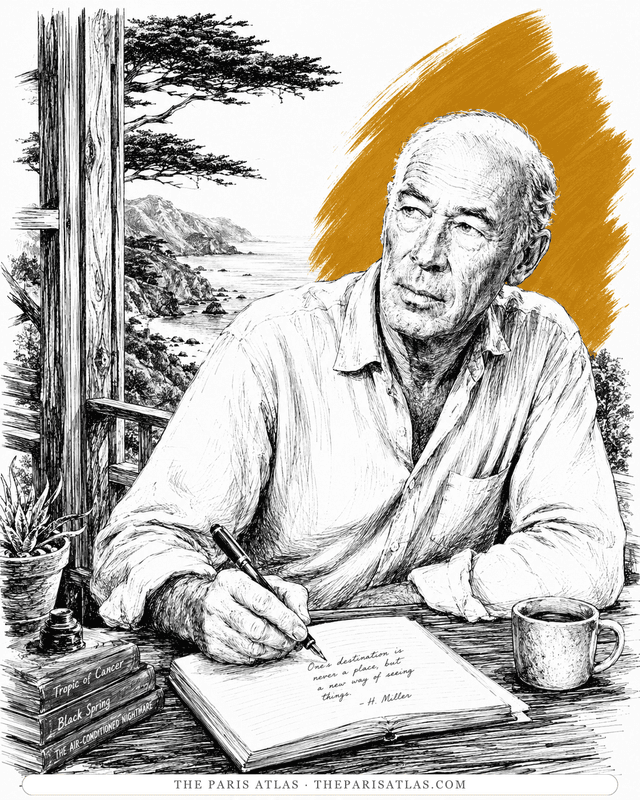
The Brooklyn dropout who arrived in Paris broke at thirty-eight and wrote the exuberant, banned books that ended American censorship.
View authorThe sources below include the primary text, editions, scholarship, archival materials, and other records that informed this page. They document Something Wicked This Way Comes, its publication, and its place in literary history.


First edition: New York, Simon and Schuster, 1962, 317 pages.

The 1958 Gene Kelly screenplay and the history of the 1983 film.
Biography: the novel as Ray Bradbury's favourite, and its link to Dandelion Wine.
Kirkus Reviews notice of 15 June 1962.
The Encyclopedia of Science Fiction on the novel and The Circus of Dr. Lao.
Contents page and full-text search, used to place quotations.
First French edition.
Denoël's first Ray Bradbury title, number 1 of Présence du futur.
Revised French edition.
Open Library edition records, used to confirm that each ISBN listed resolves to Something Wicked This Way Comes.
The primary text represented by this page, used for descriptions of the work’s contents and for any quoted passages shown here.
The primary text is the baseline reference for every book page. Additional references document publication history, interpretation, and historical context where that evidence is available.
 Explore more resources